






Washington – Said Arikat 21/5/2026
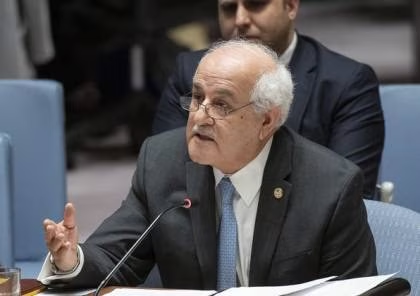
A leaked American diplomatic document revealed pressures exerted by the administration of US President Donald Trump on the Palestinian leadership to withdraw the nomination of Palestine's Permanent Representative to the United Nations, Riyad Mansour, for the position of Vice-President of the UN General Assembly, hinting at punitive measures that could include revoking the visas of members of the Palestinian mission in New York.
According to a cable issued by the US State Department on May 19, classified as "sensitive but unclassified" as reported by National Public Radio (NPR), American diplomats in Jerusalem were asked to exert direct pressure on Palestinian officials this week to persuade them to abandon the nomination, on the grounds that Mansour "has a history of accusing Israel of genocide" and that his assumption of a high-ranking position in the General Assembly "would fuel tensions and undermine Trump's peace plan for Gaza."
The cable included language considered threatening by observers, as it indicated that "Congress will take very seriously" the continuation of the Palestinian nomination, adding that "reconsidering visa waivers remains an available option."
This escalation comes at a time when the international arena is witnessing a sharp division over the Israeli war on Gaza, while the Palestinian Authority is trying to strengthen its diplomatic presence within the United Nations, benefiting from widespread international sympathy for Palestinian civilians after many months of war and destruction.
In a text message to Al-Quds newspaper correspondent, the Palestinian Permanent Ambassador to the United Nations, Riyad Mansour, denied the validity of these claims, noting that the US mission to the United Nations also denied the validity of these claims.
According to the radio, the office of Palestinian President Mahmoud Abbas refused to comment on the content of the cable, while the US State Department did not issue any official clarification regarding the leaks.
Unprecedented Diplomatic Precedent
Former diplomats say that threatening to revoke the visas of an accredited diplomatic mission to the United Nations is an unprecedented step in US-Palestinian relations. Despite successive US administrations, both Republican and Democratic, opposing Palestinian attempts to expand their international representation, resorting to the visa card against an entire UN mission raises broad legal and political questions.
Last year, the Trump administration prevented a number of senior Palestinian officials, including Palestinian Authority President Mahmoud Abbas, from obtaining visas to enter the United States ahead of General Assembly meetings, but at the time refrained from affecting the Palestinian mission to the United Nations.
In this context, former US official specializing in Palestinian affairs, Hady Amr, stated to the radio that threatening to use visa restrictions is "extremely rare" and is usually only used in extreme cases related to espionage or security interventions.
He added that "expelling diplomats or restricting their work undermines the ability of countries to resolve disputes through political and diplomatic channels."
Mansour had withdrawn his nomination for the presidency of the UN General Assembly last February, after similar American pressures, according to the leaked cable.
Israel's Ambassador to the United Nations, Danny Danon, welcomed the decision, considering the Palestinian nomination to be "an attempt to turn the General Assembly into a political circus against Israel."
Danon's statements reflect the extent of Israeli concern about the rising Palestinian political presence within the corridors of the United Nations, especially after the influential speeches delivered by Mansour during the war on Gaza, which received wide interaction within and outside the international organization.
Elections for the Vice-Presidents of the General Assembly are scheduled for June 2, with the list of candidates from the Asia-Pacific group including several countries such as Afghanistan, Iraq, Mongolia, and Palestine.
Washington fears, according to the cable, a "worst-case scenario" in which a Palestinian official is tasked with managing high-level UN sessions addressing the war in Gaza or Israeli policies.
Humanitarian Speeches that Angered Washington and Tel Aviv
Riyad Mansour's name prominently emerged in recent months due to his emotional speeches within the United Nations, especially when he broke down in tears during a session in May 2025 while speaking about Palestinian children killed in Israeli raids on Gaza.
He said then: "These are children… children," as he pounded the table with his fist, affected by the scenes of mothers embracing their dead children.
In August 2025, he also called for a ceasefire as "the only way to save Israelis and Palestinians together," emphasizing that the continuation of killing "is not an inevitable fate."
Observers believe that these speeches contributed to diplomatically embarrassing Israel, especially with the increasing international accusations regarding blatant humanitarian violations in Gaza by Israeli occupation forces, which explains the American and Israeli sensitivity to any broader UN role for Mansour.
The American pressures on the Palestinian mission reveal a clear contradiction between American rhetoric about freedom of diplomatic work and actual practice when it comes to the Palestinian issue. Washington, which constantly defends the "rules-based international order," seems willing to use immigration and visa tools to punish diplomatic representatives for political stances within the United Nations. This behavior not only weakens the image of the United States as an international mediator but also reinforces the prevailing global impression that the American administration treats international institutions as an arena for politically protecting Israel, not an independent space for balanced discussion and diplomatic representation.
The Israeli and American concern about the rise of Palestinian presence in the United Nations reflects a growing realization that the real battle is no longer just military, but also moral and informational. Riyad Mansour's influential speeches, especially those related to children and civilian victims, succeeded in conveying the Palestinian tragedy to global public opinion in direct humanitarian language that is difficult to contain with traditional propaganda. Therefore, Washington and Tel Aviv seek to reduce the space for this voice within international forums, fearing that global popular sympathy will turn into increasing political and legal pressure on Israel in international arenas.
This crisis also reflects the fragility of the relationship between the Palestinian Authority and the Trump administration, which, since its return to the White House, has re-adopted a policy of maximum political and diplomatic pressure on Palestinians. Instead of pushing for a real political process or ending the war in Gaza, the American priority seems to be focused on controlling Palestinian discourse and preventing any move that might give Palestinians symbolic momentum within the United Nations. However, this policy may backfire, as it grants Palestinian diplomacy more international sympathy and portrays Palestinians as a party being punished even within multilateral institutions that are supposed to represent the entire international community.
שתף את דעתך
Washington Threatens to Revoke Visas of Palestinian Mission to UN