






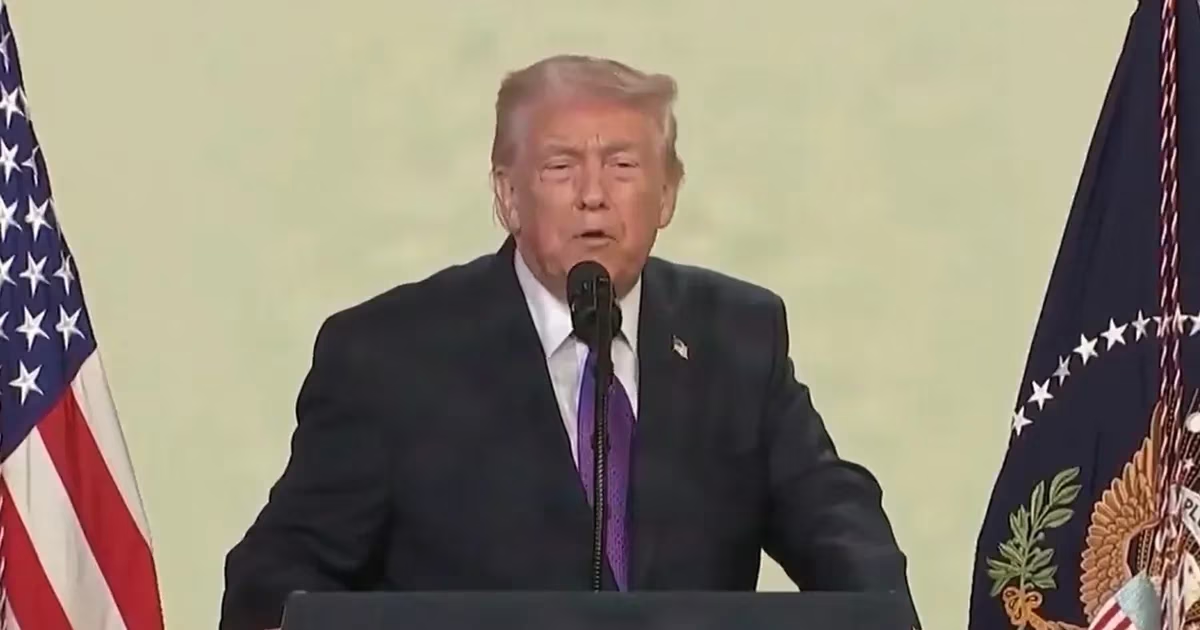
US President Donald Trump is in a state of anticipation and deep study of the latest Iranian response, which carried within it the red lines that Tehran adheres to for any future agreement. These developments come at a time when the Iranian leadership is showing increasing confidence, with the Revolutionary Guard considering the options available to the White House to be very limited and confined to paths where the best is bitter.
On the domestic political front, Trump took a preemptive step by informing Congress of the end of what he described as 'hostilities' towards Iran, in an attempt to free himself from the legislative restrictions imposed by the legislative body on decisions of war and peace. However, ambiguity still surrounds the true intentions of the US President and whether he has actually been convinced of the futility of the military option, which Tehran is betting on being excluded from his current calculations.
Trump's strategy has primarily relied on 'game theory' and the concept of 'brinkmanship' developed by the scholar Harold Schelling, with the aim of replacing deterrence with coercion and forcing the adversary to submit under the weight of a serious threat. However, field and political realities have revealed clear frustration within the American administration, after the Iranians countered these tactics with rhetoric characterized by mutual defiance and non-compliance with psychological pressures.
The levels of failure in American bets are numerous, starting with the steadfastness of the political system in Tehran and the failure of internal defection scenarios that Washington had hoped to repeat. Security data also proved the inaccuracy of American estimates regarding Iranian missile capabilities and the extent of Tehran's ability to cause widespread regional damage in the event of a direct confrontation, which confused calculations of a quick victory.
Faced with this deadlock, the American administration is left with only two difficult scenarios; the first is to tighten the economic blockade to unprecedented levels to financially strangle the state. Despite the harshness of this option, Iran's long experience in circumventing sanctions makes it a short-term weapon that does not fundamentally threaten the regime's existence as direct war does.
The second scenario is a return to the military option, a path Trump does not favor given its exorbitant economic and human costs and its objectives that may remain 'nihilistic' if Iranian steadfastness continues. Any military confrontation could lead to severe strikes affecting vital interests in the Arabian Gulf region and threatening navigation security in the Strait of Hormuz, which the international community fears.
Ultimately, the US President is torn between two contradictory factors; the first is his desire to achieve 'peace through strength' without getting involved in costly ground wars that he previously criticized. The second is his personal ego and his eagerness not to appear weak before Iran, which might at some point push him to favor confrontation if diplomatic channels fail to secure a 'decisive victory' that can be marketed domestically.
Trump's room for choice narrows between an impossible operation and a bad deal.
שתף את דעתך
Trump's Dilemma in Facing Tehran: Between Difficult Negotiation Options and the Specter of Military Confrontation