






By: Said Arikat
May 4, 2026
News analysis
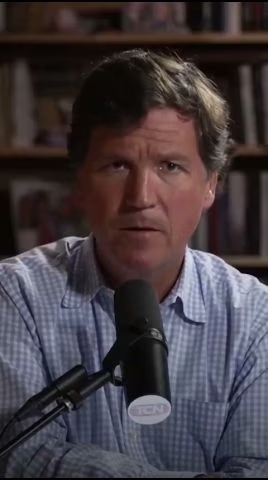
Washington, D.C- In a sweeping and exhaustingly lengthy New York Times interview with Tucker Carlson, the former Fox News host presented what may be his most forceful break yet from President Donald Trump, while advancing a broader argument that American foreign policy has become captive to Israeli interests at the expense of ordinary Americans struggling with economic decline, debt, and social instability.
The interview, published Sunday, May 3rd, centered on Carlson’s opposition to Trump’s decision to attack Iran alongside Israel. Carlson described the war as catastrophic, unnecessary, and contrary to the promises that originally drew him to Trump’s political movement. He repeatedly insisted that the United States had been pressured into conflict not by national interest, but by what he characterized as intense lobbying and influence from Israeli Prime Minister Benjamin Netanyahu and pro-Israel figures inside the United States.
Carlson said he spent years supporting Trump largely because Trump had opposed the Iraq War and criticized regime-change policies in the Middle East. According to Carlson, Trump’s decision to strike Iran represented a betrayal of those principles. He described numerous private conversations with Trump in the lead-up to the conflict, claiming the president appeared reluctant and resigned rather than enthusiastic.
In Carlson’s telling, Trump repeatedly justified the war by focusing on Iran’s nuclear ambitions, asking him whether he wanted Iran to possess nuclear weapons. Carlson replied that while he opposed nuclear proliferation, the more important question was whether another Middle Eastern war would help the United States. He argued it would not, warning that conflict with Iran threatened global energy supplies, destabilized the economy, and risked drawing the United States into another prolonged regional disaster.
The interview’s most inflammatory sections focused on Israel’s role in shaping American policy. Carlson argued that no major figure within Trump’s administration seemed eager for war, and that the real pressure came from outside actors — wealthy donors, media personalities, and pro-Israel advocates. He named media mogul Rupert Murdoch, billionaire donor Miriam Adelson, and conservative commentators including Mark Levin and Sean Hannity as people he believed pushed Trump toward military confrontation.
Carlson went even further, claiming Trump had become a “slave” to Israeli interests because he could not restrain Netanyahu despite publicly calling for cease-fire negotiations. He argued that Israel repeatedly escalated tensions to derail diplomatic efforts and prolong regional conflict. Carlson maintained that Israeli goals and American goals were fundamentally different, insisting that Washington had subordinated its own interests to those of a foreign government.
Throughout the discussion, Carlson returned obsessively to what he sees as the disconnect between elite foreign-policy priorities and the daily concerns of ordinary Americans. One of the interview’s central themes was his rejection of the idea that organizations like Hamas or Hezbollah represent the primary threat facing the United States.
Carlson dismissed what he called the “brainwashing” that places Middle Eastern militant groups at the center of American political discourse. In one of the interview’s most striking lines, he declared that “credit card debt is a much bigger problem than Hezbollah will ever be.” He argued that average Americans are far more threatened by predatory banks, rising living costs, stagnant wages, and economic inequality than by conflicts thousands of miles away.
This economic populism increasingly appears to define Carlson’s worldview. He repeatedly contrasted Washington’s obsession with war and geopolitical struggles against what he described as collapsing economic opportunity at home. Carlson pointed to soaring household debt, housing unaffordability, and shrinking prospects for younger Americans as the real crises facing the country.
He argued that both major political parties have failed ordinary citizens. According to Carlson, Democrats focus excessively on cultural and identity politics, while Republicans have become consumed by foreign wars and ideological loyalty to Israel. He repeatedly accused both parties of ignoring economic inequality and serving wealthy donors rather than voters.
Carlson also expressed sympathy for populist critiques of modern capitalism. Referencing movements such as Occupy Wall Street, he suggested that financial elites and large banks escaped accountability after the 2008 financial crisis while ordinary Americans paid the price. He warned that economic frustration among younger generations could eventually produce political radicalization and social unrest.
The interview also delved into Carlson’s criticism of what he called “Christian Zionism.” He questioned why evangelical Christians in the United States support Israeli policies so fervently and argued that religious belief should not obligate Americans to back military actions they believe are immoral or harmful to their own country.
Carlson rejected accusations of antisemitism throughout the interview, insisting that criticism of the Israeli government is not hatred toward Jewish people. He argued that conflating opposition to Israeli policy with antisemitism suppresses legitimate debate and discourages scrutiny of American foreign policy decisions.
The conversation became even more surreal when Carlson discussed religion and morality. He condemned Trump’s rhetoric toward Iran and Muslims during the conflict, particularly statements made on Easter Sunday. Carlson said mocking religion and threatening civilians crossed a moral line. He also acknowledged discussing whether Trump represented a “false prophet,” though he denied explicitly labeling him the Antichrist.
Despite his sharp criticism, Carlson said his objections to Trump were political and moral rather than personal. He repeatedly stated that he still liked Trump as an individual but believed the Iran war had irreparably damaged his presidency and betrayed the movement that originally elected him.
Perhaps most revealingly, Carlson portrayed himself as someone disillusioned not only with Trump but with the entire American political establishment. He described both Republicans and Democrats as “rotten,” accused Washington of prioritizing foreign interests over domestic needs, and argued that economic inequality and endless war are eroding the foundations of American society.
By the end of the interview, Carlson presented himself less as a conservative partisan than as a populist dissenter — one who believes the greatest threats to Americans are not Hamas, Hezbollah, or Iran, but debt, inequality, financial elites, and a political system he says no longer serves its own citizens.
שתף את דעתך
Tucker Carlson’s Reckoning: How Israel Hijacked Trump’s Presidency