






By: Said Arikat
May 2, 2026
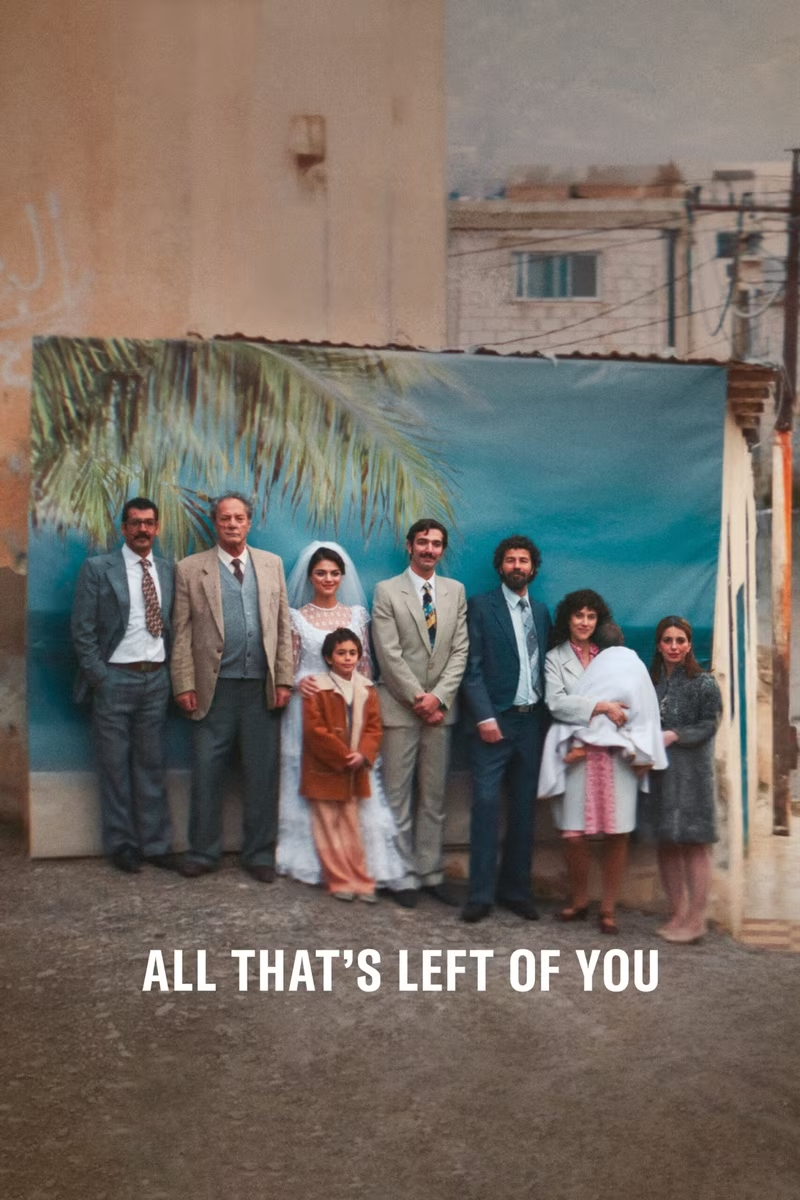
Washington, D.C- On Friday, May 1, I watched ‘All That’s Left of You’ , Cherien Dabis’s (2025) devastating cinematic chronicle of Palestinian dispossession and survival — a film that lays bare not only the original violence of the 1948 Nakba, but the continuity of Israeli aggression, displacement, and dehumanization that has persisted unabated for generations. What gives the film its extraordinary moral force is its refusal to present Palestinian suffering as an isolated historical tragedy. Instead, it exposes a system of domination and violence that continues to shape Palestinian life today, while expanding outward into Lebanon, Gaza, and even international waters with near-total impunity.
Dabis constructs her film around a painful but undeniable truth: the catastrophe that befell Palestinians in 1948 never ended. The destruction of villages, the theft of homes and land, the expulsions carried out by Zionist militias, and the mass uprooting of hundreds of thousands of Palestinians were not temporary wartime excesses. They became the foundation of an ongoing structure of occupation, siege, fragmentation, and systematic dispossession. Insists that the Nakba is not merely history; it is a continuing political reality.
The film opens in the occupied West Bank during the First Intifada, where teenage Noor navigates the suffocating landscape of checkpoints, armed patrols, and constant military intimidation. Dabis captures the physical and psychological violence of occupation with remarkable precision. Palestinian life unfolds under permanent surveillance and threat, where even ordinary acts — walking to the market, joining friends in the street, chanting at a protest — can provoke lethal force. When Israeli soldiers open fire on demonstrators, the scene is not framed as an aberration but as the predictable logic of military domination imposed on a civilian population denied freedom, sovereignty, and security.
From there, Dabis returns to 1948, tracing the destruction of Noor’s family in Jaffa. These sequences are among the film’s most haunting. Sharif and Munira lose their home, orange groves, and sense of permanence as Zionist armed gangs violently expel Palestinians to make way for the establishment of Israel. The terror generated by massacres such as Deir Yassin hangs over every decision, every hurried departure, every terrified glance exchanged between parents and children. Dabis presents these events not as disputed abstractions but as lived human devastation — families shattered, histories erased, entire communities transformed into refugees overnight.
What makes the film especially powerful is its implicit challenge to decades of Western political and media narratives that have minimized or rationalized Palestinian suffering while shielding Israel from accountability. Dabis understands that Palestinians have not only endured dispossession, but also the systematic denial of their narrative. The film therefore becomes an act of historical reclamation, restoring humanity and memory to people so often reduced to statistics, security threats, or diplomatic talking points.
That relevance has become even more urgent in light of contemporary events. Watching the film today, it is impossible not to connect its historical scenes of expulsion and bombardment to the ongoing devastation in Gaza, where entire neighborhoods have been obliterated, civilian infrastructure systematically destroyed, and tens of thousands of Palestinians killed under the justification of “self-defense.” The patterns are chillingly familiar: collective punishment, forced displacement, siege, starvation, and overwhelming military force directed against a trapped civilian population. The film’s argument is unmistakable — the mechanisms of dispossession inaugurated in 1948 continue to evolve, but never fundamentally cease.
Nor is this violence confined to Palestine alone. Israeli military aggression in Lebanon over decades, from invasions and bombardments to repeated violations of sovereignty, reflects the same broader doctrine of overwhelming force and regional impunity. Even the high seas have not been exempt, as seen in attacks and seizures involving humanitarian flotillas attempting to challenge the blockade of Gaza. Dabis’s film resonates precisely because it situates Palestinian suffering within this larger continuum of unchecked power.
Yet despite its fury and sorrow, it never abandons the humanity of its characters. Dabis fills the film with weddings, laughter, arguments, family rituals, flirtation, and communal warmth. Palestinians are not portrayed solely through suffering, but through life itself — resilient, wounded, loving, and stubbornly attached to memory and land. These moments of tenderness become acts of resistance against a political reality designed to erase them.
The performances are uniformly exceptional. Adam Bakri imbues Sharif with quiet dignity and restrained anguish, while Muhammad Abed Elrahman gives Noor a restless vulnerability that embodies a generation raised under occupation yet still searching for freedom and joy. The cinematography, rich with Mediterranean light, crowded alleyways, orchards, and weathered stone homes, gives the film both intimacy and epic scale.
At times, Dabis’s political messaging becomes direct and overt. Certain monologues function more as testimony than drama. But under present circumstances, such directness feels less like a flaw than a necessity. When entire populations continue to struggle for recognition of their basic humanity, silence and subtlety can become forms of evasion.
Ultimately, it is not simply a historical drama. It is an indictment — of dispossession, occupation, impunity, and the international normalization of Palestinian suffering. More importantly, it is a refusal to allow memory itself to be extinguished. Cherien Dabis has created a film of immense emotional gravity and political courage, one that confronts audiences with the enduring human consequences of a catastrophe that, for Palestinians, has never truly ended.
שתף את דעתך
Memory Against Erasure: Cherien Dabis’s All That’s Left of You