






By Said Arikat
The United States has long sold itself to the world as a sanctuary for free thought, political dissent, and opportunity. But under Donald Trump, that promise is being hollowed out. According to a recent New York Times report, internal Department of Homeland Security training materials show the administration expanding ideological screening for green card applicants—particularly targeting criticism of Israel and expressions of support for Palestinian rights.
This is not routine immigration enforcement. It is a loyalty purge dressed up as border policy.
For generations, permanent residency decisions were meant to rest on objective criteria: criminal history, fraud, security risks, and legal eligibility. Now, the standard appears to be mutating into something darker. Social media posts, political opinions, and moral outrage over the destruction of Gaza may now be treated as evidence against an applicant.
The message is brutally clear: if you want to build a life in America, keep quiet about Palestine.
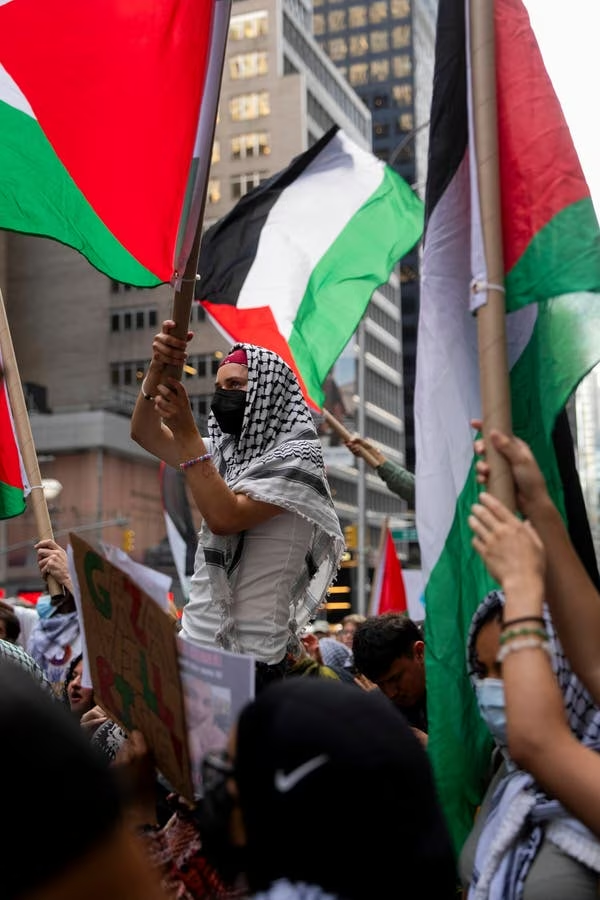
Among the examples reportedly flagged were posts saying “Stop Israeli terrorism in Palestine,” maps replacing Israel with Palestine, and expressions of sympathy for civilians trapped under siege and bombardment in Gaza. One may debate slogans or imagery, but these are political statements—not violent acts, not criminal conspiracies, not threats to national security.
Yet in Trump’s America, opposing war can become grounds for punishment.
That should alarm every defender of civil liberty. The First Amendment was designed precisely to protect controversial speech. American courts have upheld the right to express offensive, symbolic, and deeply unpopular political views. But Trump appears determined to create a two-tier system: constitutional freedoms for some, ideological vetting for everyone else.
Citizens may speak. Immigrants must obey.
What is unfolding is a corruption of immigration law into an instrument of political coercion. A green card applicant is not applying to become a soldier in Washington’s foreign policy machine. They are applying to live, work, and contribute to society. Yet the administration seems to be saying that fairness now depends on one’s willingness to stay aligned with official narratives—especially where Israel is concerned.
This is where the hypocrisy becomes impossible to ignore.
Trump officials defend these measures as part of a campaign against antisemitism and anti-American extremism. Real antisemitism exists, and it must be fought without hesitation. But deliberately conflating hatred of Jews with criticism of the Israeli state is a cynical abuse of language. It turns a serious moral struggle into a political shield for a foreign government.
Millions of people—including Jewish Americans, Israeli dissidents, scholars, journalists, and human rights organizations—criticize Israeli policies. Are they extremists? Are they enemies of America? Of course not. They are participating in democratic debate. But once criticism of Israel is recast as dangerous thought, repression becomes easier to justify.
This is precisely the point.
The administration is not merely protecting Israel diplomatically or militarily. It is attempting to protect Israel from criticism inside the United States by threatening the legal futures of vulnerable non-citizens. That crosses a profound line. It suggests that allegiance to Israeli sensitivities now carries more weight than America’s own free speech principles.
The numbers tell part of the story. Reports indicate a steep decline in green card approvals in recent months. Whether through direct denials or endless bureaucratic delay, the strategy appears consistent: make lawful immigration so punishing, expensive, and uncertain that people surrender before the government has to reject them outright.
Cruelty through paperwork is still cruelty.
Even the language of governance has changed. Immigration officers reportedly have been rebranded from public service employees into “defenders of the homeland.” That militarized rhetoric is revealing. It casts migrants as invaders, applicants as suspects, and bureaucrats as frontline combatants. A civilian agency once tasked with processing petitions now behaves like an ideological checkpoint.
America has seen this disease before.
During the McCarthy era, accusations of disloyalty were used to blacklist dissenters, narrow public discourse, and frighten institutions into compliance. Today the labels have changed, but the instinct is identical. Then it was communism. Now it is Palestinian solidarity. Then it was subversion. Now it is social media sympathy for bombed civilians.
Different era, same paranoia.
The tragedy is that this strategy may produce short-term political rewards. It flatters nativist instincts, energizes parts of Trump’s base, and reinforces the mythology that America is under siege from foreigners and dissenters alike. But the long-term cost will be severe.
The United States built much of its strength by attracting people who believed freedom here was more than propaganda. Scientists, students, entrepreneurs, refugees, artists, and workers came because America promised room to breathe. If that promise is replaced by surveillance, ideological tests, and compulsory silence, the country will lose something more valuable than any election cycle can measure.
It will lose credibility.
Abroad, many already suspect that Washington invokes democracy selectively—celebrating freedom when convenient, suppressing it when uncomfortable. Policies like these confirm the charge. They tell the world that human rights matter until Israel is criticized, and free speech matters until Palestine is mentioned.
That is not strength. It is insecurity masquerading as patriotism.
A serious democracy does not tremble at a protest slogan. It does not treat sympathy for civilians as extremism. It does not force immigrants to whisper their conscience in exchange for legal status. And it certainly does not subordinate constitutional values to the sensitivities of a foreign ally.
If America now grants green cards only to the politically obedient, then the issue is no longer immigration alone. It is whether the republic still believes in the freedoms it advertises.
שתף את דעתך
Green Cards for Silence: Trump’s America Demands Loyalty to Israel Before Freedom