






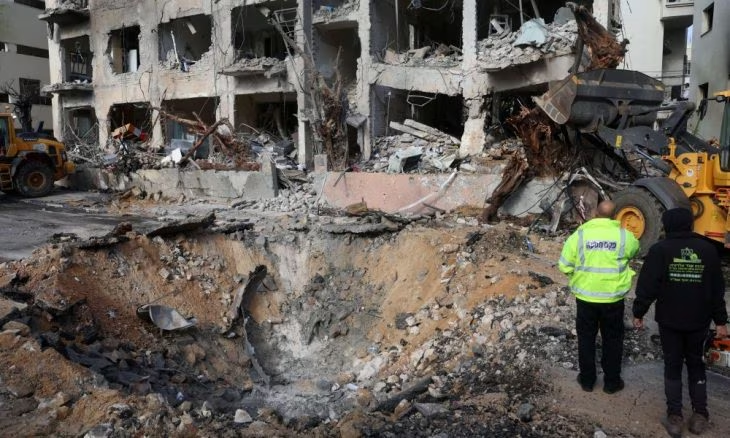
The eyes of the international community are turning towards the Pakistani capital, Islamabad, where crucial negotiations are underway, aiming to end the ongoing nightmare of bloodshed in the region. In contrast, strong voices within official and unofficial circles in Israel hope for the failure of these deliberations and the inability to reach any agreement that would end the state of conflict.
The ruling coalition led by Benjamin Netanyahu believes that any understanding between the United States and Iran represents a devastating strategic loss for Israel. This stance stems from the conviction that the Iranian regime remaining resilient and capable of self-restoration poses a future existential threat that cannot be accepted under any circumstances.
The Israeli government considers reaching an agreement without achieving the full military objectives of the war to be a disaster at the domestic political level. Netanyahu and his allies fear facing a 'day of reckoning' in the upcoming elections, where the specter of political downfall haunts the coalition leaders if the confrontation with Tehran is not decisively resolved.
The desire for continued fighting is not limited to the political level but extends to broad sectors of Israeli society. Opinion polls indicate that about 60% of Israelis support resuming military operations on the Iranian and Lebanese fronts to ensure long-term deterrence.
Former National Security Advisor, Meir Ben-Shabbat, affirmed that blowing up the negotiations without a settlement is a preferred option over any agreement that might be reached. Ben-Shabbat warned that extending the current truce might give the Iranians an opportunity to improve their terms and strengthen their leverage in future negotiation rounds.
Ben-Shabbat noted in his analysis that the three possibilities outlined since the first day of the truce remain strongly in play. These scenarios range from achieving a comprehensive agreement, extending the current ceasefire, or a full return to the square of war and direct confrontation.
Sources reported that the escalation in official statements and the reinforcement of military forces in the region do not necessarily mean a move towards war. However, these moves are used as pressure tools to influence the quality of gains and to formulate a narrative of resilience for the public on both negotiating sides.
Israeli analyses emphasize the need to prepare for the possibility of renewed fighting, especially after the revelation that Tehran retains missile capabilities described as dangerous. Observers believe that the ceasefire in Lebanon strengthened the link between the Lebanese and Iranian fronts, making any threat from one linked to the other.
A preferred scenario for some Israeli circles emerges, which involves changing the nature of military objectives if the war resumes under a Trump administration. This vision centers on shifting from striking military capabilities to targeting the functional capacity of the Iranian state, including energy and electricity facilities and bridges.
This proposed military approach aims to paralyze Iran as a state entity for a certain period, which could lead to a fracture in the regime's internal cohesion. Analysts suggest that these living pressures would erode the regime's legitimacy and lead opponents to the streets amid the government's inability to perform its duties.
Israel expresses grave concern about reports of a US proposal to establish an aid fund for Iran worth $250 billion. This proposal is viewed in Tel Aviv as a lifeline that Tehran eagerly awaits to restore its economy, which has been exhausted by sanctions and wars.
Israeli officials believe that the Iranian regime emerging with massive financial resources will not change its nuclear ambitions but will reinforce its conviction of the necessity of possessing nuclear weapons. They see the only solution as exercising unilateral pressure against Tehran while it is in its current state of weakness.
Media sources reported that the ceasefire in Lebanon was imposed on Israel by direct pressure from the new US administration. Despite official attempts to portray the agreement as the beginning of a historic peace, doubts still prevail within Israel's security and military establishment.
Military analyst Amos Harel agrees with assessments indicating that the collapse of the Islamabad negotiations is the ideal outcome for Netanyahu. Reports confirm that cabinet members are awaiting the opportune moment to complete what they describe as the mission of definitively destroying the capabilities of Hamas, Hezbollah, and Iran.
Renewing the war on Iran or blowing up negotiations without a settlement are preferred options for Israel over any agreement that might offer Tehran a lifeline.
שתף את דעתך
Israel Awaits Islamabad Negotiations: Betting on Failure and Preferring War