






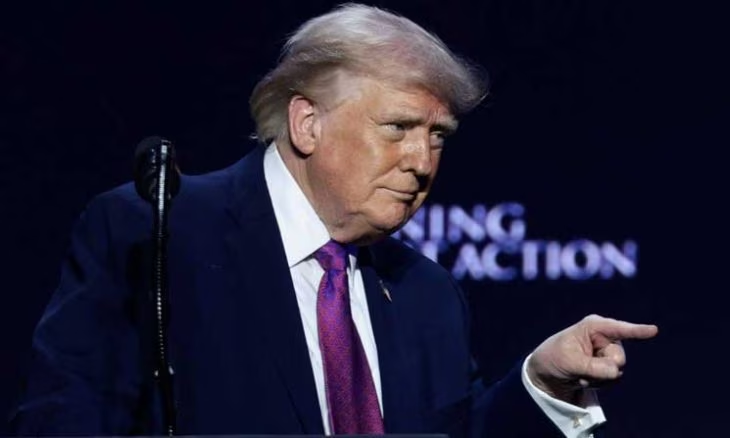
Seven weeks of direct military confrontation with Iran have shown that economic pressure is the most prominent weakness in US President Donald Trump's strategy. Despite overwhelming military power, Washington failed to overthrow the Iranian regime or force it to fully submit to American demands, revealing the limits of the current administration's ability to withstand domestic economic pain.
With Tehran's recent announcement of reopening the Strait of Hormuz to international shipping, the outlines of the crisis Trump faced due to rising fuel prices and escalating inflation began to become clear. These economic factors led to a significant decline in the president's popularity, pushing him to race against time to find a diplomatic formula that would alleviate the burden of living costs on the American voter.
Trump had engaged in a joint military campaign with Israel since late February, based on intelligence reports about imminent nuclear threats. However, the Iranian response, which targeted energy infrastructure in the region and controlled strategic waterways, caused a global energy shock that was not anticipated by White House planners.
Political analysts believe that Iran, despite suffering painful military strikes, has proven its ability to impose exorbitant economic costs on the global economy. This new reality forced Trump's team to re-evaluate the situation, especially with warnings from the International Monetary Fund about the specter of a looming global economic recession due to oil supply disruptions.
Domestically in the US, political pressure is mounting on the Republican Party, which seeks to maintain its majority in Congress during the upcoming midterm elections. Party leaders fear that continued war and its impact on basic commodity prices could lead to a harsh electoral loss next November, making an end to the conflict an urgent political necessity.
For its part, the Iranian leadership cleverly exploited the Strait of Hormuz card to draw Washington back to the negotiating table, which observers considered a lesson that other international powers such as Russia and China might benefit from. The US's adversaries realized that Trump, despite his inclination to use force, quickly retreats when economic indicators and financial markets begin to collapse.
Sources reported that Trump has already begun to change his tone towards Tehran, shifting from threatening airstrikes to talking about an imminent agreement to end the crisis. This shift comes under direct pressure from financial markets, which Trump considers the true measure of his administration's success, in addition to the damage to the American agricultural sector due to the disruption of fertilizer supplies.
Despite Trump's announcement that the Strait of Hormuz is now safe, ongoing negotiations still face significant technical and political obstacles. Informed sources confirm that there are wide gaps between what Washington demands and what Tehran accepts, especially regarding the fate of highly enriched nuclear materials that the United States claims must be transferred to its territory.
In a related context, Tehran categorically denied its agreement to ship any uranium stockpiles abroad, which puts Trump in an awkward position with his audience. The US president had stated that the anticipated agreement would include technical cooperation to recover nuclear materials damaged during previous airstrikes in June.
Economic experts warned that the damage to global supply chains and the energy sector could take years to recover from, even if a quick agreement is reached. The shock to the markets created a state of uncertainty, leading to increased shipping and marine insurance costs in one of the world's most important trading regions.
US allies in Europe and Asia expressed their dissatisfaction with the way Trump handled the crisis, as war decisions were made without prior coordination with them. These allies believe that irregular American actions caused major geopolitical risks that threatened their national security and economies, which are heavily dependent on Gulf oil.
Observers compare Trump's approach to that of the previous administration, where President Biden was more cautious in dealing with the Russian energy sector to avoid raising gas prices. Trump, who promised his voters cheap gasoline, found himself facing direct accusations that his aggressive policies were the cause of the high cost of living suffered by the American citizen.
In the Gulf region, there is a state of anxious anticipation regarding any agreement Trump might conclude without comprehensive regional security guarantees. Arab diplomatic sources stated that ending the conflict should not lead to a state of permanent instability, but rather must ensure the protection of the vital infrastructure of energy-exporting countries.
The most important question remains about Trump's ability to achieve his strategic goals through diplomacy after the military option failed to yield quick results. The current negotiations represent a real test of the American administration's credibility and its ability to balance its foreign policy ambitions with the troubled domestic economic reality.
Trump feels the economic distress, a clear weakness in this war whose global costs he underestimated.
שתף את דעתך
Economic Pressure Forces Trump's Retreat in Confrontation with Iran