






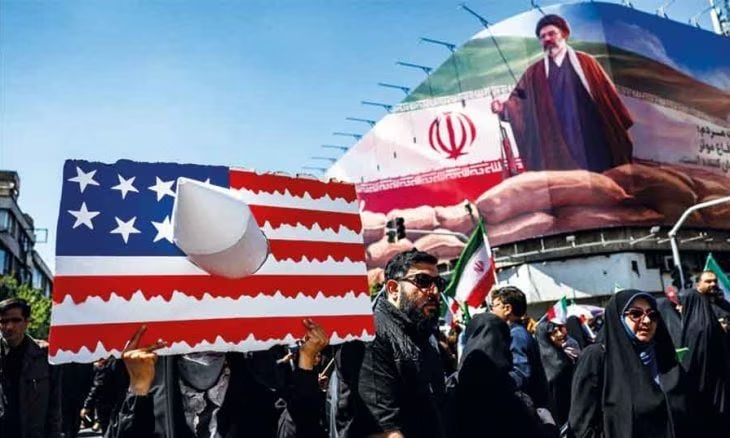
Initial readings of the results of the 'Epic Fury' operation and the subsequent military developments indicate that Iran is undergoing a crucial transitional phase, where the regime has shifted from its traditional religious form to an authoritarian dictatorship suffering from structural weakness. This transformation was not accidental; rather, it is the result of a continuous erosion of the regime's political and religious legitimacy over the past two decades, leading to the current moment characterized by fragmentation of the supreme leadership.
The concept of 'Velayat-e Faqih' (Guardianship of the Jurist), established by Khomeini, was partly based on popular acceptance and public faith, which second-generation leaders tried to maintain through delicate balances. With the rise of the extremist bureaucratic current led by Ali Khamenei, and now the current prominence of his son Mojtaba Khamenei, it seems the regime has definitively abandoned the facade of popular legitimacy in favor of absolute authoritarian rule that offers no ideological promises to the masses.
The departure of historical leaders and the escalation of assassinations targeting senior officials have created a leadership vacuum that is difficult to fill, weakening the regime's ability to mediate between warring factions. This vacuum has pushed the Revolutionary Guard to the forefront as the sole force capable of maintaining internal security and confronting external threats, signifying a comprehensive militarization of decision-making circles in Tehran and the marginalization of civilian and diplomatic tools.
The features of 'The New Iran' are evident in the transition to a new generation of leadership for whom the Iran-Iraq War is no longer the sole reference point; rather, their consciousness has been shaped by internal repression operations and modern military confrontations. This generation adopts a security doctrine based on advanced fire deterrence and confronting internal sabotage, which requires them to formulate strategies that go beyond the traditional frameworks established by the regime's founding leaders.
In dealing with the street, the regime has removed the 'silk gloves' it used to conceal its iron fist, especially after the events of January 2026, which witnessed unprecedented public violence. The damage to traditional repression mechanisms has forced the authorities to adopt brutal direct violence as the sole tool for survival, ending an era of organized protests and heralding a phase of chaos and street violence.
Economically, the regime faces a real dilemma with the damage to major industries and the deterioration of financial resources due to sanctions and military operations. In the coming phase, the regime will be forced to direct remaining resources to support only its solid base and loyalists to ensure their allegiance, which will lead to the deliberate impoverishment of the majority of the Iranian people and the widening of the class and social gap between the authorities and citizens.
The existential threats currently facing the regime represent a strong impetus to cross all red lines, including the religious barriers that once prevented the pursuit of unconventional weapons. The desire to acquire a nuclear weapon or major strategic capabilities has become a matter of technological survival, as the regime sees these weapons as the only guarantee to prevent the state's collapse in the face of direct external attacks.
Regionally, the mask that covered Iranian movements through proxies has fallen, as Tehran was forced into direct confrontations that revealed the damage to its conventional military capabilities. This shift will push Iran to adopt 'guerrilla warfare' tactics in the air and sea, focusing on carrying out qualitative operations that serve its urgent security and economic needs instead of long-term strategic plans.
The events of October 7th caused a shock to the Iranian timeline, with analysts believing that the move came earlier than Tehran had planned within its 'annihilation of Israel' strategy. This confusion has made Iranian foreign policy more responsive to immediate crises and less reliant on organized planning, increasing instability in the region and making Iranian moves unpredictable.
Supporters of the regime currently live in a state of complete isolation from the rest of society, being fed misleading media narratives that are completely detached from economic and field realities. This isolation will push them to defend the regime more fiercely because their fate is organically linked to its survival, which increases the likelihood of bloody clashes between different segments of the population in the near future.
For ethnic and religious minorities in Iran, the current crisis will force them to strengthen their self-autonomy and internal solidarity, away from the state's centralism that has neglected their needs. While this trend may not immediately transform into an organized revolution, it weakens the cohesion of the Iranian state as a unified entity and increases the chances of independent activity that could threaten the territorial integrity of Iran.
The international community must re-evaluate the situation in Iran based on these new facts and abandon the classical perceptions that prevailed before 2026. Betting on a popular revolution similar to the events of 1979 may be unrealistic given the current brutality of repression, requiring the search for new tools to support the Iranian people and protect them from the authoritarian killing machine.
Economic sanctions will play a more effective role in the next phase due to the fragility of the Iranian economy and the regime's desperate need for liquidity to rebuild its authority. It is essential to continue economic pressure and prevent the regime from developing its offensive capabilities, especially in light of indicators confirming its pursuit of unconventional military technology to threaten regional and global security.
In conclusion, the Iran that the world knew for decades has ended, replaced by a more violent and less stable political entity, opening the door to grave dangers and new strategic opportunities. Monitoring developments in Tehran in the coming months will be crucial to determining the region's direction, as the confrontation between the regime's desire to survive and the people's aspiration for liberation will be the main driver of events.
Iran today is a completely different state; it has transitioned from a religious regime seeking legitimacy to a weak dictatorship fighting for survival through excessive violence.
שתף את דעתך
The New Iran: Transformations from a Religious State to a Military Dictatorship after the 'Lion's Roar'