






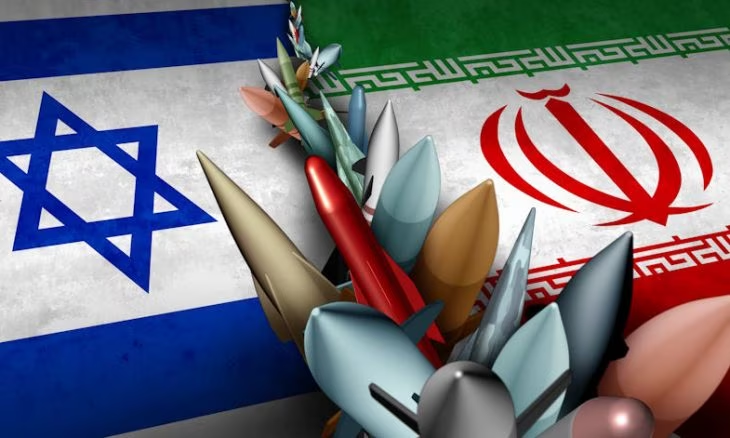
The latest round of confrontation between the United States and Iran ended with a ceasefire agreement, but the field and political results were disappointing for the Israeli leadership. Despite the grand promises made by Benjamin Netanyahu and his entourage, none of the three main objectives—overthrowing the regime in Tehran, dismantling the nuclear program, or eliminating the ballistic missile arsenal—were achieved.
Current data indicates that the Iranian regime still holds the reins, and its steadfastness in the face of the American and Israeli war machine is considered a strategic victory. In contrast, the issue of 440 kilograms of enriched uranium remains unresolved, while missile and drone programs continued to operate despite intensive airstrikes.
On the diplomatic front, Israel's standing in Washington faced a severe blow, possibly the harshest in decades, as accusations against Netanyahu for attempting to drag the United States into an unnecessary war escalated. Doubt began to creep even into the pro-President Trump base, who started questioning the true motives behind the continuous Israeli escalation.
International media reports revealed the behind-the-scenes of a crucial meeting at the White House last February, where Netanyahu and his security team presented a plan described as overly optimistic for reshaping the Middle East. The plan included promises to destroy Iran's missile capabilities within just one week and ensure the Strait of Hormuz remained open for international navigation without obstacles.
The controversial aspect of those meetings was Netanyahu's proposal for a 'succession' scenario in Iran, where Reza Pahlavi, the son of the former Shah, was presented as a potential alternative ruler. These proposals were met with muted sarcasm from senior American officials, with the CIA director describing such ideas as 'ridiculous,' while the Secretary of State considered them mere 'nonsense' not based on reality.
Field realities have proven that absolute air superiority does not necessarily translate into decisive political victory, just as happened in the Gaza Strip previously. Supporters of the Israeli government are currently trying to market new promises of an imminent final solution, in an attempt to postpone political accountability and escape the consequences of failing to achieve 'complete victory.'
Iran, for its part, succeeded in diagnosing the American weakness represented by the stability of global energy markets, and used the threat of the Strait of Hormuz as an effective bargaining chip. Reports speak of Tehran's potential to impose transit fees of up to two million dollars per ship, which implies implicit recognition of its sovereignty over this vital waterway.
Meanwhile, the northern front with Lebanon remains a political and military minefield threatening the stability of the entire region, despite the temporary ceasefire. The Israeli air force launched violent raids on Hezbollah headquarters, resulting in dozens of casualties, a move observers considered an attempt by Netanyahu to undermine American-Iranian understandings.
Residents of northern Israel live in a state of uncertainty, as the army still deploys five military divisions in ground operations in southern Lebanon with no clear horizon for withdrawal. This intensive military presence imposes significant economic and social burdens and threatens reconstruction projects in the Galilee that have completely halted due to ongoing confrontations.
Netanyahu's media machine is currently trying to craft a new narrative of victory, aimed at convincing the Israeli public that the operation achieved its deterrent goals. But this task seems impossible given the continued missile threats and the Iranian regime remaining strong and capable of maneuvering on the nuclear file.
The upcoming negotiations through the Pakistani mediator will reveal the fragility of the current agreement, especially with Tehran's insistence on lifting all international sanctions. Iran sees the ceasefire as an opportunity to strengthen its nuclear position, considering that the pressure it exerted on the global energy lifeline provided it with immunity against any future attacks.
Israel fell into a strategic trap as a result of betting on baseless desires and ignoring the opinions of military and political experts. Instead of becoming a 'great regional power' as Netanyahu promised, it found itself facing a long-term attrition on multiple fronts without a real resolution.
Trump, who dislikes losing, may soon begin searching for a scapegoat to blame for the faltering American strategy in the region, which causes great concern in the Israeli Prime Minister's office. The seemingly strong relationship between the two men could suffer a deep rift if the war is portrayed as a strategic failure for Washington.
Ultimately, Israelis emerge from shelters wondering about the utility of these endless rounds of fighting that do not lead to lasting peace. The gap between resonant speeches and the dire field reality has become too wide to be covered by political maneuvers, putting the future of the current leadership at stake before a public weary of empty promises.
His claims of transforming Israel into a regional power do not align with the strategic trap it fell into, or with the reality of Israelis' lives who emerged from shelters clinging to a faint hope.
שתף את דעתך
The Strategic Trap: How Netanyahu's Promises of 'Complete Victory' Against Iran Evaporated?