






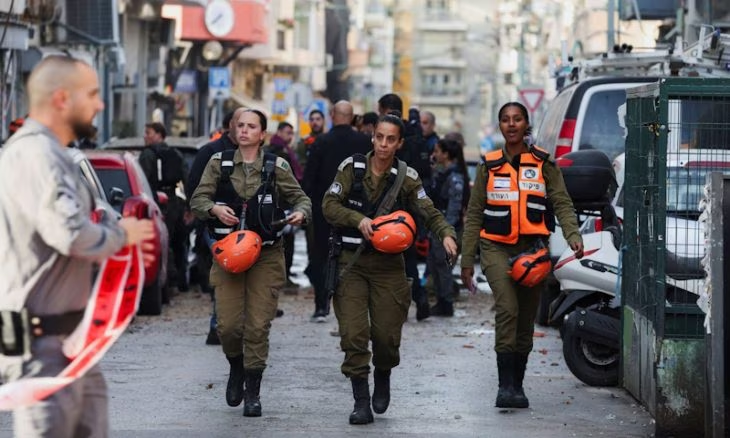
Political and military circles in Israel are experiencing a state of suppressed anger and widespread disappointment following the announcement of a ceasefire agreement with Iran. Observers and analysts believe that this agreement, which came under direct pressure from US President Donald Trump, represents a retreat from the ambitious goals announced by the Israeli government at the beginning of the confrontation, leaving the home front in a state of anxiety and confusion.
Reserve General Amos Gilad, former head of the political and security department in the Ministry of War, affirmed that the American commitment to a ceasefire might extend to include the Lebanon front, which would force Israel to comply. Gilad explained that the military gains achieved by the army did not translate into strategic achievements due to the absence of clear policy, warning that betting on the overthrow of the Iranian regime was an unrealistic goal that would take years.
Gilad strongly criticized the absence of real intelligence assessment bodies, pointing out that the position of National Security Advisor remains vacant. He added that Israel now faces a wounded Iranian regime that possesses the ability to restore itself and rebuild its strength, considering that Tehran emerged from this round feeling victorious after surviving a direct confrontation with Washington and Tel Aviv.
For its part, Hebrew media sources revealed that President Trump imposed a ceasefire on Prime Minister Benjamin Netanyahu, despite the latter's attempts to persuade him to continue military action. The sources indicated that Israel had been counting on Trump's threats to crush Iran, but Pakistani mediation succeeded in reaching a settlement that went against the wishes of the Israeli leadership, which aspired to radical change in the region.
There is a state of ambiguity surrounding the details of the agreement, especially concerning Iran's nuclear and missile projects. Sources reported that there are leaks indicating American acceptance of uranium enrichment for civilian purposes, which raises fundamental questions in Tel Aviv about whether the war has actually ended or if the region is heading towards a new round of conflict soon.
Regarding the Lebanese front, analyst Ohad Haimo expressed bitter sarcasm at the results of the confrontation, considering that the inclusion of Lebanon in the agreement represents a fundamental gain for Iran and Hezbollah. Haimo explained that Israel had rejected this linkage from the beginning, but Tehran succeeded in imposing its conditions, which raises major questions about the fate of military operations in southern Lebanon.
Heimo stressed that the true measure of the war's success or failure lies in the fate of the enriched uranium held by Iran. If this stockpile remains within Iranian territory, the war will be classified as a dismal failure for Israel, but if large quantities of uranium are removed, then a tangible strategic achievement can be discussed.
In a related context, Ofir Oppenheim, former director of the 'Peace Now' movement, launched a scathing attack on Netanyahu, describing the war as 'misleading' and based on unrealistic goals. Oppenheim accused the political leadership and media of suppressing the voice of reason and misleading the Israeli public, emphasizing that regimes are not overthrown by airstrikes alone, and that the price paid by Israelis was exorbitant and futile.
Military analyst Avi Ashkenazi described the agreement as 'strategic submission,' noting that 40 days of bleeding and damage to some 5,000 buildings in Israel ended without achieving a decisive victory. Ashkenazi added that the Iranian regime and nuclear project remained intact, while the Strait of Hormuz became a source of profit for Tehran instead of a tool of pressure on it.
Analyst Ron Ben Yishai believes that Trump bought political time with this agreement, while Israel is paying the price with its national security. He explained that Israel was forced to stop in Lebanon at the peak of its offensive, giving Hezbollah an opportunity to catch its breath and restore its capabilities, especially given the Israeli army's shortage of fighting forces and the exhaustion of reserve forces.
Ben Yishai indicated that Iran tactically retreated out of fear of 'Trump's madness' and his threats to destroy infrastructure, but it did not give up its basic demands. He considered that Trump achieved immediate gains by lowering oil prices and calming domestic opposition before the midterm elections, while Israel remained alone in facing security risks and open fronts.
There is a state of anticipation in northern Israel, where heads of local authorities fear the imposition of a sudden ceasefire on the Lebanon front before removing the threat of Hezbollah from the border. Security sources consider that the continued Israeli shelling of Tyre and other areas in southern Lebanon is an attempt to absorb internal anger and pressure the US administration to improve the terms of de-escalation.
Orly Sagi, former head of military intelligence, considered that imposing a ceasefire on the northern front would represent a major insult to the Israeli military establishment. He stressed that accepting the current situation without a tangible change in the security reality on the Lebanese border means that Israel emerged from this confrontation with a strategic loss that will affect its deterrent power in the future.
In conclusion, the Israeli street remains divided and frustrated by the results of the confrontation with Iran and its allies, amidst accusations against Netanyahu of failing to manage the crisis. With the continued rocket fire that followed the announcement of de-escalation, doubts are growing about the usefulness of political agreements in curbing Iranian ambitions and securing the Israeli home front, which suffered severe blows in Tel Aviv, Beersheba, and Haifa.
Israel and the United States emerged from the battle with an agreement of complete strategic submission, and the Iranian regime remained as it was.
שתף את דעתך
Anger and frustration in Israel: Trump imposes ceasefire, Netanyahu fails to neutralize Lebanon front