






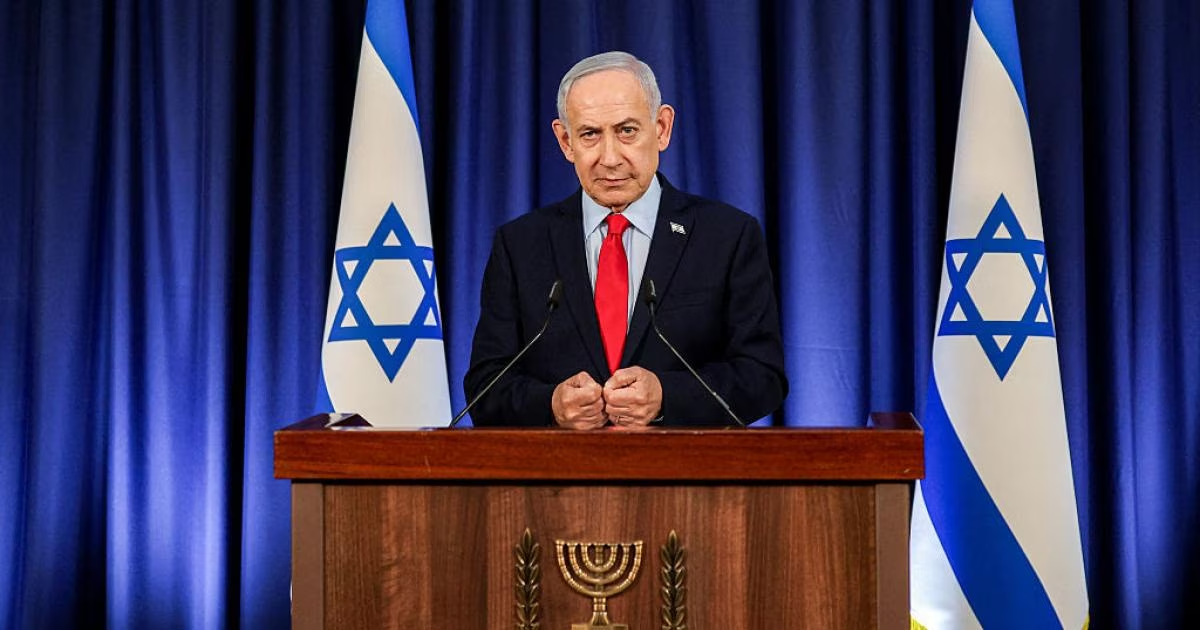
Israeli Prime Minister Benjamin Netanyahu expressed his support for US President Donald Trump's decision to halt military operations against Iran for two weeks. This stance came after Hebrew media reports indicated that Tel Aviv aligns with the new American vision for temporary de-escalation in the region. However, Netanyahu set a clear limit to this endorsement, linking it only to the Iranian arena and not to other active fronts.
Netanyahu stressed in his statements that the current understandings regarding the ceasefire do not extend to Lebanon, indicating the continuation of military operations there. This Israeli position comes at a sensitive time witnessing significant field escalation, raising questions about the effectiveness of partial de-escalation. This exception has sparked widespread debate due to the interconnectedness of regional issues in the ongoing conflict.
In contrast, Pakistan, as the mediator in this agreement, presented a completely different narrative from what the Israeli side put forward regarding the scope of the de-escalation. Pakistani Prime Minister Shehbaz Sharif announced that the agreement reached includes a comprehensive ceasefire on all fronts. Sharif affirmed that 'the Islamic Republic of Iran, the United States, and their allied parties' agreed to an immediate cessation of operations explicitly including Lebanon.
Pakistan's Prime Minister explained that his government's diplomatic efforts aim to end the war that erupted on February 28th. He indicated that the capital Islamabad is preparing to host high-level delegations from Washington and Tehran next Friday. These anticipated meetings aim to draft the final terms of a sustainable peace agreement that will end the state of tension that has plagued the region for the past weeks.
On the other hand, Israeli sources revealed a state of confusion that prevailed in political and security circles in Tel Aviv following the surprising American decision. Media sources quoted informed officials that Israel was not a partner in drafting the decision but received updates at the last minute. It appears that the US administration made up its mind regarding de-escalation before informing its close ally of the final details of the agreement with the Pakistani mediator.
US President Donald Trump announced earlier today his approval to suspend strikes against Iranian targets for 14 days as a gesture of goodwill. Trump stipulated that for this decision to be implemented, the Strait of Hormuz must be fully and immediately opened to international navigation without any obstacles. The US President also affirmed that the continuation of this calm depends on a bilateral commitment, indicating that this period will be sufficient to test intentions and finalize the drafting of the final agreement.
Trump considered this step a historic opportunity to resolve a long-standing problem in the Middle East, describing himself as representing the interests of the region's countries in this path. International parties hope that the Islamabad talks will succeed in transforming this temporary halt into permanent stability that spares the region the ravages of a comprehensive war. However, the discrepancy in interpretations between Tel Aviv and Islamabad regarding the 'Lebanon front' remains the biggest obstacle to the comprehensiveness of this diplomatic path.
Israel supports US President Donald Trump's decision to suspend attacks on Iran for two weeks, but the ceasefire does not include Lebanon.
שתף את דעתך
Netanyahu supports suspending attacks on Iran, excludes Lebanon from de-escalation