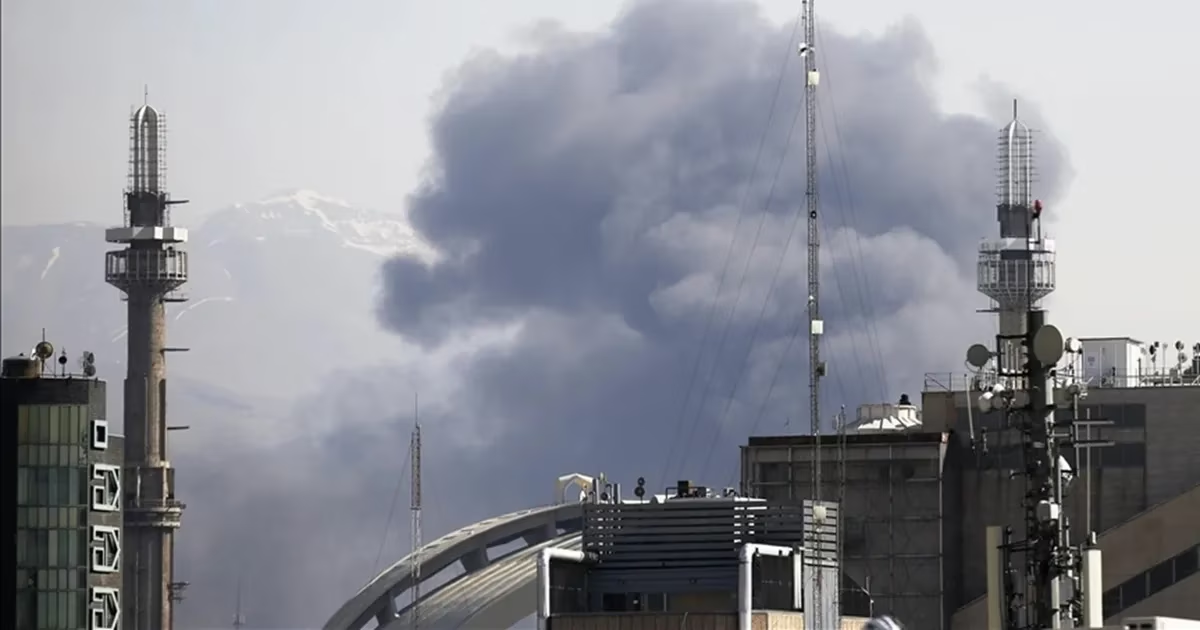







The region is witnessing an unprecedented military escalation as the confrontation between Iran, on one hand, and Israel and the United States, on the other, enters its fifth week. Field sources reported intense raids on Sunday night and Monday dawn targeting strategic sites and residential neighborhoods in Tehran, Isfahan, and Qom, resulting in dozens of casualties, including children, amidst the ongoing war that began on February 28th.
Amidst this military dust, a sharp division emerges in the Arab street that transcends traditional political analysis, reaching a stage akin to a 'great sedition'. Each side believes its position is the absolute truth, transforming the existential conflict into something resembling football matches between 'Al-Ahly and Zamalek', where there is no room to hear the other opinion or accept pluralism in media discourse.
Major media institutions face a tremendous challenge in maintaining their professional balance in front of an audience that demands their viewpoint be fully adopted. While some attack the hosting of figures who align with the Iranian vision, others launch a counter-attack when voices critical of Tehran's policies appear, putting news platforms in direct confrontation with accusations of treason and loss of credibility.
The culture of 'cheering' has moved from the stands to the screens, where viewers now seek what satisfies their political whims, not what conveys objective truth. This behavior has turned the political analyst into a mere echo of public desires, as if news programs have become political versions of 'listeners' choice' programs, which threatens the essence of journalistic work based on uncovering facts.
On the ground, reports revealed the killing of 13 people in an attack targeting the Baharestan residential area, in addition to the killing of the commander of the Air Defense College in Isfahan. These bloody developments increase the intensity of polarization, as those affected by previous Iranian policies in Syria and Iraq find it difficult to sympathize with Tehran, while others believe that the Israeli danger is the sole threat that must be confronted.
Statistics issued by the Pentagon indicate that more than 11,000 targets inside Iranian territory have been struck since the start of operations. Despite this enormous military pressure, sources confirm that Tehran still retains the ability to repair its missile facilities and reactivate bunkers within hours, despite the daily missile launch rate dropping to less than 40 missiles.
The current crisis has revealed a fragility in collective awareness regarding the concept of 'news' and 'opinion'. Social media platforms have contributed to turning every page owner into a political analyst who rejects news simply because it does not align with their preferences, which opens the door wide to the spread of fake news and the loss of direction in evaluating current events away from emotions.
In comparison with previous crises such as the invasion of Iraq, it appears that the public was more mature in accepting other opinions despite the bitterness of defeat. Today, however, the intensity has reached the point of direct incitement against journalists and institutions that try to adhere to professional rules, which reflects a decline in public dialogue tools within Arab societies.
Intellectual elites play a negative role in this scene, as some of them are swept away by demagoguery to gain public favor or settle personal scores. Instead of rationalizing the debate, these individuals contribute to formulating accusations of treason and collaboration, which deepens the gap and makes it impossible to build a unified Arab vision towards the accelerating regional challenges.
Despite the scathing criticism, major news channels still dominate viewership, proving that the public, despite its anger, knows deep down where to find reliable news. The biased viewer looks for a 'mouthpiece' that represents them, but returns to professional platforms to know the reality of military and political developments on the ground.
Finding excuses for some tense positions seems logical given the historical wounds in the region; the Syrian whose country was destroyed or the Iraqi who suffered from interventions cannot be forced to see the scene with one eye. However, turning this suffering into a tool to suppress professional media work ultimately serves the enemies of the nation who benefit from the fragmentation of awareness.
Iran, for its part, has given its opponents objective justifications through its regional policies that have raised the concerns of neighboring countries. Had it adopted a different policy, it might have pulled the rug out from under those inciting against it, and would not find itself today in confrontation with a camp that sees 'American and Israeli evil' as a parallel or even less severe threat than its own.
Amidst the continued civilian casualties, as happened in the targeting of Sharif University's gas station and the disruption of services to entire neighborhoods in Tehran, the need for media that honestly conveys human suffering without engaging in axis conflicts increases. Truth is the first casualty in wars, and professionalism is the only remaining shield to protect it.
In conclusion, this war remains a difficult test not only for military capabilities but also for the ethical and professional system in the Arab world. It is either a slide towards destructive 'populism' that negates reason, or adherence to journalistic values that differentiate between conveying reality and promoting agendas, in a time when honesty has become a rare commodity amidst the noise of missiles and statements.
This battle seems to need a 'mouthpiece' rather than a media platform that tries to be bound by the rules of professional practice amidst a division resembling the fanaticism of football stadiums.
שתף את דעתך
Between professional vision and 'stands' fanaticism.. How does the Arab street read the Iranian-Israeli confrontation?