






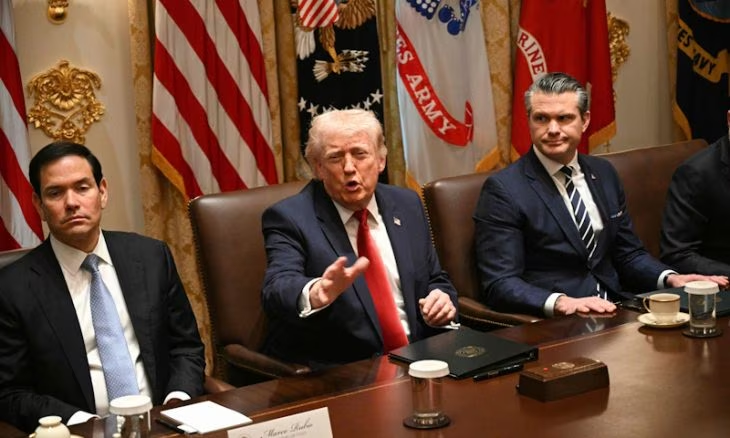
The corridors of power in Washington and Tel Aviv are witnessing a remarkable shift in the nature of discourse directed against Iran. The objectives are no longer limited to the nuclear and missile files but have extended to take on a religious character, suggesting the waging of a 'holy war'. These manifestations are evident in President Donald Trump's embrace of religious leaders who participate in official prayers inside the White House, reflecting a state of mobilization with an evangelical Christian facade to support the American administration's military orientations.
On the Israeli side, the scene does not appear different, as Prime Minister Benjamin Netanyahu has intensified the use of biblical references in his speeches since the outbreak of the recent confrontation. This was clearly evident before the Jewish Passover, when he drew a historical and religious comparison between the current war on Tehran and the story of the Israelites' salvation from Pharaoh, in an attempt to lend religious legitimacy to the ongoing military moves.
Although the United States is officially known as a secular state, the conflict with the Islamic Republic of Iran has contributed to bringing religious discourse closer to political orientations in an unprecedented way. Media sources have reported religious celebrations in the White House during 'Holy Week', which included public prayers asking for 'victory' for Trump as the person prepared for this historic moment, which sparked widespread controversy after video clips of these rituals were leaked.
This religious tone acquires double sensitivity given that the parties involved in the conflict represent the three major monotheistic religions that originated in the Middle East. This overlap between belief and military diplomacy places the region before a complex scene that transcends traditional political differences into a conflict of deeply rooted religious identities and values, which increases the difficulty of diplomatic solutions.
US Secretary of Defense, Pete Hegseth, is one of the most prominent figures adopting this hardline religious discourse within the administration. Hegseth has, on official occasions, called for prayer for American soldiers in the Gulf using specific religious formulas, ignoring the doctrinal diversity within the ranks of the US military, which observers considered a departure from established military traditions.
Hegseth bases his vision on texts from the 'Book of Psalms', where he invokes the prayers of Prophet David during his fight against his enemies, likening the current reality to the wars mentioned in the Bible. He also stated in media interviews that he is confronting 'extremists' seeking to acquire nuclear capabilities in preparation for the battle of 'Armageddon', which is the battle of the end times in Zionist Christian belief.
Hegseth's military and intellectual history reinforces this trend. Before taking over the defense portfolio, he served as an infantry officer in Iraq and Afghanistan, and bore tattoos of Christian symbols associated with the time of the Crusades, such as the 'Jerusalem Cross'. He also authored a book titled 'American Crusades', in which he called for the defense of Western civilization against what he described as decline and external and internal threats.
This increasing mixing of religion and politics has drawn sharp criticism from academics and former clerics in the US military establishment. Experts believe that imposing a specific religious vision within a national institution like the military represents an abuse of power and a lack of respect for the diversity upon which the American nation is built, warning of the repercussions of this on the cohesion of the armed forces.
On the international level, the Vatican entered the crisis through statements by Pope Leo XIV, in which he affirmed that God does not love war and cannot be used to justify armed conflicts. This position puts the American administration in confrontation with global religious authorities that reject the politicization of beliefs to serve geopolitical or military objectives.
Despite the criticism, the Trump administration continues to defend its approach, with White House spokeswoman Karoline Leavitt considering prayer for the armed forces a noble act that reflects the values of American society. Leavitt rejected suggestions that this behavior fuels religious conflicts, emphasizing the President's right to practice his rituals and invite others to participate in them.
This trend is set to culminate in a massive gathering in Washington in mid-May, where Trump intends to lead a national prayer aimed at 'rededicating America to God'. Analysts see this event as an official declaration of the shift in American foreign policy towards 'Christian nationalism' which views international conflicts as an extension of religious prophecies.
In contrast, Iran finds itself at the heart of this discourse as an 'Islamic Republic' led by a Supreme Leader who combines spiritual and temporal authority. This juxtaposition in religious discourse between Washington and Tehran transforms the conflict from a competition for regional influence into an open ideological confrontation, where each side sees itself as representing divine will in the face of 'evil'.
The invocation of terms such as 'Crusades' and 'Armageddon' brings to mind bitter historical conflicts and weakens the chances of rational dialogue based on common interests. Observers believe that this verbal escalation could lead to unforeseen military slips, driven by metaphysical convictions that transcend the traditional strategic calculations of states.
Finally, the question remains about the extent of this discourse's impact on Washington's allies in the region and the world, especially those who fear the transformation of political conflict into a comprehensive religious war. While military preparations continue on the ground, the 'holy war' promoted by some parties in Washington and Tel Aviv remains the most prominent title for the next phase in the Middle East.
Our Father, you have raised Donald Trump, you have prepared him for such a moment, and we pray, Our Father, that you grant him victory.
שתף את דעתך
Religious undertones shroud the confrontation: How did the American war on Iran turn into a 'holy war' during Trump's era?