






Calls are escalating in Israeli political circles to adopt a comprehensive diplomatic path that ends the protracted conflict on the Gaza, Lebanon, and Iran fronts. Observers believe that achieving a desired end to these confrontations requires a broad political settlement, stemming from the conviction that military force alone will not resolve the deeply rooted crises in the region.
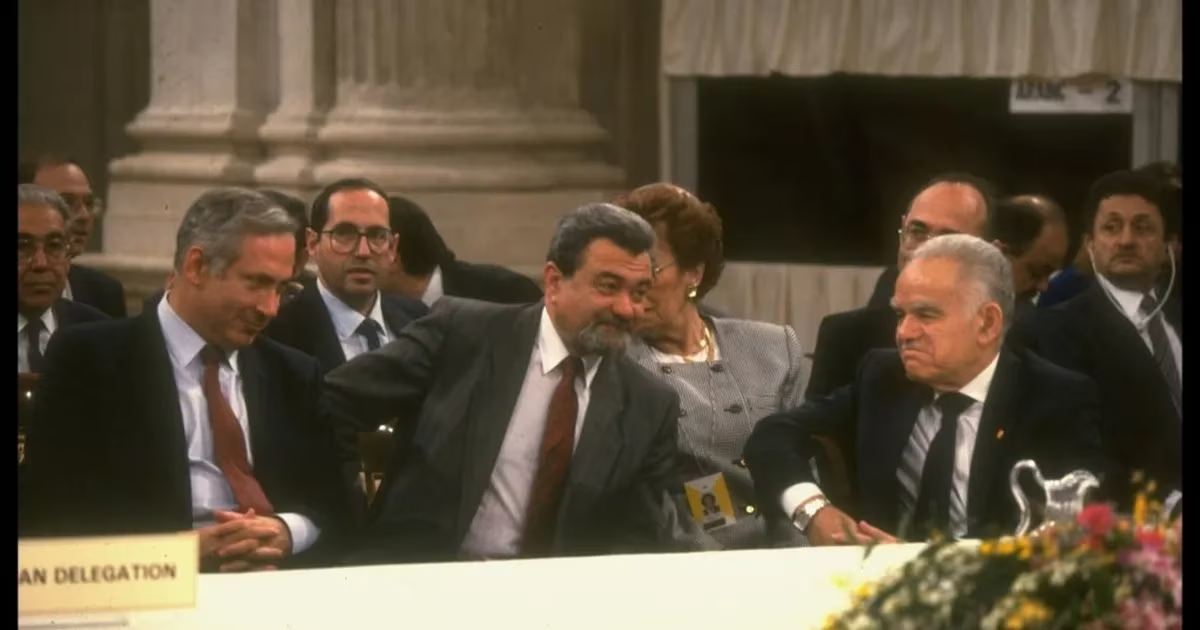
In this context, veteran diplomat Nadav Tamir reviewed the experience of the Madrid Peace Conference held in 1991 as a model that can be replicated and developed. Tamir pointed out that this conference represented the first attempt to open a direct dialogue between Israel, the Palestinians, and the surrounding Arab states under major international sponsorship.
Tamir explained in an analysis published by the occupation press that the original Madrid Conference came amidst a complex security reality and continuous wars, but the American leadership at the time realized the necessity of dialogue. He considered those discussions to be the first seeds that later led to the Oslo Accords, the peace treaty with Jordan, and eventually the modern normalization agreements.
The Israeli diplomat criticizes the absence of a comprehensive political vision in subsequent meetings held in Camp David and Annapolis, where the link between the bilateral and regional tracks was overlooked. He believes that the current leadership in Tel Aviv has become immersed in a reality that sees war as the only solution, making fighting a daily routine that exhausts all parties.
The analysis indicates that the world currently lacks the quality of leadership that prevailed in the early nineties, considering that the names put forward in the current American administration do not possess the same diplomatic weight. He also described current regional leaders as having turned the 'art of war' into a science, ignoring available opportunities to sit at the negotiating table.
Tamir believes that true victory over what he described as 'hostile forces' led by Iran requires building a regional alliance based on political and economic peace. He stressed that this path will not succeed without explicit recognition of the Palestinian people's right to self-determination and the establishment of their independent, viable state.
The analysis warned that ignoring the Palestinian issue, as successive Israeli governments have done, leads to the fueling of ongoing conflicts and the weakening of Israel's international legitimacy. It also criticized the approach of the Netanyahu government, which is working to entrench facts on the ground that undermine the chances of a two-state solution and prevent any real diplomatic progress.
The article proposes an urgent framework for regional peace talks once direct military operations cease, to avoid a dangerous political vacuum. This proposed framework includes Israel, the Palestinians, Lebanon, and Syria, in addition to active Arab states in the region to ensure the sustainability of any agreement.
Among the proposals was the idea of holding an 'updated Madrid Conference' in the Saudi capital, Riyadh, to leverage the Kingdom's influence and impact on various parties. It is believed that Riyadh's hosting of such an event would ensure broad regional commitment, especially since it was the initiator of the Arab Peace Initiative in 2002.
The Israeli diplomat calls for giving the new American administration an opportunity to build on previous successes to stop the war in Gaza and achieve a comprehensive agreement. He believes that this agreement must include a clear plan for a demilitarized Palestinian state, with precise security and political arrangements between Israel and its neighbors to the north.
The proponents of this idea believe that Donald Trump has the ability to turn military failures into major diplomatic successes if he pursues a path of comprehensive deals. The analysis indicates that Trump has significant influence over the Israeli right, which could enable him to change the current course led by Netanyahu.
The vision put forward by Tamir directly clashes with the current government's tendencies, which prefer the continuation of military operations to achieve its goals. Nevertheless, calls to return to the 'spirit of Madrid' represent a current within the Israeli establishment that sees regional diplomacy as the only way out of the cycle of bloodshed.
The analysis concludes by emphasizing that true stability will only be achieved by changing the path that leads to 'endless bloodshed.' It stresses the need to move from a state of permanent war to political agreements that guarantee security for all peoples of the region based on justice and mutual recognition.
The question remains about the extent to which international and regional powers will respond to such initiatives amidst the sharp polarization and widespread destruction left by recent wars. However, the proposal of 'Madrid 2' reflects a desire to seek a political horizon that ends the stalemate that the region has suffered from for many years.
Solutions to problems will be achieved through the negotiating table, not in endless rounds of fighting, and true victory requires concerted regional efforts to provide a joint response.
שתף את דעתך
Israeli Calls for a 'Madrid Conference 2' to Redraw a New Political Map for the Region