






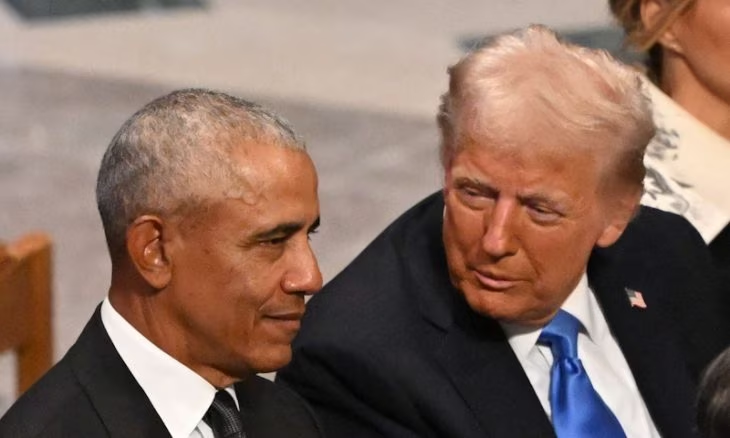
French press reports indicate that US President Donald Trump fell into a trap of miscalculation regarding the Iranian issue, as a result of his deliberate disregard for the experiences of his predecessors in the White House. Le Monde pointed out that Trump, who has always shown disdain for Barack Obama's policies, preferred to proceed with the military confrontation option, the outlines of which began last February in cooperation with Israeli Prime Minister Benjamin Netanyahu.
According to the analysis, Trump was convinced that the regime in Tehran was nothing more than a Middle Eastern version of Nicolas Maduro's regime in Venezuela, where he believed that a show of military force would lead to a rapid collapse of the regime. This perception led him to believe that victory was guaranteed, and that intense pressure would end with Iran's surrender, the dismantling of its nuclear and ballistic programs, and the end of its militias' influence in the region.
However, events on the ground contradicted the US administration's expectations, as Washington found itself in the midst of a military escalation that did not achieve the desired swift results. Sources explained that Trump, at the height of military operations, tried to reopen negotiation channels, but Tehran considered these calls merely a cover for deeper strikes targeting its senior leadership.
Data indicates that the war, which was launched based on claims of an imminent threat, has not been definitively proven by US intelligence to be true so far. With operations continuing, the prevailing logic has become continuous escalation, where Iranian reactions are used as a pretext for further attacks in a vicious cycle of violence.
In light of this political stalemate, discussions in Washington have begun to escalate regarding the possibility of sending ground troops, which was previously a red line. It seems that this option is now strongly on the table with the continuation of military operations and increasing pressure from the hardline wing of the Republican Party, which is pushing for a decisive resolution of the conflict by force.
In this context, statements by Senator Lindsey Graham, close to the White House, emerged, explicitly calling for control of vital Iranian oil facilities, specifically on Kharg Island. Graham invoked historical examples from World War II, pointing to the necessity of fighting decisive battles to secure vital American interests in the region.
Le Monde believes that if Trump had been able to overcome his personal rivalry with Obama, he would have learned lessons from Obama's famous speech in 2015. In that speech, Obama defended diplomacy as the only alternative to avoid a new war in the Middle East, warning that military action would only lead to temporary and uncertain results.
Obama had clearly warned that striking Iranian facilities would not be a quick or painless picnic, as some promoted. He affirmed then that any military intervention would undermine international consensus on nuclear non-proliferation, and would inevitably lead to the expulsion of international inspectors, making monitoring Tehran's nuclear ambitions impossible.
Despite Trump's 2016 election promises to withdraw from the nuclear deal and impose harsher conditions, reality has proven the failure of this strategy to achieve its goals. The White House belatedly discovered that the Iranian regime possesses a resilience that exceeds initial expectations, especially given its reliance on a 'chaos' strategy to confront pressures.
Trump's administration is currently facing increasing internal pressure with the upcoming midterm elections in November, as observers fear the impact of the war on fuel prices in the United States. Tensions in the Strait of Hormuz and threats to global energy supplies could lead to an economic crisis that directly affects American voters.
Analysis also revealed deep divisions within the US administration regarding how to deal with the Iranian issue. Prominent experts, such as Nate Swanson, who had a proactive vision for Tehran's moves, were removed due to internal conflicts and the influence of controversial figures on the President's decisions.
The absence of a unified vision and political favoritism within the White House has contributed to complicating the current military and political landscape. Instead of relying on sober analyses from research centers, it appears that American decisions have become hostage to partisan tug-of-war and the desire to settle scores with previous administrations.
In conclusion, the region remains open to all possibilities, in the absence of any horizon for a diplomatic solution currently. With the continued escalation, it seems that the warnings issued by Obama years ago are now turning into a tangible reality that threatens to drag the region and the world into a long-term and inconclusive conflict.
The choice before us is ultimately between diplomacy or some kind of war... perhaps not tomorrow, but soon.
שתף את דעתך
Le Monde: Trump's Miscalculation in Confronting Iran Ignores Obama's Historic Warnings