






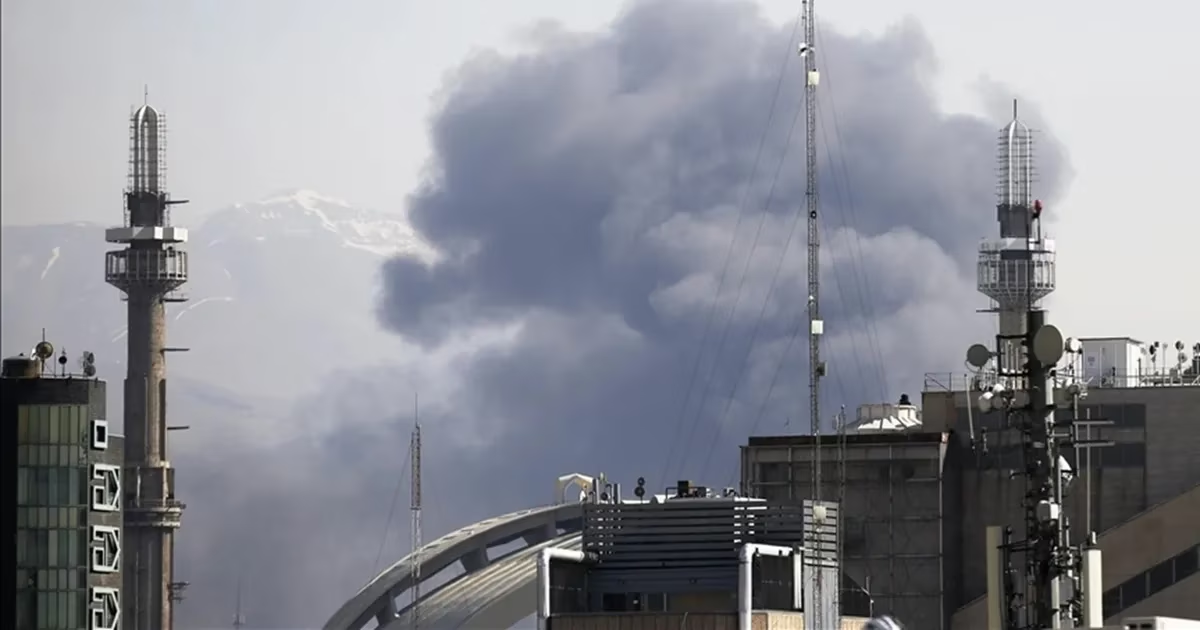
Hebrew press sources revealed the strategic features of the military campaign led by the Western coalition against Iran, confirming that the objectives go beyond localized strikes. Reports indicated that the current endeavor focuses on creating strategic pressure aimed at gradually weakening the structure of the Iranian regime, which opens the door for potential internal transformations.
Maariv newspaper clarified that US President Donald Trump's decision to suspend targeting Iranian energy facilities for five days does not constitute a retreat from escalation. Rather, the newspaper described this step as a tactical maneuver within a long-term path, noting that any strikes directed at energy would have a symbolic and limited impact at this stage.
In an interpretation of the internal political scene in Tehran, sources pointed to the absence of a leadership element with absolute authority to make fateful decisions regarding war or peace. However, Mohammad Bagher Ghalibaf emerged as the most influential figure currently, as he manages sensitive files and indirect communication with the American side.
Reports touched upon what they described as the 'small peace' currently proposed by Trump, questioning whether it would lead to a 'big peace' that guarantees complete Iranian surrender. Political circles believe that Washington will not accept ending military operations without extracting substantial concessions affecting the core of Iran's nuclear program and military capabilities.
The US administration set three impossible conditions for a ceasefire: first, the delivery of 450 kilograms of enriched uranium to ensure non-acquisition of a nuclear bomb. The demands also include Iran's unconditional agreement to open the Strait of Hormuz to international navigation, and to ensure freedom of commercial movement without military threats.
As for the third condition, it concerns the establishment of a strict and effective international monitoring mechanism to follow Iran's ballistic missile program and limit its development. Sources confirm that the Trump administration will not conclude any political deal or stop the military momentum unless these three criteria are fully and tangibly met on the ground.
Hebrew reports denied news that the Mossad was seeking the immediate overthrow of the regime through direct military force at present. They clarified that intelligence assessments indicate that regime change requires the maturation of internal political alternatives, which the current campaign is working to prepare through a policy of 'shock and subversion'.
According to intelligence estimates, the goal is to bring the regime to a state of incapacitation that prompts the Iranian street to move and engage in widespread protests. This strategy bets that intense external pressure will ultimately lead to internal fissures that could result in a coup or popular revolution that changes the face of power.
Sources stressed that any military operation, no matter how destructive its power, cannot automatically replace the regime without the presence of a ready alternative leadership. Therefore, the current plan focuses on destroying the economic and military pillars that the regime relies on to suppress internal opposition and manage its regional influence.
The newspaper expected this operation to continue for months or perhaps years, as political change in Tehran is a complex and long-term process. It affirmed that military pressure is merely a tool to serve the larger political goal, which is to make the cost of the current regime's continuation exorbitant and unsustainable.
The assessment by the Mossad and 'Aman' agency links military success to the ability of Iranian society to exploit the state of weakness that the regime will suffer. These agencies consider the current war to be the 'catalyst' that will produce a new geopolitical reality in the region, provided that strategic pressure continues without retreat.
In conclusion, it appears that the joint American-Israeli approach tends towards exhausting Iranian capabilities rather than entering into a comprehensive occupation war. The coming days remain dependent on the extent of Tehran's response to American conditions, or its ability to absorb successive military shocks targeting its infrastructure.
The path taken by the Trump administration reflects a desire to reshape the balance of power in the Middle East by definitively curbing Iran's role. This path requires long-term patience and close coordination among allies to ensure that the region does not slide into uncontrolled chaos that could harm Western interests.
The question remains about the Iranian regime's ability to withstand this fierce wave of military and economic pressures. While Washington insists on its conditions, Tehran tries to maneuver through figures like Ghalibaf to alleviate the impact of the strikes without making concessions that affect the core of the regime's existence.
The primary goal is to undermine, weaken, and shock the regime, and to prepare the ground for the Iranian people to act, not immediate overthrow through military force alone.
שתף את דעתך
Maariv: War strategy against Tehran focuses on undermining the regime, not its immediate overthrow