






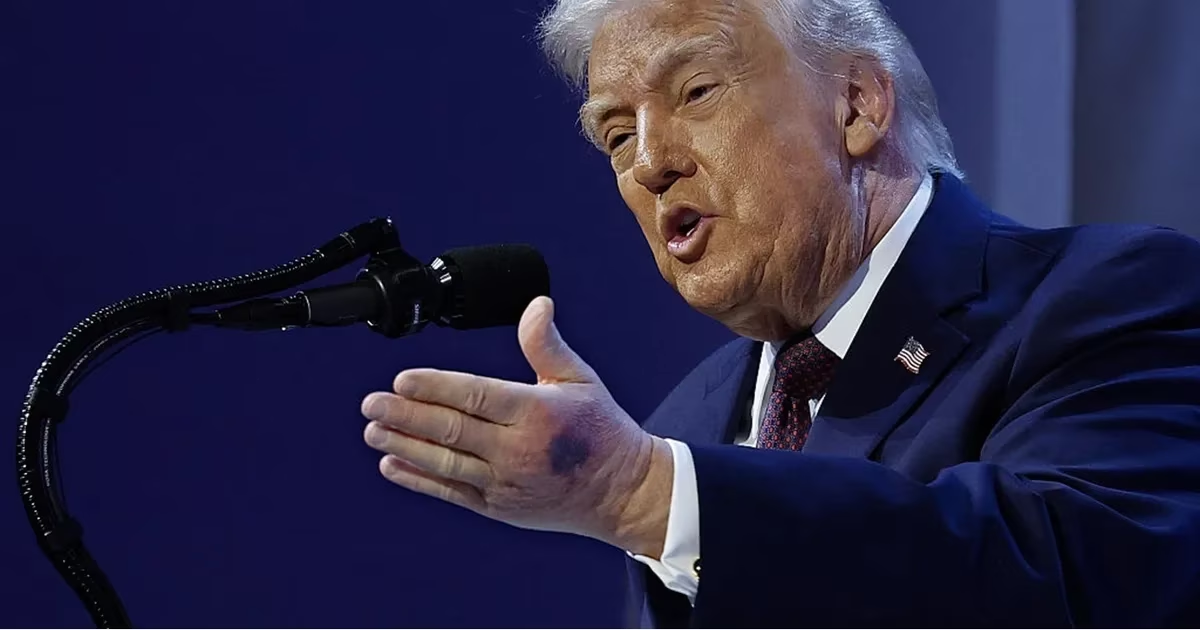
Media sources reported claims by Omani political analyst Salem Al-Jahouri that US President Donald Trump made exorbitant financial demands on Gulf states in exchange for continued military operations against Iran. Al-Jahouri explained that the requested amounts reached 5 trillion dollars to continue the war, or 2.5 trillion dollars if they wished to end it, without specifying the time or place where these demands were made.
In a related context, the General Secretariat of the Gulf Cooperation Council has not issued any official comment confirming or denying these circulating reports about the funding. These developments come at a sensitive time when the region is witnessing unprecedented military escalation, as Gulf states seek to deal with the repercussions of a direct confrontation between Washington and Tel Aviv on one hand, and Tehran on the other.
On the diplomatic front, recent documents revealed a collective Gulf move to request an emergency session of the United Nations Human Rights Council in Geneva. This step aims to discuss Iranian attacks that targeted civilian facilities and energy infrastructure in several Arab countries, considering these aggressions a serious threat to international peace and security and human rights.
On the ground, the joint military campaign launched by the United States and Israel on Iranian territory entered its third week, amidst violent Iranian reactions that included the launch of ballistic missiles and drones. These attacks targeted objectives in Bahrain, Kuwait, Saudi Arabia, the UAE, and Oman, causing significant material damage to vital energy sectors.
The ongoing military operations since late February have resulted in the killing of a number of senior Iranian leaders, most notably Supreme Leader Ali Khamenei and prominent security officials. In return, Tehran continues to target what it describes as American interests in the region, which has resulted in civilian casualties and sparked a widespread wave of condemnation from affected Arab countries.
Economically, Tehran's closure of the strategic Strait of Hormuz caused severe disruptions in global energy markets, with prices soaring to record levels. Economic reports warned that continued obstruction of maritime navigation and attacks on oil facilities would lead to an uncontrollable global inflation wave, putting additional pressure on international powers to end the conflict.
For its part, the US administration added the protection of allies in the Middle East as a fifth and main objective of its military operations, in addition to preventing Iran from acquiring nuclear weapons and destroying its ballistic capabilities. While Trump demands unconditional surrender, discrepancies emerge in American statements about the timeline of the operation, between those who see it as a short preemptive strike and those who expect it to continue for a long period.
Trump asked Gulf states to pay 5 trillion dollars if they wanted the war on Iran to continue, or 2.5 trillion dollars if they wanted to stop it.
שתף את דעתך
News of Trump demanding billions of dollars from Gulf states to fund war on Iran