






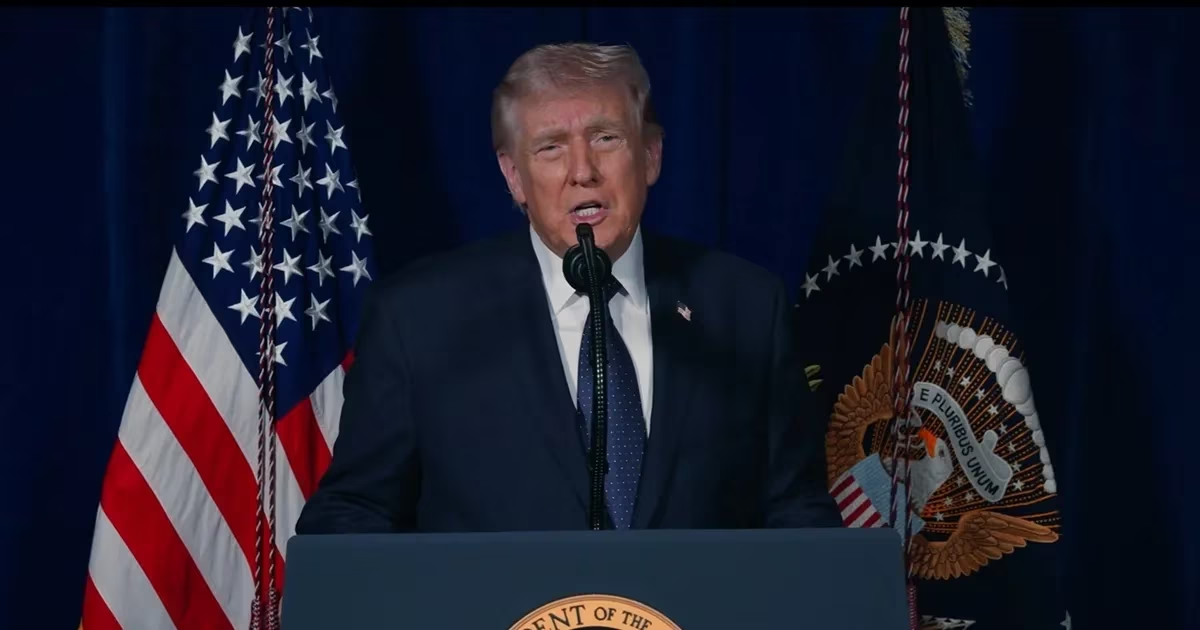
The slogan 'Make America Great Again' (MAGA) has historical roots dating back to the era of the late President Ronald Reagan, before Donald Trump revived it as a cornerstone of his election campaigns. This slogan reflects an American desire to restore economic control, which began to falter since the discovery of the 'dollar trick' in the 1970s, when countries around the world realized that Washington was printing its currency without real gold backing.
French President Charles de Gaulle's stance in 1970 was a major turning point when he refused to exchange gold for American paper, threatening the collapse of the American economy had it not been for the intervention of oil-producing nations. Through the 'petrodollar' agreements, energy sales were linked to the American currency, giving Washington a lifeline that lasted for decades, enabling it to exert wide global influence.
Current American policies, especially among the neoconservative movement, are based on the philosophy of Leo Strauss, who legitimizes what is called 'natural tyranny'. This school of thought believes that a powerful elite has a natural right to rule the majority and control the destinies of peoples, which explains the successive administrations' reliance on military force to secure energy sources and rare minerals.
The intensity of this 'tyranny' increases as the United States feels its global position declining and rival powers like China emerge, threatening the American economic throne. Observers point out that the existential panic over the decline of the American star is pushing Washington to impose exorbitant tariffs and attempt to 'siphon' money from other countries to cover the public debt deficit, which has exceeded $38 trillion.
Former National Security Advisor Zbigniew Brzezinski, in his book 'Second Chance,' warned against squandering historical opportunities to lead the world, calling for building alliances with competitors. However, American presidents chose to ignore these recommendations, preferring to build a massive military arsenal and control strategic passages under flimsy pretexts such as weapons of mass destruction or combating terrorism.
In the Middle East, Israel stands out as a primary arm of this policy, as Washington seeks to transform it into a regional superpower dominating its neighbors. The Israeli government, led by Benjamin Netanyahu, adopts the theory of 'power care,' asserting that diplomatic agreements are only achieved through overwhelming military and technological superiority.
The features of this alliance are evident in Trump's decisions that granted Israel sovereignty over the occupied Syrian Golan, a move reflecting the logic of 'giving' to those who do not own. Statements by American officials, such as Ambassador Mike Huckabee, also reinforce this trend by invoking biblical texts to justify the occupation of Palestinian and Arab lands between the rivers.
The current confrontation with Iran is a new link in a series of wars aimed at reshaping the Middle East to serve common Israeli and American interests. This plan seeks to strip the region's countries of any real defensive capabilities, while maintaining Israeli nuclear superiority as the sole guarantee for controlling the so-called 'New Middle East'.
Despite these ambitions, the Trump administration faces sharp internal divisions, even within the 'MAGA' movement itself, due to entanglement in Netanyahu's regional wars. A segment of supporters believes that returning to foreign wars represents a betrayal of the 'America First' promises that advocated avoiding international conflicts and focusing on domestic affairs.
Ultimately, the conflict between the will of 'tyranny' and global historical transformations remains, as the world no longer easily accepts unilateral hegemony. While Trump and Netanyahu try to impose a new reality by force, global public opinion realizes that regional stability cannot be built on the ruins of peoples' sovereignty and historical rights.
The right of the powerful to rule is a principle derived from ancient philosophies that grant the elite the right to control and suppress the common people.
שתף את דעתך
The Philosophy of 'Tyranny' in American Politics: Is 'MAGA' Rebuilding Hegemony Through Force?