






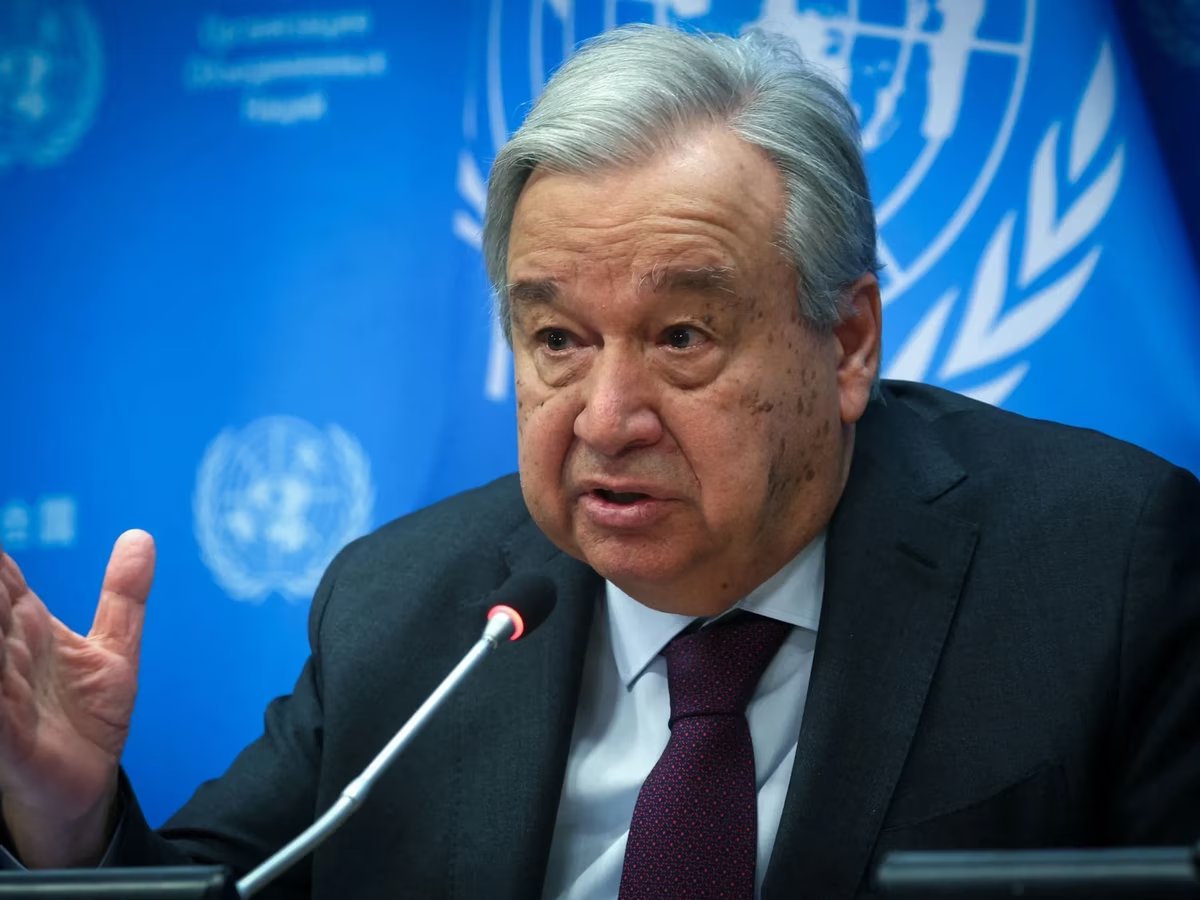
The Secretary-General of the United Nations, António Guterres, revealed the international organization's aspirations to play a pivotal role in defusing escalating tensions in the Gulf region. Guterres clarified that the UN is considering launching an initiative aimed at protecting freedom of navigation in the Strait of Hormuz, thereby ensuring the stability of global energy supplies and avoiding direct military confrontations.
Guterres indicated in press statements that the UN is currently conducting intensive contacts with key stakeholders, including the Gulf Cooperation Council and the European Council. These moves aim to build international consensus supporting a comprehensive plan to de-escalate tensions in the strategic waterway, which is witnessing unprecedented tensions.
The Secretary-General cited the success of the UN's previous mediation in the 'Black Sea Initiative,' which enabled the export of grain and fertilizers during the Russian-Ukrainian conflict. Guterres believes that applying a similar model in the Strait of Hormuz may be the only way to secure the passage of commercial ships away from political and military tug-of-wars.
Guterres affirmed the existence of specialized working groups specifically established to study the mechanisms for implementing this initiative on the ground. However, he stressed that the organization prefers direct work and close coordination with the United States and other international powers to ensure the success of any future agreement concerning navigation security.
Regarding communication with the American administration, Guterres denied holding any direct talks with President Donald Trump since the outbreak of military confrontation with Iran. He clarified that he is currently content with communicating with other officials within the American administration, without disclosing their identities or the nature of the issues being discussed.
The Secretary-General warned that recent US military strikes against Iranian targets are consistent with a strategy seeking to draw Washington into a wide regional war. He considered that this goal has already been achieved, leading to a complex overlap in regional and international strategies in the Syrian, Iraqi, and Iranian arenas.
Guterres believes that the key to ending the current crisis remains in the hands of the White House, where an American decision to halt military operations could open the door to a comprehensive de-escalation. He added that President Trump has the ability to convince the concerned parties that military objectives have been achieved, paving the way for a diplomatic path.
These UN moves come after Tehran's decision in early March to restrict navigation in the Strait of Hormuz, in response to what it described as American-Israeli aggression. Iranian authorities threatened to target any ship attempting to cross the strait without prior coordination, raising widespread international concern about the future of oil trade.
The Strait of Hormuz is a vital artery for the global economy, with approximately 20 million barrels of oil passing through it daily, representing a large share of global consumption. The recent tension has led to a jump in shipping and insurance costs, as well as a significant rise in global energy prices, threatening an economic recession.
In a separate context, Guterres touched upon the 'Peace Council' recently launched by President Trump, welcoming its stated goal of funding the reconstruction of the Gaza Strip. He affirmed that the UN is actively cooperating with the Council's affiliated structures on aspects related to building homes and Palestinian infrastructure destroyed by the war.
Despite this cooperation, Guterres described the 'Peace Council' as a 'personal project' of the American President, in which he exercises complete control over all decisions. He expressed reservations about this approach, considering that it may not be the most effective way to address serious international crises that require institutional action.
Guterres concluded his remarks by emphasizing the need to adhere to international law and the principles of the UN Charter in any peace initiative that is put forward. He affirmed that these values remain the basis for any sustainable solution, noting that the UN will remain committed to its role as a guarantor of international legitimacy despite the challenges posed by individual initiatives.
My main goal is to find out if it is possible to create conditions in the Strait of Hormuz similar to what they were in the past through an international initiative.
שתף את דעתך
Guterres proposes international initiative to secure Strait of Hormuz and welcomes 'Peace Council' role in Gaza reconstruction