






The American administration is currently considering a range of escalatory options against the Islamic Republic of Iran, prominent among them being the possibility of direct control over Kharg Island or imposing a tight military blockade on it. These moves come within the framework of pressures aimed at reopening the Strait of Hormuz and ensuring the flow of international navigation, as revealed by international press reports today, Friday.
Military sources reported that current field movements reflect an American readiness for advanced combat scenarios, which may include conducting amphibious landings at strategic locations. Kharg Island is considered a vital target due to its being the main artery for Iranian oil exports, making its control a devastating blow to the Iranian national economy and the state's ability to finance itself.
In the context of reinforcements, a group of amphibious ships departed from the west coast of the United States heading towards the region, comprising about six combat ships and approximately 8,000 soldiers. These units have also been equipped with 'F-35' aircraft, attack helicopters, and advanced missile systems to ensure qualitative superiority in any potential confrontation.
The arrival of approximately 2,200 US Marines to the region reinforces the hypothesis of preparation for limited-scale ground operations. Despite official statements denying any immediate intention for ground intervention, observers see this as part of Washington's 'strategic ambiguity' policy to keep all options open for decision-makers.
Any military landing operation requires achieving complete and absolute air control, which is what continuous airstrikes targeting military infrastructure and air defense systems aim for. However, Iranian defenses have shown an ability to create field surprises, most notably the targeting of a fifth-generation aircraft, which puts American military technology to a real test.
Tehran relies on an unconventional warfare doctrine in confronting external threats, aiming to draw attacking forces into a long-term war of attrition. This strategy could inflict significant human and material losses on US forces if they decide to proceed with the option of ground intervention or establish permanent presence points within Iran's complex geography.
Over the past three weeks, US and Israeli forces have intensified their airstrikes targeting missile launch platforms and vital ammunition depots. Despite the intensity of these attacks, reports indicate that they have not yet succeeded in fully neutralizing Iranian missile capabilities, as Tehran still retains the ability for precise and effective retaliation.
Newly developed missiles have entered the confrontation arena, including the 'Nasrallah' missile, which has a range of up to 2,000 kilometers and a superior ability to maneuver and resist electronic jamming. This qualitative development in the Iranian arsenal raises the cost of any military adventure targeting vital facilities and makes the protection of American bases in the region an extremely difficult task.
The American-Israeli target bank has undergone a radical shift in the recent phase, moving from targeting traditional military sites to striking infrastructure and economic facilities. The scope of operations has also expanded to include distant areas such as the Caspian Sea, in an attempt to cut strategic supply lines and tighten the military and political noose on the Iranian leadership.
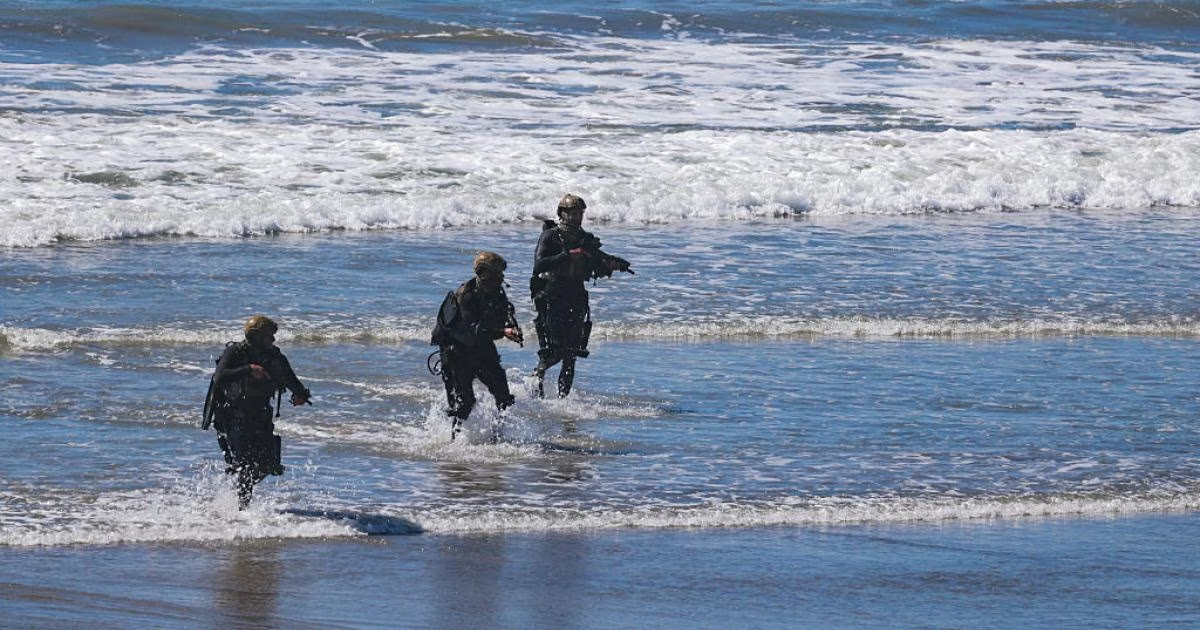
US military movements reflect a readiness for advanced field scenarios, including the possibility of an amphibious landing on the strategically important Kharg Island.
שתף את דעתך
Ground Intervention Scenarios: Is Washington Planning to Seize Iran's Kharg Island?