






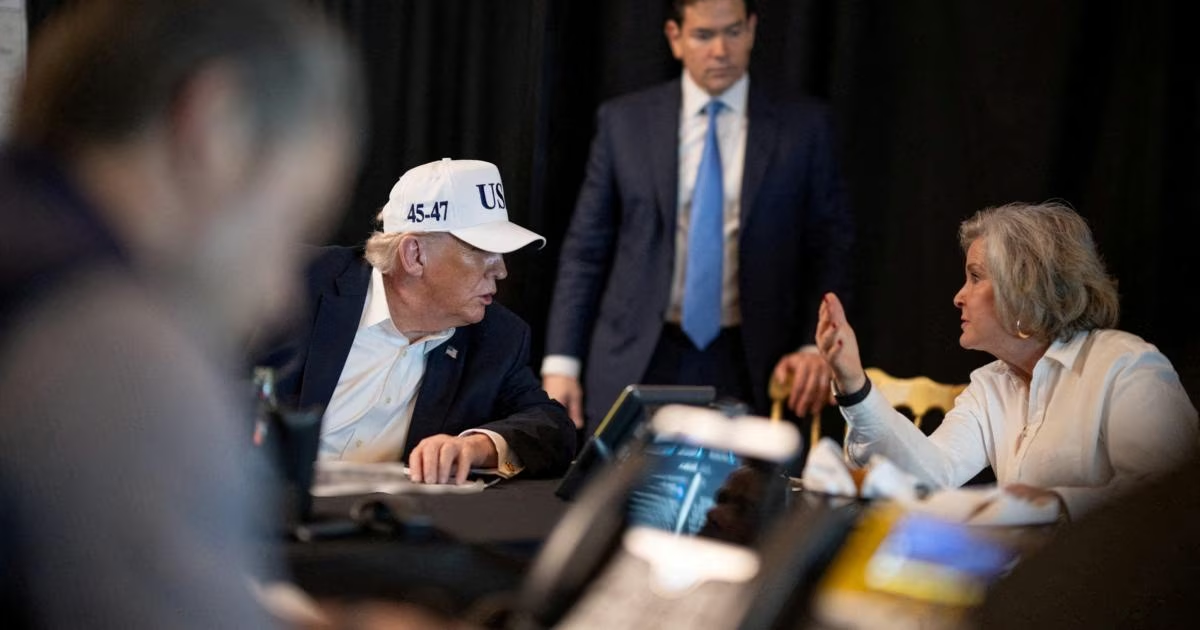
The White House is experiencing a sharp division among President Donald Trump's advisors on how to manage the military confrontation with Iran and determine the appropriate moment to declare objectives achieved. Sources indicate that this divergence comes as the President continues to adjust his public stances on the course of the conflict and its timing.
Economic concerns top the agenda for a team of advisors who warn of the dire consequences of continued war on global energy markets. Officials at the Treasury Department and the National Economic Council believe that a steady rise in fuel prices could erode public support for military operations within the United States.
In contrast, a hardline faction within the administration and the Republican camp is strongly pushing to continue military operations under the name 'Saga of Fury'. This approach is led by prominent lawmakers such as Lindsey Graham and Tom Cotton, who believe that any retreat now would give Tehran an opportunity to restore its nuclear and military capabilities.
President Trump's recent statements reflect this hesitation, as he shifted from discussing broad strategic goals to describing the campaign as limited and having achieved most of its objectives. Despite declaring 'victory' at a rally in Kentucky, he later re-emphasized in closed meetings the necessity of not ending operations quickly to ensure 'the job is finished'.
Reports indicate that White House Chief of Staff, Susie Wiles, and her deputy, James Blair, are inclined to narrow the scope of declared objectives and present the operation as a swift campaign nearing its end. This approach aims to protect the administration's political standing from any economic shocks that might result from disruptions to oil supplies through the Strait of Hormuz.
The American strategy faces field challenges related to the nature of the asymmetric warfare waged by Iran, which relies on targeting the global financial system and shipping traffic. Approximately 20% of global oil supplies pass through the Strait of Hormuz, making any threat to this waterway a major shock to the international economy.
Financially, there is a huge gap in the cost of the confrontation, with daily US operations estimated at about $1 billion, while Iran relies on low-cost weapons. An Iranian drone costs between $20,000 and $50,000, while the US military is forced to use interceptor missiles, each costing up to $2 million.
Despite US claims of destroying large parts of the Iranian fleet and reducing missile launch capabilities by 90%, there is concern about the 'alliance trap' strategy. Through this strategy, Iran aims to prolong the conflict to exhaust the US military budget, which stands at $886 billion.
Political advisors warn that continued conflict could turn the 'Saga of Fury' into a long-term attrition similar to the military interventions Trump promised to avoid. These advisors are trying to persuade the President of the need to formulate a 'victorious exit' that preserves the prestige of the United States, even if the Iranian leadership remains in power.
For her part, White House spokeswoman, Caroline Leavitt, described reports of divisions as mere 'speculation and rumors' from unknown sources. Leavitt affirmed that President Trump is the ultimate decision-maker and that he listens to multiple opinions to ensure the full achievement of the ongoing military operation's objectives.
Lawmakers in Congress are cautiously monitoring the course of operations, with hawks believing that now is the most opportune time to deliver a decisive blow to prevent Tehran from developing a nuclear weapon. They believe that any de-escalation at this time would be interpreted as American weakness in the face of attacks targeting vital interests in the region.
Gasoline prices at American stations remain the most sensitive indicator for the White House operations room as political deadlines approach. American political history proves that rising living costs associated with foreign wars often lead to a sharp decline in the popularity of the incumbent president.
Under these varying pressures, the US administration appears to be seeking a delicate balance between demonstrating military power and maintaining economic stability. The question in Washington's corridors remains: when and how will Trump decide to end the 'Saga of Fury' without it appearing to be a retreat from his electoral promises?
President Trump emphasized during closed discussions his unwillingness to withdraw early, stressing the necessity of completing the military mission entirely.
שתף את דעתך
White House Divided Over 'Saga of Fury': Economic Fears Clash with Desire to 'Finish the Job' Against Iran