






The Gulf region witnessed an unprecedented military escalation on Wednesday, as Iranian armed forces carried out a series of coordinated attacks targeting strategic locations and American military bases. These developments come in the context of Tehran's direct confrontation against American and Israeli interests in the region, amidst continuous threats to close the Strait of Hormuz.
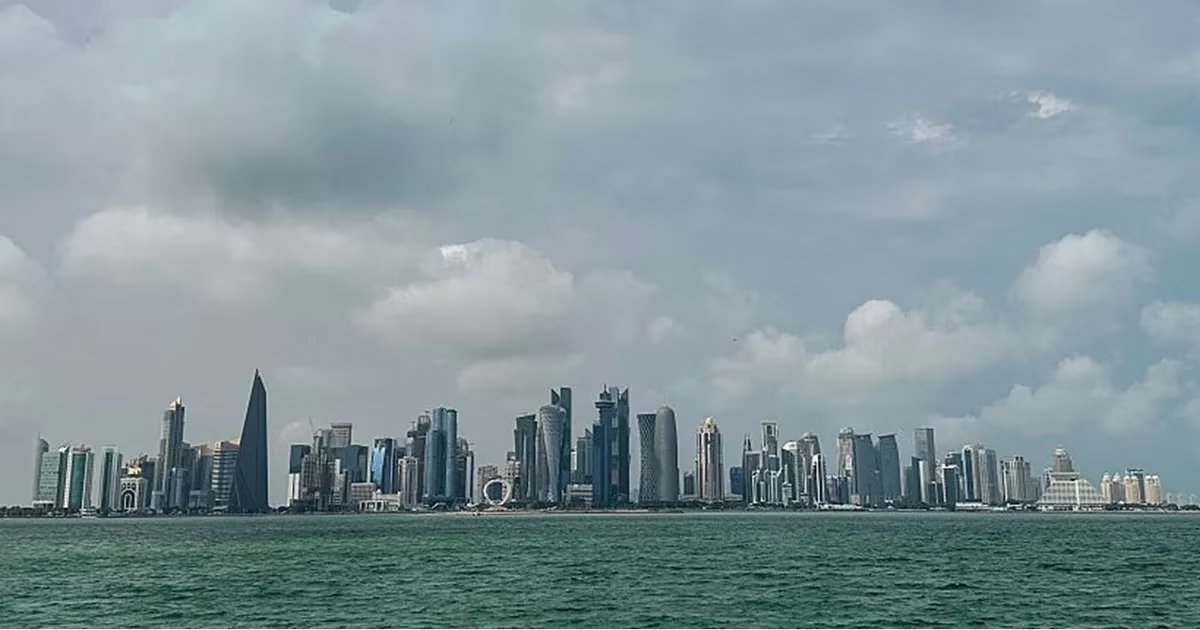
In the Qatari capital, Doha, violent explosions were heard due to a missile attack, which the Qatari Ministry of Defense confirmed was intercepted by air defense platforms. For its part, the Qatari Ministry of Interior raised the security threat level to maximum, calling on citizens and residents to stay indoors and away from windows to ensure their safety.
On the Saudi side, the Ministry of Defense announced the interception and destruction of a wave of drones that targeted the strategic Shaybah oil field located in the Empty Quarter. Sources clarified that air defenses managed to shoot down seven drones in separate incidents, confirming the protection of the facility managed by Aramco, which is a fundamental pillar of oil production.
The attacks were not limited to drones but also included the launch of seven ballistic missiles targeting the Eastern Province and Prince Sultan Air Base in Al-Kharj Governorate. Saudi defense systems successfully intercepted these missiles before they reached their targets, amid a widespread military alert at the Kingdom's air bases.
In the UAE, the Ministry of Defense announced dealing with missile attacks and drones coming from Iranian territory. The Dubai Government Media Office reported the fall of two drones in the vicinity of Dubai International Airport, resulting in injuries of varying degrees to four people of Asian and African nationalities, while confirming the regularity of air traffic.
Sultanate of Oman also entered the circle of events, as security sources reported the downing of one drone and the fall of another into the sea waters north of Duqm province. The Sultanate expressed its strong condemnation of the continuous targeting operations, affirming that it is taking all necessary measures to protect its national security and the safety of residents on its territory.
For its part, the Iranian Revolutionary Guard officially announced the implementation of the thirty-sixth wave of Operation 'True Promise 4'. The statement issued by the Guard clarified that the attacks targeted the 'operational infrastructure' of the American army in Bahrain, Qatar, Kuwait, and Iraq, using advanced 'Qader' and 'Kheibar Shekan' missiles.
Iranian reports confirmed that the missiles directly targeted the headquarters of the US Fifth Fleet in Bahrain, Al Udeid Air Base in Qatar, and Al Adairi Base in Kuwait. The attacks also included Harir Base located in northern Iraq, in an attempt to disrupt the operational capabilities of American forces stationed at those bases.
In the waters of the Strait of Hormuz, international navigation was subjected to severe blows, as maritime security agencies reported that three commercial vessels were hit by unknown projectiles. One of the attacks led to a massive fire on board a Thai cargo ship named 'Mayuree Naree' 11 nautical miles north of the Sultanate of Oman.
The Japanese container ship 'ONE Majesty' also sustained minor damage as a result of an unknown projectile while sailing northwest of Ras Al Khaimah. Security sources confirmed that the ship's crew was safe and that it headed to a safe anchorage to assess the damage, while concern continued among global shipping companies.
The third ship targeted was the cargo tanker 'Star Gwyneth', flying the flag of the Marshall Islands, whose hull was hit directly northwest of Dubai. Maritime risk management companies stated that the attack did not result in injuries among the crew, but it increased the complexity of the security situation in the vital waterway.
Navigational data indicates a sharp and rapid decline in ship traffic through the Strait of Hormuz since the start of the recent conflict in late February. This strait is a major artery for the global economy, through which about one-fifth of the world's daily oil and gas supplies flow.
Observers believe that Iran's use of 'Emad' and 'Kheibar Shekan' missiles represents a clear message of defiance to the region's defensive capabilities. Tehran claims that these operations are in response to American and Israeli movements, affirming that it will not stop targeting interests associated with them until attacks on its territory cease.
With the number of targeted ships reaching at least 14 since the outbreak of confrontations, international fears are escalating that the conflict will spiral out of control. Major capitals are cautiously monitoring the repercussions of this escalation on global energy prices and the stability of supply chains passing through the Arabian Gulf region.
The competent authorities confirmed the fall of two drones in the vicinity of Dubai International Airport, causing minor to moderate injuries to four people, with air traffic continuing normally.
שתף את דעתך
Widespread Iranian Military Escalation Targets American Bases, Gulf States, and Ships in the Strait of Hormuz