






March 12, 2026
News Analysis
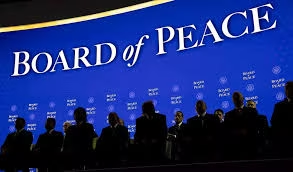
Washington, D.C-Last week, I posed a straightforward question to a senior American official: What is the status of the administration’s “Board of Peace” initiative for Gaza? Has it been shelved?
The response came quickly and with confidence: No. The effort continues.
Yet the reality unfolding across the Middle East suggests otherwise.
Behind the reassuring language coming from Washington, the diplomatic machinery meant to advance President Donald Trump’s plan to end the war in Gaza appears largely stalled.
Informed sources say negotiations intended to move the plan forward faltered last week, just as the region entered a far more dangerous phase following the joint United States–Israeli military strike against Iran.
That escalation has ignited a broader regional confrontation and, with it, a sharp shift in priorities.
The Gaza initiative—once presented by the administration as a central pillar of its regional diplomacy—now appears increasingly overshadowed by the urgent demands of a widening conflict.
From the outset, however, the initiative struggled to gain meaningful international traction.
Even before the current escalation, the so-called Board of Peace had failed to generate broad diplomatic backing among key regional and international actors whose support would be essential for any sustainable postwar arrangement in Gaza.
Several governments privately questioned both the structure of the initiative and Washington’s ability to deliver the political conditions necessary for its success.
Analysts were skeptical from the beginning. Even as Trump unveiled the “Board of Peace” initiative during his appearance at the World Economic Forum in January, some regional experts quietly dismissed the proposal as stillborn. A plan built around the voluntary disarmament of Hamas—without a broader political settlement, credible enforcement mechanisms, or clear buy-in from major regional stakeholders—was unlikely to gain traction. The initiative, they warned at the time, risked becoming another diplomatic concept announced with fanfare but lacking the political conditions necessary to survive.
Before the current escalation, the administration had nevertheless invested considerable diplomatic energy in trying to build a political framework for Gaza around that idea.
At the core of the proposal was a controversial but pragmatic concept: persuading Hamas fighters to surrender their weapons in exchange for rebuilding Gaza and granting a broad amnesty.
Supporters argued that disarmament could unlock large-scale reconstruction and eventually allow a gradual Israeli withdrawal from the devastated enclave.
According to sources familiar with the effort, White House intermediaries had quietly facilitated indirect contacts between Israel and Hamas through regional mediators.
Those delicate discussions focused primarily on the mechanics of disarmament and the political arrangements that might follow.
But the talks came to an abrupt halt when the military confrontation with Iran began on February 28.
Publicly, the administration insists that nothing fundamental has changed.
A White House official rejected suggestions that negotiations had been suspended, maintaining that discussions on disarmament are continuing and remain constructive.
According to the official, mediators still believe resolving the weapons issue is essential to unlocking the billions of dollars pledged for Gaza’s reconstruction.
Officials associated with the administration’s so-called Peace Council also downplay the significance of the pause, portraying it as little more than a temporary logistical interruption.
They say disruptions to regional air travel prevented mediators from reaching Cairo, where several rounds of negotiations had previously taken place.
Some officials even argue that the current war could ultimately strengthen the peace effort.
If Iranian influence across the region weakens, they contend, the financial and military networks sustaining Hamas could erode as well.
In theory, that might make the question of disarmament easier to resolve.
Regional officials, however, offer a far less optimistic assessment.
A Palestinian source involved in mediation confirmed that a meeting between Hamas leaders and mediators from Egypt, Qatar, and Turkey had been scheduled for the very day the war erupted.
The meeting never happened.
It was abruptly canceled as the regional situation deteriorated, and no alternative date has been announced.
Another Hamas official confirmed that talks tied to the Trump initiative have effectively been suspended for now, though he declined to elaborate on the reasons.
The Israeli government, for its part, has provided no clear public explanation regarding the status of the negotiations.
In diplomacy, silence often speaks volumes.
Even as officials insist that some form of conversation continues, the broader diplomatic architecture supporting the initiative appears to be shrinking.
Foreign diplomats say the United States–led civil-military coordination center that had been overseeing implementation of the plan from southern Israel has sharply reduced its operations.
Staffing and activity have reportedly been scaled back to a minimum amid concerns about possible Iranian missile strikes.
The strategic reality is difficult to ignore: Washington’s attention is now overwhelmingly focused on managing the confrontation with Tehran.
In that environment, Gaza inevitably slips lower on the list of urgent policy priorities.
Yet developments on the ground continue to carry serious consequences.
Israeli officials maintain that the disarmament of armed factions in Gaza remains non-negotiable, warning that military operations could intensify if no agreement is reached.
Israeli airstrikes inside the enclave have continued intermittently, even as Israel remains engaged on other regional fronts.
Only a few months ago, the administration’s Gaza initiative appeared to be gathering tentative momentum.
A ceasefire reached last October reduced violence and allowed several border crossings to reopen.
Regional governments—particularly wealthy Gulf states—signaled their readiness to contribute billions of dollars toward reconstruction if a sustainable political arrangement could be achieved.
But that fragile diplomatic momentum now appears to have dissipated under the pressure of a widening regional war.
Peace initiatives rarely survive the shock of major military confrontation, especially in the Middle East.
Negotiations require time, political attention, and sustained diplomatic focus—resources that quickly become scarce once missiles begin crossing the region.
Which brings us back to the question I asked the American official.
Officially, the Board of Peace still exists, at least on paper. In practice, however, the initiative appears adrift—overtaken by war, regional escalation, and the strategic realities that it struggled to overcome even before the current crisis.
For now, the Gaza peace track has not been formally declared dead.
But it is unmistakably missing from view.
שתף את דעתך
The Board of Peace Gone Missing