






US military movements in the Middle East have seen a notable escalation with Washington deploying qualitative air reinforcements, represented by the deployment of a squadron of advanced 'F-16 Fighting Falcon' fighter jets. These aircraft belong to the 169th Fighter Wing of the South Carolina Air National Guard and have been observed en route to the region to bolster military presence near Iran.
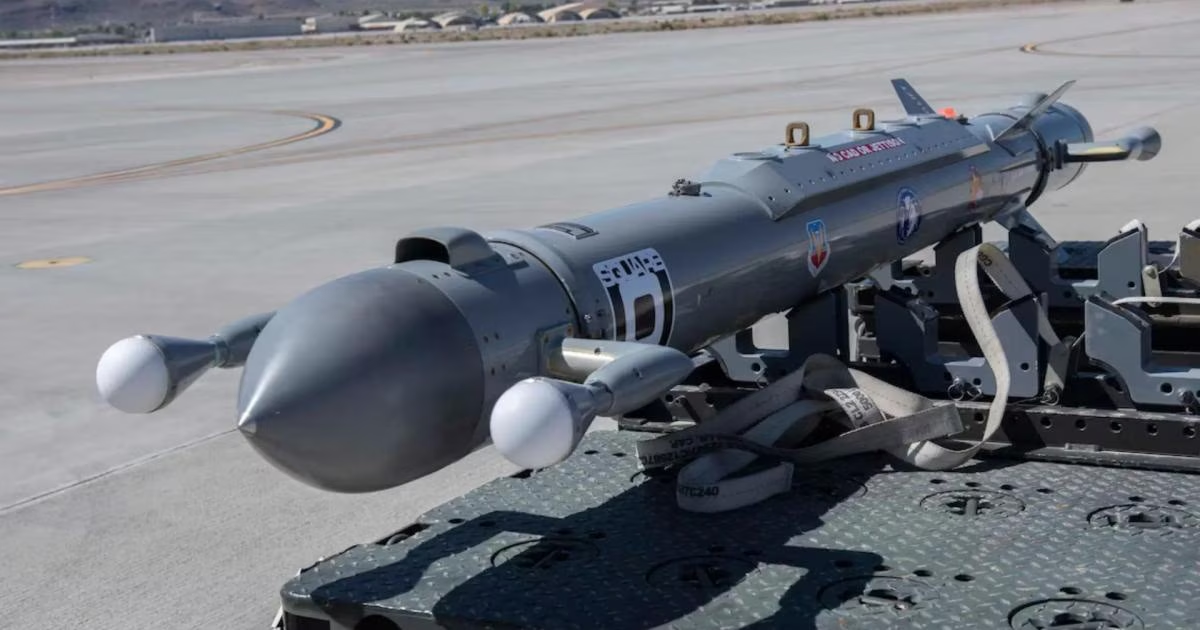
What distinguished this deployment was the equipping of the fighter jets with advanced electronic warfare pods known as 'Angry Kitten'. Air traffic observers documented the passage of 12 'F-16CJ Block 52' fighter jets through Lajes Airport in the Portuguese Azores, where the pods were clearly visible mounted under the aircraft's fuselage.
This field movement comes in the context of increasing diplomatic and military rhetoric between Washington and Tehran, with repeated American hints of resorting to force. This step reflects American readiness for direct confrontation scenarios should negotiations regarding regional and nuclear issues reach a dead end.
Technically, the 'Angry Kitten' system is known as an advanced development of the 'AN/ALQ-167' electronic warfare pod, primarily aimed at protecting aircraft in complex combat environments. This system was specifically designed to counter surface-to-air missile systems that rely on advanced radars to track and target their objectives.
Unlike traditional jamming systems that merely broadcast wide electronic noise, the 'Angry Kitten' system features intelligent adaptive capabilities that allow it to deal with threats with high flexibility. It works by detecting hostile radar signals and classifying them with extreme accuracy before digitally processing them to neutralize their effect.
At its core, the system relies on 'Digital Radio Frequency Memory' (DRFM) technology, which allows it to capture hostile radar pulses and re-transmit them after modification. This action creates phantom targets and misleading trajectories on hostile radar screens, making the process of tracking the American fighter jet almost impossible.
The true strength of this system lies in its ability to update rapidly during a combat mission, without the need for complex programming operations at ground bases. This approach reflects the Pentagon's desire to possess electronic warfare tools capable of immediate response to sudden shifts in the aerial battlefield.
Although the system has undergone extensive development and testing since 2017, its use has been limited to training and military exercises. Previous tests included various platforms such as 'A-10' attack aircraft and 'MQ-9 Reaper' drones, in addition to naval fighter jets.
The appearance of this technology now in actual operational missions in the Middle East represents a strategic shift indicating the system's full combat readiness. Observers believe that Washington has decided to move this technology from development laboratories to the front lines as a clear deterrent message to the Iranian side.
'F-16CJ' aircraft participating in this deployment specialize in 'suppression and destruction of enemy air defenses' missions, which are exceptionally dangerous operations. These missions, historically known as 'Wild Weasel', require a high ability to lure hostile radars and then destroy them using anti-radiation missiles.
Should a military confrontation erupt, these fighter jets will be in direct confrontation with the Iranian air defense network, which includes Russian 'S-300' systems and domestically produced systems. Hence, the importance of 'Angry Kittens' in providing an electronic protection umbrella that enables pilots to penetrate fortified airspace and carry out precise strikes.
Despite the Pentagon's silence regarding the precise combat details of this deployment, the field message appears clear and firm. The United States is enhancing its defensive and offensive options with the latest electronic warfare technology to ensure air superiority in any potential conflict in the region.
The appearance of the 'Angry Kitten' system on board aircraft designated for actual operational missions represents an important indicator of its transition from the development phase to full combat readiness.
שתף את דעתך
Washington deploys 'Angry Kittens' to the Middle East: Qualitative air reinforcements to counter Iranian threats