







Washington – Said Arikat – 2/25/2026
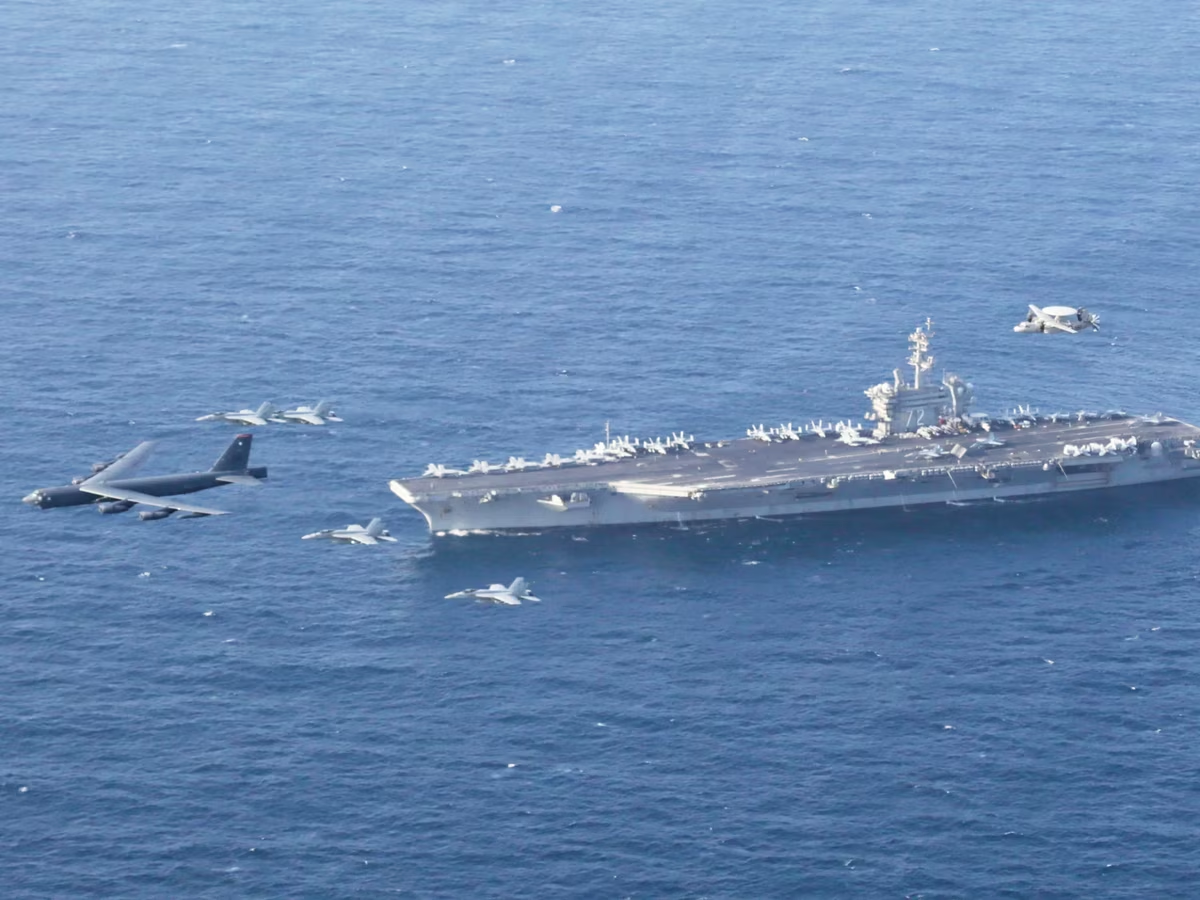
In a highly sensitive regional moment, recent military movements reveal a scene that goes beyond mere traditional "deterrence messages." Israeli media reported the arrival of American F-22 Raptor stealth jets at an airbase in southern Israel, after they had been stationed at RAF Lakenheath in the United Kingdom. According to flight tracking data, 12 aircraft took off, one of which returned due to a technical malfunction, while the rest continued their journey to the Middle East in a rare show of force in its nature and timing.
This coincides with reports published by The New York Times, based on satellite images and navigation data, indicating the presence of more than 60 attack aircraft at Muwaffaq Salti Air Base in Jordan, in addition to dozens of transport aircraft that have landed since mid-February. The latest F-35 jets were also spotted, along with drones, helicopters, and new air defense systems. Reuters, in turn, pointed to a large buildup at Al Udeid Air Base in Qatar.
This buildup, said to be the largest since the 2003 invasion of Iraq, coincides with nuclear negotiations expected to resume in Geneva, where Iranian Foreign Minister Abbas Araghchi received a green light to present a counter-proposal to the American team. However, the diplomatic path seems surrounded by unprecedented escalatory language from US President Donald Trump, who has repeatedly threatened a military strike if talks fail.
Ironically, Trump finds himself today in a political and strategic predicament. He believed, as he expressed in an interview on Fox News, that a show of force of this magnitude would compel Iran to submit and accept American terms. This assessment was also echoed by negotiator Steve Witkoff on the same channel, when he indicated that Tehran was only "one week" away from possessing fissile material suitable for a nuclear weapon, a phrasing reminiscent of previous narratives used to justify military escalation.
But the political "shock and awe" gamble does not seem to be achieving the desired results. Iran has shown no signs of backing down; instead, it responded by striking Israeli and American targets in the region, reflecting a willingness to bear risks. Here lies the dilemma: the higher the military buildup, the narrower Trump's political maneuvering room, and retreat becomes costly domestically and internationally. Trump's statements that a military confrontation would be "easy" if the decision were made, involve an oversimplification of a complex theater of operations, where American bases and allied forces are within direct firing range.
Israel, for its part, conveys through its media the conviction that an American strike is inevitable, and that military coordination is at its highest levels. Channel 12 quoted an official as saying that reaching a diplomatic solution would be the "surprise of the year." Such rhetoric creates a dynamic of mutual pressure: Washington does not want to appear hesitant, and Tel Aviv does not want to miss what it considers a historic moment.
In Washington, there is speculation that Trump may have preferred to wait until after his State of the Union address before launching any strike, so that a sudden military event would not overshadow his domestic message, or be interpreted as a distraction from his economic priorities. Postponing the decision until after the annual platform might give him room to prepare public opinion, or to show that the military option came after exhausting the diplomatic path.
Ultimately, it appears that the US administration has shifted from an economic "maximum pressure" policy to a military "maximum pressure" policy, without a guarantee that the other side will read the message as Washington intends. If the goal is to impose a deal on better terms, then exaggerating the threat might make any subsequent settlement appear as a retreat, not an achievement.
The current crisis reflects a structural flaw in the mutual assessment of deterrence. Trump built his approach on the premise that Iran acts with a loss-aversion mentality, and that it would bow to a direct threat of crushing its nuclear and military infrastructure. But experience has shown that Tehran tends to absorb blows and reposition itself, considering steadfastness itself a political victory. The higher the ceiling of the American threat, the greater the domestic cost of Iranian retreat, and deterrence turns into an open test of wills, not a tool to close the path of escalation.
Notably, the discourse about "one week" to possess fissile material reproduces the logic of urgency that characterized previous crises in the Middle East. This type of statement pressures decision-makers to take quick steps before it's "too late," which shortens the time for diplomacy and reinforces the priority of the military option. In contrast, Iran may see this urgency as evidence of American confusion, and bet on the time factor and expanding its room for maneuver. Between Washington's urgency and Tehran's reliance on patience, the region stands on the brink of calculations where everyone might err.
שתף את דעתך
The higher the military buildup, the narrower Trump's political maneuvering room with Iran