






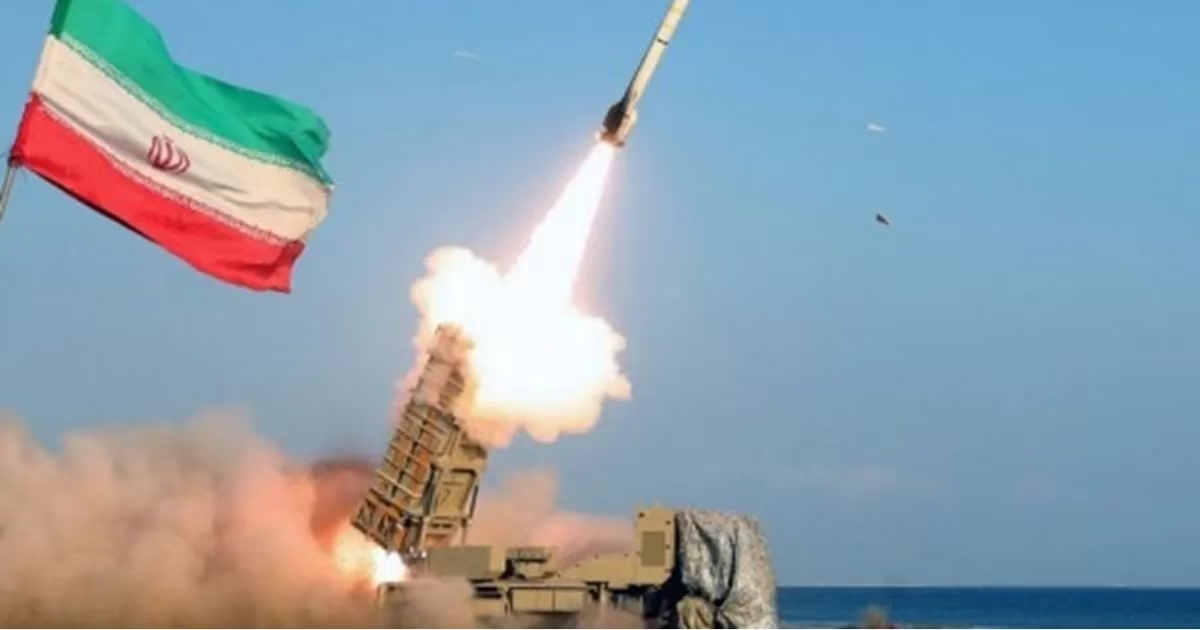
Questions are escalating in the White House corridors about the motives preventing Tehran from declaring its full surrender to the 'maximum pressure' policy pursued by US President Donald Trump. Diplomatic mediator Steve Witkoff revealed Trump's bewilderment at the Iranians' unwillingness to yield, despite unprecedented naval deployments and economic pressures aimed at forcing them to make fundamental concessions.
Observers believe that these statements may give Tehran an unintended negotiating advantage, as they show Trump in a position unable to enforce his threats that have been ongoing for months. While the American president aspires to conclude a historic agreement that surpasses what his predecessor Obama achieved, he finds himself stuck between the option of an all-out war, whose consequences he fears, and the failure of diplomatic persuasion efforts.
In a related context, Gulf academic predictions sparked widespread controversy about Iran's imminent acceptance of 90% of American conditions, which include reducing the nuclear program and dismantling ballistic missiles. However, the probabilities of a military attack remain high due to mutual distrust, reflecting the complexity of the political and military landscape in the region.
On the other hand, voices within the United States are emerging, advocating for the necessity of getting rid of the Iranian regime instead of negotiating with it, considering any agreement to be temporary and weak. This trend was highlighted by Trump's re-posting of videos calling for an end to the diplomatic path and focusing on regime change as the only solution to end the nuclear threat.
However, the military reality poses different challenges, as the Chairman of the US Joint Chiefs of Staff, General Daniel Kane, warned against sliding into a long-term conflict with Iran. This warning was met with a sharp response from Trump, who considered it 'fake news,' asserting that victory would be easy and guaranteed if a decision for military confrontation were made.
Recent American statements about Iran approaching nuclear bomb production within one week bring to mind the pretexts used before the invasion of Iraq decades ago. This verbal escalation paves the way for legitimizing any potential military strike that might target vital Iranian facilities before the assumed deadline.
On the ground, reports indicate unprecedented American military deployments in the region, including hundreds of fighter jets, aircraft carriers, and tens of thousands of soldiers. Despite the enormity of this force, military experts doubt its sufficiency to overthrow the regime or control the ground without the need for double the number of ground troops.
Iran's situation differs from the Iraqi experience in 2003 in terms of the absence of regional or internal support for any foreign military intervention. Moreover, the Iranian regime has shown an exceptional ability to use excessive force to suppress any internal rebellion, making the bet on its collapse from within during a war a risky endeavor.
Additionally, Iran possesses an alternative leadership structure, prepared in advance to deal with assassinations that may target its political or military figures. Tehran draws inspiration from Hezbollah's experience in Lebanon, which managed to quickly replace its senior leaders after a series of Israeli assassinations, ensuring the continuity of the chain of command.
US Secretary of State Marco Rubio summarized the secret of Iranian 'stubbornness' in the ideological dimension, noting that dealing with a leadership that makes its decisions based on religious foundations makes negotiations extremely complex. This ideological dimension gives the Iranian negotiator an ability to endure and maneuver that transcends traditional political calculations based on material profit and loss.
Furthermore, the model of resistance in the Gaza Strip stands out as a source of inspiration for Tehran and its allies in the region, where resistance factions have been able to withstand for two years against a massive military arsenal. This steadfastness reinforces the conviction among the Iranian leadership that advanced military technology does not always guarantee decisive battles against the will of peoples or nations with historical depth.
Iran is currently trying to avoid widespread destruction by offering 'acceptable' concessions in the nuclear file, provided that it is not deprived of its rights enjoyed by other countries in the region. However, American insistence on disarming all Iranian power cards puts the region on the brink, with only the option of retaliation or chaos looming.
Any large-scale military attack will necessarily lead to a re-production of backwardness and economic decline throughout the Middle East. This is what Netanyahu and his allies seek to achieve to ensure the absolute superiority of the Israeli occupation, far from any existential threats that rising regional powers might pose.
In conclusion, the scene remains open to all possibilities, between last-minute diplomacy and the drums of war beating strongly in Washington and Tel Aviv. The coming days will reveal whether Iran will succeed in weathering this storm, or whether the region is heading for a political and military earthquake that will change its face for many years.
They wonder why the Iranians haven't come to us to say that we don't want to possess nuclear weapons under this immense pressure.
שתף את דעתך
The Equation of Steadfastness and Confrontation: Why Does Tehran Refuse to Surrender to Trump's Pressures?