






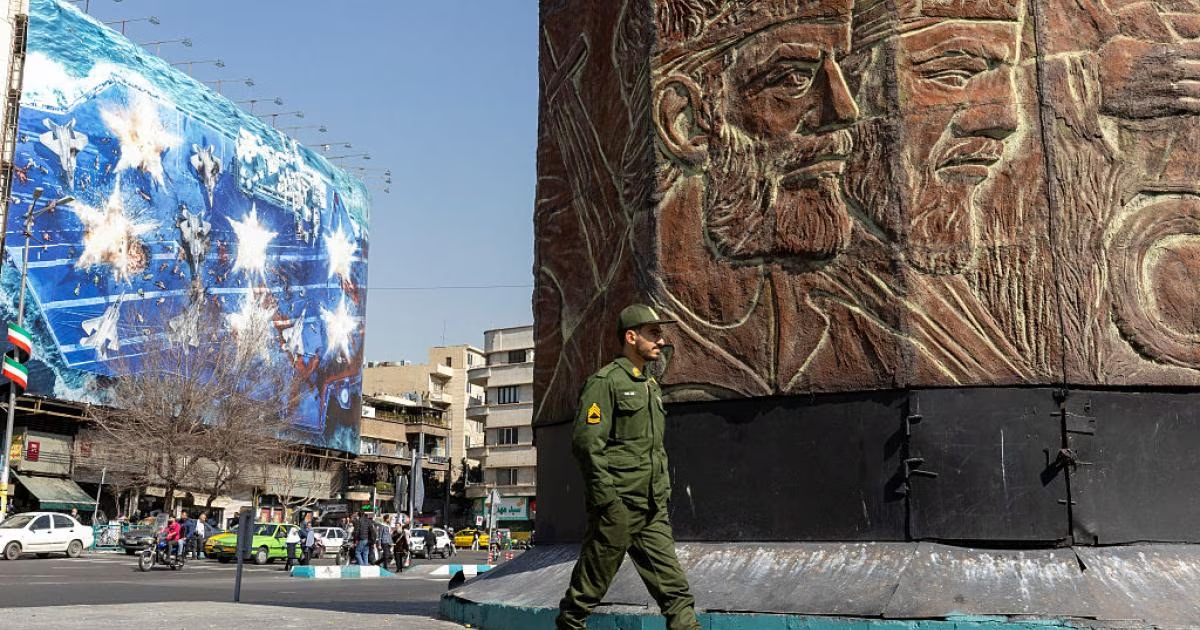
US President Donald Trump issued a stern warning to the Iranian leadership, asserting that Tehran would face very severe consequences if a political agreement is not reached. Trump clarified via his 'Truth Social' platform that he prefers the diplomatic path, but will not hesitate to make difficult decisions if ongoing negotiations fail.
The US President denied the accuracy of reports claiming opposition from senior military leaders to a potential attack, describing them as misleading slanders. He affirmed that General Dan Keane, Chairman of the Joint Chiefs of Staff, fully understands that military victory would be available and easy if a decision for confrontation is made, emphasizing that the authority to declare war falls within his exclusive prerogatives.
As part of recent diplomatic efforts, Trump granted his envoys, Steve Witkoff and Jared Kushner, an additional deadline to negotiate with the Iranian delegation in Geneva, Switzerland. The meeting is scheduled for next Thursday, in a final attempt to exhaust all political avenues before moving to more stringent options.
On the ground, the United States has significantly begun to reinforce its military presence in the region, with the aircraft carrier 'Gerald Ford' arriving at the Greek island of Crete. This step serves as a prelude for the carrier to join US forces stationed in the Middle East, thereby increasing Washington's readiness to deal with any emergency.
Concurrently, shipping sources reported the arrival of US aerial refueling aircraft at Ben Gurion Airport in the occupied territories. These aircraft are a vital component in any long-range air operation, indicating an elevated level of logistical coordination between Washington and Tel Aviv.
On the Israeli front, Prime Minister Benjamin Netanyahu chaired a small security meeting to discuss scenarios related to a potential US strike against Iranian facilities. Leaders of security and military agencies participated in the meeting, including the Ministers of Defense and the heads of Mossad and Military Intelligence, to assess Israeli readiness to cope with this escalation.
Media sources reported that Tel Aviv is awaiting the nature of restrictions Washington might impose on any Israeli reaction in the initial hours of an attack. However, assessments suggest understandings that would give the Israeli Air Force 'a green light' for immediate action if Iran targets Israeli depth with ballistic missiles.
Netanyahu reiterated his threats to Tehran during a speech in the Knesset, vowing a response beyond Iran's imagination if it commits a 'historic mistake' by attacking Israel. These statements come at a time when the Israeli government is pushing the US administration to adopt the option of direct military confrontation to end the nuclear threat.
Sources reported that the Chief of Staff of the Israeli Army, Eyal Zamir, made a secret visit to Washington earlier this month that was not announced at the time. The visit aimed to present the Israeli vision regarding Iranian risks and to try to influence military decision-making centers within the Pentagon.
Reports revealed a divergence of views within the US military leadership regarding the feasibility of military action against Tehran. While the Chairman of the Joint Chiefs of Staff shows caution towards the unclear consequences of conflict, the commander of US Central Command appears more inclined to support the option of military force to deter Iranian threats.
Recent Israeli movements indicate a multi-level strategy that includes political, military, and security pressure on the US administration. Netanyahu, through his continuous meetings with American officials, aims to obstruct any path that leads to an agreement that does not guarantee the complete dismantling of Iranian capabilities.
In a related context, Shlomi Binder, the official responsible for assessing Iranian missile capabilities, recently visited the United States to coordinate on strategic objectives. Discussions included identifying the locations of Iranian leadership and vital facilities that could be targets for military operations or precise assassinations in the event of a confrontation.
Sources confirm that Israel is working to convince Washington that any delay in military decisive action will lead to an exacerbation of risks in the future. The Israeli security establishment believes that current conditions may be favorable for delivering a decisive blow to the Iranian regime and its controversial nuclear program.
In conclusion, anticipation remains the dominant factor, awaiting the outcome of the negotiation round in Geneva next Thursday. Either diplomacy succeeds in defusing the explosion, or the world finds itself facing a large-scale military confrontation that could change the map of balances in the entire region.
If we cannot reach an agreement, it will be a very bad day for Iran, and the decision of war rests solely with me.
שתף את דעתך
Trump hints at a 'bad day' for Iran and intensified US military movements in the region