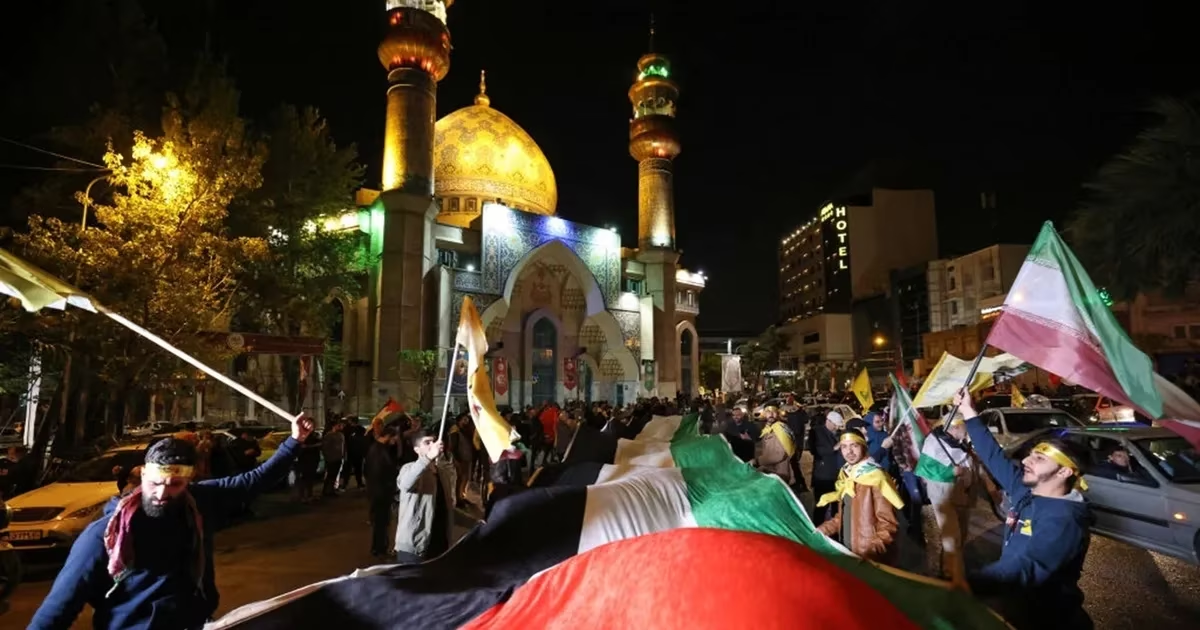







The positions of support for the Islamic Republic of Iran in its current conflict with the American-Israeli alliance are distributed on two main levels. The first stems from a practical, principled stance adopted by the resistance forces in the region. These forces consider themselves an integral part of an axis that raises the slogans of liberating Jerusalem and confronting American influence, which is described in their literature as the 'Great Satan'.
Field sources confirmed that resistance forces in Lebanon, Yemen, and Iraq have clearly announced that any direct military aggression against Iran will be met with a widespread field response. This commitment stems from a doctrinal connection and high-level coordination that goes beyond mere circumstantial solidarity to a state of harmony in objectives and combat methods.
In contrast, Palestinian resistance factions emerge as a vital part of this axis, but they maintain a specificity imposed by geography and the complex history of the Palestinian issue. These factions, through the 'Al-Aqsa Flood', managed to create a global earthquake that shifted power balances and political awareness, and they are now cautiously monitoring American diplomatic moves in the region.
On the international level, Russian and Chinese support for Iran falls under the category of practical interests rather than doctrinal principles. Both countries seek to prevent the expansion of American hegemony in their vital spheres of influence, and they realize that weakening Iran could open the door to directly targeting them or destabilizing their internal security.
The second level of support is the principled moral level represented by the masses and unorganized forces that reject global injustice. Although these positions may not have a direct military impact, they contribute to shaping a global mood that pressures against the military and aggressive options pursued by major powers.
Observers believe that American military decisions historically have not been governed by ethics, but rather by interests and hard power balances. Analysts cite the wars in Afghanistan and Iraq, where popular marches or international condemnation statements failed to disrupt the American military machine when it decided to pursue its objectives.
Nevertheless, the moral stance remains firm among its adherents who do not act based on calculations of material profit and loss. In their view, truth does not die merely with military defeat, but remains alive, passed down through generations, as martyrs immortalize their just causes from which new generations of resistors who refuse to surrender are born.
Those who support Iran on principle do so not only based on military power assessments, but also from a firm belief that the Zionist-American alliance threatens global peace. They see this alliance as an imminent danger targeting the wealth, cultures, and beliefs of peoples, making confrontation a moral necessity before it is a political one.
The Israeli-American alliance has become more audacious in targeting Arab states, even reaching the point of harassing major regional countries like Turkey. Statements from occupation leaders reveal clear expansionist intentions based on misleading and historical claims aimed at seizing more Arab lands.
In a notable development, 14 Arab and Islamic countries announced in a joint statement their condemnation of statements by American officials who supported imposing Israeli control over Arab lands. The list of signatories included influential countries such as Saudi Arabia, Qatar, Egypt, Turkey, and Jordan, reflecting growing regional concern over expansionist schemes.
This collective stance came after a period of complacency during which some regimes thought they were safe from direct targeting. However, recent developments have proven that silence or paying money did not provide the required protection against ambitions that do not stop at specific geographical boundaries.
The joint condemnation, which also included the Gulf Cooperation Council, the Arab League, and the Organization of Islamic Cooperation, represents a cry against biased American policy. These countries express their categorical rejection of any attempts to legitimize the occupation in the West Bank or any other Arab lands under any pretext.
The current reality raises bitter questions about the reasons for the continuous superiority and humiliation the region experiences in the face of colonial powers. Some compare the current shock to the shock of Napoleon's campaign in Egypt, wondering when Arabs and Muslims will rearrange their cards to face existential challenges.
Ultimately, the conflict in the region remains a struggle between the wills of peoples and the interests of major powers. While Iran continues to strengthen its axis, Arab states find themselves facing difficult choices that require moving beyond paper condemnations towards more effective positions to protect their national security and sovereignty.
Truth is not nullified by the results of military confrontations, and those with principles support just causes out of their belief that injustice is a crime that cannot be tolerated.
שתף את דעתך
Analysis: Levels of Regional Support for Iran in the Face of the American-Israeli Alliance