






The political and legal arena in the United States witnessed a radical shift following a historic ruling by the Supreme Court, which deemed unconstitutional President Donald Trump's exclusive right to impose comprehensive customs duties and tariffs. This decision was based on the illegitimacy of using emergency law to bypass Congress's powers in trade issues, putting an end to the 'big stick' economic policy Trump pursued against more than 100 countries.
This ruling comes at a time when Trump is facing a decline in his absolute influence, despite his apparent control over the joints of the political system and the Republican Party. Observers considered the court's decision to be the beginning of a 'flood' to break the executive branch's monopoly on power, especially after two judges appointed by Trump himself voted against him, reflecting the judiciary's independence in confronting presidential overreach.
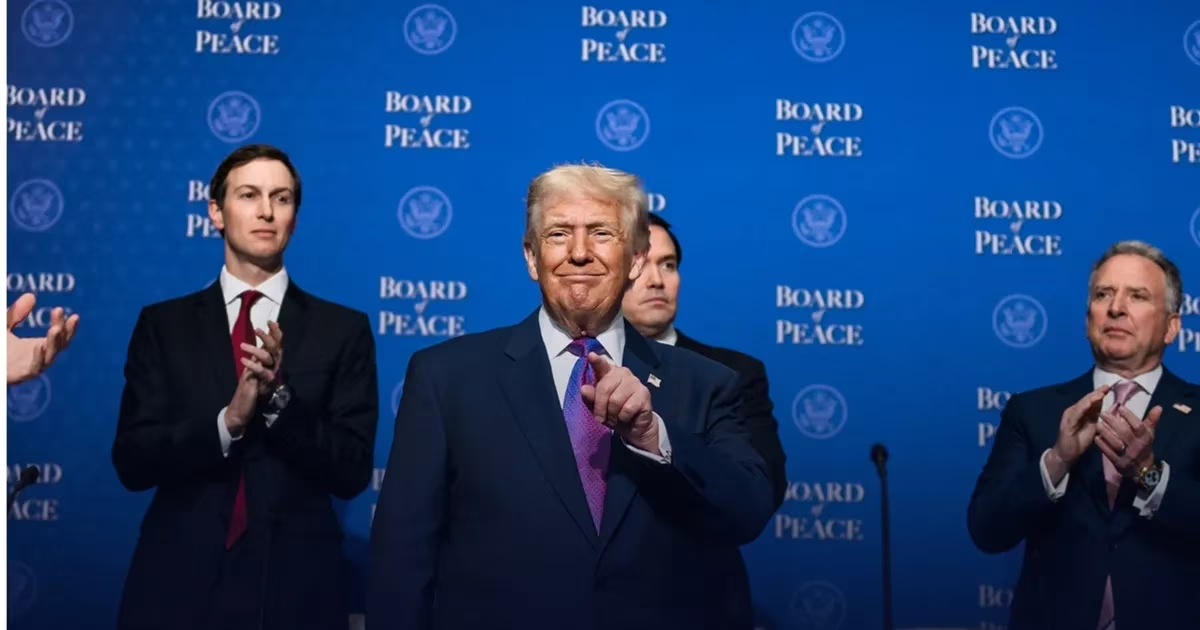
Internationally, Trump sparked widespread controversy by establishing what is called the 'World Peace Council' in Washington, under the name 'Donald J. Trump Institute for Peace'. Trump appointed himself president of this council for life, imposing membership fees of up to one billion dollars that go to a special fund he directly supervises, in a move considered a deliberate marginalization of existing international organizations.
The new council witnessed the participation of controversial figures, led by Israeli Prime Minister Benjamin Netanyahu, who is wanted by the International Criminal Court on charges of war crimes in Gaza. Tony Blair, the former British Prime Minister, also participated in the inaugural session, which sources described as a showy and theatrical display, aimed at enhancing Trump's image as a global peacemaker according to his own vision.
In contrast, Trump's initiative faced a massive international boycott by traditional US allies, led by Britain, France, Germany, Italy, and Canada. This boycott came in protest against the council's attempt to usurp the role of the United Nations, and its complete disregard for Palestinian rights and the legal references that oblige Israel to withdraw from the occupied territories.
Reports indicate that the goals of the 'Peace Council' go beyond diplomacy to include major economic projects, as Jared Kushner proposed a huge real estate project for the Gaza Strip at a cost of $25 billion. The project aims to transform the coasts of Gaza into tourist resorts for the wealthy, which critics see as an attempt to liquidate the Palestinian issue through real estate investment and cancel the right of return.
Trump did not hesitate to use threatening language against countries refusing to join his council, as he threatened to raise customs duties on French imports by 200%. This approach to dealing with allies led to increased international polarization, and prompted countries such as Norway, the Vatican, and Croatia to take a firm stance by refusing membership in an entity that replaces international legitimacy.
Domestically, the American citizen is suffering from the consequences of these policies, as high customs duties have caused an increase in financial burdens on consumers. Despite the administration's claims of ending wars, military movements and the mobilization of reinforcements against Iran indicate the continuation of the escalation approach, which led to a record decline in Trump's popularity in his first year.
The US Congress, dominated by Republicans, faces sharp criticism for its 'blind loyalty' to Trump's decisions and the approval of appointments of ministers and agency heads who lack competence. However, the recent Supreme Court ruling has restored hope for the possibility of activating the system of checks and balances, and preventing the president from unilaterally making decisions on war and peace or major tax policies.
The current transformations indicate that Trump's project based on 'executive exclusivity' has begun to collide with the rock of the judiciary and the refusal of allies to submit to economic intimidation. While Trump seeks to raise funds under the guise of 'reconstructing Gaza', questions remain about his ability to continue this approach amidst increasing legal and political challenges at home and abroad.
The Supreme Court ruling came as an earthquake that struck Trump's agenda, ending an era of exclusivity in making major economic decisions without returning to Congress.
שתף את דעתך
US Supreme Court breaks Trump's exclusivity and restricts his customs powers