






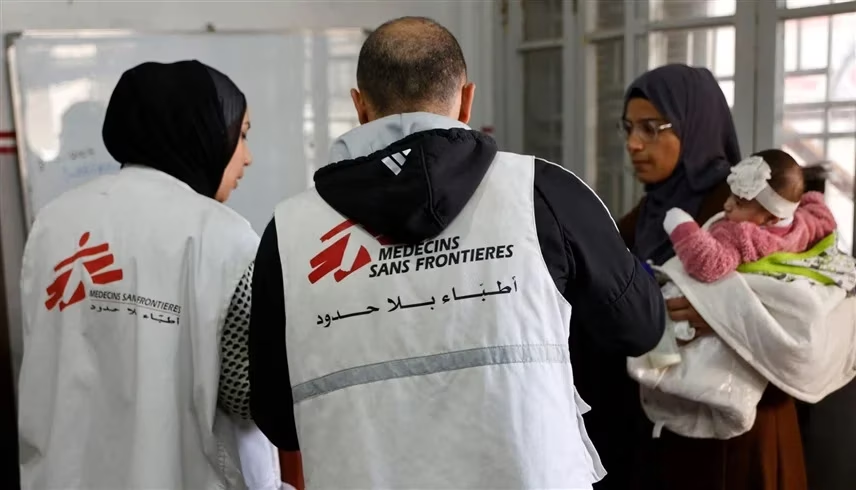
In a new escalation affecting humanitarian work, the Israeli occupation authorities have decided to ban the international organization "Doctors Without Borders" (MSF) from continuing its activities in the Gaza Strip and the occupied West Bank, after the organization refused to submit a detailed list of its Palestinian and international staff. The decision, which will force the organization to end its operations and leave Gaza by February 28, 2026, opens a new chapter of confrontation between the Israeli authorities and humanitarian organizations operating in the besieged sector.
The Israeli Ministry of Foreign Affairs justified the move with considerations it described as "security and transparency," accusing the venerable medical organization of having "something to hide" due to its refusal to provide the requested information. In a statement published on Sunday, the ministry said that the request for staff lists falls within mandatory registration procedures, aimed – according to the Israeli narrative – at protecting all parties, and not targeting humanitarian work.
In a striking post on platform X, the Israeli Foreign Ministry went further, considering that the organization's refusal to comply reflects a premeditated intention to withdraw from Gaza instead of adhering to what it called transparency. It added that MSF had publicly committed, in early January, to submitting the lists as part of an official registration protocol, but – according to the Israeli claim – it reneged on this commitment without justification.
The Israeli occupation authorities supported their position with direct accusations, claiming that two MSF staff members have ties to Hamas and Islamic Jihad movements, accusations that the medical organization categorically denied, considering them to lack any evidence, and to fall within a broader context of political and security pressure on international organizations operating in Gaza.
In contrast, Doctors Without Borders presented a completely different narrative. In a statement published on its website on Friday, the organization confirmed that it had agreed, "as an exceptional measure," to share the names of its Palestinian and international staff with the Israeli authorities, in a step that reflected – as it described it – its keenness to continue medical work in one of the most dangerous environments in the world.
However, this conditional approval, according to the organization, encountered a fundamental obstacle: the absence of any clear and binding guarantees regarding how that data would be used, and mechanisms for its protection. The organization said that it repeatedly sought assurances that staff information would be used for purely administrative purposes, and not exploited for security or to endanger workers, especially in a context that witnesses repeated targeting of medical personnel in Gaza.
The organization added: "Despite repeated efforts, it became clear that we were unable to build effective communication with the Israeli authorities regarding the concrete guarantees required." Accordingly, it concluded that it cannot, ethically and professionally, share its staff data under the current circumstances.
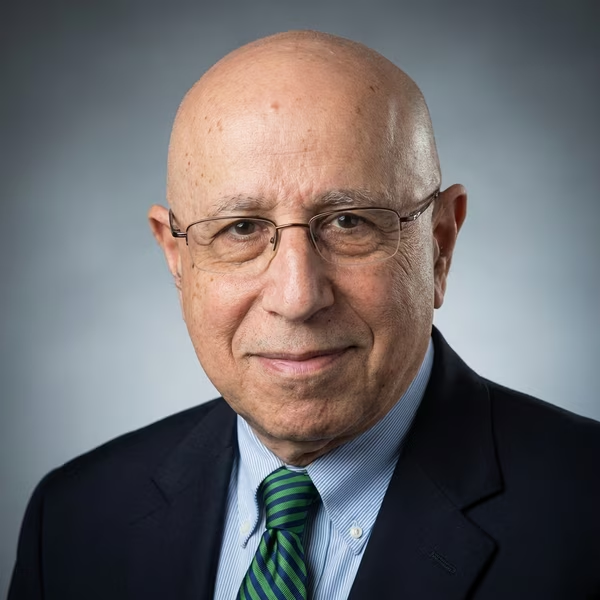
This decision did not pass without controversy within medical and humanitarian circles. MSF's initial compliance drew sharp criticism, most notably from the well-known Palestinian surgeon Dr. Ghassan Abu Sitta, who publicly warned that handing over lists of names increases the risks faced by humanitarian workers, and turns them into potential targets in a highly volatile military context.
This crisis comes in a broader context of escalating restrictions imposed by Israel on humanitarian organizations in Gaza. Last December, Israeli authorities announced plans to prevent 37 aid organizations, including "Doctors Without Borders," from operating in the sector starting March 1, on the pretext of not providing detailed information about Palestinian staff.
Human rights organizations see these measures as a systematic path to reshape humanitarian work according to Israeli security standards, thereby undermining the fundamental principles of neutrality and independence. These organizations warn that reducing the presence of international humanitarian actors will exacerbate the humanitarian catastrophe in Gaza, where the ongoing Israeli military campaign has destroyed health infrastructure, and made the population almost entirely dependent on international aid for survival.
Experts believe that the "Doctors Without Borders" issue goes beyond an administrative dispute to a fundamental question about the future of humanitarian work in conflict zones. Conditioning the submission of staff data without strict guarantees not only affects the safety of individuals but also strikes at the heart of the principle of neutrality. When aid is managed with a unilateral security logic, humanitarian organizations transform from independent actors into subordinate tools, which empties relief of its moral dimension, and makes its survival dependent on adapting to the logic of power, not to the needs of the victims.
Observers believe that in Gaza, the targeting of humanitarian organizations can only be understood as part of a conscious Israeli policy to manage the catastrophe, not to stop it. Instead of alleviating suffering, humanitarian work is being stifled and subjected to security conditions that redefine relief as a control tool, not a humanitarian duty. And the ban on "Doctors Without Borders" does not target a specific organization, but rather sends a warning to all international actors that aid will only be allowed if it submits to the logic of political and military control, in a dangerous precedent that transforms the right to relief into a privilege granted by power and denied whenever it wishes.
שתף את דעתך
Israel bans "Doctors Without Borders" from operating in Gaza and the West Bank