





Palestinian heritage represents one of the most deeply rooted and enduring elements of national identity. It is not viewed as remnants of a bygone era, but rather as a living cultural practice that renews itself through the details of daily life. Traditional attire, especially women's folk clothing, holds a special place within this heritage, serving as a witness to the social and cultural history of the Palestinian people, and carrying meanings that transcend material function to express belonging, distinctiveness, and identity.
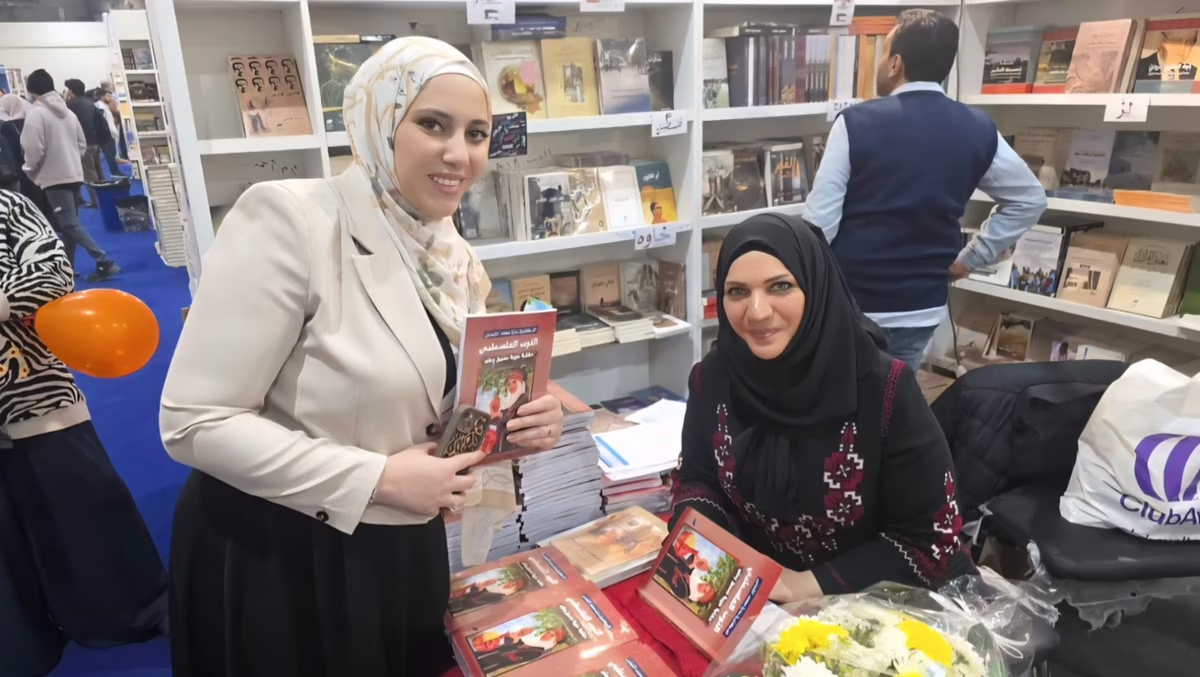
In this context, the book "The Palestinian Thobe: A Story of Identity, a Fabric of a Nation" by researcher and writer Dr. Sara Mohammed Al-Shammas was published to present a specialized academic study documenting Palestinian clothing heritage and exploring its relationship with national identity. The book, spanning 171 pages, was released by Al-Shamel Publishing and Distribution House and officially launched at the Cairo International Book Fair, its first appearance at an Arab exhibition. It garnered significant attention from cultural and research circles concerned with heritage and identity issues. The Al-Shamel booth also hosted a book signing attended by a selection of intellectuals and writers from across the Arab world, who praised its scientific value and cultural importance.
The book adopts a scientific approach that views folk clothing as a social and cultural product formed over a long historical trajectory, not merely as traditional attire or an aesthetic element. National identity, as the book demonstrates, is not confined to theoretical concepts or general slogans, but rather is embodied in daily practices, and folk attire was one of the most important of these practices that expressed the Palestinian's connection to their land, society, and values.
In its initial chapters, the book addresses the fundamental concepts related to folk clothing, identity, and national identity, clarifying the relationship between traditional attire and national belonging. This analysis highlights how clothing played a clear social role, carrying connotations related to age, social status, occasion, and position within society, making it an indirect means of communication understood within the general cultural context.
The book discusses the origins and historical development of Palestinian women's folk clothing, noting the similarities between it and the clothing of some neighboring regions, while emphasizing its Palestinian distinctiveness. In this context, the clear diversity in the nature of folk clothing among different Palestinian regions is evident, a diversity influenced by environmental and climatic factors and the nature of economic and social life, despite Palestine's limited geographical area. This diversity was reflected in the shape of the thobe, the quality of the fabric, the weaving techniques, and the presence of embellishments that gave each region its unique character within a general cultural framework.
The book clarifies that the embellishments accompanying women's folk clothing formed part of the expressive structure of the thobe, contributing to highlighting its distinctiveness and differentiation, without being a formal element separate from its social and cultural context. The presence of these embellishments was linked to the function of the thobe and its social significance, and to the occasion on which it was worn, reflecting an accumulated cultural awareness within Palestinian society.
The book sheds light on the social functions of women's folk clothing, highlighting its role in organizing social relations and regulating behaviors within an unwritten cultural system. The difference in attire between various social occasions, or between daily life and special events, constituted an implicitly understood element within Palestinian society, indicating the depth of collective consciousness that governed the features of traditional social life.
The book dedicates space to studying the types of Palestinian women's folk clothing according to social, religious, and daily occasions, showing that each occasion has its specific attire and social significance. This classification reflects a cohesive cultural system in which Palestinian women were a fundamental element in its construction and continuity across generations.
The book discusses the challenges facing the preservation of Palestinian clothing heritage in the modern era. Foremost among these challenges is the theft and falsification of heritage by the Israeli occupation, and attempts to attribute it to fabricated narratives within a systematic policy aimed at obliterating Palestinian identity. The book also addresses the effects of identity dispersion among Palestinians in the interior, and the impacts of globalization that have contributed to weakening the connection to heritage and transforming some of its elements into consumer products detached from their cultural context. This argument emphasizes that scientific documentation has become a national necessity to protect collective memory from falsification and extinction.
The book's cover carries a special significance, as the cover painting depicts the author wearing the Palestinian thobe, in a visual expression consistent with the book's subject without self-referentiality, but rather as a symbolic representation of the researcher's relationship with her subject of study. The painting was executed by the brush of Dr. Jamal Badwan, the ambassador of Palestinian art in the world, to form a calm visual introduction that reflects the presence of the Palestinian thobe as a living element of national identity.
The book's release was accompanied by a number of cultural events, most notably participation in the cultural day organized by the Embassy of the State of Palestine in the Republic of Egypt, where the book was signed at the embassy library and a copy was included in its cultural collection, in the presence of His Excellency Cultural Counselor Naji Al-Naji, along with a selection of creative intellectuals, writers, and those interested in cultural affairs. Dr. Sara Mohammed Al-Shammas also participated in a cultural event organized by the General Union of Palestinian Women - Egypt Branch, dedicated to celebrating the book and highlighting its importance in documenting Palestinian women's heritage and its role in preserving cultural memory, in the presence of the Director of the Cultural Committee Sonia Abbas, and the Director of the Heritage Committee Nadia Al-Agha, and with the participation of a selection of creative intellectuals and writers, and a distinguished cultural presence that reflected appreciation for the value of the research effort and the publication's standing in the Palestinian cultural scene.
The book "The Palestinian Thobe: A Story of Identity, a Fabric of a Nation" constitutes a qualitative addition to the Palestinian and Arab library, for the academic documentary study it provides, which contributes to filling a clear research gap in the field of studying Palestinian clothing heritage.
The book as a whole affirms that Palestinian folk attire is not merely an inheritance from the past, but an authentic part of national identity and the memory of a people that is still present, and deserves preservation and documentation as a witness to the social and cultural history of Palestine.

א 01 פבר 2026 12:02 pm - שעון ירושלים
"The Palestinian traditional dress: A Story of Identity, a Fabric of a Nation".. The Memory of a People Still Present
שתף את דעתך
"The Palestinian traditional dress: A Story of Identity, a Fabric of a Nation".. The Memory of a People Still Present