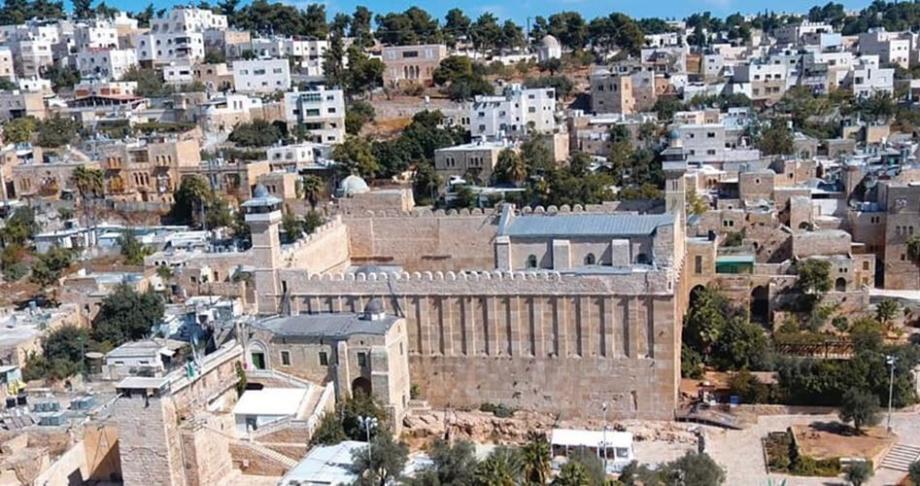







At a time when the outlines of the Israeli plan to divide the occupied West Bank into semi-independent entities known as the "Seven Emirates" are unfolding, the city of Hebron appears at the forefront of this project as the first model for implementation.
Experts believe that the choice of Hebron is not a coincidence, but rather an extension of an old Israeli policy aimed at fragmenting Palestinian society and transforming authority into scattered local powers, reminiscent of the "Village Leagues" experience that was thwarted by popular resistance in the 1980s.
Hebrew newspaper reports revealed last Friday that the occupying state plans to replace the leadership of the authority in Hebron with local clans, and to establish a separate governance that recognizes the occupying state "as a Jewish state," and joins the "Abraham Accords" for normalization, in response to the intention of several Western countries to recognize the State of Palestine.
Israeli affairs specialist Adel Shadid confirms that what is happening in Hebron is not a passing event, but rather the beginning of a strategic project through which the occupying state seeks to divide the West Bank and transform authority from a central entity into a group of scattered local authorities that do not differ from municipalities and village councils.
Shadid states that this division, and the remaining part of the city and governorate of Hebron under complete security, administrative, and life control of the occupation, has encouraged Tel Aviv as well as some parties willing to engage with the occupation to revive an experience similar to the "Village Leagues" project that was tried at the end of the 1970s and the beginning of the 1980s, which also originated from Hebron before it was thwarted thanks to the resilience of the Palestinian people and their national forces.
Shadid explains that the situation in Hebron changed completely after the redeployment agreement in 1997, as the agreement did not remain intact after the second intifada, with most Areas (A) that were under Palestinian security control being effectively canceled.
Today, the Hebron governorate – which covers an area of 1,100 km² and is home to about 900,000 people, nearly a third of the West Bank's population – is fully under Israeli security control.
The occupying army raids, arrests, and demolishes homes day and night, while the authority's powers are limited to civil and service aspects, even the movement of the security forces affiliated with the authority between areas of the governorate requires prior Israeli approval through what is known as "security coordination," which may often be rejected.
As in the rest of the West Bank, Hebron has been divided into Areas (A), (B), and (C), but with a fundamental difference: all security powers are now in the hands of the occupation.
Shadid adds that the most dangerous aspect of the scene is Area H2, which includes the old town and the heart of the city, where the Hebron Agreement kept security powers in the hands of the occupying state, while the service powers were nominally in the hands of the Hebron municipality, but even these powers have begun to be gradually withdrawn by what is called the "Settlers' Municipality" in Hebron, which means reducing its role in favor of the settlers' authority.
Shadid believes that the absence of security forces in these areas and the occupation's refusal to allow them to operate there has opened the door for the emergence of local figures who have no problem engaging with the occupation.
This brings to mind attempts to revive the "Village Leagues" but under different names and forms, by granting some service powers to these groups, as part of a larger project to fragment Palestinian national identity and transform it into local, tribal, and regional identities.
Nevertheless, Shadid emphasizes that this project – despite coinciding with the state of retreat experienced by the Palestinian national movement due to the "Oslo" agreement and the ban on the work of Hamas and Islamic Jihad and the transformation of Fatah into a party subordinate to the authority – will not succeed.
In this context, he recalls the experience of the 1970s and 1980s, when the occupying state sought to eliminate the national movement and install the Village Leagues after the invasion of Beirut and the departure of the PLO to exile, but the result was completely the opposite, as the Palestinians revived their national identity, paving the way for the outbreak of the first intifada that astonished the world and thwarted the Israeli project.
For his part, writer and political analyst Jihad Harb sees Netanyahu's plan to replace the authority with clans in the West Bank, specifically in Hebron, as part of a colonial strategy with Talmudic roots
שתף את דעתך
"The Hebron Emirate".. Israel's gateway to fragmenting the West Bank and transforming it into local entities.