






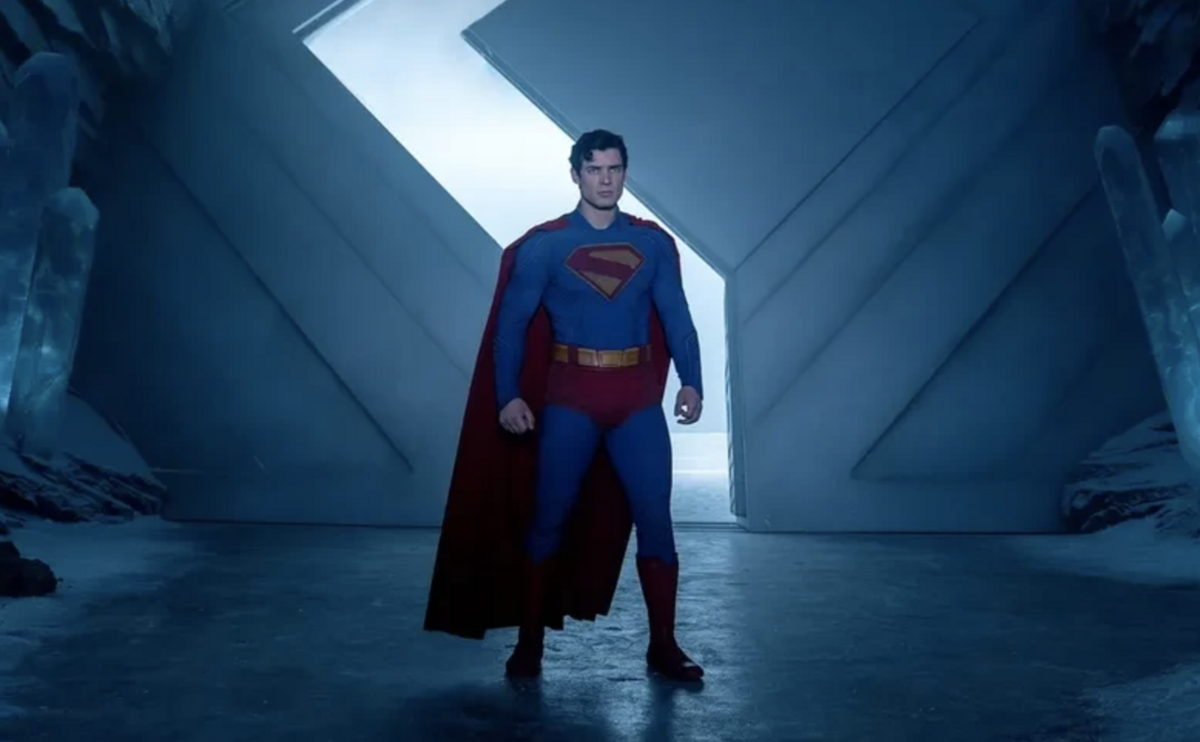
The new film "Superman," directed by American director James Gunn, which opened in US cinemas on July 11, has generated much enthusiasm and criticism since its release. The controversy revolves around the film's plot, which appears to turn the stereotypical image of superheroes on its head, condemning America rather than glorifying it.
According to many critics and journalists (including a Quds.com correspondent who watched the film on Sunday, July 20), Gunn offers a fresh take on the tired old notion that America is the best on earth, by explicitly pointing to America's involvement in the arms industry, its use of advanced technology, and its unbridled capitalism (though he is not the first to explore the dangers of unfettered military-technological capitalism).
Some viewers see Superman as an indirect attack on Israel, as the white European Boravia regime, fully allied with the United States and led by a figure similar to Israel's first Prime Minister, David Ben-Gurion, attacks its poor, non-white neighbor, Jarhanpur.
The symbolism of the key scenes, which depict a heavily armed army confronting unarmed protesters at a security fence, strongly references Israel's separation fence with Gaza and its repeated invasions of Palestinian territory. This has drawn the ire of right-wing commentators, such as Mark Levine, Fox News, and the evangelical media, who have deemed this an overreach and the film a departure from the norm.
It is noteworthy that Gunn stated that he began working on the film a year ago, "before the Hamas attack" on October 7, 2025, and that he did not mean Israel or the Palestinians, but rather that it is a fictional film, about fictional locations.
The film's main villain, Lex Luthor, is portrayed as a billionaire (possibly an Elon Musk type) who plans to divide Jarhanpur with Boraviya, supplying it with billions of dollars' worth of weapons.
In the film, Superman is presented as a naive person, obsessed with his dog, Krypto, but driven by a natural desire to fight the evil, greed, and criminality of the Financial Technology Alliance. This prompted his girlfriend, Lois Lane, a fellow reporter at the Daily Planet, to ask him in an interview why he was intervening to stop Boraviya's invasion of Jarhanpur. Citing the oppressive nature of the regime there, Superman immediately responded that the oppression of any regime is no excuse for invading the country.
In this dialogue, according to critics, the real contemporary political arguments against American intervention and the regime-change wars that the United States has waged since the 2003 invasion of Iraq are presented.
The scene following Boraviya's invasion of Jarhanpur was what most viewers focused on. It shows a young boy waving the national flag as tanks and heavily armed troops advance menacingly, while unarmed protesters flee under fire. This scene echoes the Great March of Return protests in Gaza along the Israeli separation wall in 2018 and 2019, when more than 200 Palestinians were killed and over 8,000 wounded by Israeli sniper fire.
It's worth noting that the character of "Superman" was created as a symbol of America's force of good against evil (Nazis and fascists in Europe) in the 1930s by Jewish artists and writers who, through their drawings, depicted the danger posed by these fascists and Nazis. While not all superheroes are symbols of American imperialism, the notion of "superpower" that enables the character to defeat his opponents through prolonged combat represents the essence of the American style. According to some critics, superheroes are F-35s in human form.
In the film, Superman faces a moral dilemma: how can he save the world when the rogue United States and its aggressive ally are enemies of world peace? His intervention to save a poor country in the Global South from invasion is considered unjustified against an American enemy.
The film also criticizes the military-industrial complex and its links to settler colonialism, as Lex Luthor arms Boravia to get his hands on a piece of land, much like Trump's dream of owning a "Middle Eastern Riviera" on the ruins of Gaza.
The film's heroes, along with Superman, are the Justice League trio of corporate-backed superheroes, who reluctantly join the fight against Boravya, the billionaire, and the fearless editorial team of the Daily Planet.
Here, for some, Hollywood reaches its limits with its grandiose geopolitical commentary. Instead of portraying the military-technological-financial complex as part of a larger US-controlled imperialist-political-media complex, the film depicts the sinister project of colonial land grabbing as the work of a few evil actors. Once their plot is exposed, the media and corporate heroes, who had been blind to Luther or remaining silent (the case of the US media regarding Israel's war of genocide in Gaza), act appropriately and move to end this vile plot, while the US government appears as a passive spectator, with Luther playing his part.
No wonder Israel and its supporters were so critical of the film, with Ben Shapiro, a leading advocate for Israel, simply writing: “The film is not good.”
The idea that a major newspaper like the New York Times and a major television channel would turn against the US-backed colonial regime's plans to invade and annex territory may seem unbelievable. Instead, these media figures in the film collude and attempt to obscure the truth by portraying the victims as terrorists and describing Boraviya as merely "defending herself."
Superman reaches the limits of Hollywood-style geopolitical criticism: the whole thing should be wrapped up brilliantly, with the villains defeated and the people saved at the end of the final act.
The idea of an American superhero team carelessly destroying a US-allied army in the Middle East to save the indigenous population from invasion is both preposterous and unlikely.
Palestinians are not waiting for Western superheroes to save them. The superheroes are the Palestinian medical and relief teams who are performing truly extraordinary, superhuman acts in their quest to save lives under conditions imposed by Israeli criminality, perhaps the most difficult circumstances in history. Their allies are the hundreds of millions around the world who stand in solidarity with them and demand an end to the genocidal war. They are the ones risking their lives in relief convoys, such as the Handala ship, currently heading to Gaza to break the blockade.
שתף את דעתך
Superman Movie: Palestinians Are Not Waiting for Western Heroes to Save Them