





Dr. Ahmed Rafiq Awad: The method of storming the Madeleine ship reflects an Israeli attempt to promote a false humanitarian image to prevent the breaking of the siege on Gaza.
Mohamed Gouda: "Madeleine," despite its objections, represents a real starting point for similar international popular and humanitarian movements in the future.
Dr. Raed Al-Dabai: The presence of international figures on board the ship gave the event tremendous media coverage and put Western governments in an embarrassing position.
Suleiman Basharat: The Madeleine ship revived the international popular role in solidarity with the Palestinians and will inspire similar movements.
Dr. Saeed Shaheen: Choosing the name "Madeleine" for the ship carries deep symbolic connotations and represents a message of solidarity with the Palestinians, especially the children of Gaza.
Talal Okal: This attempt will not be the last, and there are intensive preparations to repeat it in various forms, with the aim of expressing solidarity with Gaza and breaking the siege.
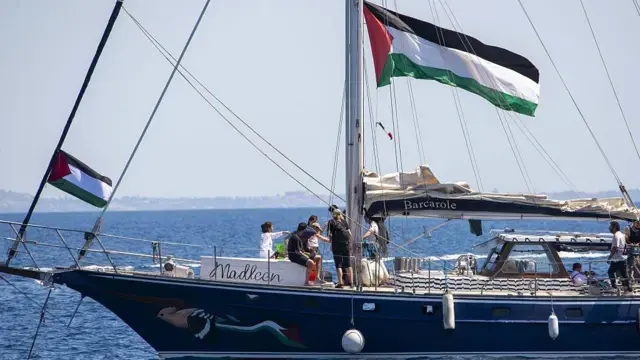
In a bid to further tighten its siege of the Gaza Strip, Israeli occupation forces stormed the Freedom Flotilla ship "Madeleine" last Monday, seizing it and detaining its 12-member crew. They prevented the ship from continuing its journey to the Strip, which has been subjected to a war of extermination and starvation for twenty months. But the message of the activists was received, despite their arrest.
In separate interviews with "I", writers, political analysts, specialists, and university professors said that the Israeli occupation forces' storming of the Madeleine was a propaganda operation. Israel attempted to present a false "humanitarian" image, avoiding the use of violence, by avoiding violence and providing food and drinks to the ship's crew, in a move aimed at delegitimizing the symbolic message of solidarity.
Writers, analysts, specialists, and university professors assert that the Madeleine, named after the Gazan girl Madeleine Kallab, the first female fisherwoman in Gaza, serves as a symbol of civil resistance and human solidarity, highlighting the humanity of Gazans and their right to life.
They believe that the ship, despite its interception, succeeded in re-highlighting the suffering of the besieged Gaza Strip, which could serve as a starting point for new international popular movements to support Gaza and break its siege.
Pulling the rug out from under the feet of the solidarity activists
Writer and political analyst Dr. Ahmed Rafiq Awad says that the Israeli occupation forces' storming of the Madeleine and the detention of its 12-member crew was a "propaganda" operation. He explains that Israel sought to falsely present itself as a "soft, humanitarian" force by refraining from using violence and providing food and beverages to the crew.
Awad points out that this new media tactic aims to pull the rug out from under the feet of the solidarity activists and strip the symbolic legitimacy of their message of humanitarian solidarity with the Gaza Strip.
Awad explains that Israel has learned from its previous experiences with solidarity ships, including the ship it bombed in Malta and the Turkish ship Mavi Marmara in 2010, which was widely criticized internationally for its use of excessive force against civilian activists.
According to Awad, Israel this time attempted to present a different image, demonstrating its ability to "contain" without abandoning its primary goal of preventing any attempt to break the naval blockade imposed on the Gaza Strip.
Awad explains that what happened was not just a security incursion, but rather a calculated media stunt, through which Israel sought to demonstrate that it had acted professionally and with restraint, thus appearing to the world as if it were not hostile to humanity but rather protecting its security.
A clear message to the international community
Awad stresses that the true objective of this Israeli action remains the same: to consolidate the blockade, whether by sea, land, or air, and to send a clear message to the international community that any similar future initiative will be prevented by force.
Awad praises the crew of the Madeleine, describing their mission as a "journey of conscience and conscience."
Awad asserts that these activists, despite their small numbers and limited resources, carried a universal humanitarian message that expressed progressive popular positions that surpassed in courage and sincerity those of many governments, elites, and international organizations.
Awad says, "They carried love and solidarity, and paid a price for their moral stance, fully aware of the risks that could lead to murder."
Awad points out that the ship, despite its simplicity, attracted the attention of the international media, which followed its movement as an expression of profound human dimension and a message of solidarity with a besieged people deprived of food and medicine.
Awad explains that Israel, despite its attempts to improve its image in the international community, continues to tighten its grip on Gaza and uses aid as a political weapon.
Awad praises the ship's name, "Madeleine," which was named after a young Gazan girl who was the first female fisherwoman and who loved life. This confirms that the ship "Madeleine" carries profound human symbolism.
Awad asserts that this connection will have a future impact on the continuation of solidarity movements, emphasizing that "the world is still largely fine, and that this ship carries within its heart a global conscience that will not stop there."
"Madeleine" re-highlighted the suffering of Gaza.
For his part, writer and political analyst Mohammed Joda says that the Israeli occupation forces' seizure of the Madeleine, a ship part of the Freedom Flotilla en route to break the siege of the Gaza Strip, is a continuation of the policy of a naval and land blockade imposed on more than two million Palestinians.
Joudeh explains that this move highlights Israel's insistence on preventing any humanitarian initiative, no matter how peaceful, considering it a threat to its project aimed at politically and economically strangling Gaza.
He links the quality of this attack on the ship to Israel's collective punishment policies, noting that the seizure of the ship clearly demonstrates the occupation's view of any humanitarian action as a challenge to its control.
Joudeh believes this act falls within a broader context of violations aimed at isolating Gaza and perpetuating the suffering of its residents, who face harsh living conditions as a result of the years-long blockade.
Despite Israel's interception of the ship, Joudeh points out that this journey could serve as a starting point for similar international popular and humanitarian movements in the future.
Joudah explains that the ship, which carried activists of various nationalities, succeeded in re-highlighting the suffering of Gaza, igniting public opinion and awakening the global conscience.
Drawing on historical experience, Joudeh asserts that such attempts, even if met with repression, have a profound impact in mobilizing international support for the Palestinian cause.
Breaking the stereotype of the passive victim
Joudeh believes that the profound symbolism of choosing the name "Madeleine" for the ship, after Palestinian fisherwoman Madeleine Kallab, breaks the stereotype of the passive victim.
Joudeh describes Madeleine as a symbol of civil resistance and the insistence on life despite the blockade, noting that the choice of this name for the ship reflects the message of the activists sailing that the Palestinian struggle is multifaceted: military, political, and humanitarian, led by children, women, and adults alike.
Joudeh asserts that this symbolism lends a popular and humane character to the struggle against the blockade, bringing the issue closer to the hearts of peoples around the world, far from the corridors of decision-makers.
Joudeh believes that focusing on stories like Madeleine's reinforces the fight against the blockade in the global consciousness, giving it a human dimension that is difficult to ignore. He asserts that this powerful symbolism will inspire more similar actions, strengthening international solidarity and keeping the Gaza issue alive in the global consciousness.
A blatant Israeli challenge to international law
For his part, Dr. Raed Al-Dabai, head of the Political Science Department at An-Najah National University, asserts that the Israeli occupation forces' interception of the Madeleine in international waters, according to crew testimonies, goes beyond being a mere maritime incident and carries extremely serious political and humanitarian implications.
Al-Dabai explains that this operation demonstrates the Israeli far-right government's insistence on preventing any humanitarian or relief efforts to break the blockade imposed on Gaza since 2007, even if the ship is carrying prominent international figures such as activist Greta Thunberg and European Parliament member Rima al-Hassan.
Al-Dabai points out that this objection is not merely a rejection of aid, but rather a blatant challenge to international law and an explicit declaration by Israel that it does not recognize the decisions of the international community.
Al-Dabai asserts that the timing of the attack is particularly significant, as it coincides with Israel's ongoing war of extermination against Palestinians in Gaza, withholding food, water, and medicine from civilians, reflecting a systematic policy of collective strangulation.
Al-Dabai points out that this incident comes weeks after an alleged Israeli drone attack on a humanitarian ship near Malta, revealing a deliberate naval escalation against all forms of international solidarity with Gaza.
Al-Dabai asserts that this policy aims to thwart any attempt to break the blockade and further isolate the Gaza Strip from the outside world.
The Gaza blockade returns to the forefront of the international agenda.
From a media perspective, Al-Dabai explains that the presence of international figures on board the ship gave the event tremendous media coverage, placing Western governments in an embarrassing position before their own peoples, who are demanding an explanation for their silence or actual steps to repatriate their citizens.
Al-Dabai believes that this event has placed the Palestinian issue, and specifically the blockade of Gaza, back at the forefront of the international agenda at a time when signs of famine in the Strip are worsening.
Al-Dabai asserts that the Madeleine, the 36th attempt by the Freedom Flotilla since 2008, has demonstrated that global solidarity with Palestine remains alive and kicking, and will usher in a new era of maritime solidarity movements, leveraging documents and evidence that can be used to hold Israel accountable before international courts.
Regarding the choice of the name "Madeleine," Al-Dabai asserts that it was a brilliant symbolic decision, inspired by Madeleine Kallab, the first Palestinian woman to become a professional fisherman in Gaza.
Madeleine Kallab, a feminist and community icon
Al-Dabai explains that Madeleine, who resisted the restrictions of the occupation for a full decade and lost her father and boat in the 2023 aggression, embodies steadfastness and civil resistance, and represents a feminist and community icon.
Al-Dabai points out that naming the ship after her transforms the issue from a theoretical political discourse into a tangible humanitarian narrative, highlighting that the victims of the blockade are not "fighters," as the occupation claims, but rather women, children, and fathers struggling for life and a future.
Al-Dabai asserts that this title breaks Israel's monopoly on the image of the "victim" and presents an alternative Palestinian narrative that depicts a struggling people, led by their women, in the face of occupation.
Al-Dabai believes that Madeleine's symbolism expands the Palestinian struggle into a global discourse that intersects with human rights, climate, and gender justice movements, strengthening international alliance building.
Al-Dabai expects this model to inspire future movements named after doctors, teachers, or mothers, to revive the voices of forgotten ordinary people.
Al-Dabai asserts that the selection of Madeleine has restored Palestine's human face, affirming its right to life and freedom, and embarrassing governments that have complicitly remained silent in the face of this "humanized" struggle that shakes the consciences of peoples.
Israel blocks every voice and every narrative other than its own.
For his part, writer and political analyst Suleiman Basharat asserts that the Israeli occupation forces' interception of the Madeleine, a ship part of the Freedom Flotilla en route to break the blockade of the Gaza Strip, reflects Israel's insistence on imposing its sole narrative on the Palestinian cause, particularly the ongoing war on Gaza for more than 19 months, and its desire to silence voices of solidarity with Gaza.
Basharat explains that Israel seeks to prevent the world from hearing any voice or narrative other than its own, arguing that the ship's arrival in Gaza would have been a "turning point" that would have dismantled the Israeli narrative and opened the door to widespread international solidarity with the Palestinians, thus hindering Israel's plans to consolidate its control over the Strip.
Basharat points out that Israel was fully aware that allowing the ship to reach Gaza would strengthen the presence of international solidarity activists and revive global interest in the Palestinian cause, which Israel is trying to suppress.
Basharat believes this objection was not surprising, as prior indications indicated the occupation's intent to prevent the ship from arriving, as its success would have posed a direct threat to its narrative justifying the blockade and war under the pretext of national security.
Basharat explains that Israel faced a delicate test in dealing with the Madeleine, especially given its recent tarnished international image.
Basharat points out that European positions have gradually begun to shift in favor of the Palestinians, although these positions have yet to translate into concrete political decisions.
The occupation forces were careful to avoid excessive violence.
Basharat points out that Israel avoided using excessive violence in dealing with the ship, fearing that it would intensify international criticism and turn European positions into political decisions under pressure from public opinion. Instead, Israel quickly released videos showing its "peaceful" handling of the ship.
Basharat points out that Israel is trying to portray the flight as a "media spectacle" rather than a genuine humanitarian effort to relieve Gaza, in order to minimize its impact.
However, Basharat asserts that this ship, despite its interception, has repositioned the war on Gaza at the forefront of popular and public priorities worldwide.
According to Basharat, after nearly 20 months of war and declining international interest, the ship succeeded in reviving the international popular role in solidarity with the Palestinians and inspired similar movements, such as the convoy that set out from Tunisia and will pass through several Arab countries to the Rafah crossing, carrying a symbolic message expressing the Arab and international peoples' rejection of the ongoing war and the "genocide" against the Palestinians.
Embodying the humanitarian situation in Gaza
Basharat asserts that choosing the name "Madeleine," after the Gazan girl Madeleine Kallab, the first young female fisherwoman, carries profound symbolic connotations. The name embodies the humanitarian situation in Gaza and highlights that Palestinians are not criminals or murderers, as Israel portrays them, but rather human beings with talents and ambitions who deserve life.
Basharat explains that the girl, Madeleine, who was waiting to catch fish by the sea, also represents the Palestinians' hope for freedom from the occupation.
Basharat points out that the Freedom Flotilla organizers chose this name to redefine Palestinian daily life, far from the stereotypical image imposed by the occupation over decades.
Basharat asserts that this symbolism represents a common point of intersection between different cultures and ideologies, as peoples agree that Palestinians deserve life and freedom.
Basharat expects Madeleine's trip to serve as a platform for repositioning the Palestinian cause and the Gaza war at the heart of popular and public concerns at the Arab, regional, and international levels.
Basharat asserts that this initiative, despite its challenges, will inspire further action to break the siege and strengthen global solidarity with the Palestinians, revitalizing the popular role in confronting the occupation and its aggressive policies.
Intimidating messages to all who support the Palestinian cause
Dr. Saeed Shaheen, a professor of political media at Hebron University, says that the recent Israeli attack on the Madeleine, a ship part of the Freedom Flotilla bound for the Gaza Strip to break the blockade, represents a flagrant violation of international humanitarian law and a serious violation of human rights.
Shaheen explains that this attack is part of an ongoing Israeli approach to defying international laws and resolutions since the 1948 Nakba, taking advantage of US support that provides it with immunity from accountability and punishment.
Shaheen points out that Israel, which considers itself above the law, has continued its war of extermination, starvation, and thirst against two million Palestinians in Gaza for more than 19 months, using the pretext of "self-defense" and protecting its national security to justify its violations.
Shaheen describes the attack on the Madeleine and the detention of its crew, which was carrying international activists seeking to break the blockade and support the Palestinian people, as an Israeli attempt to send a message of intimidation to all who support the Palestinian cause.
Shaheen explained that this action aims to deter activists from continuing their efforts to end the injustice suffered by the people of Gaza. He noted that the 12 activists on board the ship were taken to the port of Ashdod, threatened with solitary confinement at the behest of extremist Israeli Minister of Internal Security Itamar Ben-Gvir.
Shaheen asserts that the choice of the name "Madeleine" for the ship carries profound symbolic connotations, as it represents a message of solidarity with the Palestinians, especially children, who are suffering the ravages of the Israeli war, which has claimed the lives of more than 18,000 children in Gaza so far.
Shaheen explains that this name expresses the solidarity activists' commitment to standing with the Palestinian cause and rejecting the ongoing genocide perpetrated by the "Zionist killing machine."
Greater mobilization of activists and supporters of the Palestinian cause
Shaheen asserts that Israel, rather than respecting international law, resorted to intercepting the ship, thus exposing the falsity of its claims to democracy and respect for human rights.
Shaheen points out that this behavior will not stop the global anti-Israel protests. On the contrary, it will lead to an escalation of international solidarity with Palestine, especially with the launch of new convoys from countries such as Tunisia, Algeria, Morocco, and Libya to support Gaza.
Shaheen asserts that the extensive media coverage of this event, both through traditional and new media, along with the massive engagement of the global public, will strengthen efforts to break the blockade.
Shaheen expects this attack to further mobilize activists and supporters of the Palestinian cause, which will intensify the Boycott, Divestment and Sanctions (BDS) movement and expose its false narrative.
Shaheen believes that Israel, which appears confused and fearful of growing global protests, will be unable to prevent the growing wave of solidarity with Palestine and human rights.
Expected piracy reflects the identity of the occupying state
For his part, writer and political analyst Talal Okal asserts that the Israeli military's interception of the Madeleine, a ship attempting to break the blockade of the Gaza Strip, was expected, not only because of precedents such as the attack on the Mavi Marmara under less severe circumstances, but also because it reflects the core identity of the occupying state.
Okal explains that this behavior, which disregards international and humanitarian laws, reveals Israel's aggressive nature and characteristics, emphasizing that the protest clearly demonstrates the values that guide the occupying state and its role in oppressing Palestinians.
Awkal points out that the attack on Madeleine adds to a series of violations that highlight Israel as a state that defies international norms, providing further evidence of its colonialist essence.
Awkal asserts that this attempt will not be the last, as intensive preparations are underway to repeat similar initiatives in various forms, with the aim of expressing solidarity with Gaza, challenging the blockade, and breaking it.
Awkal points out that thousands of volunteers are on their way from Tunisia to the Rafah crossing, along with other popular delegations that have already arrived, reflecting the growing international momentum in support of the Palestinian cause.
Awkal emphasizes the profound connotations behind choosing the name "Madeleine" for the ship, noting that it fully embodies the goals of the voyage.
Awkal explains that the name, inspired by the Gazan girl Madeleine Kallab, symbolizes solidarity with Palestinian children, the search for a livelihood despite the siege, and the rejection of the war of genocide and starvation waged by Israel.
Awkal asserts that this symbolism reinforces the message of defiance and steadfastness, and inspires further popular action to confront the injustice imposed on Gaza.

ד 11 יונ 2025 9:24 am - שעון ירושלים
"Madeleine"... The message arrived, but the ship did not
שתף את דעתך
"Madeleine"... The message arrived, but the ship did not