





The Palestinian situation is living through one of the most dangerous moments in its modern history, not only due to the fascism of the Israeli occupation alone, nor merely as a result of internal divisions, but due to the convergence of two lethal factors: the arrogance of Israeli power supported by structural international bias, especially American, and internal Palestinian incapacity to produce a political and social alternative capable of breaking this infernal cycle. The occupation is not merely a temporary control project, but has transformed into an integrated system for managing Palestinians as a demographic burden that must be subjugated or eliminated, not as a people with rights. In contrast, the Palestinian political structure is no longer capable of transforming suffering into strength, nor pain into a project, but has become consumed in managing incapacity.
When power becomes policy and bias becomes a system
Israel today is not only waging a war of extermination, but is imposing a unilateral vision for the Palestinian future: a fragile, fragmented entity stripped of sovereignty, a society managed security-wise, a dependent economy, and a political horizon postponed indefinitely. This project would not have continued with this level of brazenness and arrogance without explicit or silent international bias, which justifies killing in the name of “security,” and treats international law as a selective tool rather than a binding reference. This bias has not only failed to protect Palestinians, but has contributed to reproducing the conflict. Whenever accountability is absent, power expands. Whenever politics recedes, war advances. Thus, Palestine enters a closed infernal loop, where violence begets violence.
Gaza today is not merely a battlefield, but a mirror of the failure of the international system. Even when a ceasefire is announced, it carries no real political or moral significance, other than reducing the daily death toll for a limited period. No serious reconstruction, no political path, or accountability. Only temporary management of a permanent catastrophe. In this sense, Gaza has turned into a laboratory for managing human pain, not ending its causes.
The Palestinian Authority: Incapacity as a fait accompli policy
In the West Bank, the Palestinian Authority is eroding dangerously. It is politically besieged, financially strangled, and functionally constrained. But more dangerously, it is losing its social base. An authority that cannot secure the minimum salaries for people, and abandons its history rooted in the legitimacy of resistance led by the national movement. At the same time, it lacks a vision to confront economic and social disintegration, meaning it is beginning to lose its practical legitimacy regardless of its legal reference. Here, one cannot suffice with explaining Palestinian incapacity solely by external factors; the absence of reform based on consensual legitimacy, the erosion of resistance legitimacy, and the postponement of democratic entitlements leading to the absence of accountability, all are internal factors that have deepened the crisis instead of containing it.
Hamas and the Authority: Different responsibilities
Political equality between Hamas and the Palestinian Authority does not hold, as each has a different position, function, and responsibility. But this does not exempt either from frank criticism.
Hamas bears heavy responsibility for linking Gaza's fate to military choices not built on national consensus, nor on sufficient assessment of societal cost. Resistance, no matter how legitimate, does not grant an open mandate to manage the lives of more than two million people without political or civilian accountability.
In contrast, the Palestinian Authority bears a more complex responsibility: it is the internationally recognized entity, required to represent the entire national body, but it has chosen, due to incapacity or narrow calculations, to manage the crisis instead of confronting it, and to preserve institutional survival instead of renewing popular legitimacy by devising governance tools capable of restoring trust and mobilizing popular energies.
The problem is not in the existence of political pluralism, but in the absence of any national framework that imposes accountability, utilizes pluralism as an element of strength, and prevents unilateralism in fateful decisions.
Can this infernal cycle be broken?
Breaking this infernal cycle will not come from isolated international initiatives, nor from betting on a sudden change in the balance of power. Rather, it begins with one indispensable condition: a realistic national consensus that reorders priorities on the basis of protecting society. This consensus does not necessarily mean resolving major issues at once, but agreeing on a minimum program: first, protecting people in the face of extermination and settler terrorism, and from economic and social collapse; second, unifying the moral and political discourse before the world; third, restoring the role of civil society in all its components as a lever for national steadfastness and preserving the social fabric from disintegration, and all of this requires national incubators in unified frameworks at the level of the organization and the authority.
Can life be managed independently of the occupation?
The experience of the First Intifada is not a myth, but its rich lessons show that managing life under occupation is relatively possible when society has organization, serious leadership attached to the national concern and people's interests, a sense of participation and responsibility, and effective networks for social solidarity. This in addition to clarity on who the enemy is. The occupation was no less cruel then, but internal confidence was higher, and popular legitimacy was clearer. Today, the challenge is not limited to the occupation, but manifests in the disintegration of the internal fabric. And if this disintegration is not addressed, nothing will remain to defend politically.
How can collapse be prevented?
Preventing collapse does not start from the outside, nor from anticipated international decisions, but from three interconnected internal circles:
First: Restoring the national function of the authority
Not as a illusory sovereign authority, but as a tool for social protection, public service, and managing the capacity for steadfastness. An authority incapable of paying salaries, and of protecting society from economic chaos, loses its practical legitimacy regardless of its political reference.
Second: Realistic unity, not ideological; unity built on a minimum program: protecting people, preventing chaos, unifying the national discourse before the world, which forms a solid lever for the possibility of answering the major questions. Unity today is a condition for survival, not a political luxury.
Third: A decisive role for networks and frameworks of civil society. When politics fails, society does not automatically collapse. Palestinians have proven that society, if its latent energy is mobilized rather than marginalized, will be capable of organizing itself, alleviating the effects of occupation and the repercussions of division together.
Today, the occupation is harsher, yes. But what we lack is not conditions alone, but internal confidence, leadership legitimacy, and organizational capacity. Managing life independently of the occupation is not withdrawal from the conflict, but redefining it: from an unequal military confrontation to a battle of steadfastness, organization, survival, and effective engagement with sweeping transformations in international public opinion.
A call to the world… Who hears Palestine's pain?
It is no longer possible to continue viewing the Palestinian tragedy as a “chronic conflict” without solutions, or a balanced struggle between two parties that “fail together.” This description is not only misleading, but morally comforting, as it exempts power from its responsibilities and empties international law of its content. Policies justified in the name of stability or security, from unconditional support for Israel, or calculated silence on grave violations, or settling for managing humanitarian crises, do not prevent explosion, but delay it and make it more destructive. The absence of accountability does not produce moderation, and depriving an entire people of horizons does not generate surrender, but more desperate and dangerous forms of conflict levels. And if the West is serious in defending an international system based on rules, values, and human principles, then Palestine is not an exception, but the clearest test of the credibility of this system. And continuing to treat human consequences without confronting political causes will only lead to reproducing the same infernal cycle that everyone claims to want to break.
Palestine today stands before two choices with no third:
Either a national consensus that reproduces politics as a tool of salvation, or a gradual fall in which the national cause turns into a humanitarian file without political horizons. The occupation seeks to impose this fall by force, and international bias facilitates the task with silence. But collapse will not become fate unless accepted Palestinianly. And history, so far, has not said its final word.

OPINIONS
Wed 31 Dec 2025 9:25 am - Jerusalem Time
Palestine: How Can We Break the Infernal Cycle?
Jamal Zaqout
Opinion Writer

PALESTINE
Wed 31 Dec 2025 9:23 am - Jerusalem Time
Accelerated Palestinian Steps with International Organizations to Prepare for the Removal of Unexploded Remnants in Gaza

Estimates of more than 20,000 unexploded bombs in Gaza
•Local and international technical teams are working to identify locations of unexploded remnants, while the occupation does not currently allow their removal
•Signing agreements with international organizations to pave the way for mine clearance and removal of unexploded war remnants in Gaza
There is no doubt that the reconstruction phase in Gaza is complex, intricate, and distributed across multiple stages, but the starting point for the recovery and reconstruction process begins with the removal of unexploded war remnants, due to the danger they pose to citizens and the technical crews working to continuously restore basic services within their limited capabilities.
According to a report issued by the Government Contact Center, the Ministry of Interior, through the Palestinian Mine Action Center, is working to strengthen the State of Palestine's partnerships with various international institutions to create the largest international alliance for mine clearance and removal of unexploded ordnance in Gaza, as soon as technical teams can enter and operate in the sector.
In light of the Center's accumulated experience, it has previously implemented unexploded ordnance removal operations in the West Bank, including clearing and removing minefields in sixteen sites, including Ein al-Sakout – Northern Jordan Valley, and Qabatiya, in cooperation with several international organizations specialized in mine clearance, including HALO Trust, the world's largest non-governmental humanitarian organization working on removing landmines and explosive war remnants, in addition to handling (2092) hazardous objects in various West Bank locations, in partnership with the Explosive Ordnance Disposal Police. In addition, the Center has conducted extensive awareness campaigns about the risks of mines and prevention.
On the Gaza front, field surveys have begun and contaminated areas in Gaza have been mapped through several local and international technical teams, alongside continuing training of local crews in preparation for the start of unexploded remnant removal in the sector.
On the ground, there is significant Palestinian coordination between relevant entities such as the Palestinian Mine Action Center, the Ministry of Public Works and Housing, and the Government Operations Room with the United Nations Mine Action Service (UNMAS), as it is the umbrella for all institutions working in the field of unexploded ordnance removal, and there are ongoing follow-ups and periodic meetings to exchange information and update joint plans. The field teams in the sector are placing warning signs at unexploded ordnance sites, but the occupation does not yet allow their removal, in addition to preventing the entry of necessary equipment to launch the operation.
Internationally, the Permanent Palestinian Mission to the United Nations in Geneva has intensified its contacts and meetings with disarmament and arms control organizations and Swiss authorities, aiming to remove unexploded war remnants, where estimates indicate the presence of more than 20,000 unexploded bombs in the sector.
According to UNMAS estimates, presented at the Donors Conference on Mine Action in the Palestinian Territories held in Amman last May, the cost of removing unexploded ordnance in Gaza is estimated at about 130 million dollars.
In Geneva, which is a major international center for global organizations and institutions, the Permanent Observer of the State of Palestine to the United Nations in Geneva, Ambassador Ibrahim Khraishi, held a series of meetings with several international entities specialized in removing unexploded war remnants, including a meeting with the Disarmament Department of the International Committee of the Red Cross, and a meeting with the Director General of the International Civil Defense Forces, Arjog Kalantarli last October, where he handed him the Palestinian plan and discussed with him the required efforts in Gaza, while Ambassador Khraishi emphasized the need to align all efforts under the supervision of the Palestinian Government, and full coordination with the Palestinian Mine Action Center and the Palestinian Civil Defense.
In addition, other meetings with mine clearance specialists in Switzerland and international organizations such as the Geneva International Centre for Humanitarian Demining (GICHD) and the Swiss Foundation for Mine Action (FSD), and other scheduled meetings, all aimed at mobilizing more international effort for the unexploded ordnance removal operation in Gaza, and mobilizing more international pressure to allow the entry of equipment, and enable specialized international organizations to operate in the sector alongside enhancing cooperation and emphasizing the existence of a ready national plan at the Palestinian Center to implement it in Gaza, in Palestine, and agreements have been signed with five international organizations to work in the sector.
Preparations are also underway to hold an expanded meeting including the United Nations Mine Action Service, the International Committee of the Red Cross, the Implementation Support Unit for the Mine Ban Convention, the Geneva International Centre for Humanitarian Demining, the Swiss Foundation for Mine Action, the International Civil Defense Forces, and from the Palestinian side, the Ministry of Interior with its specialized agencies, headed by the Palestinian Mine Action Center and Civil Defense, with the participation of the Ministry of Foreign Affairs and Expatriates, for further coordination and preparation for field work in the sector, which contributes to accelerating work on the unexploded ordnance removal plan, paving the way for economic recovery and the reconstruction phase.
PALESTINE
Wed 31 Dec 2025 9:23 am - Jerusalem Time
Simultaneous Israeli military escalation on several fronts in the Gaza Strip
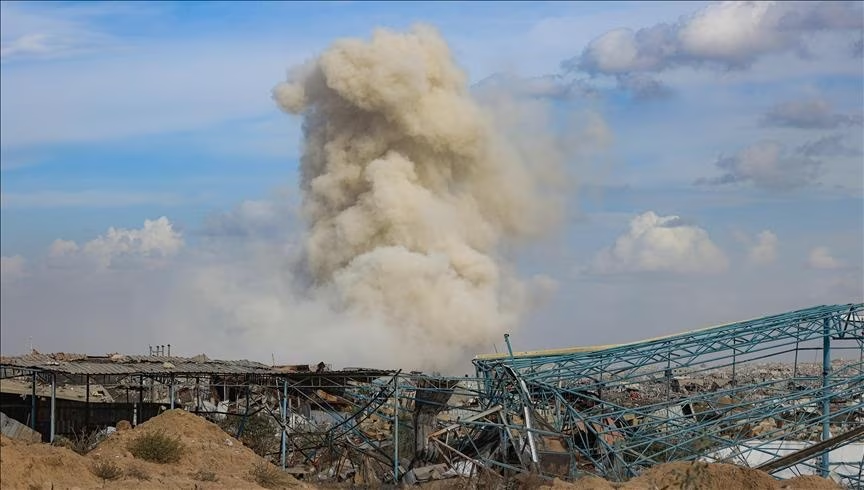
On Wednesday, the Gaza Strip witnessed a simultaneous Israeli military escalation on several fronts, including artillery shelling, air raids, and heavy gunfire, especially in the eastern and northern areas of the sector.
Eyewitnesses reported that Israeli artillery shelling targeted the vicinity of Al-Fakhoura School, which shelters displaced people west of Jabalia camp in areas from which the Israeli army had previously withdrawn in northern Gaza Strip.
The army also carried out an air raid inside the areas it still occupies east of Jabalia camp, accompanied by heavy gunfire from military vehicles.
In Gaza City, Israeli artillery shelling targeted Al-Tuffah neighborhood east of the city, while another artillery shelling hit inside areas occupied by the Israeli army east of Juhr al-Dik and Al-Bureij in the center of the sector, according to the same source.
The witnesses said that the central area saw gunfire from Israeli helicopters targeting areas still occupied by the army to the east, in addition to an air raid east of Al-Maghazi camp.
In southern Gaza Strip, Israeli warplanes carried out air raids on Rafah city in areas still occupied by the Israeli army, coinciding with gunfire from helicopters targeting the area, according to the witnesses.
No casualties or injuries were reported as a result of these Israeli violations.
This comes amid the ongoing Israeli breaches of the ceasefire agreement that came into effect on October 10, which resulted in the killing of 414 Palestinians and the injury of 1,145 others.
On October 8, 2023, Israel began a genocide in Gaza that lasted two years, with its death toll exceeding 71,000 Palestinians and 171,000 injured, alongside massive destruction affecting 90 percent of the civilian infrastructure, with reconstruction costs estimated by the United Nations at around 70 billion dollars.
On Wednesday, the Gaza Strip witnessed a simultaneous Israeli military escalation on several fronts, including artillery shelling, air raids, and heavy gunfire.
PALESTINE
Wed 31 Dec 2025 9:19 am - Jerusalem Time
Israeli Army Injures Two Palestinians and Arrests 28 in Jaba South of Jenin
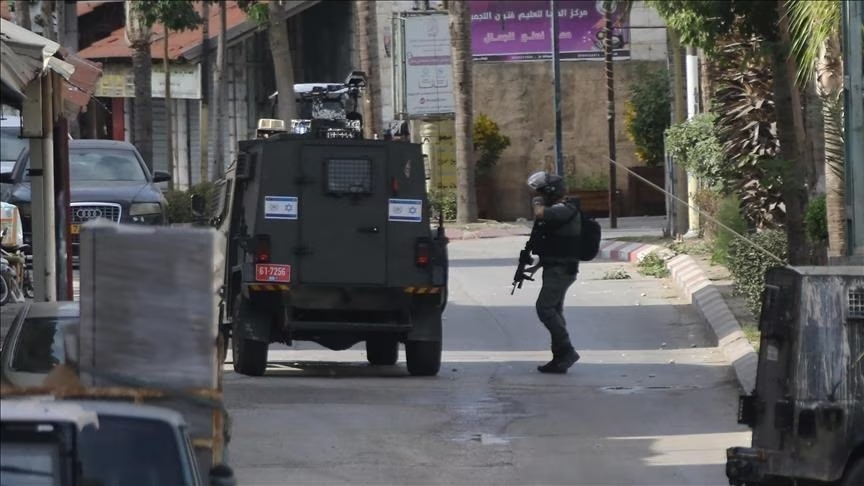
On Wednesday, the Israeli army injured two Palestinians and arrested 28 during its raid on the town of Jaba south of Jenin in the northern occupied West Bank.
The Palestinian Red Crescent Society stated in a statement that its crews in Jenin treated two injuries resulting from beatings, and they were transferred to the hospital for treatment, coinciding with the occupation forces' raid on the town.
Eyewitnesses said that "the occupation forces arrested 28 citizens from Jaba during a campaign of raids and searches that targeted a large number of homes, accompanied by field investigations inside one of the homes."
They added that "the occupation forces tampered with the contents of the homes, deliberately causing widespread destruction inside them, amid a heavy deployment of soldiers in various neighborhoods of Jaba."
The raid is still ongoing (until 06:30 GMT), amid an atmosphere of tension and fear of an escalation in arrests and violations against citizens, according to the witnesses.
On a daily basis, the Israeli army carries out extensive raids on cities and towns in the West Bank, arresting dozens of Palestinians during them.
Since the start of the genocide war in Gaza on October 8, 2023, the Israeli army and settlers in the West Bank, including East Jerusalem, have killed at least 1,104 Palestinians and injured about 11,000, in addition to arresting more than 21,000.
Meanwhile, the Israeli genocide in Gaza, with American support, has left more than 71,000 Palestinian dead and 171,000 injured, and massive destruction affecting 90% of the civilian infrastructure, with reconstruction costs estimated by the United Nations at around 70 billion dollars.
Israel was established in 1948 on lands occupied by armed Zionist gangs that committed massacres and displaced hundreds of thousands of Palestinians, then Tel Aviv occupied the rest of the Palestinian lands, and refuses to withdraw and establish a Palestinian state.
The raid is still ongoing, amid an atmosphere of tension and fear of an escalation in arrests and violations against citizens.
PALESTINE
Wed 31 Dec 2025 9:14 am - Jerusalem Time
Trump and Netanyahu in Mar-a-Lago: Sharp political messages on Gaza, Iran, and the future of the US-Israel partnership
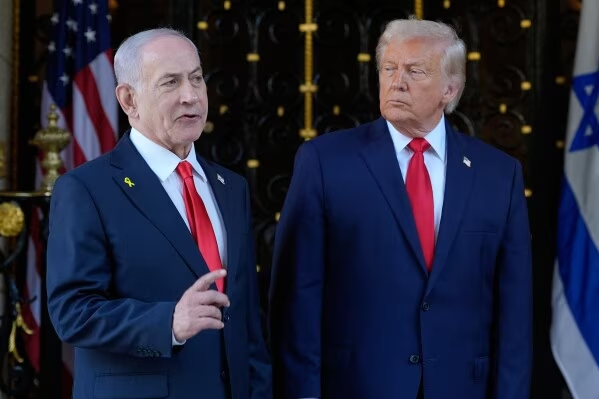
The former US President Donald Trump and Israeli Prime Minister Benjamin Netanyahu held a joint press conference at the Mar-a-Lago resort in Florida, focusing on the developments in the war in Gaza, the future of the ceasefire, and regional challenges, especially Iran, affirming the strength of the US–Israeli alliance in a highly sensitive regional phase.
Trump said that his talks with Netanyahu were "fruitful" and resulted in "many conclusions", emphasizing that the United States will continue to support Israel politically and militarily. For his part, Netanyahu expressed his appreciation for what he described as "steadfast support" from Trump, considering that the relationship between the two sides forms a fundamental pillar for regional security.
The Gaza file topped the agenda of the conference, where Trump confirmed that the transition to the second phase of the ceasefire agreement is directly linked to the disarmament of Hamas. He added that the reconstruction of Gaza "will not be possible" as long as the armed movement remains, noting that any reconstruction efforts must be preceded by strict security arrangements that ensure no return to fighting.
Trump threatened Hamas that the results will be horrific for them if they do not disarm, claiming that 59 countries have expressed readiness to participate in international forces as part of the Peace Council.
Netanyahu, in turn, emphasized that Israel will not accept any political or humanitarian settlement that leaves what he described as "the military threat" in Gaza. He confirmed that his government views the next phase as a real test of the international community's ability to ensure Israel's security, while maintaining humanitarian aid channels to the civilian population.
Regarding Iran, Trump made sharp statements, warning that any Iranian attempt to rebuild its nuclear or missile capabilities will be met with decisive military response from the United States and Israel. He confirmed that the deterrence policy must be clear and unambiguous. Netanyahu supported this position, describing Iran as "the greatest source of threat to stability in the Middle East".
The conference also addressed other regional files, including tensions on the Lebanese front with Hezbollah, and security challenges in the Red Sea, where both sides emphasized the importance of military and intelligence coordination to confront what they described as "the axis of multiple threats".
In a domestic political context, Trump expressed his personal support for Netanyahu, praising his leadership during the war. He referred to what he said was information he received about the possibility of an Israeli presidential pardon for Netanyahu, in reference to his legal cases, although official Israeli sources later rushed to deny the existence of such a decision.
The press conference reflected a hardline political tone, prioritizing security over any political or humanitarian paths, at a time when international pressures are increasing for a permanent ceasefire in Gaza, and providing a clear political horizon for the Palestinian–Israeli conflict.
The discourse of Trump and Netanyahu in Mar-a-Lago reflects a purely security vision for the conflict in Gaza, presenting the disarmament of Hamas as a prerequisite for any political or humanitarian process. This approach, despite its alignment with the Israeli vision, collides with a complex humanitarian reality, where it is difficult to separate reconstruction from political solutions. It also reproduces the equation of "security versus stability", which has proven its limitations in previous experiences.
It is noted that the joint emphasis on confronting Iran reveals an attempt to link the Gaza war to the broader regional context, allowing justification for deterrence and escalation policies. However, this linkage may expand the circle of conflict and increase the likelihood of open confrontation. Trump's insistence on a rhetoric of strength also reflects his desire to establish the image of "the tough president", whether in foreign policy or in his domestic political calculations
ARAB AND WORLD
Wed 31 Dec 2025 9:11 am - Jerusalem Time
Trump Faces Netanyahu with Disputes over the West Bank Amid Escalating Settlements and Settler Violence
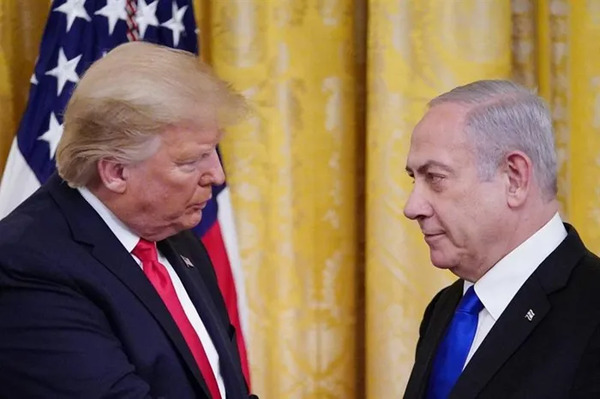
The meetings that brought together U.S. President Donald Trump and Israeli Prime Minister Benjamin Netanyahu in Mar-a-Lago, Florida, revealed clear differences between the two sides regarding Israeli policies in the occupied West Bank, despite mutual efforts to maintain the relationship within its overall strategic framework. According to an American official, Trump and his senior aides expressed growing concern over undisciplined settler violence, the accelerating settlement expansion, and Israel's continued withholding of billions of dollars in Palestinian tax revenues, policies that have pushed the Palestinian Authority to the brink of financial and political collapse, according to the American website "Axios".
A source confirmed to the site that the discussions were characterized by a friendly tone, but Washington warned that the deteriorating situation in the West Bank could negatively impact efforts to stabilize Gaza, and could undermine the U.S. administration's efforts to regionally expand the Abraham Accords. When asked whether Trump had raised the issue of settler violence during his meeting with Netanyahu, he acknowledged the existence of disagreements, saying that the two sides do not agree "100 percent" on the West Bank, but expressed confidence in reaching a "result" regarding it.
At the same time, the United States is pressuring Israel to release the withheld funds that it collects on behalf of the Palestinian Authority, which it has repeatedly refused to transfer since the October 7, 2023 attack. Finance Minister Bezalel Smotrich is leading this approach, considering these funds "support terrorism," and openly declaring his aim to weaken the Palestinian Authority through what he described as "economic strangulation" to prevent the establishment of a Palestinian state, a position that reflects the growing weight of the far-right within the ruling coalition.
Netanyahu, for his part, faces significant pressure from his right-wing partners who are pushing for the expansion of settlements and the annexation of the occupied West Bank, alongside undermining the role of the Palestinian Authority. The West Bank has witnessed a notable escalation over the past year in attacks by extremist settlers on Palestinians and their property, with the Israeli occupation army documenting more than 752 incidents of violence and hate crimes since the beginning of the year, compared to 675 incidents during 2024, amid almost complete absence of judicial accountability, where indictments are rarely filed, and convictions remain exceptional.
Alongside settler violence, the Israeli government has proceeded to consolidate its civilian presence in the occupied West Bank, announcing the establishment of 11 new settlements and the legalization of eight additional settlement outposts. The United Nations had confirmed earlier this month that the pace of settlement expansion has reached its highest levels since at least 2017, considering these activities illegal under international law, a characterization rejected by the Israeli occupation authorities.
Despite the disagreements over the occupied West Bank file, a senior Israeli official described the meeting between Trump and Netanyahu as "the best" among the meetings held by the two leaders since Trump's return to office. He noted that the meeting addressed major regional issues, including how to deal with the Iranian threat, the future of Hamas and Hezbollah, in addition to other security issues, according to "Axios". During the joint press conference, both Trump and Netanyahu took care to exchange compliments, with Trump praising Netanyahu, describing him as "a prime minister in time of war" who "did a great job," indicating the continued strength of the alliance despite tactical differences.
The U.S.-Israeli disagreements over the West Bank reflect the widening gap between political warnings and the actual ability to influence. Washington recognizes that the continuation of settlements and settler violence threaten the stability of the Palestinian Authority and undermine any future political path, but it has so far limited itself to signals of concern without translating them into real pressure tools. It seems that the U.S. administration is betting on containing the repercussions rather than confronting the roots of the crisis, fearing damage to an alliance it considers a cornerstone in its regional strategy.
The Trump administration also recognizes that what is happening in the West Bank points to a structural shift in Israeli policy, where the land is no longer a subject of negotiation but a field for imposing permanent facts. In this context, weakening the Palestinian Authority becomes a strategic choice, not a side effect. The continuation of this approach not only threatens what remains of the two-state solution, but also portends the reproduction of chronic tension spots that could explode at any moment, putting the U.S. bets on regional stability to a tough test.
ARAB AND WORLD
Wed 31 Dec 2025 9:09 am - Jerusalem Time
Trump's Year in Palestine: Unbounded Support for Israel and a Harvest of Destruction in Gaza and the West Bank

The American President Donald Trump concluded the year 2025 in Palestinian–Israeli policy in the same way he began it: with blatant, overt bias, devoid of any claim to balance or respect for international law. He ended the year by hosting Israeli Prime Minister Benjamin Netanyahu, wanted by the International Criminal Court as a suspect in war crimes, at his private resort in Mar-a-Lago on Monday, December 29, 2025, where he showered him with praise and commended "his leadership" and "military achievements," completely ignoring his government's record of widespread destruction and civilian killings. Most tellingly, Trump did not mention Israel's ongoing violations of the ceasefire in Gaza, nor the devastating human cost of these violations, in a scene that clearly reflected that American policy was not concerned with ending the war, but with protecting those who wage it, no matter the consequences.
Since his return to the White House, Trump has reshaped American policy toward the Palestinian–Israeli conflict on the basis of complete bias toward Israel, not only in its security aspect, but in its broader political and settlement project. This approach reached its peak during Israel's devastating war on the Gaza Strip, where Washington provided unconditional political and military cover, ignoring the unprecedented scale of the humanitarian catastrophe that befell Palestinian civilians.
American support was not limited to supplying Israel with advanced weapons and ammunition, but also included systematic disruption of any international path to accountability, through the use of veto power in the Security Council, rejection of repeated calls for a ceasefire, and questioning the reports of international human rights organizations. This cover turned the war on Gaza into an open-ended operation without temporal or moral limits, contributing to deepening the destruction, rising casualty numbers, and expanding the scope of forced displacement.
In contrast, Palestinians were reduced in American discourse to a "security problem" encapsulated by Hamas, in deliberate disregard for the true roots of the conflict, represented by the prolonged occupation and blockade for years, and the complete blockage of the political horizon. The Trump administration showed no readiness to recognize Palestinian national rights, or even to commit to the minimum standards of international humanitarian law that mandate the protection of civilians during conflicts.
However, focusing solely on Gaza hides another no less dangerous aspect of American policy, manifested in what is happening simultaneously in the occupied West Bank and occupied East Jerusalem. While the world was preoccupied with the war on Gaza, the West Bank witnessed an unprecedented escalation of settler violence, including organized attacks on Palestinian villages, burning of homes and farms, physical assaults and field killings, often under the protection of the Israeli army, and amid total American silence.
This escalation coincided with a remarkable acceleration in the pace of settlement, reaching unprecedented levels, whether through approval of thousands of new settlement units, or through the legalization of random outposts that were previously considered illegal even under Israeli law itself. As for East Jerusalem, the Israeli government continued to impose Judaization policies, from demolishing homes, revoking identities, and expanding settlement around the Al-Aqsa Mosque, in a systematic attempt to change the city's demographic and political reality.
The American position on these developments was characterized by explicit complicity, whether through abstaining from any serious condemnation, or settling for vague statements not followed by practical measures. In fact, Trump's policy provided, practically, a political umbrella for these practices, by treating settlement as a "fait accompli," not a crime under international law, which encouraged the Israeli government and settlers to proceed without fear of accountability.
This American complicity reaches its peak when it comes to the killing of Palestinians holding American citizenship in the occupied West Bank, where facts reveal a recurring pattern of impunity that undermines any American claim to defend its citizens or principles of justice. Several Palestinian Americans have been killed since Trump took office (as in recent years) by Israeli army fire or settlers, under circumstances documented by human rights organizations and eyewitnesses, without any of these crimes leading to real accountability or legal prosecution.
Each time, the American State Department settles for stereotypical statements calling for "investigation" or expressing "concern," then practically closes the files once Israel announces the opening of a formal internal investigation, which often ends in acquitting the killers or blaming the victim. This automatic American acceptance of the Israeli narrative, even when field evidence contradicts it, reflects a conscious political decision to provide diplomatic protection to Israel, even if the price is the blood of American citizens.
More dangerously, this disregard is not limited to individual cases, but reflects a systematic policy that considers the Palestinian American an exception to the concept of "citizenship" that is supposed to enjoy full state protection. While political, media, and legal pressure tools are mobilized when an American is harmed anywhere else in the world, the Palestinian American is treated as a marginal case, whose life is reduced to equations of "Israeli security."
This approach not only encourages the repetition of crimes, but sends a clear message to Israeli settlers and soldiers that killing a Palestinian, even if he holds an American passport, will not entail political or legal consequences. Thus, American citizenship is transformed from a protective shield into a worthless detail, as long as the killer is Israeli and the victim Palestinian.
In this context, the Trump administration presented what was called the "Gaza Plan" as a political exit, but it essentially treated the effects rather than the causes, focusing on disarming Palestinians and re-engineering the administration of the sector, without any commitment to ending the occupation or recognizing Palestinian political rights, whether in Gaza or the West Bank. Thus, it seemed that Washington was dealing with the Palestinian issue as a fragmented security–humanitarian file, not as an integrated national liberation issue.
Regionally, this approach reinforced a growing sense that the United States is no longer a mediator, but a fully biased party. The American bombing of Iranian sites confirmed that the logic of force has become the preferred tool in managing regional files, at the expense of diplomacy and political solutions, while the Palestinian issue is left out of any serious strategic calculations.
The most dangerous aspect of Trump's policy is not only his unconditional support for the Gaza war, but in providing comprehensive cover for a broader Israeli project aimed at liquidating the Palestinian issue, through combining widespread destruction in Gaza, creeping annexation in the West Bank, and Judaization of East Jerusalem. Under this approach, international references erode, and the door is closed to any fair and viable political solution.
Trump's policy toward Gaza and the West Bank reveals a single integrated vision, not separate files. The war in Gaza, settlement expansion in the West Bank, and Judaization of Jerusalem are all links in a single path that enjoyed explicit American support or complicit silence. This approach does not seek to end the conflict, but to manage it by force, imposing permanent facts on the ground.
In the foreseeable future, Trump's policy appears to be a recipe for further explosion. A people being bombed in Gaza, attacked in the West Bank, and uprooted from Jerusalem cannot be subdued by force forever. Without a radical change in the American approach, stability will remain an illusion, peace postponed, and violence likely to recur in harsher forms.
PALESTINE
Wed 31 Dec 2025 8:41 am - Jerusalem Time
The occupation prevents non-governmental organizations from operating in Gaza in 2026
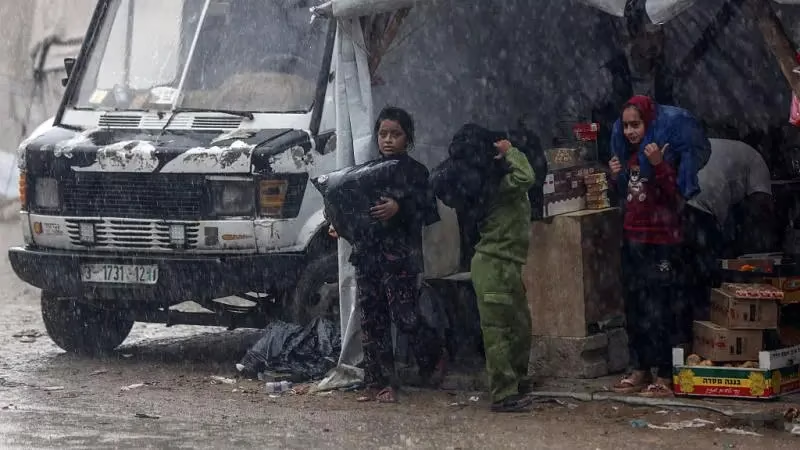
The Israeli occupation announced that it will prevent non-governmental organizations from operating in the Gaza Strip in 2026, if they do not submit a list of their Palestinian employees by Wednesday.
This comes as foreign ministers of 10 countries, including Britain, Canada, and France, expressed their deep concern over the deterioration of humanitarian conditions in the Gaza Strip and their return to catastrophic levels, demanding that the Israeli government lift the restrictions imposed on the entry of humanitarian aid into the sector.
This was stated in a joint statement published by the foreign ministers of Britain, Canada, Denmark, Finland, France, Iceland, Japan, Norway, Sweden, and Switzerland on Tuesday regarding the humanitarian situation in Gaza.
And in a statement from what is called the Israeli Ministry of "Diaspora and Combating Antisemitism" yesterday Tuesday, it stated that organizations that "refused to submit a list of their Palestinian employees in order to exclude any link to terrorism", as it put it, "will have their licenses revoked starting from the first of January/January next".
It said that the concerned organizations "will have to stop all their activities by the first of March/March next 2026".
The ministry explained that only 15% of non-governmental organizations are covered by this measure, adding that actions undermining what it called "Israel's legitimacy", legal pursuits against Israeli army soldiers, denial of the Holocaust, as well as denial of the events of October 7/October last (2023), are considered reasons for revoking the license", according to its claim.
International non-governmental organizations had expressed, in mid-December/December last, their fear of not being able to continue working in the Gaza Strip, which was destroyed by the ongoing genocide war for two years, due to these new measures.
Since October/October last, a fragile truce has been in effect in the Gaza Strip, which faces a humanitarian crisis threatening its population of 2.2 million people, amid ongoing Israeli violations.
The ceasefire agreement stipulates the entry of 600 aid trucks daily into Gaza, but the actual number ranges between 100 and 300 trucks, according to non-governmental organizations and the United Nations.
Amid the Israeli blockade and the complex humanitarian situation, foreign ministers of ten countries expressed their deep concern over the renewed deterioration of the humanitarian situation in the Gaza Strip, describing the scene as catastrophic, amid harsh winter conditions and a severe shortage of shelter and healthcare.
Foreign ministers of European countries, in addition to Canada and Japan, confirmed in a joint statement that about one million three hundred thousand people in the sector are in urgent need of support, calling on Israel to open the crossings and increase the flow of aid, and enable international organizations to work towards humanitarian response.
This bleak humanitarian scene comes amid a state of anticipation and waiting for the future of the ceasefire agreement and its promised second phase.
At a time when the occupation army continues to bombard civilians, leaving 414 Palestinian martyrs since the ceasefire agreement came into effect on October 10/October last.
The occupation also demolishes residential buildings in areas it controls east of Gaza City, and in Rafah city south of the sector.
Palestinians are forced to live in cracked and dilapidated buildings due to the lack of options amid Israel's destruction of most buildings in the sector.
Organizations that refused to submit a list of their Palestinian employees will have their licenses revoked starting from the first of January/January next.
PALESTINE
Wed 31 Dec 2025 2:35 am - Jerusalem Time
The Israeli Army Announces the Suicide of 21 Soldiers During 2025
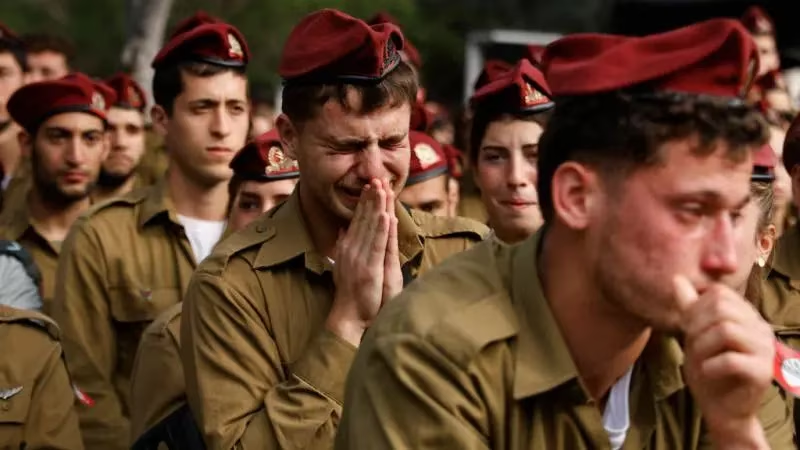
The Israeli Army announced on Tuesday evening the suicide of 21 soldiers during 2025, out of 151 killed since the beginning of the current year.
The occupation army stated in a statement: "151 of its officers and soldiers were killed during the year 2025, including 88 killed in operational activities."
It added that "3 soldiers were killed in attacks and hostile acts, 15 due to illness, 17 in civilian traffic accidents, one in a military traffic accident, another due to a weapon incident, and 5" in other incidents not mentioned.
Also, 21 soldiers committed suicide, including 11 in mandatory service, 9 in reserve, and one soldier from the regular forces.
How many were the Israeli Army's casualties since the start of the war on Gaza?
According to the army's announced data, 923 soldiers were killed and 3,879 were injured since the start of the war on the Gaza Strip on October 7, 2023.
The Israeli Army faces internal accusations of concealing a higher toll of its human losses, to maintain morale and within a propaganda war.
The army continued on Tuesday that it "is working to provide tools and support for all service members in the fields of mental health and suicide prevention."
It added that a specialized clinic was established for regular service members concerned with treating "combat reactions of those discharged from service."
On December 16 of this month, an Israeli soldier committed suicide by shooting himself in a military base in the north of the country, according to a Hebrew newspaper.
With his suicide, the number of soldiers who committed suicide since the beginning of the genocide war on Gaza rose to 61, according to Israeli data.
Soldiers in the Israeli army usually suffer from severe psychological disorders after participating in genocide crimes in Gaza, where about 2.4 million Palestinians live.
The Israeli genocide in Gaza has resulted in more than 71,000 Palestinian martyrs and 171,000 injured, mostly children and women, and massive destruction, with reconstruction costs estimated by the United States at about $70 billion.
Since October 10 last month, a ceasefire agreement has prevailed between Hamas and Israel, which the latter violates daily, resulting in the martyrdom of 418 and the injury of 1,141 Palestinians, according to the government media office in the sector.
The Israeli Army faces internal accusations of concealing a higher toll of its human losses, to maintain morale and within a propaganda war.
PALESTINE
Wed 31 Dec 2025 2:35 am - Jerusalem Time
Netanyahu: Hamas still possesses 20,000 fighters and tens of thousands of Kalashnikov rifles
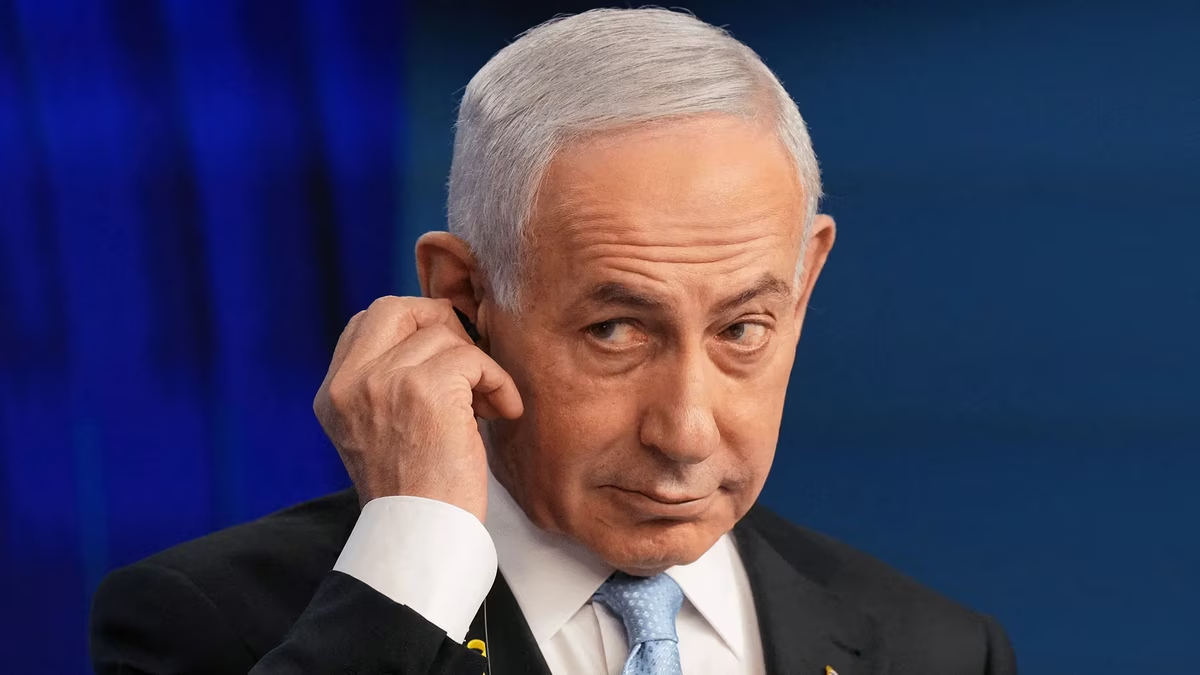
Israeli Prime Minister Benjamin Netanyahu said that the Islamic Resistance Movement (Hamas) still possesses about 20,000 fighters with tens of thousands of Kalashnikov rifles, despite the military operations carried out by the Israeli occupation army over two years in the Gaza Strip.
Netanyahu - wanted by the International Criminal Court on charges of committing war crimes in Gaza - added in an interview that these fighters still hold about 60,000 stored rifles, emphasizing that the war goals have not been fully achieved, foremost among them "the complete elimination of Hamas", according to his expression.
Netanyahu continued his speech saying "Israel emerged from the seven-front war imposed on us as the strongest country in the Middle East".
Regarding the deployment of international forces in the Gaza Strip, Netanyahu explained that there is an attempt to bring in an international force but this attempt has not succeeded so far "but we will give it a chance".
In response to a question about transitioning to the second phase of the ceasefire in Gaza, Netanyahu said "I think we should give the matter a chance".
He said he is making a special effort to stop retaliatory actions in the occupied West Bank, and that he wants peaceful coexistence between Israelis and Palestinians living in the West Bank, noting that Israel must ultimately have military control over the West Bank.
In another interview, Netanyahu said "We will recover the remains of the last hostage in Gaza by any means necessary".
Regarding the separatist region of Somaliland, the Israeli Prime Minister said that "Somaliland wants to join the Abraham Accords and differs democratically from the rest of Somalia".
Netanyahu issued a warning to Iran saying "We do not want escalation with Iran and if it dares to target us, the consequences will be catastrophic for it", adding that Tehran must accept the reality that it should not possess nuclear enrichment capability.
Hamas still possesses about 20,000 fighters with tens of thousands of Kalashnikov rifles, despite the military operations carried out by the Israeli occupation army over two years in the Gaza Strip.
PALESTINE
Wed 31 Dec 2025 1:09 am - Jerusalem Time
The Israeli Army Admits Its Soldiers Stormed a Palestinian Village and Vandalized Citizens' Cars
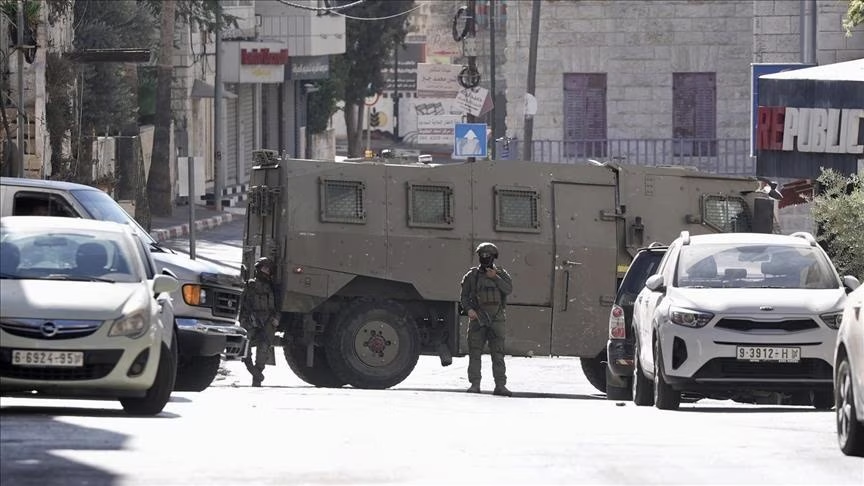
The Israeli Army admitted on Tuesday evening that its soldiers stormed a Palestinian village in the occupied West Bank and vandalized citizens' cars.
The Army stated in a statement: "Last Saturday, a force from the Paratroopers Brigade entered the village of Deir Dibwan, contrary to instructions and without permission," east of Ramallah city.
It added: "The soldiers vandalized Palestinian vehicles in a manner that violates regulations, orders, and what is expected from fighters of the Israeli Army."
The Army claimed that upon learning of it, it opened an in-depth investigation into the incident "to examine the soldiers' conduct," adding "during the investigation, additional violations were revealed and dealt with as well," without specifying them.
It indicated that "all the soldiers involved were summoned to their commanders, tried, and punished."
It said that the platoon commanders who participated in the incident "were tried by the Paratroopers Brigade commander with military imprisonment, and another fighter from the Benjamin Brigade who initiated the vandalism acts was tried by the Benjamin Brigade commander with military imprisonment as well."
The Army continued in its statement "all the commanders involved in the incident will not return to command or combat positions in the Army."
It added: "The results of the initial investigation in the case were presented to the Chief of Staff (Eyal Zamir), who concluded that the incident is serious and contradicts the values of the Israeli Army and the standards of professionalism expected from its fighters."
Israeli settlers attacked a Palestinian sheep farm and assaulted workers in it in the municipality of Deir Dibwan at dawn on Friday before stealing dozens of sheep.
At the time, local sources reported that the settlers attacked the town of Deir Dibwan east of Ramallah, stormed the farm, and assaulted two workers by beating them, before stealing a flock consisting of 150 heads and fleeing.
The sources indicated that the town had previously been subjected to repeated attacks by extremist settlers, including stealing sheep, burning vehicles and shops, and assaulting citizens.
About 750,000 settlers live in hundreds of settlements built on West Bank lands, including 250,000 in East Jerusalem, and they commit daily attacks against Palestinian citizens with the aim of forcibly displacing them.
In November 2025, settlers committed 621 attacks against Palestinians and their properties and livelihoods in the West Bank, according to data from the Palestinian Anti-Wall and Settlement Resistance Commission (governmental).
Since the genocide war in Gaza began on October 8, 2023, the Israeli Army and settlers in the West Bank have killed at least 1,103 Palestinians, injured about 11,000, in addition to arresting more than 21,000.
Israel is also intensifying its crimes to annex the West Bank to it, especially through demolishing Palestinian homes, displacing them, and expanding settlements, according to Palestinian authorities.
Annexing the West Bank to Israel would end the possibility of implementing the two-state solution (Palestinian and Israeli), as stipulated in UN resolutions.
Israel was established in 1948 on Palestinian lands occupied by armed Zionist gangs that committed massacres and displaced hundreds of thousands of citizens, then Tel Aviv occupied the rest of the lands, and refuses to withdraw and establish a Palestinian state.
The soldiers vandalized Palestinian vehicles in a manner that violates regulations, orders, and what is expected from fighters of the Israeli Army.
PALESTINE
Wed 31 Dec 2025 12:59 am - Jerusalem Time
Head of the Turkish Presidency's Communication Department Calls for Support of Upcoming March in Istanbul in Solidarity with Gaza
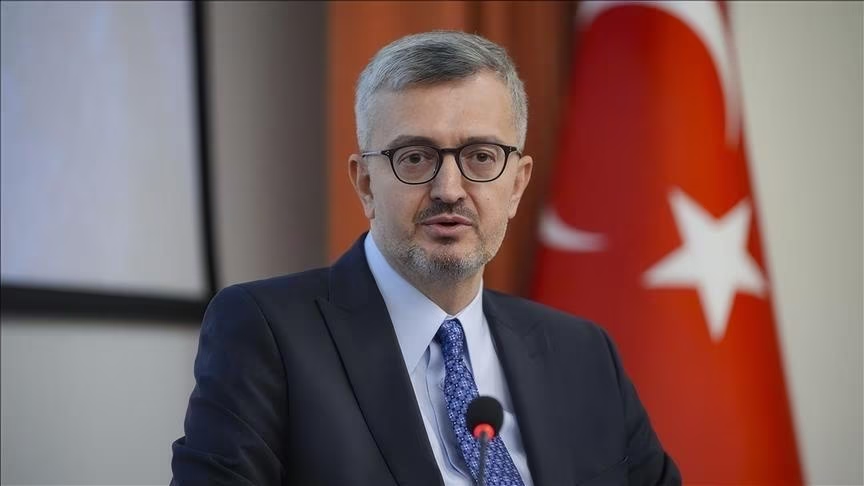
On Tuesday, Fahrettin Altun, Head of the Turkish Presidency's Communication Department, called on citizens of his country to support an upcoming march in Istanbul next Thursday, demanding a halt to the Israeli genocide against Palestinians.
This came in a post on the Turkish platform "X", regarding a march organized by the "National Will Platform" and the "Humanity Alliance" on January 1st in the center of Istanbul on the Galata Bridge, to demand an end to the massacre in Palestine.
Altun said that the march will be organized for the third time with the participation of nearly 400 Turkish non-governmental organizations.
He added: "We will meet on the Galata Bridge so that we do not remain silent in the face of the humanitarian tragedy in Gaza, and to leave a mark for humanity, justice, and history."
He continued: "Standing against oppression and injustice, and showing solidarity with the oppressed, is one of the requirements of humanity, and this march is a strong call for justice, mercy, and our shared human values."
Altun concluded by saying: "Every step on the Galata Bridge will echo as a voice of conscience around the world."
It is worth noting that tens of thousands of Turkish citizens participated at the beginning of this year in a solidarity march with the Gaza Strip in the center of Istanbul, organized by the "National Will Platform" under the patronage of the "Turkey Youth Foundation".
Following the dawn prayer, the march, which was named "Mercy for our martyrs, support for Palestine, and curse on Israel," started from the Hagia Sophia, Eminönü, Sultan Ahmed, and Süleymaniye mosques towards the Galata Bridge.
The participants chanted slogans and takbirs, raised the Turkish and Palestinian flags, coinciding with the genocide committed by Israel against Palestinians in the Gaza Strip.
With American support, Israel launched a war of extermination in Gaza on October 8, 2023, which lasted two years, resulting in more than 71,000 Palestinian deaths and more than 171,000 injuries, mostly children and women, along with massive destruction of infrastructure.
We will meet on the Galata Bridge so that we do not remain silent in the face of the humanitarian tragedy in Gaza, and to leave a mark for humanity, justice, and history.
ARAB AND WORLD
Tue 30 Dec 2025 10:58 pm - Jerusalem Time
The pro-Israel lobby changes its tactics in America after rising public anger
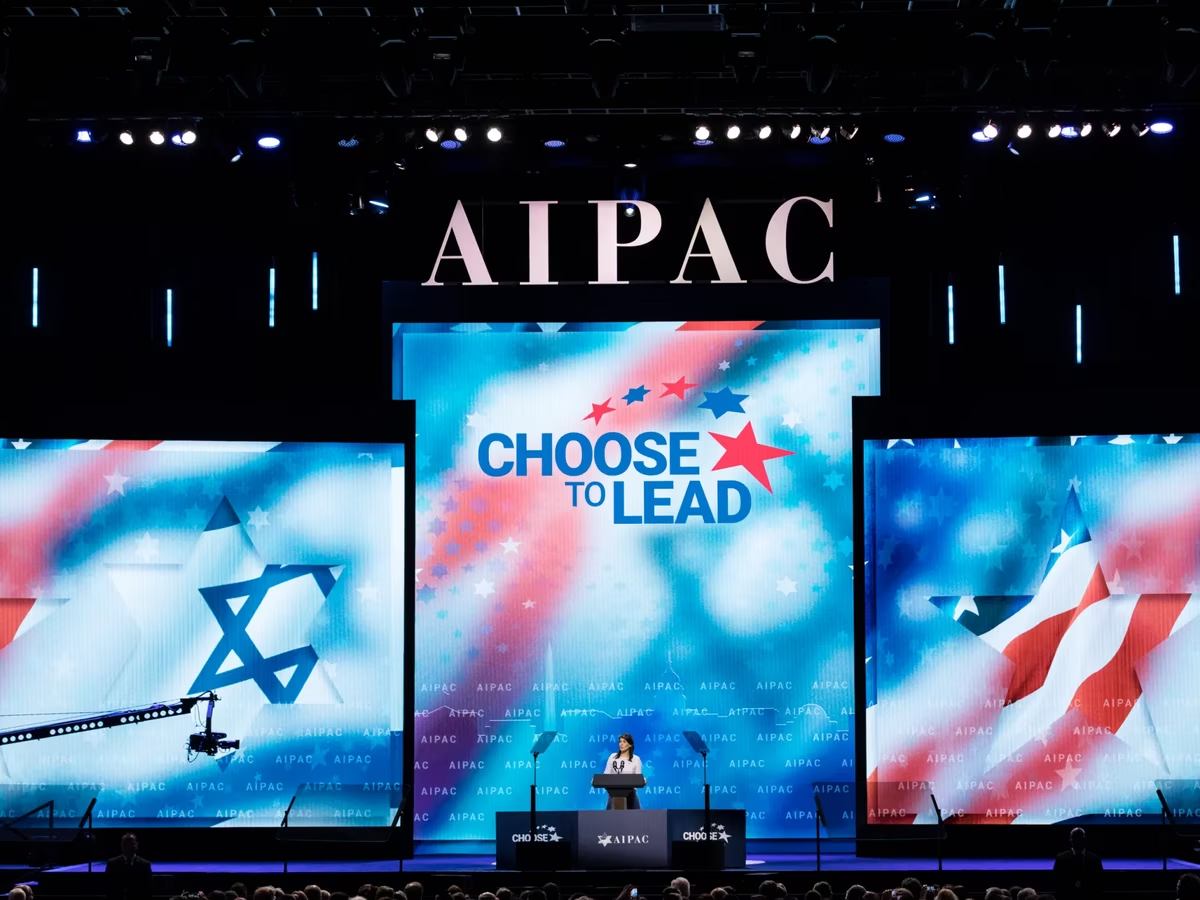
The American website 'Intercept' discussed the transformations facing the pro-Israel lobby in the United States, primarily the American Israel Public Affairs Committee (AIPAC), amid rising public anger over Israel's war on Gaza and its political repercussions on the American elections.
It noted that the growing support for Gaza forced 'AIPAC' to abandon its confrontational public campaigns from previous elections, replacing them with a more cautious approach that allows it to financially support its candidates through intermediaries and indirect funding networks, to maintain its influence in Congress.
The report mentioned that AIPAC waged an unprecedented public campaign during the 2024 election cycle to prove its influence, spending more than $100 million to oust critics of Israel from Congress, and credited itself with supporting 361 pro-Israel candidates who won in hundreds of electoral races.
This success was met with rising 'public disgust' over the genocide in Gaza, according to political affairs correspondent Akila Lacy.
This led to a widespread backlash in American politics, where a growing movement seeks to eliminate AIPAC's influence and push anti-AIPAC candidates into Congress, provided they pledge to reject support from the pro-Israel lobby, according to Intercept.
According to the report, AIPAC appears more cautious ahead of the 2026 midterm elections, having retreated from the aggressive public strategy it adopted in the previous cycle.
Former Democratic Representative Mary Newman, who was ousted in 2022 with help from pro-Israel donors, said 'AIPAC fully realizes that its reputation is at rock bottom,' as reported by the site.
For his part, Hamed Bendas, communications director at the 'Middle East Understanding Policy Project,' said that 'there is an increase in the number of Democrats who disavow AIPAC money because it has become an electoral burden.'
He added that 'it is unclear whether they will maintain this standard by rejecting support from other organizations, primarily the Democratic Majority for Israel, which adopts political agendas similar to AIPAC, especially regarding more weapons for Israel.'
The site warned that AIPAC's public retreat does not mean losing its influence in upcoming elections, as it continues to work behind the scenes to support its candidates.
It explained that AIPAC resorted in previous election cycles to indirect support methods, funding the candidates it supports through alternative channels to distance its name and criticisms from the campaigns, according to the report.
Recently -the report continues- donors linked to the pro-Israel lobby have funded electoral campaigns in various districts without officially announcing it.
Former Representative Newman mentioned that AIPAC is withdrawing its name from the forefront and passing funding through other committees and individual donors, allowing candidates to claim that the support came from independent donors, avoiding any direct link to the pro-Israel lobby.
The report described these moves as the latest in a series of AIPAC's attempts to adapt to the rising hostility toward Israel in recent years, thus returning to the traditional method it operated with before its direct intervention in the 2022 elections.
Over more than half a century, AIPAC built its influence quietly within Congress and Washington through political pressure, presenting itself as a source of information for Congress members, organizing trips to Israel, and expanding its network of regional activists, without directly entering electoral campaigns.
This strategy succeeded for a long time in establishing bipartisan consensus on supporting Israel, and AIPAC had previously affirmed that it would not launch a political action committee, according to the report.
This changed -according to Intercept- with the increasing number of candidates who began running in elections in the late last decade based on criticizing unconditional American military support for Israel.
At that point, AIPAC began direct spending on electoral campaigns, starting with funding ads for the 'Democratic Majority for Israel' organization, which attacked Bernie Sanders during the 2020 presidential primaries, according to the site.
Intercept's report concluded that AIPAC is not withdrawing from the scene, but repositioning, reviving its traditional methods that relied on indirect influence for decades, in an attempt to maintain its influence in a political environment that has become more hostile toward it than ever.
AIPAC fully realizes that its reputation is at rock bottom.
PALESTINE
Tue 30 Dec 2025 7:45 pm - Jerusalem Time
Several Palestinians injured due to wall collapse on displaced people's tent in southern Gaza
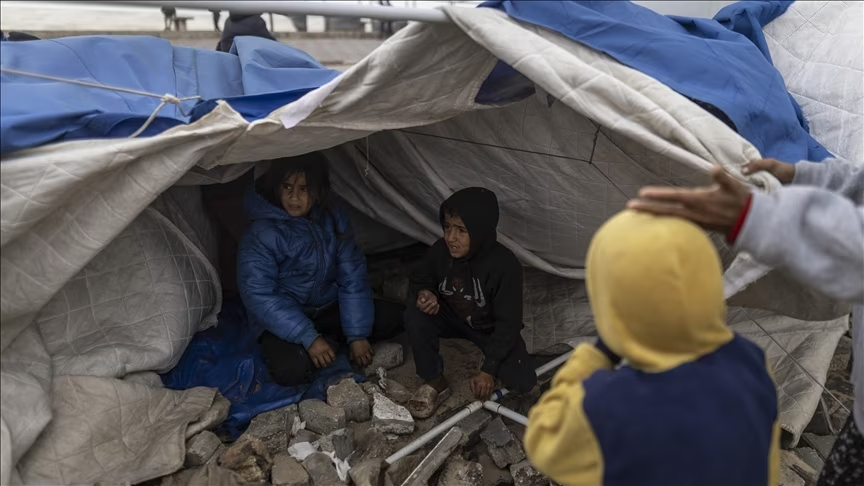
Several Palestinians were injured on Tuesday evening due to a wall collapsing on a tent housing displaced people in southern Gaza Strip.
Medical sources reported the transfer of a number (not specified) of injured, including children, following the collapse of a wall of a house damaged by previous Israeli bombing during the genocide war, in the Al-Mawasi area northwest of Rafah city.
Recently, incidents of collapsing cracked and dilapidated buildings in Gaza have recurred due to bad weather conditions, resulting in fatalities and injuries.
In the latest statistics, Gaza Civil Defense announced on Monday that 25 people have died due to weather depressions since the beginning of December of this year, including 6 children who died from extreme cold.
The spokesperson for Civil Defense, Mahmoud Basil, said in a statement that 18 residential buildings damaged by previous Israeli bombing collapsed completely due to the effects of weather depressions and rains in the same period.
More than 110 residential buildings suffered partial collapses described as "dangerous", posing a direct threat to the lives of thousands of Palestinians living in them or nearby, according to Basil.
Palestinians are forced to reside in cracked and dilapidated buildings due to the lack of options amid Israel's destruction of most buildings in the sector.
Despite the end of the genocide with the entry of the ceasefire on October 10, 2025, living conditions have not seen significant improvement, due to Israel's failure to fulfill its commitments, including importing the agreed quantities of food, relief, and medical supplies, and mobile homes.
On October 8, 2023, Israel began a genocide in Gaza that lasted two years, leaving more than 71,000 Palestinian deaths and over 171,000 injured, and massive destruction affecting 90 percent of the civilian infrastructure, with reconstruction costs estimated by the United Nations at around 70 billion dollars.
Palestinians are forced to reside in cracked and dilapidated buildings due to the lack of options amid Israel's destruction of most buildings in the sector.
PALESTINE
Tue 30 Dec 2025 7:29 pm - Jerusalem Time
Martyrdom of two girls and injury of others in Gaza.. and the occupation carries out 7 demolition operations in Rafah and east of Gaza City
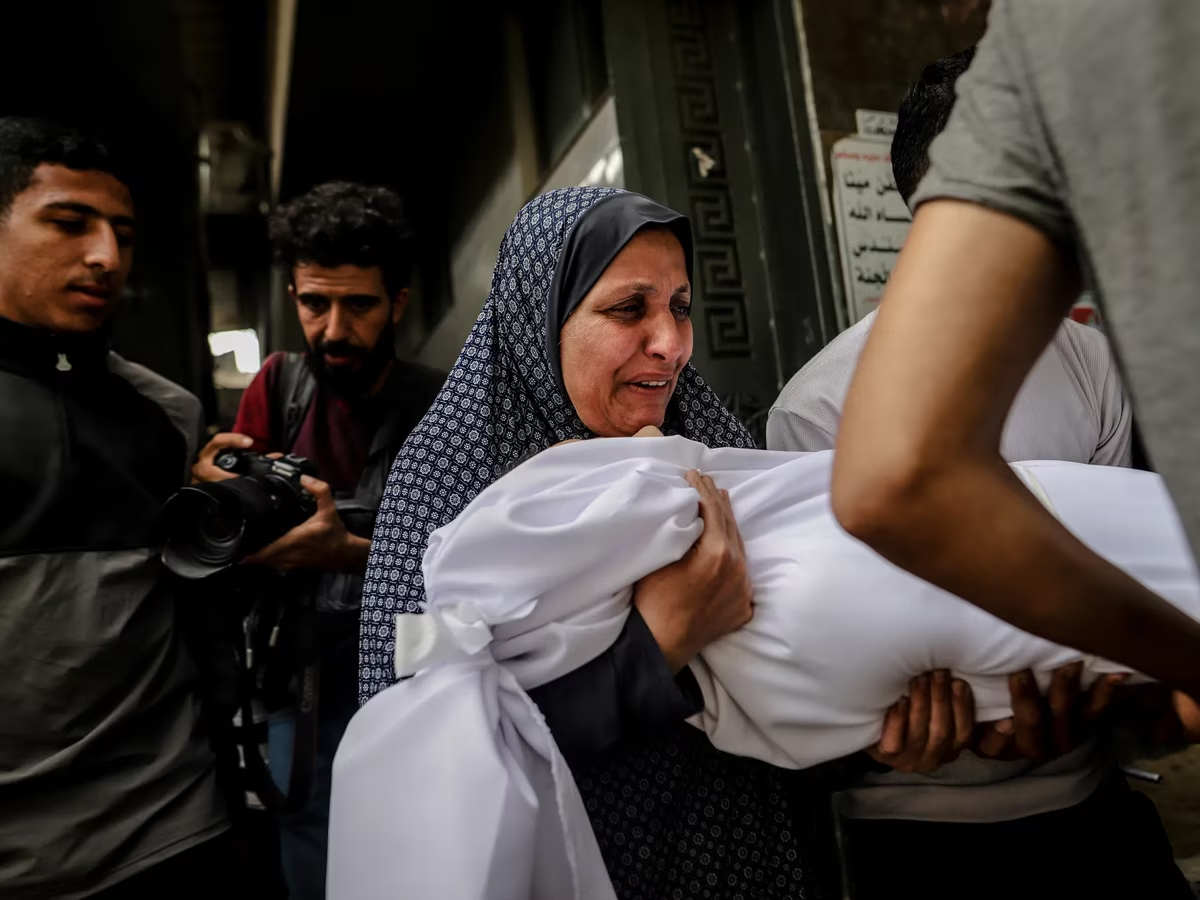
Two girls were martyred and a number of other Palestinians were injured today, Tuesday, in the Gaza Strip by Israeli occupation gunfire and due to the repercussions of the war on the sector, while the occupation army carried out 7 simultaneous demolition operations in areas of its deployment north of Rafah city, and another east of Gaza city.
A medical source at Al-Shifa Hospital said that an eleven-year-old girl was martyred by gunfire from the occupation army outside its deployment areas in the Al-Zarqa area in Al-Tuffah neighborhood east of Gaza City.
A source in the ambulance and emergency services also reported that another girl was martyred and a number of other Palestinians were injured in the collapse of a wall on a displaced persons' tent in the Moasi area of Rafah south of the sector.
A child was also injured by fire from an Israeli drone outside the deployment areas of the Israeli occupation army in Khan Yunis city.
A Palestinian woman was injured with wounds by gunfire from occupation forces infiltrating east of Deir al-Balah city in the center of the sector.
In a related development, a source at the Al-Shifa Medical Complex in Gaza City announced the drowning of a Palestinian fisherman after being pursued by an Israeli warship off the coast of Gaza City.
The Fishermen's Committees Union said that the pursuit of the Israeli boats against the fishermen during their activity led to the overturning of one of the fishing boats coinciding with high sea waves and the martyrdom of one of the fishermen.
It is noted that the targeting of civilians in Gaza continues in parallel with the worsening suffering of the displaced amid the weather depression striking the sector.
The Israeli army still controls the southern and eastern strips of the sector, in addition to large parts of northern Gaza, continuing to occupy nearly 60% of the sector's area.
Since the ceasefire agreement came into effect on October 10 last, the Israeli army has committed hundreds of violations, resulting in the martyrdom of 418 Palestinians and the injury of 1,141 others, according to data from the Gaza Government Media Office.
An eleven-year-old girl was martyred by the occupation army's gunfire outside its deployment areas in the Al-Zarqa area in Al-Tuffah neighborhood east of Gaza City.
PALESTINE
Tue 30 Dec 2025 6:47 pm - Jerusalem Time
Western countries express concern over the deterioration of the humanitarian situation in Gaza.. and the occupation kills a child
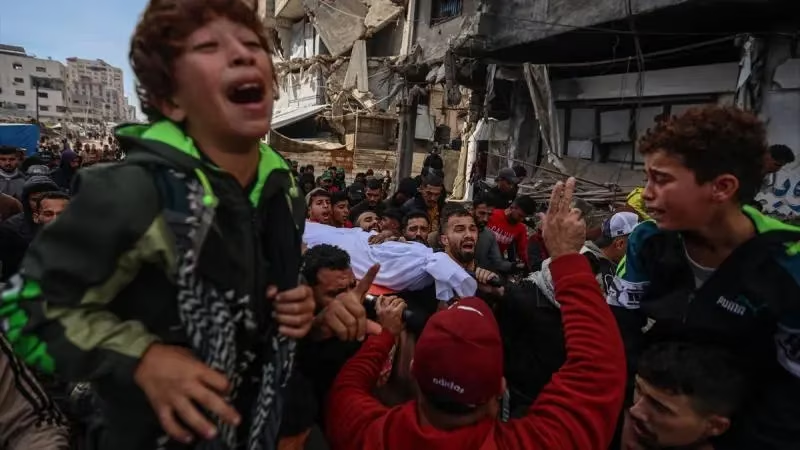
Britain, Canada, France, and other countries expressed in a joint statement today, Tuesday, their deep concern over the deterioration of the humanitarian situation in Gaza, and called on Israel to take urgent measures.
The statement issued by the foreign ministers of Canada, Denmark, Finland, France, Iceland, Japan, Norway, Sweden, Switzerland, and Britain stated: "We express our deep concern over the renewed deterioration of the humanitarian situation in Gaza, which remains catastrophic."
On the ground, the Israeli army killed a Palestinian child on Tuesday by shooting at her in the Tuffah neighborhood east of Gaza City.
The child Dana Hussein Muqat (11 years old) was martyred in the Zarqa area of the Tuffah neighborhood, which is among the areas from which the Israeli army withdrew under the ceasefire agreement.
This comes amid the ongoing Israeli violations of the ceasefire agreement that came into effect on October 10, resulting in the martyrdom of 414 Palestinians and the injury of 1,145 others.
Humanitarian-wise, the Health Ministry in Gaza warned on Tuesday that cancer patients in the sector face a "slow death sentence" amid a severe shortage of medicines and widespread deprivation of diagnostic services.
The medical director of the "Gaza Cancer Center" affiliated with the ministry, Muhammad Abu Nada, stated in a statement: "Cancer patients face a slow death sentence, which heralds an unprecedented humanitarian and health catastrophe with serious consequences that cannot be remedied."
This shortage results from the Israeli occupation authorities' failure to fulfill their obligations stipulated in the ceasefire agreement regarding opening crossings and allowing patients to travel for treatment, in addition to importing the agreed quantities of medical aid.
On December 21, the Health Ministry in Gaza stated in a statement that the shortage in the list of therapeutic oncology drugs reached 70% due to the closure of crossings, causing the death of several cancer patients.
Abu Nada confirmed the existence of a "major shortage in the list of oncology drugs, in addition to depriving patients of diagnostic services, and the continued closure of crossings for their exit for treatment abroad is the completion of the triangle of death that threatens their lives at any moment."
He called on the international community to take urgent action to ensure the safe and rapid exit of cancer patients from Gaza for treatment abroad, considering it "the only way to save their lives."
In a previous statement, the Health Ministry in Gaza said that Israel continues to reduce the entry of medical trucks into the sector to less than 30% of the monthly need, causing a shortage in the drug list reaching 52%, and in medical supplies reaching 71%.
This shortage crisis is added to the difficult reality experienced by the health system in Gaza due to its exposure during the two years of genocide to systematic Israeli targeting that affected hospitals, medical facilities, drug warehouses, and the working staff in the field.
Despite the end of the genocide with the entry of the ceasefire agreement into effect on October 10, the ministry confirmed earlier a state of "dangerous and unprecedented depletion" suffered by the health system, leading to a sharp decline in its ability to provide diagnostic and therapeutic services.
We express our deep concern over the renewed deterioration of the humanitarian situation in Gaza, which remains catastrophic.
ARAB AND WORLD
Tue 30 Dec 2025 6:01 pm - Jerusalem Time
Ma'ariv: Saudi Arabia's normalization with Tel Aviv depends on political change in the Israeli government's composition
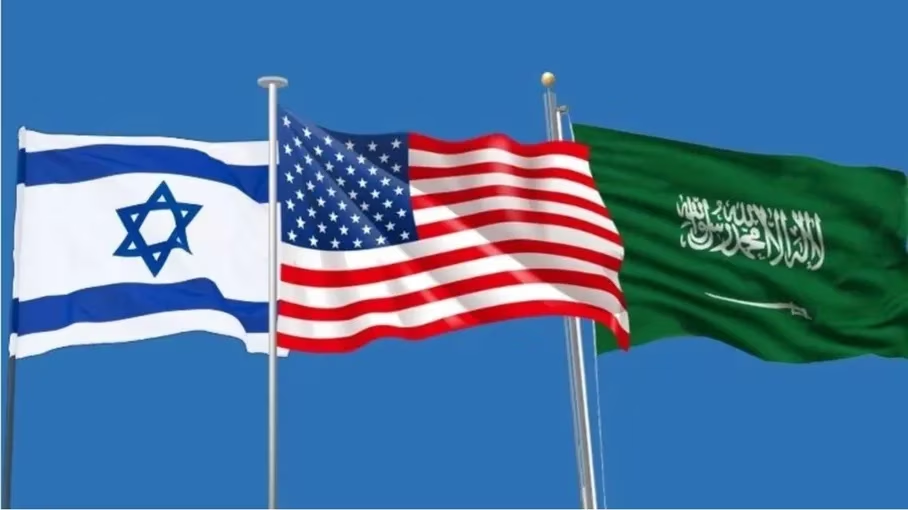
The Hebrew newspaper "Ma'ariv" highlighted the possibility of Saudi Arabia normalizing relations with Tel Aviv in the coming period, confirming that this depends on political change in the composition of the Israeli government.
The newspaper mentioned that "the possibility of reaching a historic normalization agreement between Israel and the Kingdom of Saudi Arabia has returned to the forefront, but according to various assessments, it depends on a complex mix of American moves, political change in Israel, and removing the legal barriers surrounding the Prime Minister."
The newspaper quoted expert Kobi Barda as saying that "the opportunity to reach an agreement may be available as early as 2026, as part of a broad strategic plan led by the American administration," noting that "the Kingdom of Saudi Arabia does not view normalization as a specific regional step, but as a fundamental pillar in the global conflict between the United States and China, and in building a new economic security structure."
Barda linked the political developments to "the political situation in Israel and the international pressures surrounding Gaza," explaining that the United States is striving to move to "the second phase" after the war, but is facing difficulty in finding an international force willing to confront Hamas directly.
Barda clarified that under the current Israeli government, normalization cannot be achieved, saying: "With the current government, this is impossible. But according to the American timeline, the president will have to reach a peace agreement by September."
According to the expert, the Prime Minister who will sign the agreement will not head the current coalition: it could be Benjamin Netanyahu in a new government, or an alternative to him like Naftali Bennett. Barda even hinted at American pressures to reach a legal solution that allows Netanyahu to reach the moment of political decision-making.
"Ma'ariv" confirmed that as long as the legal obstacle before Netanyahu is not lifted, there will be no real option for the planned political step, as a normalization agreement with Saudi Arabia under the current coalition composition is impossible, and the presence of Itamar Ben-Gvir, Bezalel Smotrich, and Orit Struck hinders any mention of a two-state solution.
The newspaper noted that the demands of the Saudi Crown Prince are clear, and include clear defense guarantees, long-term security commitments, and practical and serious recognition of the Palestinians' fate.
With the current government, this is impossible. But according to the American timeline, the president will have to reach a peace agreement by September.
PALESTINE
Tue 30 Dec 2025 9:03 am - Jerusalem Time
Netanyahu Agrees to the Second Phase of Gaza Agreement and Trump Demands Changes to West Bank Policies
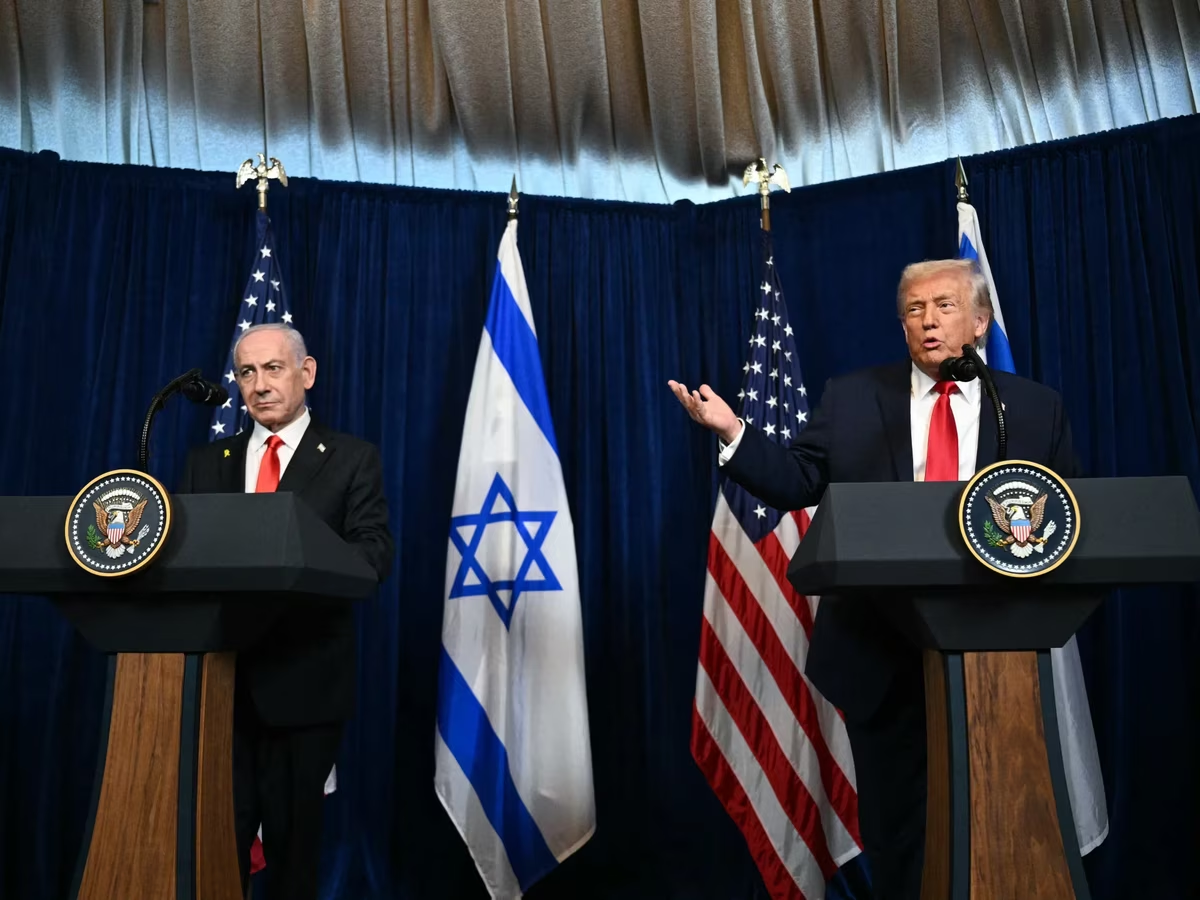
According to two informed sources, Israeli Prime Minister Benjamin Netanyahu has agreed to proceed with the second phase of the Gaza agreement, while US President Donald Trump and his senior advisors have demanded changes to Israel's policies in the occupied West Bank.
The US administration sees that the violent escalation in the West Bank could undermine the implementation of the peace agreement in Gaza and hinder efforts to expand the Abraham Accords for normalization before the end of Trump's term.
The US message emphasized that changing course in the West Bank is necessary to repair Israel's relations with European countries and to enhance opportunities for expanding normalization agreements.
The report also quoted one of the sources as saying that Netanyahu spoke strongly against settler violence and expressed readiness to take further measures.
Since the start of the genocide war in the Gaza Strip, the Israeli occupation army and settlers in the West Bank, including East Jerusalem, have killed more than 1,103 Palestinians and injured about 11,000, in addition to arresting more than 21,000.
It stated that Netanyahu agreed to proceed with the second phase of the ceasefire agreement in Gaza, despite his disagreements with the Trump team on its implementation mechanisms, and also accepted the US president's request to resume talks with the Syrian government regarding a potential security agreement.
On October 10th last year, the first phase of the ceasefire agreement came into effect, while Israel violated some of its provisions and delayed the transition to the second phase, citing the remaining body of one of its soldiers in Gaza captivity, despite the Palestinian factions continuing their search for him amid the massive destruction caused by the Israeli genocide.
The agreement was supposed to end a collective genocide committed by the Israeli occupation army over two years starting from October 7, 2023, which resulted in about 71,000 martyrs and more than 171,000 injured Palestinians, most of them children and women, but Israel continues its violations and suffocating blockade on the sector to this day.
The US administration sees that the violent escalation in the West Bank could undermine the implementation of the peace agreement in Gaza.
ARAB AND WORLD
Tue 30 Dec 2025 8:47 am - Jerusalem Time
Trump Asked Netanyahu to Change Israel's Policies in the Occupied West Bank
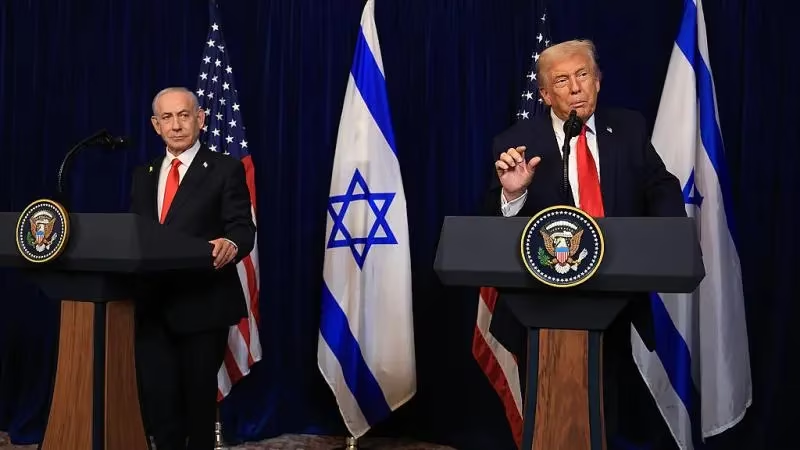
The Axios website reported today, Tuesday, that US President Donald Trump and his senior advisors asked Israeli Prime Minister Benjamin Netanyahu during their meeting to change Israel's policies in the occupied West Bank.
This comes at a time when international pressure on Israel is increasing to curb settler attacks on Palestinians in the West Bank.
Trump had confirmed yesterday, Monday, that he had not reached "complete consensus" with Netanyahu regarding the occupied West Bank, during the joint press conference between them following their meeting.
In his speech at the press conference, Trump said: "I discussed the issue of the West Bank with Netanyahu, but we did not agree 100%."
In response to a question whether the Palestinian Authority would be part of Gaza in the "day after," Netanyahu replied: "We will see if they carry out reforms. It depends on them."
He continued: "I believe that President Trump has clarified the required reform conditions for the Palestinian Authority to participate in Gaza reconstruction plans," as he put it.
Contrary to these statements, Netanyahu had previously emphasized on more than one occasion his rejection of the Palestinian Authority taking any role in the Gaza Strip after the war.
Netanyahu praised the US President, saying: "We have never had a close friend like you."
He added: "I think he (Trump) is exceptional in his friendship and in his support for Israel. The President has broken many norms, and therefore we also decided to award him the Israel Prize (Israel's highest award)."
Regarding Syria, the Israeli Prime Minister said that interest requires there to be "peace borders" with Syria.
Netanyahu continued: "We want to ensure that these borders are safe, without terrorists and protecting our Druze friends and minorities in Syria," as he put it.
President Trump responded: "This will work between Israel and Syria."
Israel has occupied the Golan since 1967, then expanded after the fall of Bashar al-Assad's regime into the buffer zone and Mount Hermon in southern Syria, and announced the collapse of the disengagement agreement concluded between the two sides since 1967.
In recent months, Syrian-Israeli talks were held to reach a security agreement that curbs Tel Aviv's assaults on Damascus, but the agreement did not materialize due to Israel's insistence on not withdrawing from the areas it occupied after the fall of Assad on December 8, 2024.
Despite US President Donald Trump's call for Israel to calm down with Syria, Tel Aviv continued its violations against Damascus's sovereignty through bombings and incursions that have become almost daily in recent times.
Earlier in the evening of Monday, Trump hosted the Israeli Prime Minister at the Mar-a-Lago resort in Florida, shortly after Netanyahu's meeting with US Secretary of State Marco Rubio along with Trump's advisors Jared Kushner and Steve Witkoff.
Netanyahu also met shortly before his meeting with Trump with US Secretary of Defense Pete Hegseth.
I discussed the issue of the West Bank with Netanyahu, but we did not agree 100%.
ARAB AND WORLD
Tue 30 Dec 2025 8:35 am - Jerusalem Time
Egyptian Foreign Minister: We faced pressures and large financial offers to deport the Palestinians
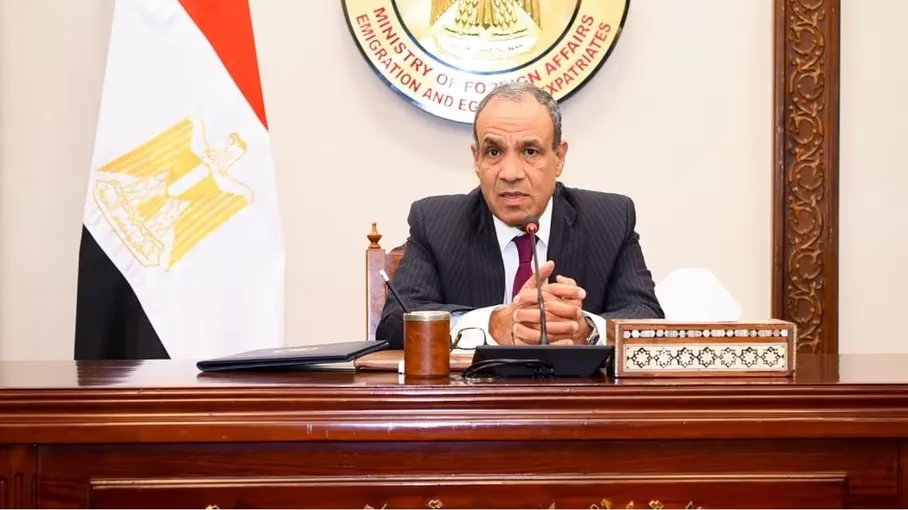
The Egyptian Foreign Minister, Badr Abdel Ati, revealed that Cairo was subjected to pressures and large financial offers in recent times, in the context of attempts to pass a plan to deport Palestinians from the Gaza Strip, confirming that the Egyptian state dealt with these pressures with the logic of international law and rejected any bargain that affects Palestinian rights or national security.
Abdel Ati explained that some of these offers included waiving huge financial debts on Egypt, in addition to other economic incentives, in exchange for accepting arrangements related to the deportation of Palestinians, but Cairo categorically rejected those proposals, considering that accepting them represents a violation of the rules of international legitimacy.
The minister affirmed that Egypt's position is known and clear to all parties, including the Israeli side, noting that long years of diplomatic relations have established a mutual understanding of the nature of the red lines that cannot be crossed.
Regarding the humanitarian situation in the Gaza Strip, Abdel Ati emphasized that Israel, as an occupying power, bears full legal responsibility for opening the crossings and ensuring the flow of aid, accusing Tel Aviv of ignoring its international obligations, and added that abandoning the international law system will lead the world to the logic of chaos and "the law of the jungle."
The Foreign Minister addressed the Rafah crossing file, confirming that Egypt rejects its unilateral operation, and that any talk of dividing the Gaza Strip or imposing new paths and borders is completely rejected. He also indicated that there is a conviction in Washington of the need to quickly move to the second phase of the ceasefire agreement, with continued Egyptian efforts to push towards a fair settlement.
On the energy front, Abdel Ati denied any political dimensions to gas import agreements from the Israeli occupation, saying they are purely commercial deals between international companies, and confirmed that Egypt's ownership of two liquefaction plants in Idku and Damietta gives it a pivotal position as a regional center for gas collection and re-export, whether from Israel or Cyprus, alongside new discoveries that support local production.
On the Syrian file, the minister affirmed Cairo's support for the unity of Syrian territories and its stability, pointing to continuous communication with the new Syrian administration, and advised it not to provide pretexts for foreign interventions. He also emphasized the importance of combating terrorism and preventing Syria from becoming a platform threatening neighboring countries.
Abdel Ati also addressed the refugee file, confirming that Egypt bears heavy burdens without sufficient international support, warning that the continuation of this situation requires the international community to bear its responsibilities, especially in light of the escalating regional crises.
In conclusion of his speech, the Foreign Minister reiterated that the Grand Ethiopian Renaissance Dam file represents a national security issue that does not tolerate negligence, stressing that Egypt will defend its water rights by the means guaranteed by international law, while maintaining balanced relations with the Nile Basin countries except for the ongoing dispute with Ethiopia over unilateral policies.
The Egyptian state dealt with these pressures with the logic of international law and rejected any bargain that affects Palestinian rights or national security.
ARAB AND WORLD
Tue 30 Dec 2025 7:37 am - Jerusalem Time
Trump: We have not reached full agreement with Netanyahu regarding the West Bank
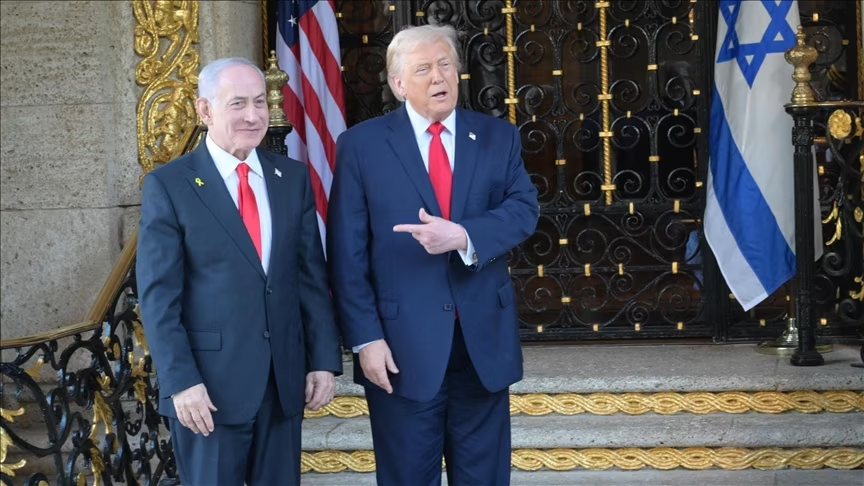
US President Donald Trump said on Monday that he had not reached "full agreement" with Prime Minister Benjamin Netanyahu regarding the occupied West Bank.
This came during a joint press conference held by Trump with Netanyahu at the White House following a meeting between them.
In his speech at the press conference, Trump said: "I discussed the West Bank issue with Netanyahu, but we did not agree 100 percent."
In response to a question whether the Palestinian Authority would be part of Gaza in the "day after," Netanyahu replied: "We will see if they carry out reforms. It depends on them."
He continued: "I believe that President Trump has clarified the required reforms from the Palestinian Authority to participate in Gaza reconstruction plans."
Contrary to these statements, Netanyahu had previously emphasized in more than one occasion his rejection of the Palestinian Authority taking any role in Gaza after the war.
Netanyahu praised the US President, saying: "We have never had a close friend like you."
He added: "I think he is exceptional in his friendship and support for Israel. The President has broken many norms, and therefore we decided to award him the Israel Prize (Israel's highest award)."
Regarding Syria, the Israeli Prime Minister said that interest requires having "peace borders" with Syria, and did not rule out the Palestinian Authority being a partner in the "day after" in Gaza, contradicting his previous statements.
Netanyahu continued: "The interest is to have peace borders with Syria."
He added: "We want to ensure these borders are safe, without terrorists, and protect our Druze friends and minorities in Syria."
President Trump responded: "This will work between Israel and Syria."
Israel has occupied the Golan since 1967, then expanded after the fall of Bashar al-Assad's regime into the buffer zone and Mount Hermon south of Syria, and announced the collapse of the ceasefire agreement signed between the two sides since 1967.
In recent months, Syrian-Israeli talks have been held to reach a security agreement that stops Tel Aviv's attacks on Damascus, but the agreement has not materialized due to Israel's insistence on not withdrawing from the areas it occupied after Assad's fall on December 8, 2024.
Despite US President Donald Trump's call for Israel to calm down with Syria, Tel Aviv continued its violations of Damascus's sovereignty through bombings and incursions that have become almost daily in recent times.
Earlier in the evening of Monday, Trump received the Israeli Prime Minister at Mar-a-Lago resort in Florida, shortly after Netanyahu's meeting with US Secretary of State Marco Rubio along with Trump's advisors Jared Kushner and Steve Witkoff.
Netanyahu also met shortly before his meeting with Trump with US Defense Secretary Pete Hegseth.
On Sunday evening, Netanyahu arrived in Florida on a visit announced by his office to last 5 days.
In recent days, Hebrew media reported that Netanyahu and Trump's discussions are expected to focus on the second phase of the ceasefire in Gaza, in addition to issues related to Iran, Syria, and Lebanon.
The Israeli Army Radio reported earlier in the evening of Monday that Trump may not make the return of the body of the Israeli policeman held in Gaza, Ran Guili, a condition for moving to the second phase.
Israel conditions the start of negotiations to launch the second phase of the agreement on receiving the body of the last prisoner in Gaza, Ran Gvili, while Hamas confirms that it may take time to extract it due to the massive destruction in Gaza.
On Wednesday, the Hebrew Channel 12 reported that Washington informed Israel and the mediators that the second phase of Trump's plan for a ceasefire in Gaza will begin early January 2025.
It is recalled that on September 29, Trump announced a peace plan and ceasefire in Gaza consisting of 20 points, including: the release of Israeli prisoners, ceasefire, disarmament of Hamas, Israel's withdrawal from the sector, formation of a technocratic government, and deployment of an international stabilization force.
On October 10, the first phase of the ceasefire agreement came into effect, while Israel violated some of its provisions and delayed moving to the second phase, citing the remaining soldier in captivity in Gaza, despite Palestinian factions continuing their search for him amid the massive destruction caused by the Israeli genocide.
The agreement was supposed to end a genocide committed by Tel Aviv over two years starting from October 8, 2023, which resulted in about 71,000 Palestinian deaths and more than 171,000 injuries, mostly children and women, but Israel continues its violations and suffocating siege on the sector to this day.
I discussed the West Bank issue with Netanyahu, but we did not agree 100 percent.
ARAB AND WORLD
Tue 30 Dec 2025 2:41 am - Jerusalem Time
Trump is considering a deal to sell F-35 fighters to Turkey despite Netanyahu's opposition
US President Donald Trump said on Monday that he is considering a deal to sell F-35 fighter jets to Turkey, during a visit by Israeli Prime Minister Benjamin Netanyahu, who strongly opposes it.
Turkey was excluded from the F-35 fighter development program during Trump's first presidential term due to its purchase of the Russian S-400 air defense system.
Washington also prevented Turkey from buying F-35 aircraft, claiming that the presence of the S-400 system allows Russia to gather information about the capabilities of these aircraft. Nevertheless, Trump has good relations with Turkish President Recep Tayyip Erdogan.
Trump responded to a question about the deal to sell F-35 aircraft to Turkey during his meeting with Netanyahu in Florida by saying, "We are seriously considering it."
In response to a question about the possibility of conflict between Israel and Turkey, Trump described Erdogan as a "very good friend," and added, "There will be no problem. Nothing will happen."
Trump also approved in his first term the sale of F-35 aircraft to the UAE after it recognized Israel.
He finally gave approval for the sale of F-35 aircraft to Saudi Arabia.
In January of last year, the US State Department officially notified the Department of Defense of its approval for a deal to sell 40 F-16 fighters to Turkey worth $23 billion, in addition to upgrading its current fleet, thus ending months of negotiations between Ankara and Washington over the deal, which coincided with Turkey's decision to approve Sweden's accession to the North Atlantic Treaty Organization (NATO).
The US Agency for Security Cooperation and Defense reported that the State Department sent the official notification to Congress approving the sale of 40 F-16 Block 70 fighters to Turkey and 79 upgrade kits for F-16 aircraft.
We are seriously considering it.
ARAB AND WORLD
Tue 30 Dec 2025 1:32 am - Jerusalem Time
Trump threatens Hamas with a heavy price if it does not give up its weapons and calls for rapprochement between Netanyahu and Al-Sharaa
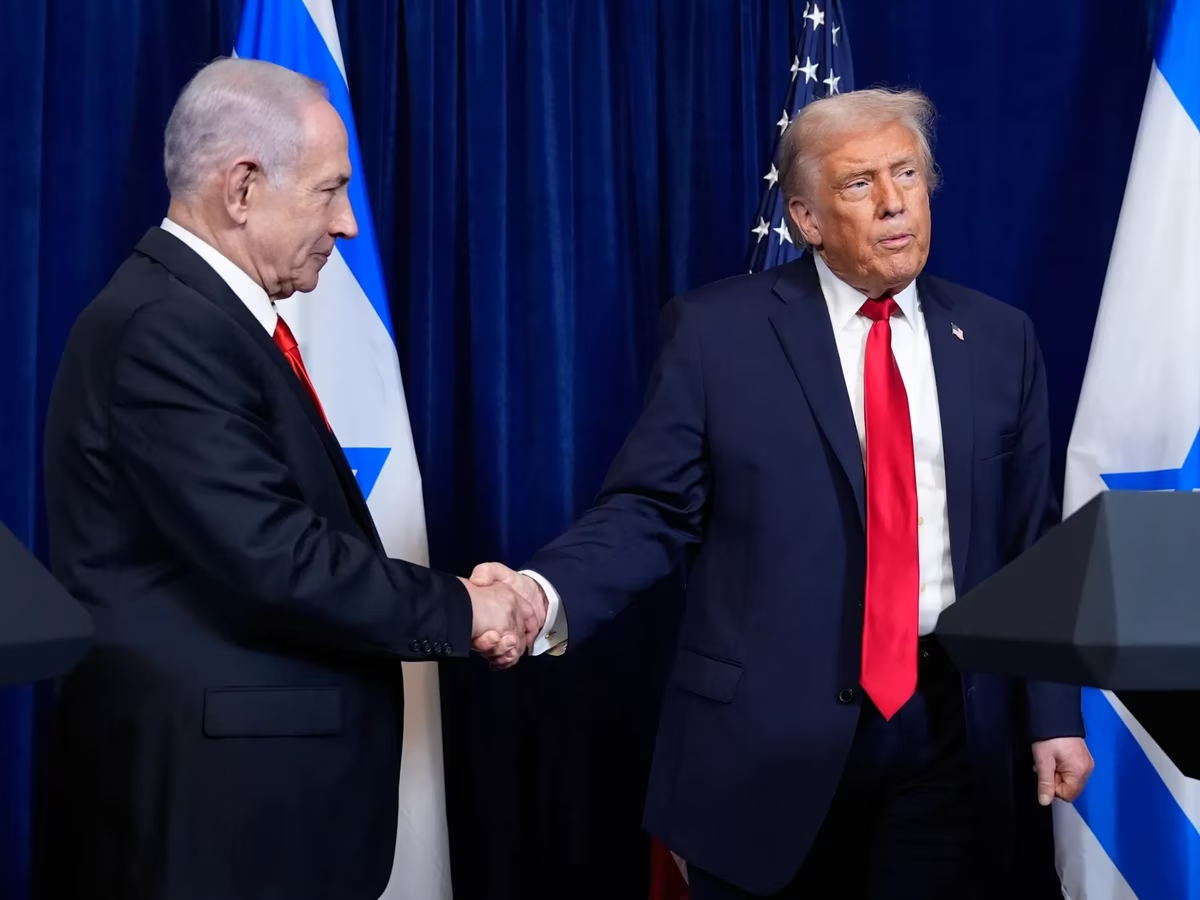
The American President Donald Trump said he would work to achieve consensus between the Syrian President Ahmed Al-Sharaa and the Israeli Prime Minister Benjamin Netanyahu, while threatening both Hamas with a heavy price if it does not give up its weapons, and Iran if it tries to rebuild its nuclear power.
Trump clarified, in a press conference following Trump's meeting with Netanyahu at Mar-a-Lago resort in Florida, that there is an understanding between the United States and Israel regarding Syria.
He renewed his expression of admiration for the Syrian President, saying "I respect President Al-Sharaa and he is a strong person that Syria needs at the present time, and our relationship with him is good".
Trump mentioned that he reached several conclusions during the meeting with Netanyahu, noting that he has done a lot of work with him, and that this matter will continue.
He addressed Netanyahu - who is wanted by the International Criminal Court on charges of committing war crimes in Gaza - saying "We will always be with you and stand by your side", while affirming at the same time his keenness to establish peace in the Middle East.
Regarding the Palestinian issue, Trump threatened the Islamic Resistance Movement (Hamas) with a heavy price if it does not give up its weapons, adding that the movement has a short time to do so.
He explained that some countries that signed the Gaza agreement because of the movement's commitment to disarm are the ones who will destroy Hamas's weapons if it does not give them up.
While pointing to Israel's fulfillment of its commitments regarding the Gaza agreement, and to the agreement with Netanyahu on "most matters", Trump clarified that the consensus between them is not 100% regarding the issue of settler violence in the occupied West Bank.
The White House man touched on the Lebanese Hezbollah party, noting that it is dealing "badly" and that he will follow what the efforts of Lebanon to disarm the party will result in.
He affirmed that Iran's strength has declined greatly and that it will not be allowed to regain it, threatening to attack it again if it attempts to rebuild its nuclear program, while expressing at the same time his openness to conducting talks with Tehran.
Trump touched on the relationship between the Turkish President Recep Tayyip Erdogan and Netanyahu by saying that there will be no problem between them, and that he supports them.
He added that Erdogan deserves great praise for "helping Israel get rid of a regime that was working against it in Syria", in reference to the ousted Bashar al-Assad regime.
Trump noted that his administration is studying the sale of F-35 fighters to Turkey.
Hamas and Israel signed a ceasefire agreement on October 10 last year, and since the agreement came into effect, the Israeli occupation army has committed hundreds of violations, resulting in the martyrdom of 418 Palestinians and the injury of 1,141 others, according to data from the Gaza Government Media Office.
The agreement ended a genocide war launched by Israel on October 8, 2023, which lasted two years, leaving more than 71,000 Palestinian martyrs, more than 171,000 injured, and massive destruction that affected 90% of the civilian infrastructure at a reconstruction cost estimated by the United Nations at around 70 billion dollars.
I respect President Al-Sharaa and he is a strong person that Syria needs at the present time, and our relationship with him is good.
PALESTINE
Mon 29 Dec 2025 11:43 pm - Jerusalem Time
The Israeli Army Raids Nablus and Forces Residents to Evacuate in Preparation for Settlers' Raid
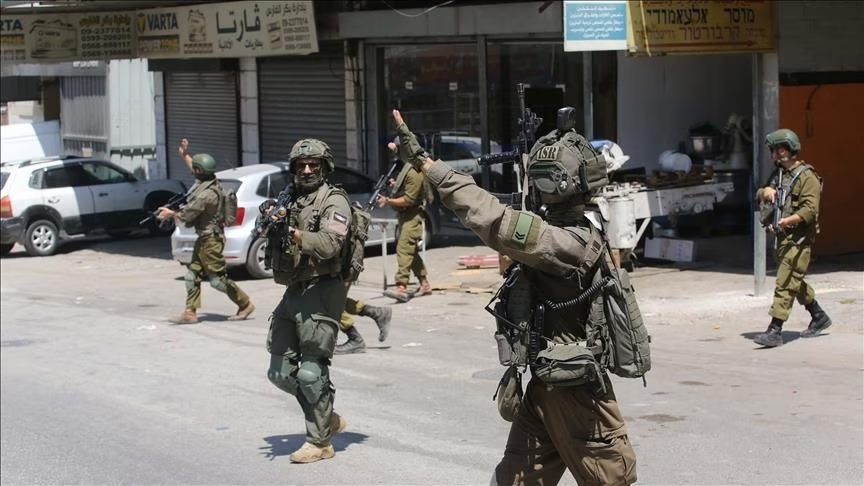
The Israeli army raided the city of Nablus in the northern West Bank occupied territory late Monday evening, forcing residents of residential buildings to evacuate.
Large forces from the occupation army, accompanied by a military bulldozer, raided the eastern area of the city, coming from the Orta, Hawara, and Beit Furik checkpoints.
It added that the army's raid comes "in preparation for settlers raiding the Tomb of Joseph and performing Talmudic prayers there".
The "Tomb of Joseph" is located in the eastern part of Nablus, which is under Palestinian control, and Jews consider it a holy site since Israel's occupation of the West Bank in 1967.
Settlers promote that the remains of the Prophet Joseph son of Jacob were brought from Egypt and buried in this place, but archaeologists have denied the validity of this narrative, saying that the age of the site does not exceed a few centuries, and it is a shrine for a Muslim sheikh named "Yusuf Dweikat".
For its part, the Palestinian Red Crescent Society announced in a statement that the army forced residents of two buildings in the Dahiya area and Amman Street in the city of Nablus to evacuate them, turning them into two observation points.
Meanwhile, Palestine TV confirmed that the Israeli army deployed snipers on Amman Street, Al-Ghawi roundabout, and the Dahiya area, and "forced residents to evacuate their homes in the eastern area of Nablus to secure the settlers' raid on the Tomb of Joseph".
It added that "occupation forces prevent media crews from covering the raid on the eastern area of the city of Nablus".
Since the start of the genocide war in the Gaza Strip, the Israeli army and settlers in the West Bank, including East Jerusalem, have killed more than 1,103 Palestinians, injured about 11,000, in addition to arresting more than 21,000.
Israel began on October 8, 2023, a genocide war with American support, lasting two years, resulting in more than 71,000 Palestinian deaths, over 171,000 injured, and massive destruction affecting 90% of civilian infrastructure, with reconstruction costs estimated by the United Nations at about $70 billion.
The army forced residents of two buildings in the Dahiya area and Amman Street in the city of Nablus to evacuate them, turning them into two observation points.
PALESTINE
Mon 29 Dec 2025 10:32 pm - Jerusalem Time
Revealing the Fate of Prominent Leaders in Al-Qassam Brigades
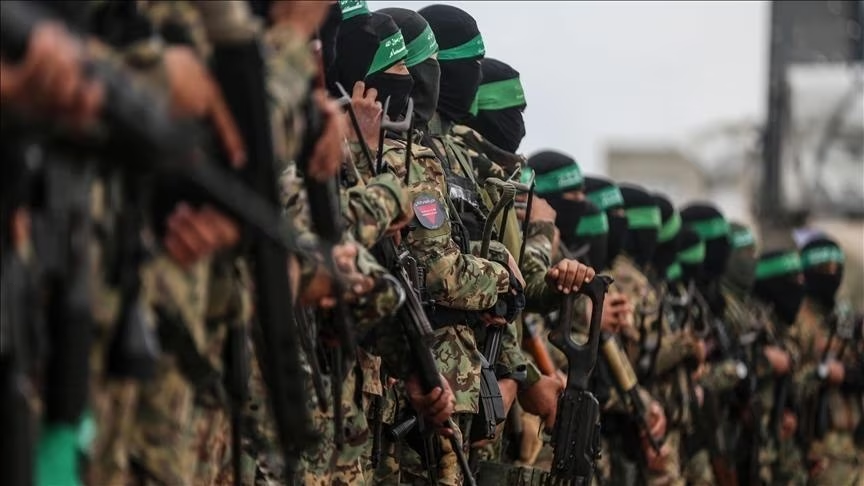
After months of silence and ambiguity, the Al-Qassam Brigades, the military wing of the Hamas movement, revealed on Monday evening the fate of a number of its military leaders, in a file that has been the subject of conflicting narratives between Israel and the Palestinians.
And Al-Qassam announced the death of its Chief of Staff Muhammad al-Sinwar, its spokesperson Hudhaifa al-Kahlout "Abu Ubaida", Rafah Brigade commander in southern Gaza Strip Muhammad Shabana, Hukm Issa commander of the Weapons and Combat Services Branch, in addition to Ra'id Saad commander of the Manufacturing Branch, during the Israeli genocide war.
Sources in Hamas provided information about the lives and careers of the Qassam leaders, confirming their prominent roles in the military and organizational structure of the brigades.
** Muhammad al-Sinwar (Qassam Chief of Staff)
- One of the first leaders of the brigades in Khan Yunis in southern Gaza Strip, and succeeded Muhammad al-Deif in the leadership of Qassam Staff, and the movement described him as having a "brilliant mind" in leading military operations during a difficult period.
- Brother of Yahya al-Sinwar, the former head of the Hamas Political Bureau, who was assassinated by Israel on October 16, 2024.
- He assumed command of the Khan Yunis Brigade, then managed the Human Resources Branch, before overseeing the Operations Branch that planned and executed the "Al-Aqsa Flood" operation on October 7, 2023.
- He carried out a number of military operations against Israeli sites and settlements during the Al-Aqsa Intifada (2000 - 2005) before Israel's unilateral withdrawal from Gaza Strip in 2005.
- He is directly responsible for planning and executing the operation to capture the Israeli soldier Gilad Shalit in 2006 from the Sofa military site east of Rafah in southern Gaza Strip.
- Israel announced his assassination in an airstrike targeting him in Khan Yunis in May 2025.
** Muhammad Shabana, Rafah Brigade Commander in Qassam:
- One of the prominent leaders in Al-Qassam Brigades in southern Gaza Strip.
- Participated in planning and executing a number of military operations during the Al-Aqsa Intifada, including the operation to capture the soldier Gilad Shalit in 2006.
- He assumed command of a battalion in Rafah Brigade, and later was appointed responsible for the brigade succeeding Ra'id al-Attar, who was assassinated by Israel in mid-2014.
- He held membership in the General Military Council of Al-Qassam Brigades, until Israel announced his assassination alongside Muhammad al-Sinwar in May 2025.
** Hukm al-Issa, Commander of the Weapons Branch
- Founder and director of the military training system in Qassam.
- His military nickname is "Abu Omar al-Suri" and he arrived in Gaza Strip from Syria after Israel's withdrawal from Gaza in 2005.
- Participated in transferring military expertise from abroad to inside Gaza Strip.
- He founded the military academy affiliated with Al-Qassam Brigades, which was established in 2010, and directly supervised the military curricula.
- He oversaw the development of defensive plans for Al-Qassam Brigades, and contributed to building the technical and structural infrastructure of the brigades.
- Israel killed him in an airstrike on Gaza City in June 2025 along with his wife and a number of his children.
** Ra'id Saad, Commander of the Manufacturing Branch
- Born on August 15, 1972 in Gaza City, and he is from the first generation of Qassam leaders since the Second Palestinian Intifada in 2000.
- He held membership in the Military Council of Al-Qassam Brigades during that period since 2003, and was known for his closeness to the General Commander Muhammad al-Deif in previous periods.
- He was subjected to several assassination attempts in recent years, most notably in 2006, when the Israeli Air Force targeted a meeting of the Military Council of Al-Qassam Brigades, but he survived the raid.
- He has been one of Israel's most wanted for years.
- During his career, he held multiple leadership positions, most notably commander of Gaza City Brigade, before later assuming command of military manufacturing in Al-Qassam Brigades, according to local media.
- He held the position of Commander of the Operations Branch in the General Military Council, before these tasks were later assigned to Muhammad al-Sinwar, while Saad remained one of the most important military leaders within the military and organizational structure of the movement.
- After the cessation of the Israeli war, Saad held membership in the new Military Council as part of Qassam's efforts to reorganize its ranks, where he manages military operations, and is seen as the second man in the leadership after Izz al-Din al-Haddad.
- He is considered the oldest, most experienced, and senior among the current military leaders, and one of the most knowledgeable about the history and details of the military work of Al-Qassam Brigades.
- Israel assassinated him on December 13 of this year by bombing his car in Gaza City.
** Hudhaifa al-Kahlout (Abu Ubaida)
- His name and image remained hidden for two decades, but he became the voice of resistance and the media face of Qassam.
- He led the media system, and conveyed the developments of the "Al-Aqsa Flood" operation to the world, and he is a prominent media symbol during all military confrontations with Israel.
- Born in 1984 in Jabalia camp in northern Gaza Strip, and joined Hamas and its brigades since the Second Intifada in 2000, and obtained a master's degree in Quranic interpretation.
- His name is linked to prominent military announcements, including the capture of the Israeli soldiers Gilad Shalit in 2006, and Shaul Aaron in 2014.
- Abu Ubaida emerged media-wise for the first time in October 2004, during the "Days of Wrath" battle that lasted 17 days, where he held the first press conference for Al-Qassam Brigades, announcing the progress of confrontations against the Israeli invasion in northern Sector.
- He appeared in the recent rounds of fighting displaying samples of locally manufactured weapons and remains of destroyed Israeli vehicles.
- His last appearance was on July 18, 2025, where he said that Palestinian factions are ready to wage a "long attrition battle" against Israel.
- Israel assassinated him on August 30, 2025.
Al-Qassam announced the death of its Chief of Staff Muhammad al-Sinwar, its spokesperson Hudhaifa al-Kahlout "Abu Ubaida", Rafah Brigade commander Muhammad Shabana, Hukm Issa, and Ra'id Saad.
ARAB AND WORLD
Mon 29 Dec 2025 10:17 pm - Jerusalem Time
Netanyahu directs the army to suspend military operations fearing 'undesirable involvement' during his meeting with Trump
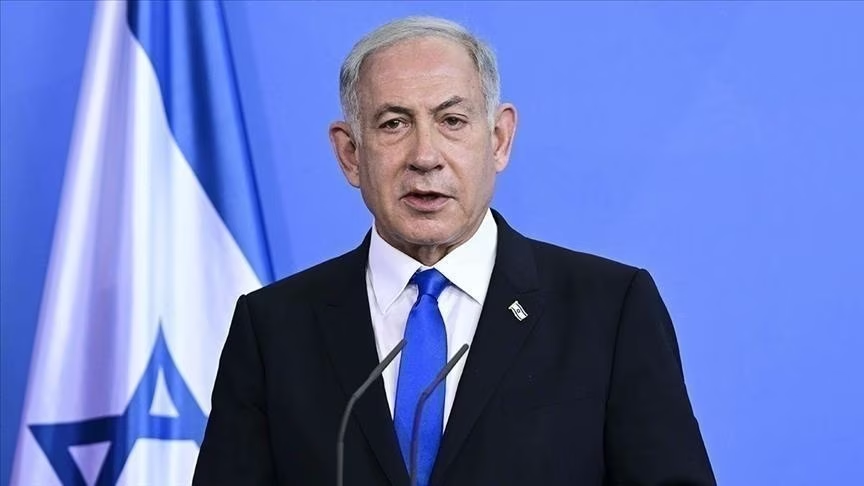
Hebrew media said on Monday that Israeli Prime Minister Benjamin Netanyahu directed the army to suspend military operations until his return from the United States, fearing "undesirable involvement" during his meeting with US President Donald Trump.
On Sunday evening, Netanyahu arrived in the American state of Florida for a visit that the official Israeli Broadcasting Corporation said lasts 5 days.
The political leadership directed the Israeli army to suspend some military operations until Netanyahu's return from his visit to the United States.
And it explained: "This decision stems from fears of undesirable involvement during Netanyahu's meeting with President Trump in Florida".
And the corporation continued: "On Wednesday, a reserve officer was injured due to the explosion of an explosive device in Rafah, and regardless of Netanyahu's comment in English, Israel did not respond to the incident".
At the time, Netanyahu accused the Hamas movement of being behind the explosion in a post in English on the American company "X" platform.
And he said then: "Hamas' open and continuous refusal to disarm is a blatant and ongoing violation, and its violent intentions and violations were confirmed today by its detonation of an explosive device that resulted in the injury of an officer in the Israeli army, and Israel will respond accordingly".
And earlier on Monday, the US President received Netanyahu at the Mar-a-Lago resort in Florida.
And on September 29 last year, Trump announced a peace plan and ceasefire in Gaza consisting of 20 points, including: the release of Israeli prisoners, ceasefire, disarmament of Hamas, Israel's withdrawal from the sector, formation of a technocratic government, and deployment of an international stabilization force.
And on October 10 last year, the first phase of the ceasefire agreement came into effect, while Israel violates its terms and delays moving to the second phase.
And the agreement was supposed to end the genocide committed by Tel Aviv over two years starting from October 8, 2023, which resulted in about 71,000 Palestinian deaths and more than 171,000 injured, most of them children and women, but Israel continues its violations and suffocating siege on the sector to this day.
The political leadership directed the Israeli army to suspend some military operations until Netanyahu's return from his visit to the United States.
PALESTINE
Mon 29 Dec 2025 10:07 pm - Jerusalem Time
1.6 Million Palestinians in Gaza Suffering from Malnutrition and Occupation Blocking Aid Entry
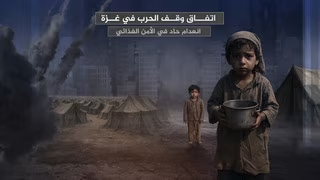
The media advisor for the United Nations Relief and Works Agency for Palestine Refugees in the Near East (UNRWA), Adnan Abu Hasna, stated that 1.6 million Palestinians in the Gaza Strip are currently suffering from dangerous or multiple levels of malnutrition or food insecurity amid the ongoing obstruction by the Israeli occupation of the entry of essential humanitarian materials for the winter season.
This dangerous warning comes coinciding with a severe weather depression striking the sector, uprooting thousands of dilapidated tents, while Israel is holding six thousand trucks loaded with hundreds of thousands of tents, blankets, and food supplies at the gates of Gaza.
Abu Hasna added that the current weather depression leaves catastrophic direct effects on the lives of the displaced.
He explained that the weather depression caused the uprooting of thousands of tents and the flooding of residential areas with rainwater and sewage water, confirming that most of what are called tents were built haphazardly from plastic sheets and some fabric, and they are practically not real tents capable of protecting their inhabitants.
Abu Hasna pointed out that even the real tents have become worn out and worthless after repeated displacements dozens of times, and cannot withstand the storms or heavy rains currently hitting the sector.
The UN official confirmed that what people in Gaza feel is that the war continues, but in other ways and forms.
He explained that the continued deterioration of humanitarian conditions, the increase in the number of patients, and the non-entry of hundreds of types of food and non-food items, spare parts for sewage and water stations, medical devices, and medicines, all represent different forms of the continuation of the war on civilians.
Regarding the detained aid, Abu Hasna explained that Israel is preventing UNRWA from entering six thousand trucks loaded with hundreds of thousands of tents that the agency purchased for hundreds of millions of dollars and which people are now severely lacking.
He added that these shipments also contain hundreds of thousands of blankets and winter clothing, in addition to food supplies sufficient for the Gaza Strip for three months, all detained at the sector's gates.
On the deadly repercussions of the weather depression, three deaths have been recorded since the start of the current weather depression, the latest being an infant who died from the severe cold.
The current weather depression leaves catastrophic direct effects on the lives of the displaced.
ARAB AND WORLD
Mon 29 Dec 2025 10:05 pm - Jerusalem Time
Herzog Denies Trump's Statements on Pardon for Netanyahu: We Have Not Conducted Talks
Israeli President Isaac Herzog said on Monday that he has not conducted talks with his American counterpart Donald Trump since Prime Minister Benjamin Netanyahu submitted a pardon request from corruption trials, denying Trump's statements that "the pardon is on the way".
On November 12, 2023, Trump formally requested Herzog to grant a pardon to Netanyahu, and the latter subsequently submitted a request for a pardon, while the Israeli president said he is studying the request.
Trump's request sparked widespread criticism within Israel, with accusations of interference in Israel's internal affairs and harming equality before the law.
During his reception of Netanyahu at Mar-a-Lago resort in Florida earlier Monday evening, Trump said: "How can they not grant a pardon to Netanyahu? He is a prime minister during war."
He added: "I spoke with the President (Herzog) and he says it's on the way."
However, Herzog's office said in a statement: "No contact has been made between President Herzog and President Trump since the submission of the pardon request."
Netanyahu faces charges of corruption, bribery, and breach of trust in 3 corruption files that require his imprisonment if convicted.
"File 1000" involves him and his family members receiving valuable gifts from businessmen in exchange for providing facilities and assistance to them in various fields.
While in "File 2000", he is accused of negotiating with the publisher of the Hebrew newspaper "Yedioth Ahronoth" (private) Arnon Mozes to obtain positive media coverage.
As for "File 4000", it concerns providing facilities to the former owner of the news site "Walla" Shaul Elovitch, who was also an official at the "Bezeq" communications company, in exchange for positive media coverage.
In addition to his local trial, the International Criminal Court issued an arrest warrant for Netanyahu in 2024 for committing war crimes and crimes against humanity against Palestinians in the Gaza Strip.
No contact has been made between President Herzog and President Trump since the submission of the pardon request.
PALESTINE
Mon 29 Dec 2025 9:25 pm - Jerusalem Time
Palestinian trade unionist warns of liquidation and assassination operations against Palestinian workers in Israel
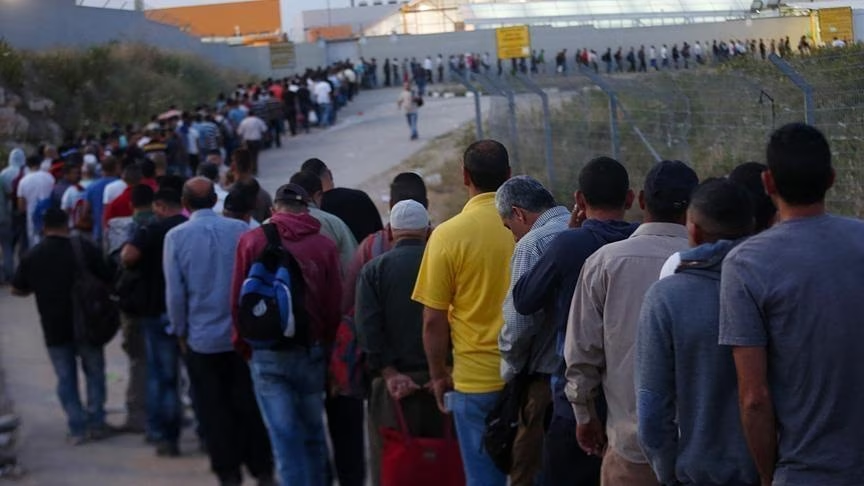
A Palestinian trade unionist warned of liquidation and assassination operations against Palestinian workers in Israel, calling on institutions and trade unions around the world to take serious action to prosecute the crimes committed against the workers.
This came in a statement by Shahar Saad, Secretary General of the Palestinian Workers' Trade Unions Federation, on Monday, in response to statements by National Security Minister Itamar Ben-Gvir, who said that the treatment of Palestinian workers trying to "infiltrate" into Israel would be by opening fire.
Saad condemned the "blatant threats issued by Ben-Gvir through the Hebrew Channel 14 and other Israeli platforms, which included explicit calls to kill Palestinian workers by shooting at them while they try to reach their workplaces by various means".
He added that the incitement of settlers "through the dissemination of video clips showing Palestinian workers entering by climbing the separation walls between the West Bank and the occupied interior reveals a prepared ground for carrying out a series of liquidation and assassination operations against the workers, under the pretext of what is called illegal infiltration".
Saad warned "of the danger of this approach adopted by official Israeli parties, and implemented in many cases in undeclared ways, amid the continuous rise in the number of martyrs for a living wage during the current year".
He called on institutions, trade unions, and labor unions around the world to "take serious action to prosecute the crimes committed against Palestinian workers, expose them at international levels, and work to establish mechanisms and international courts to hold all those involved accountable".
He pointed out that Israeli policies for more than two years "have led to more than 500,000 Palestinian workers losing their livelihoods, and unemployment rates rising to unprecedented levels".
Almost daily, injuries to Palestinians near the separation wall around Jerusalem and along the borders between the West Bank and Israel recur, during attempts by Palestinian workers to cross it in search of work inside Israel, which occupies their lands.
Data from the General Federation of Palestinian Workers indicates that 44 Palestinian workers were killed by Israeli army gunfire, and more than 32,000 others were arrested, inside workplaces or during their attempts to seek work since the start of the genocide war until October 28 last.
Since the start of the genocide war on Gaza in October 2023, Israel has prevented Palestinian workers from returning to their workplaces, so some resort to climbing the separation wall despite the risks involved in the adventure.
A Palestinian trade unionist warned of liquidation and assassination operations against Palestinian workers in Israel, calling on institutions and trade unions around the world to take serious action to prosecute the crimes committed against the workers.
PALESTINE
Mon 29 Dec 2025 9:18 pm - Jerusalem Time
Occupation forces remove the United Nations flag and raise their own above the UNRWA headquarters in Jerusalem
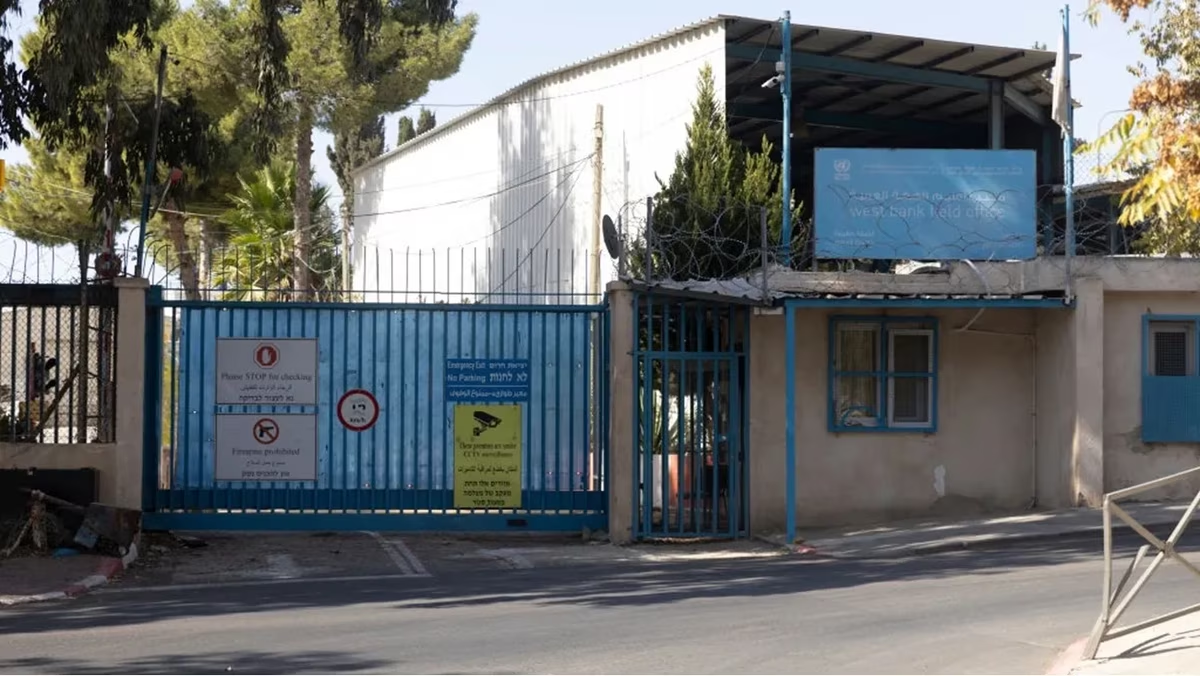
Israeli occupation forces proceeded to remove the United Nations flag and raise the Israeli flag above one of the international organization's headquarters in occupied East Jerusalem, during the raid on the headquarters of the United Nations Relief and Works Agency for Palestine Refugees (UNRWA) in the Sheikh Jarrah neighborhood, on December 8, 2025. The Israeli police, accompanied by employees from the occupation municipality, forcibly entered the compound, confiscated equipment and property belonging to the agency, before removing the UN flag and raising the Israeli flag in its place. The raid was carried out at dawn using motorcycles and lifting trucks, after cutting off communications inside the headquarters, in preparation for starting the confiscation operations.
With this unprecedented scene, fundamental questions arise: What remains of the United Nations' prestige when its flag is forcibly removed? And how can an organization presumed to be a guardian of international peace claim its ability to protect civilians if it is incapable of protecting its symbols and facilities? Then, can this act be understood in isolation from a broader context that witnessed the targeting of UN schools in Gaza, the destruction of refugee camps in the West Bank, and the criminalization of UNRWA's work in Jerusalem? And does the removal of the UN flag represent a merely symbolic step, or a practical declaration that Israel no longer recognizes any authority or jurisdiction of international law on the ground?
The legal framework for the immunity of international headquarters
Theoretically, the presence of the United Nations and its agencies enjoys special legal protection under international law. Since the establishment of the UN organization, the Convention on the Privileges and Immunities of the United Nations of 1946 has been adopted, which stipulates the inviolability of UN headquarters and properties in any country. This means that it is not permissible for the host country's authorities to raid, search, or confiscate them. International agreements also exempt UN headquarters from local taxes and fees, recognizing the non-profit nature of the international organization and its humanitarian function. This legal protection is not merely formal procedures, but its essence is to preserve the neutrality of the United Nations and the safety of its operations, as the United Nations flag raised above its headquarters is considered a symbol of international immunity and protection.
The international judiciary has repeatedly affirmed the obligation to respect this immunity; for example, in October 2023, the International Court of Justice issued an advisory opinion explicitly reminding Israel of its legal duty to facilitate UN relief efforts in Gaza and cooperate with the organization's agencies in the occupied territories. These obligations fall on Israel as a UN member state and signatory to the relevant agreements, making any violation of them a direct breach of international law.
The symbolism of the United Nations and international protection
The presence of the United Nations in conflict zones symbolizes international protection and the neutrality of the international community. For decades, the blue UN flag has been adopted as a sign for internationally protected sites, starting from UN headquarters and refugee camps, even to ambulances and humanitarian convoys affiliated with it. Historically, this symbolism has gained deterrent power; it provides a safe haven for civilians under the UN banner and warns conflict parties against targeting it. But in the Palestinian case, Israel has increasingly targeted this symbolism. Forcibly removing the UN flag from above a UN-affiliated building does not represent a mere protocol incident; rather, it is a message rejecting any guardianship or international protection for Palestinians. It is tantamount to a declaration that the only reference on the ground is the power of the occupation.
UNRWA and the headquarters agreement:
The United Nations Relief and Works Agency for Palestine Refugees (UNRWA) is the most prominent example of UN presence in historic Palestine, and it is the axis of the recent event. The UN established UNRWA in 1949 to provide basic relief to Palestinian refugees after the 1948 Nakba. Since then, the agency has operated in refugee areas including the Gaza Strip and the West Bank (including East Jerusalem) alongside neighboring countries. UNRWA's presence in the occupied territories was regulated by agreements and arrangements with the relevant authorities; after Israel's occupation of the West Bank and Gaza in 1967, the Israeli government requested UNRWA to continue its operations in the areas under its control and pledged to facilitate its mission. This came in an official exchange of letters between the then UNRWA Commissioner-General Laurence Michelmore and the Israeli official Michael Comay (known as the "Comay-Michelmore Agreement"), where the Israeli side confirmed that these temporary arrangements would remain in effect until replaced or canceled by another agreement. Under this understanding, Israel committed to facilitating UNRWA's work as much as possible while considering the security considerations that Israel has always raised.
Over the following decades, despite tensions, UNRWA maintained its presence as a lifeline for millions of Palestinian refugees. It manages schools and clinics, distributes food aid, and provides social services in refugee camps, thus bearing a highly important humanitarian and stabilizing role. Therefore, international agreements, including the aforementioned Convention on the Privileges and Immunities of the United Nations, include UNRWA and its staff and headquarters within the scope of protection. Staff enjoy relative diplomatic immunities, UNRWA facilities are protected from local interventions and taxes and fees, and local authorities (including the occupation authority) are supposed to respect the agency's status and the inviolability of its facilities.
On the ground, Israel has often complained about UNRWA and accused it of taking biased positions or turning a blind eye to "terrorist" activities, accusations that the agency has repeatedly denied. Israeli governments, with the support of some allies, have sought to reduce UNRWA's role or even end it, but they failed to achieve that. The decision to continue the agency remains with the UN General Assembly, which renews UNRWA's mandate periodically with an overwhelming majority, the latest being the extension until 2028.
Israeli behavior from Gaza and the West Bank to Jerusalem:
The recent years have witnessed an escalation in Israel's hostile behavior towards the UN presence in the Palestinian territories, culminating in the flag incident in Jerusalem. This behavior has taken various forms across regions:
In the Gaza Strip: During the recent war on Gaza (starting from October 2023), UN facilities, especially UNRWA schools that were turned into shelter centers, were subjected to repeated bombing. Hundreds of civilians fell during the bombing of UNRWA sites, even dozens of UNRWA staff themselves fell while performing their humanitarian duties. The UN has repeatedly declared that "there is no safe place in Gaza" including its buildings, and considered the ongoing targeting of facilities bearing the UN emblem as a blatant disregard for UN immunity and humanitarian law. Nevertheless, Israeli operations continued fiercely, justifying them by the presence of resistance elements or weapon caches near some facilities, excuses that do not exempt it from legal responsibility for protecting civilians and relief headquarters.
In the West Bank: The situation was no less dire, albeit in a different context; UN agencies, primarily UNRWA and OCHA, faced chronic Israeli restrictions including bureaucratic obstacles, restrictions on the movement of staff and aid, in addition to arrests and injuries affecting international workers, which limited their ability to perform their tasks. Simultaneously, refugee camps in Jenin, Tulkarm, and Nour Shams were subjected to an unprecedented wave of destruction and displacement, including orders to demolish dozens of residential buildings, destroy hundreds of units, and displace thousands of families, until some camps turned into areas almost devoid of civilian life. UN reports have described these developments as the largest displacement wave in the West Bank since 1967, reflecting the transition of Israeli policy from disrupting humanitarian work to demographic engineering targeting the dismantling of camps and depriving their residents of stability and return.
In occupied East Jerusalem: The series of targeting culminated in the most dangerous measure in the occupied city of Jerusalem. Since 2024, Israel has taken escalating steps in Jerusalem, enacting a law banning UNRWA within what it considers its territories, forcing the agency to close its offices at the beginning of 2025. Then came the climax of this campaign in December 2025 with the public raid on the UNRWA headquarters in Sheikh Jarrah, under flimsy pretexts such as municipal tax debts despite the UN being exempt from taxes by law. Indeed, the raid was carried out, the office's contents were confiscated, the UN flag was removed, and the Israeli flag was raised in its place.
This development in Jerusalem carries dangerous implications, as it is the first direct and explicit challenge to the symbolism of the United Nations in this way within the occupied territories and under Israel's full control. The UN has strongly condemned this raid and described the step as a "blatant violation of the inviolability of its headquarters under international law."
The UNRWA Commissioner-General, Philippe Lazzarini, confirmed that the agency's headquarters in Jerusalem remains a UN facility subject to international immunity regardless of any measures or local legislation imposed on it, emphasizing that any Israeli attempt to strip it of its UN status lacks any legal value, because the status of UN headquarters is governed by international agreements that supersede the domestic law of states. His statements came in an official statement published on the morning of December 8, 2025 via the X platform, in response to the occupation forces' raid on the UNRWA headquarters in Sheikh Jarrah, removing the UN flag and raising the Israeli flag in its place, confiscating the agency's property, and cutting off communications inside the compound. Lazzarini warned that resorting to local legislation to criminalize UNRWA's work or confiscate its facilities represents an attempt to abolish international immunity, which is legally impossible, and entails a dangerous precedent that undermines the foundations of the international legal system.
Do states align with these calls and measures?
In the face of these developments, a question arises about the position of the rest of the states: Does any state support Israel's endeavor to "criminalize" international protection and remove the UN from the Palestinian scene? The reality is that the vast majority of the international community has explicitly rejected that. When Israel proposed a bill to ban UNRWA at the end of 2024, several Western allied countries issued statements of concern and warning. For example, the European Union issued a warning of "catastrophic consequences" if UNRWA's work was banned; similarly, other Western countries called on Israel to respect UNRWA's immunity and not obstruct it.
Some countries temporarily suspended their funding for UNRWA following Israeli accusations after October 2023, but they quickly resumed it after UN investigations proved most of those allegations false. Even the United States, which froze part of its funding at the time, did not go so far as to support banning the agency, but focused on ensuring its neutrality.
It is clear that Israel's approach to criminalizing the UN presence and international protection of Palestinian civilians faces broad rejection. The main donor countries - European, Arab, and others - have continued to provide financial support (albeit at declining rates) and political support for UNRWA and the UN in general in the Palestinian territories, considering it a fundamental stability factor. While Israel continues its campaign against UNRWA, it finds itself isolated in this endeavor.
Removing the UN flag and targeting the symbolism of the international organization in Jerusalem does not only express an assault on a UN body, but is also considered a direct targeting of the Palestinian refugees' right itself, as UNRWA is linked in existence and non-existence to UN Resolution 194 stipulating the right of return, making any tampering with it tampering with the legal structure that historically preserves this right. Despite the fact that international reactions showed a politically supportive stance rejecting the undermining of the international legal system, this response remained more symbolic than practical; if any other country had taken a similar step, the reactions would have been stronger and more procedural.
The background of this behavior becomes clear in that Israel seeks to empty the UN organization of its practical and legal content in the occupied territories as a first stage, paving the way for extending this emptying later to include the neighboring countries that host the largest bloc of Palestinian refugees, primarily Jordan, Syria, and Lebanon. From here, this approach cannot be considered an isolated event, but comes within an integrated and continuous policy aimed at redefining the international legal framework for the Palestinian issue, specifically the refugee issue, by neutralizing UNRWA and drying up its ability to perform its historical role.
Today, the question has become far beyond the incident of removing the UN flag; the real dilemma lies in the fact that the international organization has witnessed, in full view of its institutions and bodies, practices more dangerous than merely targeting its symbolism, starting from policies of widespread killing, passing through annexation operations, reaching the inhuman treatment of prisoners and imposing facts on the ground in Jerusalem. And if these fundamental violations were not met with deterrent measures, has there remained any practical status for the UN's purposes and prestige to rely on? The question is no longer related to an incident of raising or lowering a flag, but to the extent of the organization's own ability to uphold the principles it was founded on, and prevent their undermining when violated in this blatant and repeated manner.
What remains of the United Nations' prestige when its flag is forcibly removed? And how can an organization presumed to be a guardian of international peace claim its ability to protect civilians if it is incapable of protecting its symbols and facilities?