PALESTINE

Sun 22 Feb 2026 12:32 pm - Jerusalem Time

New Israeli Escalation in Gaza: Intense Raids and Worsening Crisis for Displaced in Tents

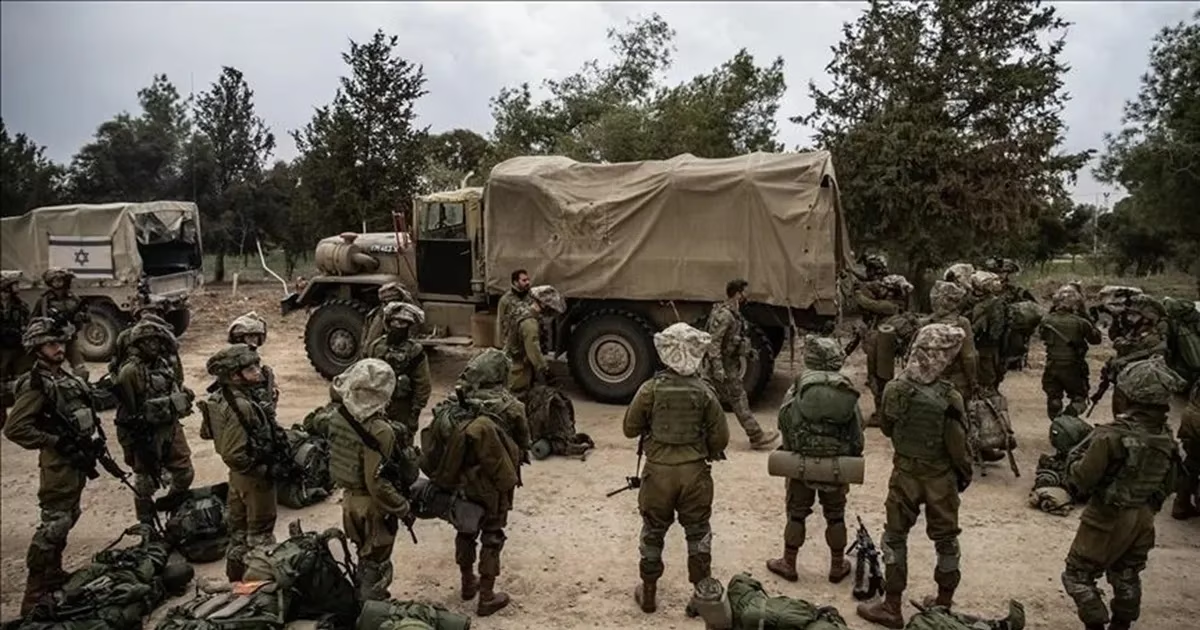
The Israeli occupation army escalated its military attacks early Sunday morning, with its warplanes launching seven airstrikes targeting various areas in the Gaza Strip. The attacks focused on the cities of Rafah in the south and Gaza in the north, coinciding with widespread demolition operations of residential buildings in areas where military vehicles had advanced, leading to the destruction of citizens' property and exacerbating panic among residents.

In the context of field assaults, medical sources reported the martyrdom of two Palestinians due to gunfire by occupation forces in Khan Yunis city and Jabalia refugee camp. Three other citizens were injured by occupation bullets east of Gaza City, accompanied by indiscriminate artillery shelling that targeted residential neighborhoods near the contact lines, while the occupation army claimed to have eliminated an armed individual who approached its forces north of the Strip.

Field statistics indicate that the occupation has committed hundreds of violations of the ceasefire agreement in effect since October 10th. These continuous violations have resulted in the martyrdom of 612 people and the injury of approximately 1640 Palestinians with varying degrees of wounds, placing fragile understandings under the pressure of ongoing military escalation and daily violations.

On the humanitarian front, Amjad Al-Shawa, head of the Palestinian NGO Network, warned of the deteriorating living conditions for displaced persons due to the prevention of mobile homes ('caravans') from entering. Al-Shawa affirmed that the occupation continues to control large areas of the Strip and is working to expand what is known as the 'Yellow Line' towards populated areas, tightening the noose on residents and depriving them of vital spaces.

Al-Shawa explained that thousands of Palestinian families are still living in dilapidated tents or in the open without any real shelter solutions to protect them from weather fluctuations. He accused the occupation authorities of reneging on humanitarian understandings that stipulate the entry of shelter supplies, noting that Israeli forces effectively control about 60% of the total area of the Gaza Strip.

Expanding the scope of buffer zones and military control has directly led to a reduction in available space for residents, especially in the eastern and northern areas, which are considered the food basket of the Strip. These measures complicate international and local relief efforts and limit the ability of institutions to reach the most affected groups by the aggression and ongoing siege.

Regarding border crossings, human rights sources confirmed that the entry of humanitarian aid remains below the required level and does not meet the minimum needs of the population. The occupation authorities impose strict restrictions on the entry of building materials and prefabricated homes, hindering any attempt to address the escalating housing crisis that hundreds of thousands have suffered from for many months.

Approximately 2.4 million Palestinians live in the besieged Gaza Strip for over 18 years, including 1.5 million displaced persons who lack the most basic necessities for a dignified life. Israel continues to prevent the entry of sufficient quantities of food, medicine, and medical supplies, placing the health and relief sectors before unprecedented challenges amid the ongoing aggression and siege.

Thousands of families are still residing in dilapidated tents or in the open, in the absence of real shelter solutions and the prevention of mobile homes from entering.

PALESTINE

Sun 22 Feb 2026 12:32 pm - Jerusalem Time

Washington reveals details of a $17 billion plan for Gaza reconstruction and Israeli calls for displacement

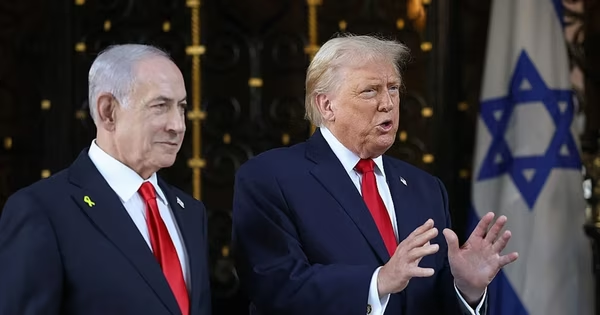
The US Special Envoy for the Middle East, Steve Witkoff, unveiled the outlines of a comprehensive economic plan for the Gaza Strip, based on the financial pledges announced by President Donald Trump. Witkoff clarified that the allocated funding will primarily be directed towards implementing massive projects in the housing and public transportation sectors, noting that these steps are part of a comprehensive vision to reshape the living reality in the Strip after the end of military operations.

During the founding meeting of what is known as the 'Peace Council' in Washington, US President Donald Trump affirmed his commitment to providing $10 billion to support this initiative. Reports indicated that nine other countries pledged to contribute a total of $7 billion, raising the current available funding ceiling to $17 billion, with official expectations to double this figure to $34 billion in later stages of the reconstruction process.

In a related context concerning security arrangements, five countries expressed their preliminary readiness to participate in an international force aimed at ensuring stability within the Gaza Strip and implementing development projects. Witkoff described these moves as 'inspiring,' emphasizing that the top priority will be to remove the massive rubble left by the war and prepare the ground for what he called the anticipated 'renaissance of Gaza' under direct international and American supervision.

On the other hand, controversial statements emerged from within the Israeli Knesset, where extremist Knesset member Zvi Sukkot called for the evacuation of the Gaza Strip's Palestinian residents, estimated at two million people. Sukkot claimed that the continued presence of residents poses a security risk, calling for what he described as 'encouraging voluntary migration' as a means to circumvent international laws prohibiting forced displacement, considering that tunnels still represent an ongoing threat.

These political and financial developments come at a time when Gaza is suffering from an unprecedented humanitarian catastrophe due to the ongoing war since October 2023, which has resulted in the martyrdom and injury of hundreds of thousands, most of whom are women and children. Field statistics confirm that the Israeli war machine has destroyed nearly 90% of vital facilities and infrastructure, making the proposed reconstruction projects a tremendous challenge for the international community.

With these funds, we will be able to remove the rubble and prepare Gaza for a renaissance, and this is just the beginning.

OPINIONS

Sun 22 Feb 2026 12:32 pm - Jerusalem Time

Peace now has an institute and a lifelong president!

Dr. Ibrahim Melhem

Editor-in-Chief

The least that can be said is that the Peace Council dispersed after millions of dollars that we heard about but never saw, just as we heard about what was collected during previous wars, while not a single brick was laid in the homes of the Strip, which remained destroyed until the war of extermination on October 8th, and has not yet reached its end.In the language of deals that Trump's businessmen master, not politics, the Peace Council will be managed, which was said not to be limited to Gaza, but its influence will extend to address other global crises, as stated in remarks by US Secretary of State Marco Rubio, who said that the solution in Gaza will represent an international model that will be generalized to settle similar global crises, which raised the concerns of European countries that refused to participate in it, emphasizing the importance of adhering to the multilateral international system represented by the United Nations and the Security Council.In the manner of "and the beautiful women are deceived by praise," Trump overpraised his inflated self, and showered praise on his "wonderful" team. While he claims to be a "firefighter," he does not hesitate to wave a matchstick in an incendiary region.Trump does not seek to solve crises, but to "privatize" them, as the Palestinian issue has become for the real estate mogul merely an "investment portfolio" managed by war brokers under the banner of peace... and peace.One day after the dispersal of the "Peace Council," the US Ambassador to Israel, "Mike Huckabee," revealed the hidden truth and "spilled the beans" by saying: Israel has a biblical right in the Middle East, and it has the right to annex areas within it.We recall the saying of the poet of the Mu'allaqat, Tarafa ibn al-Abd:The days will show you what you were ignorant of, and he who you did not provide will bring you news.

OPINIONS

Sun 22 Feb 2026 12:32 pm - Jerusalem Time

With the National Committee for the Administration of Gaza... Palestinian Self-Rule Enters a New Era

The announcement of the establishment of the "National Committee for the Administration of Gaza," within the authority and powers of the "Peace Council," and even before it began its assigned tasks, was met with skepticism and belittlement from Palestinians, while being welcomed by Arabs and internationally. However, what cannot be denied is that the event finally allows for a silent end to the Oslo phase, which represented the last model of "non-sovereign" Palestinian self-governance during more than a century of administrative experiences under imperial or colonial rule. In the context of the global disorder overseen by Donald Trump, armed with the arrogance of excessive American military power, the Palestinian people are not the only or the strongest among the peoples and nations of the world who have been forced to submit to his will or mood. While Hamas reluctantly agreed to Trump's plan, the organization/authority expected to reap the return of its administration to the Strip and a seat at the decision-making table. Despite remaining players in the Palestinian political arena, one militarily defeated in Gaza and the other politically defeated in the West Bank, their influence no longer extends beyond the right of "non-objection" regarding the formation of the National Committee, nor does it reach the point of insisting on stopping the war of extermination or opening the vital Rafah crossing or basic life issues such as bringing in 200,000 mobile homes to relieve a distressed people. The Only Arena in the Country In light of the "compulsory or voluntary" Arab complicity with the sovereignty of the Peace Council and its senior and middle management mechanisms, and despite European and international reservations towards the Council, especially regarding its charter which is considered an abandonment of the UN system established 75 years ago, it is a project blessed by the UN Security Council, and the Peace Council and its mechanisms have become "the only arena in the country." The PLO realized early on the inevitability of imposing Trump's distorted formula on all principles, legitimacies, and norms regarding the Palestinian issue, and tried with limited success to introduce its own formulas, texts, and preferences into both Trump's original plan and the Security Council resolution and the composition of the National Committee. The organization has also maintained, and continues to maintain, close coordination with the Egyptian patron regarding internal political and security matters, and with Saudi Arabia regarding the promised and conditional political horizon in the UN resolution, of course. But the final path in the international plan to fulfill the Palestinian people's "desire" for "self-determination" - meaning not necessarily because it is a "right" - remains a mirage. As for Hamas, it is looking for any way out to survive humanly and politically, to reduce the widespread blame directed at it and the repercussions of the Al-Aqsa Flood - according to the majority of opinion poll results. While it announced its directives to its cadres to facilitate the transfer of government administrations to the supervision of the National Committee on the eve of its entry into the Strip to take over its duties, as well as its readiness to hand over its offensive weapons, some of the staunchest supporters of the resistance among analysts and thinkers have concluded that the Flood "not only did not achieve its declared goals, but brought about their opposite." Consequently, the two Palestinian parties, exhausted by two years of bloody war and an existential struggle with an exterminationist colonial project on the one hand, and their historical legitimacy on the other, are now ready to accept any formula that does not exclude them from the arena, despite the limited space available for demanding, or even complaining. The Peace Council... The New Reality I leave it to analysts and researchers from various parties to prepare the indictment against the Peace Council, which will certainly be long, and to hold accountable those responsible for both Oslo and the Al-Aqsa Flood. These are natural critical processes after the major transformations the region has witnessed. But it seems to me today that we must deal with the new reality, which has been accepted by all Palestinian and Arab parties, some under duress, for a temporary American mandate in a part of the occupied Palestinian territory, or rather for actual American sovereignty in the Gaza Strip replacing direct Israeli occupation and Israeli exclusivity in Palestinian affairs. This involves the transfer of the administration of the Strip from the authority of the "de facto government" to a new de facto government, under the supervision of the Peace Council and through professional Palestinians who do not belong to any political faction, even if they have their national past and their connections here and there, Palestinian and Arab. At the same time, the direct influence of the Palestinian Authority in the Strip, and in the occupied West Bank as well, is being removed or restricted, after it had worked for two years to prepare itself to fill the governance and security vacuum. This is the new reality, and the Palestinian people must realize how to deal with it and avoid its worst consequences, and perhaps even resist them intelligently and not just by condemnation. Indeed, the goals, laws, and structures of Oslo, or even those prevalent in the contemporary Palestinian revolution phase, no longer govern the scene. The greater Palestinian national struggle for freedom and independence faces a new dilemma of dispersion and human and material defeat, perhaps more difficult than what it faced in previous stages, but full of possibilities that were not present before this stage. Therefore, I seek here to reach an initial realistic understanding of what the experience of establishing, operating, and empowering the National Committee might bring, in light of the experiences of its predecessors and their lessons - if any - and also the size, level, and urgency of the Committee's responsibility stipulated by the Security Council resolution, and defined by supervising "civil service and administration" in the afflicted Strip. There are a number of important paradoxes and indications in the formation of this new administration, mandated by major global powers, and within the limits of its powers and capabilities, and in its legitimacy and the possibility of it deviating from the path of subservience to the existing mandatory/occupying power, which was the dominant feature of previous self-governance experiences. The Succession of Palestinian Self-Rule Eras Since the announcement of the Peace Council charter and the formation of the National Committee, pessimistic assessments have poured in, some due to Donald Trump taking the reins of managing Palestinian affairs, and the resulting extension of imperial-royal control over the fate of the issue, and some fearing a new transitional phase "supposedly for two years" that distances the issue further from sovereignty and justice, and renews and prolongs the suffering of a people exhausted by the struggle against colonialism and genocidal wars. What much of this criticism overlooks is that the new formula for Palestinian administrative self-governance that is crystallizing today does not differ much in terms of powers and expected role from the Palestinian Authority today in the West Bank, albeit under different names and political references. Therefore, the Gaza committee formula, as some portray it, is not different from what remains of the Authority's influence in the West Bank, where the PLO supervises and/or blesses both, while the organization retains the official international representative status of the Palestinian people. That is, the National Committee will not constitute an independent political entity as Trump, Kushner, and Netanyahu might like, just as the Palestinian Authority is not considered a political entity separate from the organization. Regardless of the legal debate about Palestinian legitimacy, it is important to acknowledge that this is not the first time the Palestinian people have been under the hegemony of an external, imperial, mandatory, occupying, colonial power, although we hope it will be the last. Without delving into a historical study here, we note that for more than a century, and even before the crystallization of a distinct Palestinian national identity, the Arab people in Palestine faced a series of forms of self-governance, more or less controlled by the center, and struggled in various forms and with the participation of all social classes, for liberation and then independence. Of course, the global balance of power allied with the Zionist movement has historically not been in favor of the Palestinian national right, and the latter sufficed with a policy of adaptation, survival, and preventing displacement, until the Arab-Jewish demographic balance in Palestine was achieved in 2025. During the Ottoman imperial rule, the provinces of Palestine were mainly administered by their people "politically affiliated with the Ottomans," and through local service, financial, judicial, and military administrations. Then, during 30 years of British Mandate, Arabs as well as Jews had their main place - but not leadership - in all administrations of the ruler ("High Commissioner"). The Mandatory Authority dealt with the political representatives of each party according to its policy favoring the Zionist project, i.e., through continuous cooperation with the Jewish Agency and representative Zionist institutions, and by excluding and banning the Arab Higher Committee. While the Palestinian people have been under direct Israeli rule since 1948 (inside Israel until today and since 1967 in the occupied territories), there was a "civil administration" affiliated with the Israeli army managing the affairs of the Palestinian people through 20,000 civil and service employees (who were later absorbed into the Authority's ministries). Then, with the Oslo framework after 1995, a "Palestinian Transitional Self-Government Authority" was established with functionally and geographically restricted powers (which remains the legal name stipulated despite its renaming as the "Palestinian National Authority"). With this long history and bitter experience with forms and succession of models of hostile external rule imposed on the Palestinian people, the constant has been the resistance of that people, in all arenas of confrontation with policies of extermination, deprivation, and exclusion, with a wide range of means according to the conditions and balances of each battle and front, sometimes advancing and sometimes retreating. This is perhaps the most important historical lesson in our assessment of the fate of the National Committee and the national project itself in the face of what is to come. Exaggerated Risks of Separation We also find some parties, especially those loyal to the PLO's vision, looking with reservation at the distinctive formula granted to the National Committee by its primary patron, the Peace Council, instead of the return of full administrative, security, and political national authority, a formula that it had planned and maneuvered with various parties to achieve. Nevertheless, the composition of the Committee does not show any political color hostile to the organization or to Fatah at all "and perhaps the opposite is true," including a wide range of experienced professional classes that were largely excluded from the structures of the Gaza and Ramallah authorities. Despite their non-factional affiliation, all the zealous people of the Gaza Strip know its people, their concerns, their communities, their traditions, and their politics better than others. It is certain that the most dangerous political challenge the Committee may face will come from the highest leadership levels: the Executive Council, composed of the President's Israel-loving group, through the High Representative Mladenov, who is more sympathetic to the Palestinian position. The Committee's task will be to present the preferred Palestinian vision, the reasonable Palestinian technical solution, and the authentic expertise available, in the face of a decision, plan, or instructions regarding humanitarian, economic, and internal security matters. This will require exceptional astuteness in dealing with the Israeli adversary, and persistent demands on the American patron to resort to logic and Palestinian rights, and to be armed with Arab patronage in this, in addition to accommodating the PLO so that it does not see the Committee as a separate or rebellious entity from it and from the national project. Above all, the Committee remains responsible not only to its conscience, but to two million Palestinians who need professional and honest administration in dealing with their catastrophe. Knowing that the Committee does not possess independent resources, institutions, or systems from those available under the slogan of "one authority, one law, one weapon." Perhaps the strongest argument the Committee can hold onto to resist the pressures it will be subjected to from the Executive Council of Gaza is that its legal status places it under the administration of the Peace Council, but that is only subject to two conditions. The first is that the Peace Council's mandate from the UN Security Council is the basis of the Committee's political "legitimacy," regardless of the internal regulations formulated by Trump's team as the Council's charter and its anticipated first decision. Then, the Security Council resolution links the establishment of the Committee to the Arab League, which worked to establish the Committee before Trump came to power. In addition, the Council must be reminded that its mission does not involve "regime change" in Palestine, and such a policy is not preferred by the Trump administration despite its imperial actions. The mission of the Council and its agencies is limited to helping Palestinians manage their affairs and rebuild what existed after the war within the framework of existing laws and Palestinian administrations, and not building a new, separate Palestinian Gazan system from the unity of the national project. Perhaps there was a valid reason before 2023 for fears that the isolated Gaza Strip under Hamas rule and besieged by Israel, after 15 years of a different path from the rest of the homeland, had become a separatist project, and that the geographical unity of the occupied territories was no longer inevitable. But those who warned of the "emirate in Gaza" project can now pause, as that project no longer exists if it ever actually existed, and Hamas no longer dreams of its detailed imaginary draft for after the defeat of the entity "the promise of the hereafter" published in 2021, especially after the 2.2 million Gazans of the hereafter and their daughters visited them for two years. Risks of Disaster Capitalism It is often overlooked that the "reconstruction" phase is many months away, in terms of the priorities of addressing the needs of relief and shelter phases, then the phase of starting to remove rubble and then rehabilitating and operating service facilities, all before the stages of economic recovery or permanent and comprehensive reconstruction. Despite this fact, the prevailing vision among Trump and those around him focuses on a real estate investment project of more than $115 billion (with a $55 billion return on investments over 10 years). Through this plan, the Gaza Strip will be acquired and "developed" real estate and economically according to a strange Western architectural design and an acquisitive investment doctrine where there is no place for humans or the Palestinian people to determine their destiny or draw their future map. Thus, we saw at the launch ceremony of the Peace Council the gap between the updated formula of "disaster capitalism" presented by Jared Kushner with shiny maps and images (that policy pursued by American and European money in many post-conflict situations, most notably Iraq and the list goes on), on the one hand, and the modest Palestinian humanitarian vision on the other, which was included in the speech of the Commissioner-General of the National Committee, Dr. Ali Shaath, focusing on the magnitude of the catastrophe that the Committee will do its best to alleviate its burden on the "distressed people of Gaza." This conflict over spatial and architectural planning visions and priorities is not new, but rather reflects a Palestinian professional and scientific pluralism in the issue of planning, and the self-ability to determine the future. In a recent Palestinian study, no less than six "authentic" Palestinian spatial plans were identified, covering among them all possible conceptions for the future Gaza Strip, and a number of them were completed before 2023. Since the war, many international institutes and companies have worked on formulating a similar number of plans for Palestine that reflect their interests, in addition to an additional number of "expert" international plans for the future governance of Gaza and Palestine in what is called "the day after." Therefore, as long as the Palestinian side "the organization, the committee, and the Arab patrons" insists on adopting their planning models and not the imaginary ones proposed by greedy and strange parties, the temptations of disaster capitalism can be confronted, especially since its success poses a great danger to Palestinian resources and to individual and collective Palestinian rights, and will not pass unnoticed. Perpetuating an Authoritarian Ideological Division Far from the Concerns of the People - Or the Unity of the Struggle Under the Umbrella of the State of Palestine? More than two years after the launch of the Israeli genocidal campaign that affected and continues to affect all Palestinians: people, land, identity, and belief, the majority of the Palestinian people expected, and were exhausted by repeated demands to end the division and achieve national unity politically, militarily, and governmentally. Unfortunately, all Palestinian parties failed, from Fatah and the PLO factions to Hamas and the resistance factions, passing through the bewildered leftist factions between the two poles, in addition to the financial and liberal elites who became accustomed to the division and adapted to it, and contributed intentionally or unintentionally to its perpetuation. Ultimately, the train of reunifying the organization or rehabilitating the authority for updated governance has passed, and with time, the experience of division will become a subject of historical study and a bitter memory for the majority of Gazans who look to the future and try to turn the page on the terrifying past as much as possible. All influential Palestinian parties must understand that the entitlement of the Peace Council and the Gaza Committee, and their loss of their previous legitimacy and the absence of unified Palestinian representation globally, constitute strong driving forces to reorient the compass of Palestinian political action to ensure a smooth transition to the next phase and to mobilize all elements of Palestinian power at home and in the diaspora. This requires courage in formulating new liberation agendas and national demands that deal with the new field reality of apartheid in all of Palestine, and just social programs that restore to people even a part of their deprived rights, and modern political representation through young professional leaders and faces who have been deprived of responsibilities in managing the affairs of the Palestinian people, not associated in the eyes of the general public with the tragedies of past years. Such a proposal is not revolutionary or rebellious, but rather a frank conclusion of the repercussions of the dilapidated state of Palestinian governance and the inevitability of getting rid of the legacy of both the non-liberationist Oslo and the non-national separatist projects. Therefore, the upcoming self-governance experience in the context of the Gaza administration committee and its absorption of cadres from both Hamas and the Authority governments, can be seized by Palestinians not only in defense of the larger project and its reconstitution process, but because it is the high price that must be paid to stop the Israeli genocidal advance in Gaza and deter it, and to provide the minimum necessities of life and hope for its people. It may seem today that the Palestinian political system is at a dead end, at least for two years, with no promised or binding horizon for liberation and self-determination. But what is not taken into account when looking at the fragmented Palestinian political scene is that the Gaza Committee derives functional legitimacy within the limits of its administrative, service, and security powers, and enjoys perhaps unprecedented Palestinian, Arab, and international consensus for a Palestinian political entity, and will be mandated and empowered to perform its humanitarian mission by the largest global power. Nevertheless, it may find its actual national legitimacy as it is not a "local committee" as some belittle it, not because it is affiliated with the organization or approved by Hamas, but because it is a national institution responsible to its people, meaning it is a transitional state institution, or the first administrative offspring of the future state of Palestine. Even if this administration is under American and international guardianship in Gaza, the organization launched months ago the process of transitioning from the entity of the National Authority to the entity of the State of Palestine through drafting a constitutional document and setting a program for holding elections for its institutions within a year. This is an ongoing process that seems irreversible regardless of the organization's leadership controlling its helm. This process, if allowed to continue, will bring the state of Palestinian governance, including its transitional self-governing institutions, to a declared or perhaps more fundamental unity, within the framework of a non-sovereign State of Palestine, representing an organizational and mobilization tool for all Palestinians wherever they are, in the face of the project to end their cause globally and their liberation project on the ground. There is no other way.


OPINIONS

Sun 22 Feb 2026 12:32 pm - Jerusalem Time

Huckabee: Israel Controls a "Large Piece" of the Middle East: A Reading into the Unveiling of the American-Israeli Relationship and the Fall of Masks

Tucker Carlson did not reach Jerusalem, but he reached the heart of the political scandal. He did not enter the city, but he breached the symbolic wall that protects the official narrative. His feet did not touch the stones of the Old City, but his words touched the deep structure of the American-Israeli relationship, a relationship not based on alliance, but on identification, and not on partnership, but on functional dependency. He interviewed former US Ambassador Mike Huckabee, and emerged from the interview to find his program's producer in the grip of Israeli security, surrounded by investigation and interrogation, while his team was surrounded by men Carlson explicitly described as thugs. The scene was not a fleeting security incident, but an intense image of a police state that sees the camera as a danger, the question as a threat, and the press as an enemy. The meeting was not a coincidence. Huckabee himself publicly requested it in a tweet on the "X" platform, after an episode Carlson filmed in Jordan about Christianity and Christians in the Holy Land. But as soon as the interview ended, the scene turned into a political and media scandal, and the question shifted from the content of the interview to an existential one: Has the American journalist himself become a security target in a state that claims democracy? What happened was not an isolated incident, but a political display of an entire system. A system that does not tolerate questions, cannot bear criticism, and accepts nothing but obedience. A system that considers media a danger, a free narrative a threat, and an uncontrolled word a security breach. After the war of annihilation in Gaza, Carlson changed. There is no denying that. His discourse changed, his program changed, his audience changed, his perspective on the world changed. He did not become a defender of Palestine, nor did he become a bearer of its flag, but he emerged from the closed ideological cage in which he had lived for a long time. He emerged from the discourse of "Great America" as a sacred doctrine, and began to see the contradictions, to see the rot beneath the slogans, to see the violence beneath the soft language, to see the occupation beneath the discourse of democracy. I fundamentally disagree with him. I do not share his worldview, his intellectual background, his right-wing ideology, or his political project, but I respect the moment of breaking away from the herd. I respect that he decided to listen to those who differ from him, to engage with them, to ask instead of repeating, to doubt instead of sanctifying, to deconstruct instead of justifying. And this alone is enough to make him more honorable than Arab and Western media mouthpieces who have turned into propaganda tools for the entity, and more honorable than Zionist presenters who practice symbolic rape of the Palestinian narrative in the name of professionalism. Carlson shocks his audience because he himself is shocked. Shocked by a state that talks about freedom and practices oppression. About a democracy that exports values and funds genocide. About a human rights discourse that justifies the killing of children. His shock resembles, in reverse, the shock of the Palestinian who sees the American ambassador talking about the "existential right of the entity," and about "Netanyahu's ancestors' right to Palestine," and justifying the killing of civilians, journalists, and children in Gaza as "self-defense." Carlson's sarcasm about the cleanliness of Ben Gurion Airport was not a fleeting sarcastic comment, but a symbolic deconstruction of a state clean in appearance, dirty in essence, modern in structure, savage in behavior, immoral, technologically advanced, primitive in ethics. A state of registration, monitoring, and espionage, a state of total security, a state with more cameras than schools, more prisons than libraries, and more emergency laws than laws of life. But the real political bombshell was when Carlson said that his own country's embassy coordinated a systematic campaign against him, which began before his arrival in Tel Aviv, through leaks, propaganda warfare, and distortion, without any official communication, and without any accountability. He asked clearly: Who does Huckabee work for? We are Americans, he is our ambassador, we pay his salary from our taxes, but he works for a foreign government, repeats its lies, defends its narrative, and sides with it against the citizens of his country. Then he said the most dangerous sentence: If you are an American in Israel, your government will side with Israel, not with you. And if you are an American within America, your government will also side with Israel. This is the essence of the crisis. This is not an alliance relationship, but a sovereign coup relationship. This is not a partnership, but a confiscation of decision. This is not foreign policy, but a structural hostage situation. Here, all myths fall. The myth of the nation-state falls. The myth of sovereignty falls. The myth of independent decision falls. And the naked truth appears: a government that works for others, not its people, a state that funds a project that does not serve its citizens, and a political system that prioritizes the security of a foreign state over the dignity of its citizens. And this is exactly what we, as Palestinians, have been experiencing for decades. When the occupation forces assassinated the Palestinian journalist and American citizen Shireen Abu Akleh, the American state did not move. Israel was not held accountable. No one was summoned. No sanctions were imposed. No pressure was exerted. Complete silence. Complete complicity. Complete protection for the perpetrator. How many Palestinian-Americans have been killed in Gaza? In the West Bank? At checkpoints? In bombings? In incursions? What did the embassy do? What did the administration do? Did it contact the families? Did it protect its citizens? Or did it practice silence, prohibition, gagging, and disregard? Where are the investigations? Where is the accountability? Where is the law? And where is justice? All the evidence is available, all the crime is documented, and all the criminal structure is clear: official statements, military doctrine, soldier behavior, hate speech, settler violence, a fascist government, a colonial project, an occupying state. The talk about "Great America" is no longer a political discourse, but a dark joke. A state that arrests and kills defenders of immigrants, pursues Palestinians, deports them on private planes, and throws them at checkpoints, in blatant violation of all its laws and standards, and then talks about human rights. Then comes the biggest scandal: the American ambassador himself attacks America, because he sees the Israeli army as more "humane" than the American army. Then he clearly states that the entity is nothing but an American base, and that more than 720,000 American citizens live there, a number equivalent to the number of Palestinians who were displaced in the Nakba. This is not a statement. This is a structural admission. This is a functional definition of a state as an advanced military base. Here the truth is revealed without masks: Israel is not an ally, but a tool. Not a friendly state, but a base. Not an independent entity, but a strategic function. Not a democratic project, but a protected colonial project. Tucker Carlson did not become a Palestinian, but he revealed, from within the system, part of its structural defect. He revealed that the problem is not only in the occupation, but in the system that protects it. Not only in the army, but in the state that funds it. Not only in the Israeli government, but in the American structure that legitimizes it. And from Jerusalem, the city that is closed to its people and open to its settlers, the city where voices are suppressed and myths are made, we understand that the battle is not only over land, but over truth. Not only over geography, but over consciousness. Not only over sovereignty, but over narrative. The most dangerous thing in this scene is not what Carlson said, but what he revealed: that truth has become a political danger, and that whoever approaches it is targeted, besieged, distorted, and isolated. That the empire does not fear weapons as much as it fears questions. And it does not tremble from resistance as much as it trembles from narrative. And it does not fear missiles as much as it fears words. This is why the Palestinian narrative is suppressed. This is why journalists are hunted. This is why words are besieged. This is why truth is assassinated before bodies are assassinated. And in this deep sense, Carlson's story is not a journalist's story, but a system's story. It is not a security incident, but a political structure. It is not a media crisis, but an imperial unveiling.

OPINIONS

Sun 22 Feb 2026 12:31 pm - Jerusalem Time

"Peace Council" or Engineering of Separation? A Reading of the Transformations of Legitimacy and Representation in the Gaza Scene

The convening of the first meeting of what was called the "Peace Council" for the Gaza Strip constituted a highly sensitive political juncture, not only in terms of its timing and context, but also due to the nature of the representative structure upon which it was based. The absence of genuine and effective Palestinian representation raises a dual problem: the problem of political legitimacy, and the problem of the implications of this framework for the unity of the land and the cause. In light of this scene, Gaza appears to be managed within a supra-national approach, in which roles, attributes, and commitments are redefined away from internationally recognized legal and political references.First: The Crisis of Legitimacy Between International Law and the Logic of PowerThis meeting comes in an international context witnessing a tangible decline in the effectiveness of international law rules, and a marginalization of the United Nations' role as a regulating framework for relations between conflicting parties. Instead of resorting to legal references and multilateral institutions, the logic of power and the imposition of facts on the ground are advancing as a tool for reshaping political reality.Any framework established outside or beyond the international legitimacy system opens the door to questions about its nature: Is it a transitional, emergency path, or an alternative structure intended for permanence? In the Gaza case, it seems that the exceptional character may turn into a rule, unless any new arrangements are reconnected to the determinants of international law and UN legitimacy resolutions.Second: Towards the Entrenchment of Long-Term Administrative-Political SeparationThe proposed formula for the "Peace Council" suggests a direction towards re-engineering the relationship between the Gaza Strip and the rest of the Palestinian geography. Instead of the framework being a tool for reintegration and unity, the danger arises of it transforming into an administrative-political umbrella that entrenches Gaza's specificity as a separate entity, even under the guise of reconstruction or transitional administration.This path not only deepens the division but also redefines the Palestinian cause from a unified national liberation issue into fragmented files, each managed separately. Here lies the structural danger: separating reconstruction from the political context, and separating Gaza from the broader national framework.Third: The Paradox of "Partnership" and the Dilemma of Political EthicsDescribing Israel as a "partner in the Peace Council" raises a deep ethical and legal problem, in light of the serious international accusations directed against it regarding what happened in the Gaza Strip. How can a party accused of committing grave violations (genocide) be presented at the same time as a partner in formulating post-war arrangements?This paradox reflects an imbalance of power in the contemporary international system, where roles may be redefined according to pragmatic political considerations, not according to standards of justice and accountability. The result is a weakening of the principle of accountability, and the transformation of "peace" into a technical process for managing post-destruction, not a path to achieving justice.Fourth: The Crisis of Palestinian Representation and the Emptying of National CharacterIn contrast to granting Israel the status of a partner, (Ali Shaath) was not defined by his Palestinian representative capacity, nor was he given a clear position that expresses the national identity he is supposed to represent. The absence of national character is not a matter of protocol, but carries a deep political significance: redefining the Palestinian presence as an individual or technical presence, not a political representation of a people and a cause.Any political process that does not explicitly recognize national identity and legitimate representation opens the door to the erosion of the concept of sovereignty, and the transformation of the Palestinian actor into an administrative party in a project drawn outside its collective will.Fifth: Reconstruction Between Financial Commitment and Political CaptivityThe issue of Gaza's reconstruction is presented as an urgent humanitarian title, yet indicators suggest that the assumed financial commitments may remain hostage to political calculations. In the absence of clear executive guarantees, the reconstruction file may turn into a tool of pressure or bargaining, instead of being a legal and moral entitlement for the responsible parties.Separating reconstruction from a clear accountability framework threatens to turn it into a conditional process, managed according to power balances, not according to the rights of the affected population.Sixth: Possibilities for Correction and Restoring National InitiativeDespite the bleak picture, the door remains open for an alternative Palestinian approach. This approach is based on three main pillars:1. Strengthening the elements of steadfastness and survival as a strategic priority.2. Consolidating the unity of national decision and representation.3. Fortifying the internal front before engaging in any new political or administrative arrangements.The essential equation is not between "participation or boycott," but between participation from the position of a unified national actor, or engagement from the position of the acted upon in a political engineering drawn outside of it.In conclusion; the "Peace Council" in its current form tests the limits of international legitimacy, the meaning of national representation, and the possibility of preserving the unity of the Palestinian cause.Between the discourse of peace and the logic of power, the features of the next stage are determined. The central question remains:Will this council be an entry point for reconstruction within a comprehensive national framework, or an additional step in the process of dismantling Palestinian geography and decision-making?The answer depends not only on the nature of the council, but on the ability of the Palestinians themselves to redefine their position in the equation, as the owners of the land, the right, and the decision.

PALESTINE

Sun 22 Feb 2026 9:20 am - Jerusalem Time

Repressive Measures in 'Ofer' Prison: Occupation Withholds Adhan Timings from Prisoners in Ramadan

Legal sources affiliated with the Prisoners' Affairs Commission revealed a new escalation in the repressive measures adopted by the 'Ofer' prison administration against Palestinian prisoners, coinciding with the advent of the holy month of Ramadan. The sources explained that the occupation authorities have begun imposing restrictions directly aimed at limiting the practice of religious rituals inside the detention center, reflecting a systematic policy to increase psychological and physical pressure on those behind bars during these blessed days.

Among the most prominent of these violations is the prison administration's deliberate refusal to inform prisoners of the timings for the dawn (Fajr) and sunset (Maghrib) calls to prayer (adhan), which deprives them of knowing the correct legitimate times to begin or break their fast. This practice disrupts the prisoners' daily routine, as they find it extremely difficult to organize their meals and perform their prayers on time, representing a blatant assault on their most basic internationally guaranteed rights.

The Commission affirmed that this step comes within a long series of collective punishments aimed at isolating the prisoner from their spiritual and temporal environment, and confiscating their fundamental rights guaranteed by international agreements. Withholding the prayer timings is not merely an administrative procedure; rather, it is a means of moral torture aimed at depriving prisoners of their connection to the spiritualities associated with this holy month, thereby increasing the daily suffering inside the detention cells.

In a related context, reports indicated that the already harsh conditions experienced by prisoners inside 'Ofer' prison have worsened with these new measures that directly affect freedom of worship. The Commission considers that the international community's silence on such practices encourages the occupation authorities to innovate in methods of repression, warning of the health and psychological repercussions that prisoners may suffer as a result of irregular meals in an environment lacking the most basic human necessities.

The Prisoners' Affairs Commission called on all international and human rights institutions, especially the Red Cross, to intervene immediately and urgently to put an end to these transgressions that violate the conventions guaranteeing prisoners' right to worship. The Commission stressed the necessity of obliging the occupation prison administration to respect the religious rituals of prisoners and to stop using religion as a tool for punishment and pressure, emphasizing that the occupation's practices disregard all human and legal norms.

The prison administration uses all means to repress prisoners and deprive them of the most basic elements for practicing their religious rituals, in violation of international norms and conventions.

ARAB AND WORLD

Sun 22 Feb 2026 9:20 am - Jerusalem Time

Repercussions of the "Ben Gurion Battle": American Right's Division Shakes Foundations of Alliance with Israel

Said Erikat

Opinion Writer

Washington – Said Arikat - 2/22/2026

News Analysis

In a scene reflecting deep transformations within the American right, the lengthy debate between conservative commentator Tucker Carlson and the US Ambassador to Israel, Mike Huckabee, filmed at Ben Gurion Airport, ignited a fierce discussion about Israel's position in American policy priorities. The interview, which lasted more than two hours, appeared to be a public political trial of an alliance long considered self-evident within the Republican Party, but this time it took place before a self-divided conservative audience.

The encounter, which could be called the "Battle of Ben Gurion," revealed a division between two wings: a rising populist nationalist current within the "MAGA" movement (which brought Donald Trump to the White House) that questions the cost of foreign engagement, and a conservative evangelical Christian current that views supporting Israel as a strategic and doctrinal commitment. Carlson repeatedly hinted that Huckabee seemed more preoccupied with defending Israeli government policies than representing the priorities of his American constituents, while the Ambassador responded that the alliance with Israel is not an emotional matter but a cornerstone of American national security.

Perhaps the most controversial moment came when Carlson asked if Israel, according to a literal religious interpretation, had the right to claim lands extending from the Nile to the Euphrates. Huckabee replied: "It's fine if they take it all," before partially retracting and describing the question as irrelevant. Despite the retraction, the statement sparked a storm of criticism, bringing back to the forefront the discourse of "divine right" which contradicts international law and the principle of self-determination, and places Washington in an awkward position as a mediator supposedly committed to a political solution.

The debate comes amidst the ongoing Gaza war, where military operations continue to claim Palestinian lives despite a fragile truce, and with accelerating Israeli steps to consolidate control in the West Bank. Ministers in Benjamin Netanyahu's government have openly spoken of "eliminating the idea of a Palestinian state," deepening the rift with international consensus on the two-state solution. In this context, Saudi Arabia called on Washington to explicitly clarify its position on Huckabee's statements, considering that such proposals undermine the foundations of regional stability and any serious political path.

In parallel, Donald Trump is hinting at the possibility of striking Iran, a prospect Carlson strongly opposes, citing polls indicating that a limited percentage of Americans support engaging in a new war in the Middle East. Huckabee refused to rely on polls in national security matters, considering that leadership is not managed by the logic of popularity, without providing concrete data on a direct threat from Iran against the United States.

The confrontation was not limited to strategic issues. Carlson criticized Huckabee's meeting with Jonathan Pollard, convicted of spying for Israel, and questioned the continued flow of American money to a country with a relatively high standard of living compared to some American regions. He also referred to previous connections between Ehud Barak and Jeffrey Epstein, while acknowledging that Barak was not accused. These points reflected an attempt to link support for Israel to sensitive issues affecting conservative public opinion.

Moreover, the controversy preceded the broadcast of the interview; Carlson said that his team was subjected to a "strange" security detention at Ben Gurion Airport, while Huckabee responded that what happened was a routine procedure at an airport known for its strict measures. Despite the intensity of the debate, both parties maintained a degree of respect, reflecting an understanding that the disagreement goes beyond individuals to a deeper struggle over the identity of the American right and its role in the world.

Historically, the Israeli right has strengthened its relations with the Republican Party and evangelical movements, based on the conviction that the conservative Christian base represents a more stable ally than liberal American Jewish segments. However, this gamble today faces a clear generational test; young conservatives are less enthusiastic about religious narratives that justify expansionist policies, and more inclined towards an isolationist discourse focused on domestic priorities.

The interview reveals that the American-Israeli alliance is no longer beyond debate within the right, but has become part of a battle to define national interests. When the logic of "divine right" is put forward to justify expansionist policies, the discussion shifts from strategic calculations to a doctrinal certainty that is difficult to question. This shift weakens Washington's ability to claim neutrality, and gives its adversaries material to question its credibility. It also deepens internal division, as Republican politicians find themselves between a skeptical populist base and a traditional elite that sees Israel as an organic extension of shared Western identity.

In the field, data is accumulating that complicates the scene further, as human rights reports indicate that most settler attacks on Palestinians in the West Bank occur under the protection or acquiescence of the occupation army. These facts empty any talk of a political horizon of its content, and give the discourse of creeping annexation practical cover. Ignoring this dynamic in the internal American discussion turns the debate into an ideological argument detached from reality. If the division within the right continues, unconditional support for Israel may become a growing political burden in Washington.

PALESTINE

Sun 22 Feb 2026 9:19 am - Jerusalem Time

Teenager killed by occupation bullets in Nablus amid escalating settler attacks in the West Bank

The teenager Muhammad Wahbi Abdul Aziz Hanani, 17 years old, was martyred at dawn today, Sunday, succumbing to critical injuries he sustained from bullets fired by Israeli occupation forces in the town of Beit Furik, east of Nablus. Medical sources reported that the martyr was hit by a direct live bullet to the head during the occupation soldiers' raid on the town, where he was transferred to the hospital in critical condition before his martyrdom was announced later.

The occupation army's raid on Beit Furik came after a violent attack by extremist settlers on the 'Officers' Quarter' in the area, which led to fierce confrontations with residents who tried to confront the assault. Local sources stated that occupation soldiers fired live ammunition and tear gas heavily, resulting in another 14-year-old child being injured by live bullets, in addition to damaging citizens' vehicles and properties.

In a related context, various areas of the West Bank witnessed similar attacks, where a Palestinian young man was shot in the back by settlers in the village of Al-Mughayyir, northeast of Ramallah, and his condition was described as critical. Occupation forces also carried out an arrest campaign targeting 10 citizens from the Al-Hathrour Bedouin community near Khan al-Ahmar, at a time when settler gangs continue to pursue shepherds and destroy agricultural crops in Masafer Yatta and the Jordan Valley.

Official statistics indicate a dangerous escalation in the intensity of Israeli violations in the West Bank since October 2023, with the number of martyrs rising to 1116, in addition to about 11,500 injured. These attacks coincide with forced displacement policies, as 11 Palestinian families were recently forced to dismantle their homes and leave the 'Al-Khalayel' Bedouin community east of Ramallah due to ongoing settler terrorism.

The Palestinian Ministry of Health announced the martyrdom of the teenager Muhammad Wahbi Abdul Aziz Hanani (17 years old), who succumbed to his injuries from bullets fired by Israeli occupation forces in the town of Beit Furik.

PALESTINE

Sun 22 Feb 2026 9:19 am - Jerusalem Time

Widespread Military Escalation: Intense Raids on Rafah and Artillery Shelling Targeting Northern and Eastern Gaza

The Gaza Strip witnessed a series of intense military attacks at dawn on Sunday, as occupation aircraft carried out widespread airstrikes targeting various areas in the city of Rafah, in the far south of the Strip, causing widespread destruction and a state of panic among residents.

In the northern areas, field sources reported that the occupation's military vehicles directly opened fire with their machine guns towards citizens in the Al-Razan area, located within the Beit Lahia project, which hindered the movement of residents in that targeted area.

Concurrently, the occupation's artillery expanded its targeting to include the eastern neighborhoods of Gaza City, where loud explosions resulting from heavy shelling were heard, amidst the ongoing military escalation affecting all governorates of the Strip from north to south.

Occupation forces launched intense airstrikes on the city of Rafah in the southern Strip, while its vehicles simultaneously opened fire towards citizens in the north.

PALESTINE

Sun 22 Feb 2026 9:19 am - Jerusalem Time

Plans to 'Abduct' the Palestinian People: How Israel Seeks to Impose a One-State Reality?

Israel adheres to a set of security pretexts for rejecting the establishment of an independent Palestinian state, based on its experience of withdrawing from the Gaza Strip and the subsequent repercussions leading up to the events of October 7th. Israeli circles believe that the elevated terrain of the West Bank poses a strategic threat to coastal areas, making the hypothetical Palestinian state militarily vulnerable and capable of targeting the Israeli heartland.

Political analyses confirm that these security arguments lack objectivity, as they can be addressed through international understandings and joint security coordination. However, the real reason lies in the Israeli political doctrine that refuses to relinquish land, which explains the absence of the flexibility that previous governments showed towards historical peace proposals.

Currently, demographic and social crises within Israel are being transferred to large-scale settlement projects in the heart of the West Bank. This settlement expansion, whether official or informal, aims to encircle the Palestinian presence and transform it into small, fragmented enclaves, easily controlled and separated from the outside world by simple security measures.

Israeli steps to effectively annex the West Bank are accelerating, a path that cannot be completed without widespread displacement of Palestinians. Annexation means placing Israel before the choice of a one-state solution, which, to ensure its continuation, requires achieving a decisive demographic superiority, so that Palestinians do not exceed one-third of the population in the new entity.

Israeli political literature proposes the idea of displacement as a solution to the demographic obstacle that previously hindered the one-state project. The options proposed for implementing this vary, from fabricating major crises as a pretext for widespread military operations, to opening paths for forced migration to distant areas or countries willing to receive quotas of displaced persons.

Should the one-state project be implemented, the remaining Palestinians will be subjected to 'social engineering' operations aimed at keeping them as a workforce serving only Israeli interests. This model resembles old colonial systems in Africa, where all details of daily life and education of the population are interfered with to ensure their complete submission to the new system.

These paths are linked to major regional transformations, especially concerning the conflict with Iran and Israel's strategic positioning in the region. The right-wing government led by Benjamin Netanyahu seeks to capitalize on any moral victory to strengthen its influence, which necessitates a counter-movement from the Arab-Islamic alliance to prevent Israeli regional dominance.

Assassinating the two-state solution represents continuous pressure on neighboring Arab countries, as it leads to fragile settlements and endless security and political attrition. The Israeli plan aims to strip Palestinians of their status as a people, transforming them into a mere demographic bloc without political rights, which threatens regional stability as a whole.

While Israel invests in a policy of fait accompli and unilateral actions, the absence of a corresponding Palestinian move to fortify the national presence on the ground is evident. The bet remains on the ability of regional and international alliances to curb Israeli ambitions that seek to impose a solution that serves only its interests without offering any real concessions.

Displacement is inherently linked to annexation, both practically and objectively, and Israeli options include fabricating major events to carry out massacres leading to the departure of Palestinians.

ARAB AND WORLD

Sun 22 Feb 2026 9:18 am - Jerusalem Time

Tehran Prepares Counter-Nuclear Proposal, Washington Threatens Military Option During 15-Day Deadline

Iranian Foreign Minister, Abbas Araghchi, revealed his country's intention to submit a draft counter-proposal to the American administration in the coming days, following a round of intensive nuclear talks hosted in Geneva last week. These diplomatic moves come at a sensitive time when the relationship between the two countries is experiencing escalating tension, as both sides seek to define the contours of a new agreement to end the current crisis.

In contrast, US President Donald Trump issued firm statements, indicating that he is seriously considering options for launching limited military attacks against Iranian targets to pressure Tehran. Trump clarified in his remarks to reporters at the White House that the military option is on the table, emphasizing the necessity for the Iranian leadership to negotiate an agreement he describes as fair and appropriate for American interests.

Informed sources reported that military planning in the US Department of Defense has reached very advanced stages, with scenarios including targeting key figures and vital facilities. The sources added that orders might extend to include working towards regime change in Tehran if President Trump issues a final decision on the matter, reflecting the seriousness of current American threats.

Trump had set a strict deadline for the Iranian side, ranging from only 10 to 15 days, to reach a final agreement formula, warning of consequences he described as 'very bad.' These threats coincide with widespread American military reinforcements in the Middle East, raising international concerns about the region sliding into a comprehensive confrontation.

For his part, Araghchi explained that the indirect talks held in Geneva with US Special Envoy Steve Witkoff and Jared Kushner led to initial understandings on guiding principles. Despite this progress, the Iranian minister affirmed that reaching a final agreement still requires more time and review by senior officials in Tehran before submitting an official response.

In a media interview, the Iranian minister indicated that the counter-proposal might be ready within two or three days, with the possibility of holding a new round of talks within a week. Araghchi stressed that brandishing the military option will not contribute to resolving the crisis, but rather will complicate the diplomatic path that has recently begun to show slight breakthroughs.

President Trump linked his current pressures to the human rights file in Iran, referring to the suppression of recent popular protests as an additional motive to tighten the American stance. Trump claimed that the number of deaths in those protests reached 32,000 people, a figure he considered evidence of the need to change the approach taken with the current Iranian leadership.

In a related context, Trump claimed that his direct military threats succeeded in stopping the execution of mass death sentences that were scheduled two weeks prior, as he alleged he informed Tehran of an immediate strike if any execution was carried out. He explained that there is a fundamental difference in his administration's treatment between the Iranian people, whom he described as victims, and the ruling regime that practices oppression.

The Iranian Foreign Minister responded to these figures by publishing what he described as a 'comprehensive list' of protest victims, confirming that the actual number was only 3,117 deaths. Araghchi challenged those skeptical of official Iranian data to provide concrete evidence to the contrary, considering that exaggerating the numbers falls within the psychological warfare practiced by Washington.

On the technical side of the negotiations, Araghchi confirmed that Washington did not request a complete halt to uranium enrichment during the Geneva talks, nor did Tehran offer it. He explained that the discussion currently focuses on establishing technical and political guarantees to ensure the peaceful nature of Iran's nuclear program forever, in exchange for concrete measures to lift economic sanctions.

In contrast, the White House's response on this point was decisive, with its spokesperson affirming that President Trump will not allow Iran to possess nuclear weapons or even the capability to manufacture them. The American statement emphasized that the administration's firm position is to prevent Iran from enriching uranium, which represents a fundamental point of contention that could hinder reaching a quick agreement.

The United Nations entered the crisis, with its spokesperson Stéphane Dujarric expressing the international organization's concern about the escalating tone of military threats in the region. The international organization urged both the United States and Iran to exercise restraint and adhere to the diplomatic path as the only way to resolve deep differences and avoid a regional catastrophe.

Observers believe that the coming days will be crucial in determining the course of relations between Washington and Tehran, especially with the approaching end of the deadline set by Trump. Either the Iranian counter-proposal succeeds in opening a breach in the wall of the crisis, or the region will face military scenarios that could reshape the political map in the Middle East.

American military reinforcements continue to flow into bases near Iran, in a clear message that the military option is not just a verbal threat. At the same time, world capitals await the results of the Iranian review of the proposals, amidst slim hopes that diplomacy will succeed in defusing an imminent explosion that could affect energy markets and global security.

The military option will only complicate efforts to reach an agreement, and we are in the process of preparing a draft counter-proposal within days.

PALESTINE

Sun 22 Feb 2026 9:18 am - Jerusalem Time

Widespread Arab Anger Following US Ambassador's Remarks on 'Israel's Expansion'

A state of popular and political anger prevailed in Arab circles following statements made by the US Ambassador to the Israeli occupation authorities, Mike Huckabee, in which he referred to what he described as "Israel's rights" to expand into Arab territories. Observers and tweeters considered these statements a green light for further violations and settlement policies in the region.

In the context of official and popular reactions, Egyptian parliamentarian Mustafa Bakri criticized the US administration's silence regarding its ambassador's positions, pointing out that these claims, which extend "from the Nile to the Euphrates," represent political audacity and starkly contradict the proposed political initiatives. Monitoring sources confirmed that the absence of an official comment from Washington exacerbates the state of tension in the Arab street.

Social media platforms witnessed widespread interaction under the hashtag "provocation and terrorism," where thousands of users expressed their categorical rejection of these trends targeting Arab sovereignty. Activists stressed that such statements end any remaining opportunities for the peace process and reveal the true face of US foreign policy, which absolutely supports the plans of the Israeli far-right.

The US Ambassador's statements contradict announced initiatives and audaciously speak of alleged rights in Arab territories.

ISRAELI AFFAIRS

Sun 22 Feb 2026 9:18 am - Jerusalem Time

Warnings of Israel's slide into civil war amid escalating polarization and attacks on the judiciary

Political and security circles in the occupation state are experiencing a growing state of anxiety, as acknowledgments escalate that society is gradually sliding towards a deep abyss. These indicators are evident in the repeated attacks on judges, which have been accompanied by waves of incitement and insults that reflect the depth of internal division.

The incident of a right-wing activist blocking the car of former Supreme Court President, Professor Aharon Barak, sparked widespread reactions in academic circles. Observers considered this behavior a dangerous shift from the language of political persuasion to methods of intimidation and overt thuggery against symbols of the judiciary.

Historian Eran Shalev believes that what contemporary Israel is witnessing is a sharp division between political and societal camps, reaching a stage where reconciliation between the warring parties is difficult. He explained that the recent verbal assaults revealed an emotional and political chasm separating the components of society in an unprecedented way.
What further intensified the shock in the Israeli street was the state of jubilation that prevailed on social media platforms among far-right activists following the attack on judges. This celebration reflects an unbridled desire to undermine the existing political system and challenge institutions that were previously considered red lines.

Sources indicated that the absence of official condemnation by members of the right-wing government coalition for these incidents gives them implicit legitimacy and increases their danger. This political silence is interpreted as an acceptance of the erosion of the basic rules upon which the state was built, which accelerates the pace of internal collapse.

Experts warned that civil wars do not erupt suddenly through armed confrontations, but rather begin with the disintegration of national consensus around the legitimacy of central institutions. When a large segment of the public views the court or security agencies as illegitimate entities, this paves the way for widespread chaos.

Israeli society is currently experiencing extreme difficulty in absorbing fundamental discussions about the budget or security policies due to a lack of mutual trust. Political opponents have transformed in each other's eyes into enemies threatening the state's existence, eliminating any space for rational dialogue.

Accusations against the heads of security agencies are increasing, claiming they represent the so-called 'deep state,' a term used by the far-right to demonize sovereign institutions. This systematic incitement weakens the ability of these agencies to perform their duties in an environment characterized by internal hostility.

Israel's survival has historically been linked to the concept of internal solidarity and unity in the face of external challenges, but this concept is now threatened with extinction. The perception that there is a unity of purpose that unites Israelis despite their different backgrounds has begun to fade in the face of narrow partisan interests and ideological polarization.

Analysts hold Justice Minister Yariv Levin largely responsible for accelerating these destructive processes since he announced the judicial overhaul plan in early 2023. This initiative was not merely a legislative change, but a powerful shock that shook the foundations of the fragile social partnership among Israelis.

Limiting oneself to accusing the left and continuously attacking public figures and journalists is a stark indicator of the disintegration of the social fabric. These practices contribute to dividing society into extremist camps that do not accept coexistence with others, placing the state before an existential test.

Reports confirm that the current leadership bears direct responsibility for ensuring that matters do not slide into a comprehensive civil confrontation. The absence of responsible leadership that seeks to calm spirits and prioritize the public interest increases the chances of an explosion at any moment under street pressure.

The fears of 'the abyss' are no longer mere theoretical analyses, but have become a reality that Israelis feel in their daily lives and political interactions. The erosion of democratic 'rules of the game' means that the decisive moment may shift from ballot boxes and courts to the streets and direct confrontations.

Ultimately, it seems that Israel faces a deep identity crisis that goes beyond disagreements over laws to the core of the social contract. If the situation is not remedied through a comprehensive review of political discourse, the specter of civil war will continue to haunt the future of the Hebrew state.

Civil wars do not begin with armed battles, but when large segments of society stop recognizing the legitimacy of state institutions and their political opponents.

PALESTINE

Sun 22 Feb 2026 9:18 am - Jerusalem Time

Settlers attack a Bedouin community east of Ramallah under the protection of occupation forces

Armed settler groups launched an attack on Saturday evening targeting the 'Abu Najeh' Bedouin community located in the town of Al-Mughayyir, east of Ramallah. Field sources reported that the settlers intimidated Palestinian families and directly assaulted their properties, including sheep pens that families rely on for their livelihood.

This attack coincided with a large-scale incursion carried out by significant forces of the occupation army into the area, where they imposed a security cordon and provided protection for the settlers during their assaults. Sources indicated that the presence of military vehicles prevented residents from confronting the attackers or defending their homes and properties.

This escalation comes amidst an increasing pace of settler attacks in areas east of Ramallah, which aim to pressure Bedouin communities to displace them from their lands, with a clear integration of roles between settler groups and the occupation forces that secure the operational area and prevent any Palestinian reaction.

Occupation forces provided cover for these attacks and prevented citizens from exercising their right to defend themselves and their homes.

PALESTINE

Sun 22 Feb 2026 9:18 am - Jerusalem Time

Tucker Carlson: Israel Represents the Greatest Burden on the United States Outside Its Borders

Prominent American journalist Tucker Carlson launched a sharp attack on the current nature of relations between Washington and Tel Aviv, considering that excessive attention to supporting Israel comes at the expense of escalating internal crises in the United States. Carlson affirmed that the Hebrew state has become the greatest burden on his country outside its geographical borders, pointing to the necessity of re-evaluating this political dependency.

In a television interview he conducted after a field visit to Israel, Carlson explained that the shared policies between the two parties have directly harmed supreme American interests. He stated that this assessment does not hold the Israeli government directly responsible, as it operates according to what serves its national agenda, but rather blames decision-makers in Washington who allow this drain.

Carlson indicated that Israeli Prime Minister Benjamin Netanyahu intelligently maneuvers to harness American resources to achieve his country's goals, which Carlson sees as logical from an Israeli perspective. However, he simultaneously expressed his astonishment at the surrender of American leaders to these pressures, questioning the reasons that drive them to prioritize the interests of an external party over their constituents.

Carlson touched upon the escalation with Tehran, revealing the existence of immense pressure within political circles in Washington to push for a military confrontation aimed at changing the regime in Iran. He considered that engaging in a proxy war on behalf of Israel would only lead to widespread chaos in the region, which does not serve the stability of the United States or its allies.

The American journalist questioned Israel's understanding of its long-term interests, explaining that the pursuit of destroying regional regimes could have counterproductive results for everyone. He believed that engaging in plans aimed at killing those in power in Iran without a clear vision for the future is a dangerous gamble lacking political and strategic wisdom.

Carlson stressed that the United States suffers from real structural dilemmas related to a faltering economy, an unregulated immigration crisis, and a decline in national unity among its citizens. He called on leaders in the White House and Congress to have sufficient strength to reject the demands dictated by Netanyahu, and instead focus on repairing the American domestic house.

In a direct message to decision-makers, Carlson called for adopting a firm stance towards Israeli desires to ignite tensions with Iran, suggesting that the American response should be to distance itself from these conflicts. He affirmed that any Israeli step towards Tehran should remain a private matter for Tel Aviv without involving the American military or treasury.

Carlson sharply criticized a number of US senators, describing them as showing loyalty to Israel that surpasses their loyalty to the United States itself. He specifically mentioned Senator Ted Cruz and Senator Lindsey Graham, accusing them of prioritizing Israeli demands over the needs of the American citizen who gave them their vote in the elections.

Carlson considered that this duality of loyalty represents the fundamental problem hindering the formulation of an independent and balanced American foreign policy. He explained that the influence exerted by pro-Israel lobbying groups within the halls of Congress has led to diverting the compass of American national priorities towards conflicts in which Washington has no stake.

These statements come at a time when the region is witnessing intensive American military reinforcements, driven by continuous Israeli incitement to strike the Iranian nuclear and missile program. Informed sources believe that Washington is brandishing the military option to force Tehran to make substantial concessions regarding its regional influence and strategic weapons.

For its part, Tehran continues to warn that American and Israeli moves are primarily aimed at changing the existing regime under false pretexts. The Iranian government promises a decisive and devastating response to any military aggression, while at the same time affirming its adherence to the necessity of lifting comprehensive economic sanctions as a condition for any nuclear understandings.

Observers linked Carlson's statements to the extreme positions expressed by the US Ambassador to Tel Aviv, Mike Huckabee, in a previous interview. Huckabee expressed his support for Israel's geographical expansion in the Middle East, based on what he described as biblical rights extending from the Nile to the Euphrates, which sparked a wave of condemnation.

Carlson believes that such statements from American officials reflect the depth of the crisis in understanding the national interests of the United States. He considered that being drawn into religious interpretations or the expansionist ambitions of external parties weakens the prestige of the American state and embroils it in endless religious and ethnic conflicts.

In conclusion, Carlson called for the necessity of restoring sovereignty over American political decision-making away from the influences of foreign capitals. He affirmed that America's true strength lies in its ability to say 'no' when the demands of allies conflict with its internal stability and the safety of its economic and human resources.

Israel is a very heavy burden on the United States, and in fact, it is the biggest burden we face outside our borders.

PALESTINE

Sun 22 Feb 2026 9:18 am - Jerusalem Time

International Report Warns: Al-Aqsa 'Status Quo' Agreement Collapsed, Turned into a Time Bomb

An international press report revealed a serious deterioration in the legal and historical status of the blessed Al-Aqsa Mosque, confirming that the agreement that regulated prayer at the site since 1967 has effectively collapsed. The report clarified that this collapse resulted from continuous pressure from extremist Jewish groups enjoying direct support from ministers in the current Israeli government.

The report indicated that the first days of Ramadan witnessed an unprecedented escalation, represented by Israeli police raiding prayer areas during Tarawih prayers and arresting the Imam of Al-Aqsa Mosque. These actions reflect a new direction among Israeli security agencies, which are now under the supervision of far-right leaders seeking to change the identity of the holy site.

Sources quoted experts in Jerusalem affairs as saying that the current policy aims to end the exclusivity of prayer for Muslims in the Noble Sanctuary, which constitutes a clear violation of the Status Quo. Israeli authorities now allow settlers to perform Talmudic rituals and raise their voices in prayers inside the courtyards, a step that was strictly forbidden in past decades.

In the context of restricting the Islamic administration of the mosque, sources in the Waqf Department reported that the 'Shin Bet' launched a campaign of arrests and expulsions targeting dozens of employees and guards. The measures also included preventing the entry of imams and administrative staff, which weakened the Waqf's ability to manage the affairs of thousands of worshippers who flock during the holy month.

The violations did not stop at arrests but extended to include the sabotage of administrative offices belonging to the Waqf and preventing any necessary maintenance work in the mosque's facilities. Sources stated that authorities prevented the installation of protective sunshades or the establishment of field medical clinics to serve worshippers, and even went as far as preventing the entry of essential health supplies.

Lawyer Daniel Seidemann, an expert in Jerusalem affairs, believes that what is happening is a display of power and control aimed at forcing Palestinians to accept a new reality. Seidemann stressed that the real threat to the sanctity of the holy site is the primary driver of unrest, warning that the current situation is more sensitive than ever before.

National Security Minister Itamar Ben-Gvir is openly leading these changes, having repeatedly expressed his desire to build a Jewish synagogue inside the Al-Aqsa courtyards and raise the Israeli flag there. Ben-Gvir has carried out a series of provocative incursions, supported by government decisions that facilitate the entry of settlers and unilaterally extend their presence hours in the mosque.

For his part, Amjad Iraqi, an analyst at the International Crisis Group, considered that the current Ramadan carries exceptional risks due to the confluence of complex political and field factors. He explained that the current Israeli government feels complete impunity, making it indifferent to international warnings or regional reactions to its violations in Jerusalem.

Field data indicate that Jerusalem police, led by Afshalom Peled, have begun implementing policies that allow settlers to bring prayer books and hymns into the Sanctuary. These changes, which were previously considered a 'red line,' are now a daily practice carried out under heavy protection from occupation forces, which provokes anger in the Palestinian street.

The report stated that the Jerusalem Governorate monitored the prevention of more than 25 Waqf employees from performing their work, in an attempt to empty the mosque of its official guards and custodians. These measures coincide with intensive calls from alleged 'Temple' groups to intensify incursions during the upcoming Jewish holidays, increasing the likelihood of a comprehensive confrontation.

Historically, violations at Al-Aqsa Mosque have been a cause for major intifadas and popular uprisings, such as the Al-Aqsa Intifada in 2000 following Sharon's visit to the site. Today, observers warn that continued tampering with the Status Quo could lead to an uncontrollable explosion, especially given the escalating tension in the West Bank and Gaza Strip.

The Islamic Waqf Department, affiliated with Jordan, faces unprecedented challenges in maintaining its role as the sole body responsible for managing the site under Hashemite custodianship. Increasing Israeli pressure aims to marginalize the Waqf's role and turn it into a ceremonial entity with no actual authority on the ground, which is rejected by both the Palestinian and Jordanian sides.

Amidst this grim scene, extremist groups continue to mobilize their supporters to carry out mass incursions, with recent days recording the entry of hundreds of settlers who performed provocative dances. These scenes, circulated on social media platforms, increase the state of tension and push towards spontaneous or organized field reactions.

In conclusion, experts agree that the 'Status Quo' no longer exists except on paper, while Israel imposes a new reality based on temporal and spatial division. This radical shift places the international community before its responsibilities to prevent the explosion of the 'time bomb' that could burn everything in the entire region.

Al-Aqsa is like a time bomb, and what we are witnessing today are repeated provocations that make the West Bank resemble a powder keg ready to explode.

ISRAELI AFFAIRS

Sun 22 Feb 2026 9:17 am - Jerusalem Time

Erosion of AIPAC's Influence in Washington: Has the Era of Absolute Dominance by the Israeli Lobby Ended?

The American Israel Public Affairs Committee (AIPAC) is facing an unprecedented crisis in maintaining its traditional narrative, which considers support for the Israeli occupation a strategic necessity for American national security. Analytical sources reported that the assumptions on which the organization has operated for decades no longer resonate widely in Washington's decision-making circles, especially with the shifting international balance of power and the emergence of new global challenges that top the American administration's priorities.

Observers believe that the environment in which AIPAC thrived during the Cold War years has fundamentally changed. Israel is no longer classified as the sole strategic asset for countering foreign influence in the region. This shift has weakened the fundamental pillars that enabled the organization to impose its dominance on the political discourse in the United States, making massive financial spending on lobbying campaigns insufficient to address structural challenges.

Paradoxically, recent normalization agreements have contributed to undermining some of the arguments AIPAC used to promote, as they proved that countries in the region can build their relationships based on their own interests and regional power dynamics. This regional integration may proceed in ways that do not necessarily require traditional American mediation or the advocacy style that the organization championed for many years.

The collapse of bipartisan consensus between the Republican and Democratic parties is considered the biggest challenge facing the Israeli lobby, as support for the occupation is no longer a position that transcends internal political differences. The increasing polarization in American politics has reflected genuine differences over strategic priorities, making opposition to AIPAC's positions politically possible after it was previously described as political suicide.

In a related context, young voices within the Democratic Party have begun to seriously question the extent to which absolute support for Israeli governments aligns with contemporary American values and interests. Conversely, some right-wing voices have started to question the utility of massive foreign aid, creating a competitive environment with the emergence of alternative organizations like J Street, which broke AIPAC's monopoly on the market of political ideas related to the Middle East.

The ongoing war in the Gaza Strip revealed additional weaknesses in AIPAC's performance, as its automatic defense of Israeli military operations led to a clash with broad segments of American public opinion. This stance put the organization at odds even with segments of American Jews who now see the occupation policies as a threat to regional stability and international humanitarian values.

In conclusion, the Middle East no longer occupies the same central position in American strategic thinking amidst intense competition with China and the repercussions of the war in Ukraine. Although AIPAC still possesses financial resources and deep connections in Congress, it now operates in an environment where its dominance is no longer assumed, as alternative voices are heard and more influential in shaping foreign policy.

AIPAC's recent trajectory reveals its struggle to adapt to radical changes in the strategic landscape, more than it reveals ethical issues.

ARAB AND WORLD

Sun 22 Feb 2026 9:17 am - Jerusalem Time

Massive US Military Reinforcements in the Middle East: 'Gerald Ford' Arrival Raises Ship Count to 17

The Mediterranean region witnessed a large-scale US military movement as the giant aircraft carrier 'USS Gerald Ford' transited the Strait of Gibraltar on Friday. This ship is the largest of its kind in the world, and its movement comes as part of a strategy to bolster military presence in the region by direct decision of the current US administration.
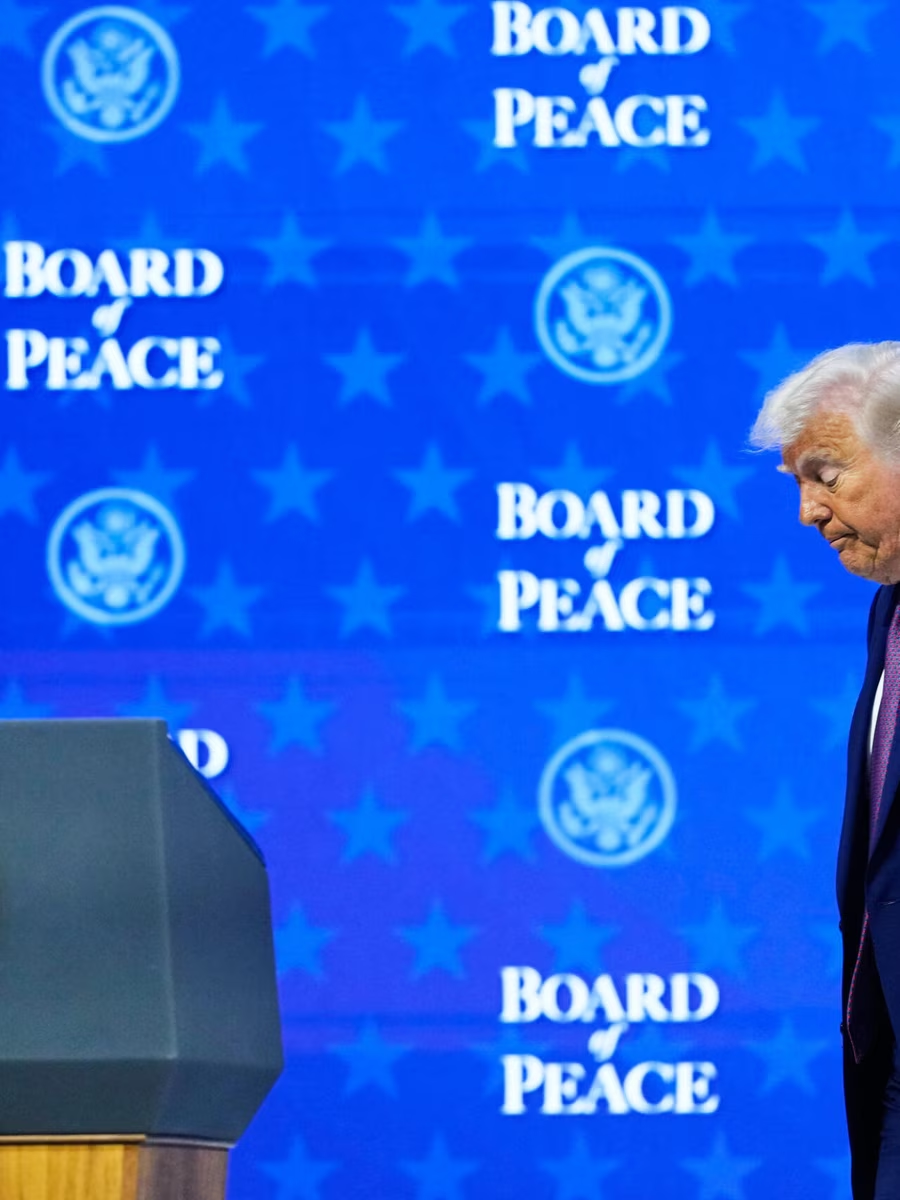
Informed sources reported that this extensive deployment comes in the context of preparing for the possibility of launching a military strike against Iranian targets, in response to escalating tensions. The aircraft carrier 'Ford' is accompanied by three additional destroyers, which unprecedentedly raises the combat readiness of US naval forces stationed near the region's coasts.

With the arrival of these new reinforcements, the total number of US warships in the Middle East rises to 17 combat vessels. This force currently includes the aircraft carrier 'USS Abraham Lincoln,' in addition to nine destroyers and three littoral combat ships specialized in near-shore operations.

The presence of two massive aircraft carriers in the region simultaneously is a rare military event, as each carries thousands of sailors and integrated air wings. These wings include dozens of fighter jets capable of executing complex offensive and defensive missions around the clock, providing vast air and naval superiority.

In addition to naval power, Washington has deployed dozens of additional warplanes to its bases in the region to enhance air deterrence capabilities. These reinforcements included advanced fifth-generation fighters such as the 'F-22 Raptor' and 'F-35 Lightning,' which are characterized by stealth capabilities and high maneuverability in hostile airspace.

Air reinforcements were not limited to offensive fighters only but also included 'F-15' and 'F-16' aircraft, supported by a fleet of 'KC-135' aerial refueling tankers. This system allows fighter jets to remain airborne for extended periods and conduct long-range operations without the need for frequent landings.

In terms of air defense, the United States has strengthened the capabilities of its guided-missile destroyers to provide a wide protective umbrella at sea. These systems work in conjunction with ground defenses deployed at military bases to protect US assets from any missile attacks or drones that might target them.

In parallel with this technical buildup, tens of thousands of US soldiers are deployed at strategic military bases across the Middle East. Despite the exclusion of ground forces participation in direct offensive operations, these forces remain on high alert to confront any reactions or counterattacks that might affect US interests.

The simultaneous presence of two massive warships of this type in the Middle East is rare, reflecting the current level of tension.

PALESTINE

Sun 22 Feb 2026 9:17 am - Jerusalem Time

Injuries from Settler Gunfire and Displacement of Bedouin Families in Widespread West Bank Attacks

Three Palestinian citizens, including a child, were injured today, Saturday, as a result of a series of attacks carried out by Israeli settlers in various areas of the central and southern occupied West Bank. The most severe attacks were concentrated in Al-Mughayyir village, northeast of Ramallah, where settlers directly fired live ammunition at residents.

Ameen Abu Alia, head of the local council of Al-Mughayyir village, confirmed that the attack resulted in a young man being shot in the back, with his injuries described as critical, in addition to another child being injured. He pointed out that the southern part of the village witnessed severe tension with continuous gunfire from settler groups targeting citizens and their properties.

In a related context, medical sources at the Palestinian Red Crescent Society reported that a citizen sustained injuries and bruises after being severely beaten by settlers in the Masafer Yatta area, south of Hebron. The sources stated that Israeli army forces obstructed the access of ambulance crews to the injured person, which delayed the provision of necessary treatment on the field.

The attacks were not limited to physical injuries but also extended to the destruction of agricultural property, as settlers grazed their sheep in the fields of Al-Mughayyir village and destroyed crops. This incident comes just days after settlers threw stones at citizens' vehicles at the entrance to the village, causing significant material damage to Palestinian property.

In a serious field development, 11 Palestinian families in the Bedouin community of 'Al-Khalayel' east of Ramallah began dismantling their homes, which consist of tin shacks and tents. This forced step came as a result of continuous pressure and attacks by settlers and the occupation army, which made staying in the area impossible, prompting the families to seek refuge in other areas.

Citizen Mustafa Kaabneh, one of the displaced residents of the community, explained that the families began removing their tents early in the morning to leave their lands, which they had inhabited for many years. He affirmed that the escalating pace of coordinated attacks between the army and settlers clearly aims to empty pastoral areas of their original inhabitants for the sake of settlement expansion.

In Hebron city, groups of settlers stormed the alleys of the Old City under heavy protection from Israeli occupation forces this evening. Local sources reported that the incursion involved provocations against Palestinian citizens and the closure of some entrances to secure the movement of settlers, which increased the state of tension in the city, which already suffers from severe military restrictions.

Official statistics indicate an unprecedented escalation in the pace of violence in the West Bank since October 2023, where attacks by the occupation and its settlers have resulted in the martyrdom of 1,116 Palestinians. Medical teams also recorded injuries to approximately 11,500 others with varying degrees of severity, amid a complex security environment imposed by daily checkpoints and incursions.

The widespread arrest campaigns launched by the occupation forces continue in various cities and refugee camps of the West Bank, with the number of detainees reaching nearly 22,000 Palestinians since the beginning of the recent escalation. These arrests coincide with demolition and displacement policies targeting the Palestinian presence in areas classified as 'C', threatening to further ignite the field situation.

The situation is very bad; gunfire continues in the southern part of the village, and there are injuries, including a child and a young man in critical condition.

UNCATEGORIZED

Sun 22 Feb 2026 9:08 am - Jerusalem Time

Theology as Policy: Huckabee and the Diplomacy of Dispossession

Washington, D.C- When U.S. Ambassador to Israel Mike Huckabee declared that Israel would be “fine” taking territory from the Nile to the Euphrates, he did more than indulge in rhetorical excess. In a televised exchange with Tucker Carlson on The Tucker Carlson Show, Huckabee articulated a worldview in which biblical promise supersedes international law, and theology is permitted to hover over statecraft as a legitimizing force. Even if later softened as “hyperbolic,” the statement was revealing. It exposed a narrative that has long circulated at the ideological margins but now echoes from the mouth of a sitting American envoy.


The provocation centered on Genesis 15 in the Book of Genesis, which speaks of land promised “from the river of Egypt to the great river, the River Euphrates.” Pressed on whether Israel had a right to that territory today—an expanse covering parts of Egypt, Jordan, Syria, Iraq, Lebanon, and Saudi Arabia—Huckabee replied that it would be “fine” if Israel took it all. The ease of that answer is what unsettles. It collapses millennia of theological interpretation, a century of modern conflict, and a dense web of international agreements into a single civilizational claim.


This is not merely a private article of faith. Huckabee has consistently rejected the legal description of the West Bank as occupied territory, preferring the biblical nomenclature “Judea and Samaria” and insisting on an inherent Jewish right to settle it. In doing so, he repudiates not only the prevailing international consensus but also the cautious language that successive U.S. administrations have employed to preserve the possibility—however remote—of negotiated borders. His rhetoric is not an aberration; it is coherent with a Christian Zionist framework that regards territorial compromise as a dilution of divine decree.


What that framework erases are the political and human consequences of permanent occupation. On the ground, the expansion of settlements has been accompanied by a sustained pattern of violence against Palestinians—arson attacks, land seizures, assaults on farmers and shepherds, and, in some cases, killings. Human rights organizations, Israeli and international alike, have documented that much of this violence occurs in the presence of, or under the protection of, the Israeli occupation army. Soldiers frequently stand by as settlers attack Palestinian property or individuals; at times, they intervene not to restrain the aggressors but to disperse or arrest the victims. The structural message is unmistakable: settlement expansion is shielded by state power.


Huckabee’s public posture toward this reality has been, at best, indifferent. He has shown little inclination to condemn settler violence with the clarity he reserves for defending settlement rights. When violence claims the life of a Palestinian— even one who holds U.S. citizenship—the outrage that might be expected from an American ambassador is muted. The killing of 19-year-old Nasrallah Abu Syiam, a U.S.-born Palestinian attacked by settlers, barely penetrated mainstream American coverage. The silence of senior U.S. officials, including the president, compounds the asymmetry. The moral vocabulary deployed to defend territorial maximalism rarely extends to the Palestinians living under its shadow.


Regionally, Huckabee’s comments reverberated with predictable alarm. Egypt, Jordan, Saudi Arabia, Kuwait, Oman, Qatar, the United Arab Emirates, Iraq, and the Arab League condemned the remarks as extremist and destabilizing; Indonesia and Pakistan followed suit. Their reaction was not hysteria but recognition. In a region where borders were drawn through war, treaty, and uneasy compromise, casual endorsement of sweeping annexation reads as a threat to sovereignty itself. Jordan, whose stability is intimately tied to the fate of the West Bank, hears in such statements an existential undertone.


The deeper danger lies in the normalization of a narrative that fuses sacred text with contemporary territorial entitlement. Modern international order rests on the inadmissibility of acquiring land by force and on the principle that sovereignty emerges from mutual recognition, not revelation. To suggest that ancient scripture provides a standing deed to modern territory is to undermine that order. It licenses a politics in which power is sanctified and compromise is recast as heresy.


Diplomacy depends on disciplined ambiguity—on the careful separation between personal conviction and official policy. When an ambassador blurs that line, foreign governments do not parse theological nuance; they assess strategic intent. Even if Washington formally disavows expansionist goals, the spectacle of its envoy entertaining them corrodes credibility. It signals that maximalist visions are not fringe fantasies but tolerated discourse within the orbit of power.


Huckabee’s remarks are thus symptomatic of a broader drift. They reflect a movement in which empathy is selective, legality is negotiable, and the vocabulary of destiny supplants the language of rights. In that narrative, Palestinians appear less as a people with claims than as obstacles to fulfillment of a promise. Settler violence becomes an unfortunate byproduct rather than a structural feature of entrenching control. The occupation army’s role in shielding expansion is obscured beneath invocations of history.


The question is not whether religious belief may inform personal identity; it inevitably does. The question is whether American diplomacy can afford to subordinate international norms to theological conviction. If the United States wishes to remain a credible actor in a conflict defined by land and legitimacy, it cannot allow its representatives to speak as if borders are matters of prophecy rather than negotiation. Words about territory in this region are never abstract. They map themselves onto lives, homes, and graves

ARAB AND WORLD

Sat 21 Feb 2026 10:53 am - Jerusalem Time

US Military Movements: Hundreds of Soldiers Evacuated from Qatar and Bahrain Amid Rising Tensions with Iran

The United States of America has begun a large-scale evacuation operation involving hundreds of soldiers from Al Udeid Air Base in Qatar, in addition to similar movements at military bases in the Kingdom of Bahrain. These precautionary steps come amid escalating regional tensions and mutual threats of military attacks, which prompted the US Central Command to reassess the positioning of its forces in the region.

Press sources quoted officials at the US Department of Defense 'Pentagon' as saying that the evacuation operations also included vital centers where the US Fifth Fleet is stationed in Bahrain. These movements aim to reduce potential human losses in the event of a direct confrontation with Iran, especially with growing concerns about Tehran's reactions to any military move by Washington.

Military estimates indicate that there are between 30,000 and 40,000 US soldiers distributed across 13 military bases throughout the Middle East, which puts them in direct danger. Accordingly, the Department of Defense quickly moved to strengthen its defensive systems by transferring additional missile batteries to protect vital installations and the remaining forces at those bases.

In a related context, intelligence reports recalled Iran's targeting of Al Udeid Air Base last June with a barrage of missiles, despite the existence of secret communication channels at the time that informed both the American and Qatari sides of the attack in advance. However, the current circumstances appear more complex with the absence of mutual guarantees and Washington's insistence on an unprecedented military buildup in the region.

Open-source intelligence tracking sources observed the arrival of more than 100 US Army aircraft at bases in Europe and the Middle East in the last week alone. These air reinforcements coincide with the presence of the aircraft carriers 'USS Abraham Lincoln' and 'USS Gerald R. Ford' in the region, which carry more than 120 fighter jets ready for deployment.

For his part, US President Donald Trump issued firm statements during a 'Peace Council' meeting in Washington, indicating that the next ten days will be crucial in determining the course of the relationship with Tehran. Trump stressed the need to reach a 'meaningful' agreement that guarantees American interests, warning of serious consequences if the diplomatic path fails.

Washington adheres to strict demands that include a complete halt to Iran's uranium enrichment activities and the transfer of enriched stockpiles out of the country, in addition to including the ballistic missile program in any future agreement. The US administration believes that these conditions are necessary to ensure regional stability and limit the influence of armed groups supported by Tehran.

In contrast, Tehran categorically rejects expanding the scope of negotiations to include its defensive capabilities or regional influence, asserting that its nuclear program is the only issue open for discussion. The Iranian leadership vows a firm response to any military aggression, considering that American and Israeli moves aim to change the regime and impose political dictates through economic sanctions.

We must reach a meaningful agreement with Iran, or bad things will happen.

ISRAELI AFFAIRS

Sat 21 Feb 2026 10:52 am - Jerusalem Time

An Israeli Security Vision for 2026: Four Conclusions Reshaping the Confrontation with the Palestinians

Sources reported that security circles in Tel Aviv have begun re-evaluating the strategic threat map for 2026, in light of escalating regional risks and the development of drone technology and precision missiles. Security experts believe that the principle of traditional disarmament is no longer effective in confronting current challenges, which forces the occupation to formulate a political alternative that balances security control in the Gaza Strip and preventing existential threats in the West Bank.

In this context, General Giora Eiland, former head of the National Security Council, stated that the radical shift following the events of October 7 triggered a sharp strategic discussion about the security vision adopted in recent decades. Eiland clarified that the long-held concept that Hamas had been deterred proved false, noting that this erroneous assessment came at a heavy cost in lives and demonstrated the failure of government policies towards the Strip.

Eiland pointed out that Israeli policy was not only aimed at deterrence but also sought to deepen the division between Gaza and the West Bank to ensure the absence of unified Palestinian representation that would thwart any opportunities for political negotiations. However, this approach ignored the increasing security costs, as the government believed that Hamas could be allowed to achieve political and economic stability while preventing the growth of its military capabilities, which later proved to be false.

According to published analyses, Hamas managed to collect huge financial resources that were not only used to strengthen its political rule but were primarily directed towards building a sophisticated military arsenal. Despite these results, political levels in Tel Aviv still reject the return of the Palestinian Authority to Gaza, fearing that this would lead to the unification of Palestinian geography and pave the way for a comprehensive political arrangement that does not serve Israeli security interests.

The former general believes that the two-state solution in its traditional form is no longer a viable option under current circumstances and changing regional power balances. He considered that the old assumption that a Palestinian state would be militarily weaker than Israel no longer holds true, especially since Tel Aviv operates in a turbulent environment and faces cross-border military alliances and armed organizations.

The October 7 attack revealed the possibility of fighting on one front quickly escalating into a multi-front war, with Israel now facing missile threats from Iraq, Yemen, and Iran. In this scenario, the establishment of a Palestinian state is seen as an additional hotbed of danger that could turn into a security choke point threatening Israel's heartland and vital population centers in the center.

Eiland addressed the technological revolution in weaponry, emphasizing that the term 'disarmament' in its classical sense, associated with tanks and planes, is outdated. Modern warfare relies on small and lethal means such as anti-tank missiles and drones that are easy to smuggle and hide within civilian environments and supply trucks, making their monitoring almost impossible.

The analysis concluded with four main findings. The first is that the return of the Palestinian Authority to Gaza may be a better security option than the continued rule of Hamas or attempts to find fragile local alternatives. The second conclusion emphasizes the necessity of formulating a new international strategy that recognizes that the two-state solution is no longer technically and security-wise possible given technological developments that grant small groups enormous destructive capabilities.

In conclusion, Eiland called for moving beyond the dichotomy that limits options between eternal control over the West Bank or the establishment of a fully sovereign state, proposing temporary political models that meet security needs. He stressed the need to confront the international community with the realities of the military danger resulting from any withdrawal to the 1967 borders, considering that the exclusion of the two-state solution must be based on purely security considerations, away from ideology.

The guiding concept that Hamas had been deterred was wrong, and it came at a heavy cost in blood.

OPINIONS

Sat 21 Feb 2026 10:52 am - Jerusalem Time

America in the Trump Era: Transformations of Nihilism and the Rise of the 'Mad Wolf' Among Nations

Ramallah - "Al-Quds" Dot Com

Ramallah - "Al-Quds" Dot Com

Opinion Writer

The writer evoked the memory of the golden age of journalism through the experience of the late French journalist Hervé Bourges, who saw newspapers as an addiction from which there was no escape, just like music or sports. Reading in those decades was a sacred daily ritual that went beyond novels to include philosophy, politics, and economics, where reading the newspaper was associated with morning habits in cafes and public transport, a scene that has become rare today, especially in the Arab region, which has witnessed a sharp decline in the number of paper journalism addicts.

The charm of journalism in the past was linked to that ethical and cultural contract between the reader and prominent writers and respected columnists who shaped public consciousness. In American and British journalism, names such as William Pfaff, Peter Jenkins, and Hugo Young emerged, who gave their journalistic institutions intellectual weight, making their articles eagerly anticipated events by the public, given their deep connection to European intellectual formation and their ability to provide insightful visions that went beyond mere news reporting.

In the context of major transformations, the renowned commentator David Brooks announced his retirement from writing for the 'New York Times' after a career that began in 2003, expressing in a sarcastic manner his disappointment with the direction American politics had taken. Brooks, who sought to establish a moderate conservative ideology, found himself facing a reality completely different from what he aspired to, as he believes that the world has dramatically changed for the worse since he joined the newspaper, which prompted him to dedicate himself to writing and research projects.

The analysis points to a state of collective loss of trust that has afflicted American society, where disappointment is no longer limited to the religious aspect but has extended to include political and economic institutions. The Iraq War contributed to shattering trust in military power, while the financial crisis destroyed faith in absolute capitalism, leading to the internet, which transformed from a communication tool into a platform for exacerbating hatred and social isolation, making public discourse more negative than it has been in a century and a half.

The culmination of these transformations is embodied in the rise of the Trump phenomenon, which Brooks describes as 'nihilism incarnate,' based on the principle that power and tyranny are the only drivers of life, far from any moral constraints. With 69% of Americans no longer believing in the 'American Dream,' it seems that the United States is on a rough path that may end with it becoming a 'mad wolf' in the international arena, driven by a desire to harm and impose absolute authority.

Trump is nothing but nihilism personified in a man, claiming that morals are only for fools and that life means nothing but power, authority, and tyranny.

PALESTINE

Sat 21 Feb 2026 10:52 am - Jerusalem Time

Palestinian Authority Announces Establishment of Liaison Office with "Peace Council" to Coordinate Gaza Strip Administration

The Deputy President of the State of Palestine, Hussein Al-Sheikh, expressed the Palestinian leadership's welcome of the announcement by the High Representative for Gaza in the "Peace Council," Nikolay Mladenov, regarding the establishment of an official liaison office affiliated with the Palestinian Authority. This office aims to institutionalize joint coordination processes with the International Council to oversee the implementation of the transitional phase management plan in the Gaza Strip, and to ensure smooth communication between the concerned parties.

Al-Sheikh affirmed in his statements that this step represents an official and organized channel for direct communication with the office of the High Representative, serving the implementation of US President Donald Trump's vision and Security Council Resolution No. 2803. He clarified that the new mechanism will ensure the transfer of correspondence and decisions through a clear institutional framework, which enhances the role of the Palestinian Authority in following up on field and political files during the upcoming period.

For his part, Nikolay Mladenov stated in an official statement that the High Representative's office will serve as a vital link between the Peace Council and the National Committee tasked with managing Gaza's affairs. He stressed that this cooperation aims to ensure the implementation of all aspects of transitional administration and redevelopment processes with high integrity and effectiveness, meeting the needs of the population affected by the two-year war.

This development comes in the context of activating the "Peace Council" which the US President announced its establishment in mid-January 2026, following the ceasefire agreement that came into effect last October. These moves are based on the UN Security Council resolution issued in November 2025, which set a timeline for the international civilian and security presence in the Strip extending until the end of 2027.

The second phase of the international agreement includes sensitive provisions, including the disarmament of Palestinian factions in Gaza, in exchange for additional withdrawals of the occupation army from areas where it is still present. This phase also focuses on launching comprehensive reconstruction efforts, in an attempt to repair the massive destruction that affected about 90% of the civilian infrastructure in the Strip as a result of the prolonged military operations.

Despite diplomatic efforts, field sources reported that the occupation forces continue to repeatedly violate the ceasefire agreement, with the martyrdom of more than 600 Palestinians recorded since the truce began. These violations raise serious concerns about the stability of the transitional phase and the ability of the Peace Council to enforce full compliance with the provisions signed between the warring parties.

It is worth noting that the war of extermination launched by the occupation forces since October 2023 has left a heavy toll of 71,000 martyrs and more than 171,000 injured, in addition to an unprecedented humanitarian crisis. UN reports estimate that the reconstruction process of what the war destroyed will require a huge budget of up to 70 billion dollars, which requires extensive international coordination led by the bodies emanating from the Peace Council.

This step provides an official channel for coordination and communication between the office of the Peace Council representative and the Palestinian Authority, to implement the US President's plan and Security Council Resolution 2803.

OPINIONS

Sat 21 Feb 2026 10:45 am - Jerusalem Time

The Two-State Hocus Pocus: The Diplomacy of Illusion

Washington, D.C. — For more than three decades, the two-state solution has served as the international community’s default formula for resolving the Israeli–Palestinian conflict. It appears with ritual regularity in presidential speeches, United Nations resolutions, and European communiqués. Yet repetition has not produced resolution. As the language hardened into orthodoxy, the material foundations necessary to realize it steadily eroded. What remains today is less a political program than a diplomatic incantation.


Recent diplomacy has only reinforced that reality. The “Board of Peace” meeting convened in Washington on February 19 under U.S. President Donald Trump’s chairmanship was presented as a renewed push for regional stabilization. In substance, it demonstrated how detached official discourse has become from conditions on the ground. The gathering preserved the vocabulary of peace while avoiding the structural transformations that have rendered territorial partition increasingly implausible. Such forums now resemble rituals designed to sustain a narrative long after its feasibility has expired.


The flaw is not philosophical. The idea of two peoples exercising sovereignty in two states retains moral coherence in theory. The failure is political. The two-state solution is no longer tethered to enforceable steps, binding timelines, or consequences for noncompliance. It has become a diplomatic alibi—language that signals moderation and responsibility while sparing governments the political cost of enforcement or accountability.


The confusion begins with mistaking a slogan for a strategy. A credible plan would define borders, mandate withdrawal, dismantle settlements deemed illegal under international law, and secure genuine Palestinian sovereignty. Instead, process has replaced outcome. Negotiations are elevated above results. Calls to “return to talks” obscure a fundamental asymmetry: one side retains the power to reshape realities unilaterally, while the other negotiates over territory that continues to fragment.


The notion that occupation is temporary has likewise collapsed. The Israeli presence in the West Bank has evolved into a system of territorial integration. Settlements are embedded in a network of roads, military zones, and administrative regimes that divide Palestinian areas into disconnected enclaves. Expansion continues, accompanied by escalating settler violence, often carried out under the watch—or protection—of Israeli forces. This is not a frozen dispute awaiting compromise; it is an active process of consolidation that narrows the horizon of partition with each passing year.


Diplomatic language further blurs the distinction between statehood and sovereignty. The Palestinian state frequently envisioned would be demilitarized, territorially discontinuous, and subordinate in matters of borders, airspace, and security. A polity lacking authority over land, resources, and external relations does not meet the threshold of sovereign equality. Administrative autonomy under overarching control is not self-determination.


The original Oslo bargain—security and normalization in exchange for statehood—has effectively unraveled. Israel has secured expanding regional integration and strategic cooperation, while Palestinian sovereignty remains indefinitely deferred. When one party accrues tangible diplomatic and economic benefits absent reciprocal territorial concessions, negotiations cease to function as instruments of compromise. They instead stabilize and legitimize imbalance.


Time compounds the distortion. Each year of inconclusive diplomacy coincides with further settlement growth and territorial entrenchment. International initiatives absorb pressure without reversing facts on the ground. Assertions that two states remain “within reach” increasingly sound less like sober analysis than institutional habit.


The symmetrical framing of the conflict reinforces the illusion. The language of “two sides” suggests parity between actors of comparable power. In practice, one authority exercises overarching control over borders, land allocation, population registries, and security across the territory, while the other operates under layered restrictions and military oversight. Recasting structural inequality as mutual intransigence obscures responsibility and diffuses accountability.


International law has been diluted in the process. Settlements, annexation, and self-determination—issues grounded in established legal norms—are routinely recast as negotiable “final status” matters. Violations become bargaining positions; rights become concessions to be traded. Through endless procedure, the abnormal is normalized.


The political utility of this framework is evident. By affirming support for a negotiated two-state outcome, Western governments align themselves rhetorically with international law while avoiding measures—conditionality, sanctions, recognition—that might alter incentives. The vocabulary of peace substitutes for policies capable of changing realities. The formula manages the conflict; it does not resolve it.


At some point, Palestinians must confront the implications of this trajectory. Continued reliance on a framework that lacks territorial feasibility, political enforcement, and meaningful international backing risks prolonging strategic paralysis. Clinging to the promise of imminent statehood may serve external diplomatic interests more than Palestinian self-determination. Disabusing themselves of the illusion is not a renunciation of rights; it may be a precondition for redefining them on firmer ground.


 Two states may once have represented a plausible historical compromise. Today, absent dismantlement of the settlement enterprise and the restoration of genuine sovereignty, the formula functions primarily as cover for inaction. The central illusion is not simply diplomatic. It is the belief that repetition can substitute for reality—and that language alone can reverse facts deliberately created on the ground.

PALESTINE

Sat 21 Feb 2026 5:11 am - Jerusalem Time

Blair reveals features of 'Peace Council' plan for Gaza: Disarmament and a technocratic committee to manage the Strip

Tony Blair, a member of the executive board of what is known as the 'Peace Council', revealed the outlines of an international plan aimed at reshaping the security and political reality in the Gaza Strip. Blair explained that the success of any future vision for reconstruction is fundamentally based on dismantling the military capabilities of Palestinian factions and ensuring the transfer of governing authority to a technocratic committee that manages civil affairs.

Blair stressed in statements to the media during the Washington summit that the top priority at the current stage is the complete disarmament of the Hamas movement. He considered this step to be the only guarantee to enable the proposed technocratic committee to carry out its administrative tasks without military obstacles or field interventions.

In contrast, the Hamas movement's response was firm in rejecting any plans that overstep national rights, as the movement affirmed that any political path must begin with a comprehensive cessation of Israeli aggression. The movement also demanded the lifting of the unjust siege on the Strip and ensuring the legitimate rights of the Palestinian people as a fundamental condition for any future arrangements.

Blair indicated that the plan enjoys direct support from US President Donald Trump, whom he described as fully committed to Israel's security while seeking to improve the living conditions of Palestinians. The former British official's statements did not address the necessity of stopping Israeli military operations or obliging the occupation government to a timeline for withdrawal.

The meeting revealed the committee's orientations, which appear to be consistent with Israeli security requirements in the first place, as the focus is on administrative and security arrangements, regardless of the ongoing humanitarian tragedy. Observers believe that this vision ignores the extent of the destruction and the victims who have fallen since the aggression began on October 7, 2023.

Regarding international participation, Blair announced that five 'moderate' Islamic countries have agreed to send personnel to participate in the 'International Stabilization Force'. This force will undertake internal security tasks in the Strip in coordination with the international and regional bodies overseeing the plan.

Regarding the financial aspect, Blair revealed massive pledges from Saudi Arabia and the United Arab Emirates amounting to $7 billion. These funds will be allocated to finance massive reconstruction operations and support the institutional capacity building of the new civil police in Gaza.

Blair explained that Israel will have a pivotal role in security oversight, as it will inspect and review the elements of the new police force to ensure what he described as 'proper governance'. This measure aims to reassure the Israeli side about the identity and orientations of the individuals who will take over the security file in the Strip.

Despite the optimistic tone Blair displayed, he acknowledged the existence of ongoing complexities that may hinder immediate implementation, particularly regarding potential contributions from countries such as Turkey. He noted that some international parties might raise concerns for Israel, requiring careful and precise coordination to overcome these diplomatic obstacles.

Blair affirmed that the 'Peace Council' initiative does not seek to undermine the role of the United Nations or replace it in the Palestinian territories, but rather aims to complement existing international resolutions. Through this approach, the Council seeks to create a broad international alliance that provides the necessary political and financial cover for implementing the new arrangements.

Regarding the Council's structure, Blair explained that there is increasing international momentum for participation, with most participating countries providing diverse contributions including funding, troops, or technical support. He considered that the door is still open for other countries to join this alliance aimed at changing the face of the region.

It is worth noting that Tony Blair was a candidate to assume the position of the Council's executive official, but he was replaced by the Bulgarian politician Nikolay Mladenov, the former coordinator of the peace process. Nevertheless, Blair continues to play a central role in promoting the plan and mobilizing international support for it through his extensive connections.

Blair admitted that there are parliamentary and constitutional challenges in some countries that may delay their official involvement in the proposed international force, but he stressed that the summit achieved its primary goal. He believes that the combination of American leadership and strategic planning provides a realistic path towards what he described as 'a more stable and secure Gaza'.

The Washington summit, chaired by Trump, witnessed a noticeable absence of influential European powers, while attendance focused on specific Arab and Islamic countries. This formation reflects the US administration's desire to build a new regional alliance that will take responsibility for the Palestinian file according to a vision consistent with common security interests.

The most important thing now is the disarmament of Hamas and ensuring the new technocratic committee's ability to govern with its powers.

PALESTINE

Sat 21 Feb 2026 5:11 am - Jerusalem Time

Bishara Bahbah attacks Tony Blair's role in Gaza: His history in Iraq makes him untrustworthy

Bishara Bahbah, president of Americans for Peace, expressed strong reservations about recent statements made by Tony Blair, former British Prime Minister and member of the Peace Council, regarding future arrangements for the Gaza Strip. Bahbah pointed out that Blair's proposal, which grants Israel the right to inspect and test the new police force in the Strip, entrenches security dependence on the occupation and undermines the concept of independent governance.

In press statements, Bahbah considered that Tony Blair's political record, especially his controversial role in the invasion and destruction of Iraq, strips him of the necessary credibility to play the role of mediator or supervisor in the Arab region. He clarified that figures associated with previous colonial files cannot gain the trust of the Palestinian street or regional powers in shaping the future of the war-torn Strip.

The president of Americans for Peace warned that Israel seeks to remain an effective controlling power in the details of life in the Gaza Strip, exploiting American influence that grants it broad powers in the Middle East. He believed that the Peace Council seems compelled to follow Israeli dictates, which transforms reconstruction efforts into a tool to enhance security control instead of achieving true stability.

Regarding the humanitarian aspect, Bahbah affirmed that the declared goal of the Peace Council is to provide shelter, food, and clothing for Gaza residents, but these efforts will remain insufficient unless Israeli security control is ended. He stressed that sending any international stabilization forces will not be effective or acceptable if Israel remains the party that determines the rules of engagement and movement within the Strip's borders.

Bahbah emphasized the necessity for the technocratic committee responsible for reconstruction to deal directly with the Palestinian Authority as the sole legitimate representative of Palestinians. He explained that bypassing the Authority at this stage threatens national sovereignty and creates a state of administrative duality that primarily aims to satisfy the Israeli side at the expense of independent Palestinian political decision.

Bahbah described the field situation in Gaza as tragic, noting that the international momentum promoted by the Peace Council has not yet translated into tangible improvement in citizens' lives. He added that humanitarian aid still arrives in drips and does not meet basic needs, which has made the Palestinian people almost entirely dependent on international organizations in the absence of a clear political horizon.

The discussion touched upon the ceasefire agreement signed last October, where Bahbah pointed to the stalled implementation of the second phase, which includes the withdrawal of occupation forces and securing the entry of international forces. He affirmed that postponing these steps for several months weakens the effectiveness of the Peace Council and proves that Israel continues to procrastinate in fulfilling its international obligations to ensure the continuation of its military grip.

Regarding the disarmament of the resistance, Bahbah explained that the guarantees provided to the Hamas movement are insufficient in light of daily Israeli violations, which makes the movement hesitant to hand over its military capabilities. He concluded by emphasizing that the success of any reconstruction process requires serious and comprehensive negotiations that ensure a national administrative role that protects the security of the residents and prevents the renewal of armed conflict in the future.

Blair's political background and involvement in the destruction of Iraq make him an untrustworthy figure on both the Arab and international levels regarding the Gaza issue.

PALESTINE

Sat 21 Feb 2026 5:11 am - Jerusalem Time

United Nations: Settler Attacks Displace Thousands of Palestinians in West Bank

United Nations sources reported that the escalating pace of settler attacks in the occupied West Bank has led to a widespread displacement wave affecting approximately 880 Palestinian families. Stéphane Dujarric, spokesperson for the UN Secretary-General, clarified that these coercive practices have resulted in the displacement of over 4,700 people, amidst warnings of continued violence perpetrated by both Israeli forces and settler groups.

Dujarric noted in a press briefing that international humanitarian organizations are gravely concerned about the destruction of property and the casualties resulting from these policies. He confirmed that the period between February 3rd and 6th witnessed a bloody escalation that led to the martyrdom of three Palestinians by occupation forces' bullets, raising the death toll since the beginning of this year to nine martyrs, including two children.

Regarding the details of the field attacks, sources recorded at least 86 attacks carried out by Israeli settlers in just a few days. These attacks resulted in injuries to over 60 Palestinian citizens, in addition to forcing another 146 people to leave their homes and be forcibly displaced for fear of their lives from sudden attacks.

The UN Secretary-General strongly condemned the killing of 19-year-old Nasrallah Abu Siam, a Palestinian citizen holding American nationality, who fell victim to an attack carried out by settlers. The same assault resulted in three other Palestinians being shot, in an incident described by the international organization as reflecting a lack of accountability and rampant violence in the occupied territories.

The United Nations called on Israeli authorities to conduct an immediate, transparent, and comprehensive investigation into the circumstances of Abu Siam's death and ensure that the perpetrators are brought to justice. Dujarric stressed that Israel, as an occupying power, is legally obligated to take concrete steps to prevent acts of violence committed by settlers against unarmed Palestinian civilians and protect them from retaliatory practices.

On the Lebanese front, the UN spokesperson revealed continued Israeli violations targeting international peacekeeping forces (UNIFIL). He pointed to repeated incidents of obstruction and aggressive behavior by the occupation army, the latest of which was a serious intimidation incident targeting a UN soldier while performing his official duties at a UN site.

According to field reports, Israeli soldiers approached a peacekeeper near the Naqoura area, pointing their weapons directly at him from a very close distance of no more than ten meters. The United Nations affirmed its categorical rejection of these actions, demanding an immediate halt to any interference or intimidation that hinders the work of international missions tasked with monitoring stability on the borders.

Settler attacks in the West Bank have caused the displacement of approximately 880 Palestinian families, totaling over 4,700 people.

PALESTINE

Sat 21 Feb 2026 5:11 am - Jerusalem Time

Hamas Sets Conditions for International Forces in Gaza, Rejects Interference in Internal Affairs

Hamas spokesman Hazem Qassem affirmed that the movement does not veto the presence of an international peacekeeping force in the Gaza Strip, as long as its tasks are limited to monitoring the ceasefire agreement. Qassem clarified that the purpose of these forces should be to form a barrier preventing Israeli army aggressions and protecting Palestinians, while simultaneously emphasizing a categorical rejection of any interference in the administrative or internal affairs of the Strip.

In a related context, the spokesman indicated that the movement supports the training of Palestinian police forces within purely national frameworks to ensure internal security and counter attempts to spread chaos. He considered strengthening the police apparatus a necessity to confront plans through which the occupation seeks to destabilize societal stability, stressing that any dialogue about Gaza's future must first be based on a comprehensive and final cessation of Israeli aggression.

These statements follow an extensive meeting of the Peace Council held in Washington D.C., where funding for the reconstruction of the devastated Strip was discussed. Attendees discussed mechanisms for deploying foreign forces to undertake the task of achieving stability after two years of war that left massive destruction, affecting about 90% of Gaza's infrastructure and civilian facilities.

During the meeting, US President Donald Trump revealed massive financial pledges from several countries, particularly from the Gulf region, exceeding $7 billion. These funds aim to launch a comprehensive reconstruction process in the Strip, which is suffering from a suffocating humanitarian crisis, with statistics indicating over 72,000 martyrs and more than 171,000 Palestinians injured since the start of the aggression.

The Washington meeting witnessed a presentation of a future vision for the Gaza Strip through artificial intelligence technologies, depicting the city as a prosperous urban center with skyscrapers and modern facilities. According to the presentation, the plan aims to transform Gaza into an independent, secure, and globally connected area, ensuring a dignified and stable life for its residents away from the woes of repeated wars.

On the military and field side, the features of the stabilization force, which will operate under US leadership, were defined, and its strength is expected to reach 20,000 soldiers. Military sources announced that Indonesia will play a pivotal role in this force by assuming the position of deputy commander, in addition to contributing eight thousand soldiers to enhance security in the region.

Alongside Indonesia, four other countries will participate in providing the necessary elements for the stabilization force: Morocco, Kazakhstan, Kosovo, and Albania. This international diversity aims to give broad legitimacy to the force and ensure its ability to deal with complex security challenges in the Strip, with a focus on preventing the return of armed confrontations.

For his part, Peace Council coordinator Nikolay Mladenov announced the start of procedures for forming a new police force in Gaza, indicating that applications for this force have officially opened. Mladenov confirmed that the first hours saw a large turnout, with about two thousand people applying to join, in a step aimed at building a security apparatus free from direct factional influences.

On the regional level, Egyptian Prime Minister Mostafa Madbouly expressed his country's readiness to continue efforts aimed at training Palestinian police cadres. This Egyptian initiative comes within the framework of empowering Palestinians to manage their internal security affairs efficiently and ensuring the sustainability of stability in the Strip after the withdrawal of occupation forces from populated areas.

In the same context, Moroccan Foreign Minister Nasser Bourita affirmed his country's readiness to send members of the Moroccan police and contribute to specialized training programs for local police in Gaza. These moves reflect an Arab and international desire to find institutional security alternatives that ensure the Strip does not slide into a security vacuum or internal fighting during the transitional phase.

Press reports indicate that Hamas may seek to integrate about 10,000 of its current police elements into the new internationally supported Palestinian administration. This comes at a time when the movement still controls less than half of the Strip's area, while the occupation army continues to occupy more than 50% of the territory, according to the arrangements of the latest ceasefire agreement.

Our position on international forces is clear: we want peacekeeping forces to monitor the ceasefire and ensure its implementation, without interfering in Gaza's internal affairs.