ISRAELI AFFAIRS

Mon 09 Mar 2026 3:37 am - Jerusalem Time

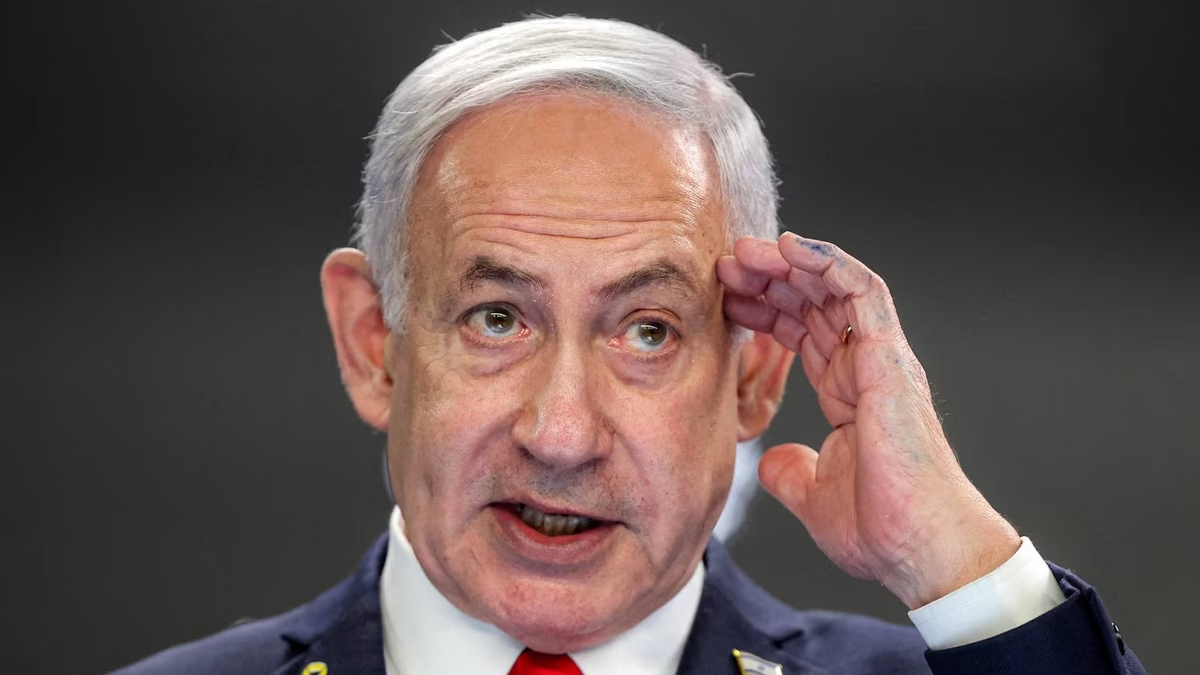
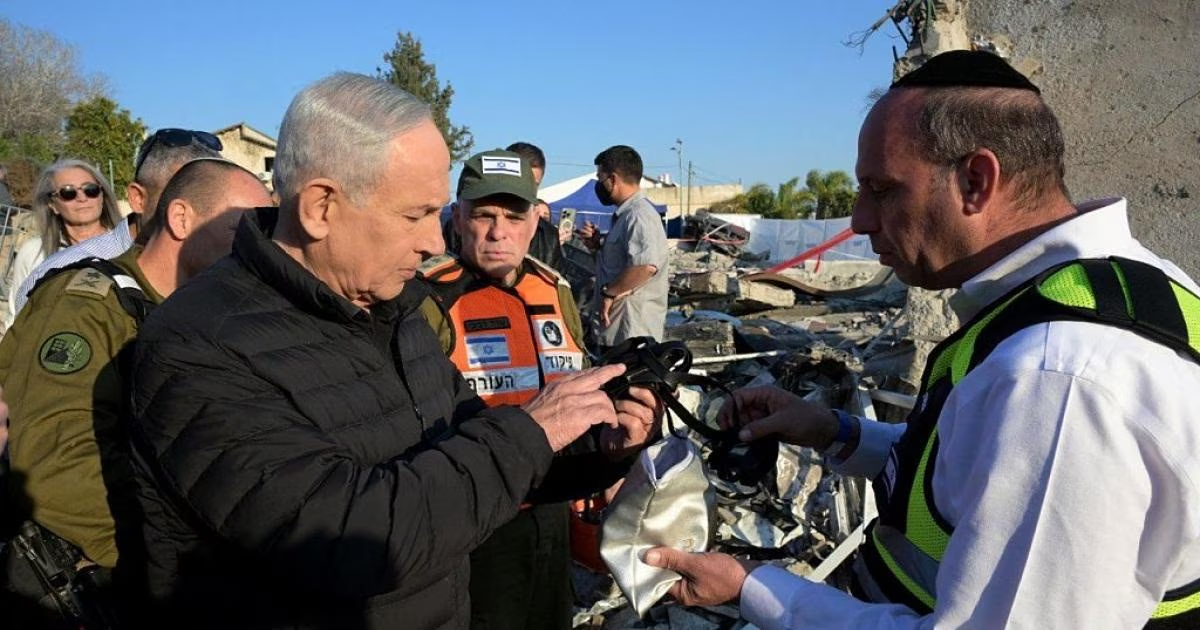
Strict security measures to protect Netanyahu from drone threat

Hebrew security sources revealed an official decision to tighten and enhance the personal protection measures surrounding the occupation prime minister, Benjamin Netanyahu. This step comes amid security assessments indicating a high level of risks facing political and military leaders in Tel Aviv during the current period.

The reports clarified that the security system decided to focus intensively on confronting threats resulting from drones, which have become a major challenge for defense agencies. The security team will be equipped with advanced technologies capable of detecting and neutralizing small flying objects before they reach their targets.

Observers link this decision to the escalating regional tensions, especially with the ongoing open confrontation with Iran and its proxies in the region, such as Hezbollah and the Houthis. Intelligence agencies consider the use of suicide drones to be the preferred weapon for carrying out precise targeting operations that bypass traditional radars.

Data indicates that the recent period has witnessed actual attempts to target facilities and figures belonging to the occupation through waves of missiles and unmanned aircraft. This reality prompted security circles to conduct a comprehensive review of protocols for protecting important figures and update them to suit the nature of the new aerial weapon used in the battle.

The new defensive measures are expected to include changes in the movement routes of the occupation prime minister, in addition to strengthening fortifications in his residences and workplaces. These moves come at a time when various fronts are witnessing a state of maximum alert in anticipation of any military escalation that may directly affect Israeli depth.

The new measures focus particularly on confronting potential threats from drones amid regional tensions.

ISRAELI AFFAIRS

Mon 09 Mar 2026 3:37 am - Jerusalem Time

An Israeli Reading of the Region's Future: Lebanon, Iraq, and Yemen Facing Radical Transformations

Israeli security assessments indicate that the Middle East region is undergoing a period of labor that will lead to a political and geopolitical reality completely different from what it was before October 6th. According to the vision presented by Segev Steinberg, an official at the Jerusalem Center for Foreign Affairs, future alliances will not be based on sectarian slogans, but will primarily rely on common interests, technological superiority, and military strength.

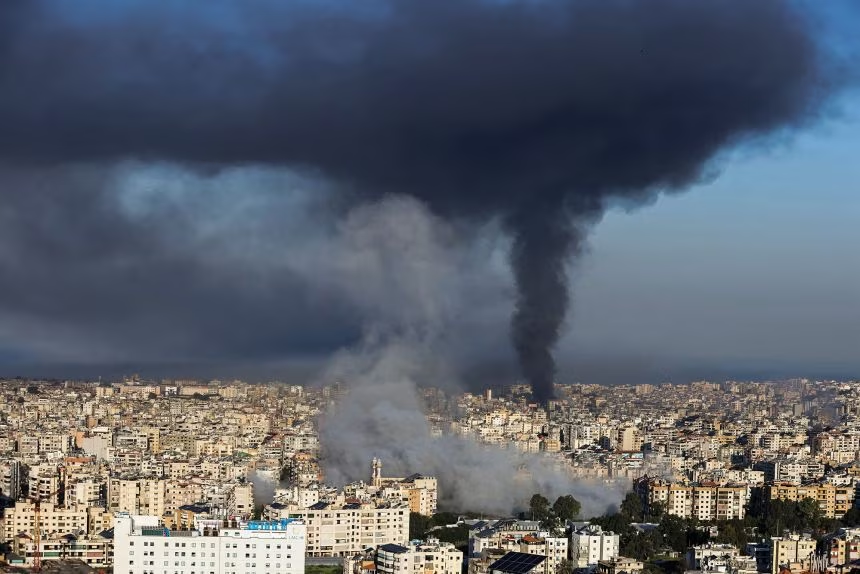
Lebanon stands out as one of the first countries affected by these transformations, as Hezbollah faces unprecedented military and financial pressures that have eroded its influence in its traditional strongholds in the southern suburbs. Sources believe that Israel does not aim to change the Lebanese regime by force, but rather seeks to create a political environment that weakens the party and removes it from the sphere of effective influence, exploiting the decline in financial support from Tehran and the damage to its military infrastructure.

As for Iraq, the equation is moving towards breaking the Iranian grip that has controlled Baghdad for many years, especially with the change in the American administration and the return of Donald Trump to the White House. The Israeli reading clarifies that cutting the land corridor connecting Iran to the Mediterranean Sea represents a cornerstone in changing the regional balance, which puts Iraq before two choices: either sinking into internal conflicts or engaging in new economic axes.

Regarding Yemen, the Houthis are experiencing a state of increasing anxiety as they observe the decline in the power of their allies in the region, realizing that Iranian aid is no longer guaranteed as before. Field pressures on the group by government forces are increasing, at a time when Saudi Arabia is anticipating any reckless move that might give it a pretext to definitively end the security threat on its southern borders.

This strategic shift is linked to a broader American vision aimed at connecting India with the UAE and Saudi Arabia, all the way to Israel, which means a complete break with other international projects such as China's "Silk Road." This new axis requires regional stability that ensures the flow of trade and energy, which necessitates reducing the influence of armed groups loyal to Iran in countries that represent vital corridors for these projects.

In conclusion, these readings confirm that the region is living a moment of truth, where old powers will not automatically disintegrate, but they face existential challenges that may redraw the boundaries of influence. The shape of the future Middle East remains dependent on the outcomes of current confrontations and the ability of central states to impose a new reality that transcends the conflicts of past decades towards a stage of economic and technological competition.

When the storm of war finally subsides, the regional balance of power and the historical confrontation between political and sectarian axes will witness radical transformations that will shape future generations.

OPINIONS

Mon 09 Mar 2026 3:28 am - Jerusalem Time

A War Without a Calendar: The Pentagon’s Expanding War with Iran

March 9, 2026


News Analysis


Wars rarely follow the neat timelines announced by politicians. In Washington, a widening gap is emerging between the White House’s early portrayal of the war against Iran as a short campaign and the Pentagon’s increasingly sober military calculations. What was initially framed as a limited operation lasting only weeks now appears to be evolving into a conflict that could stretch for months.


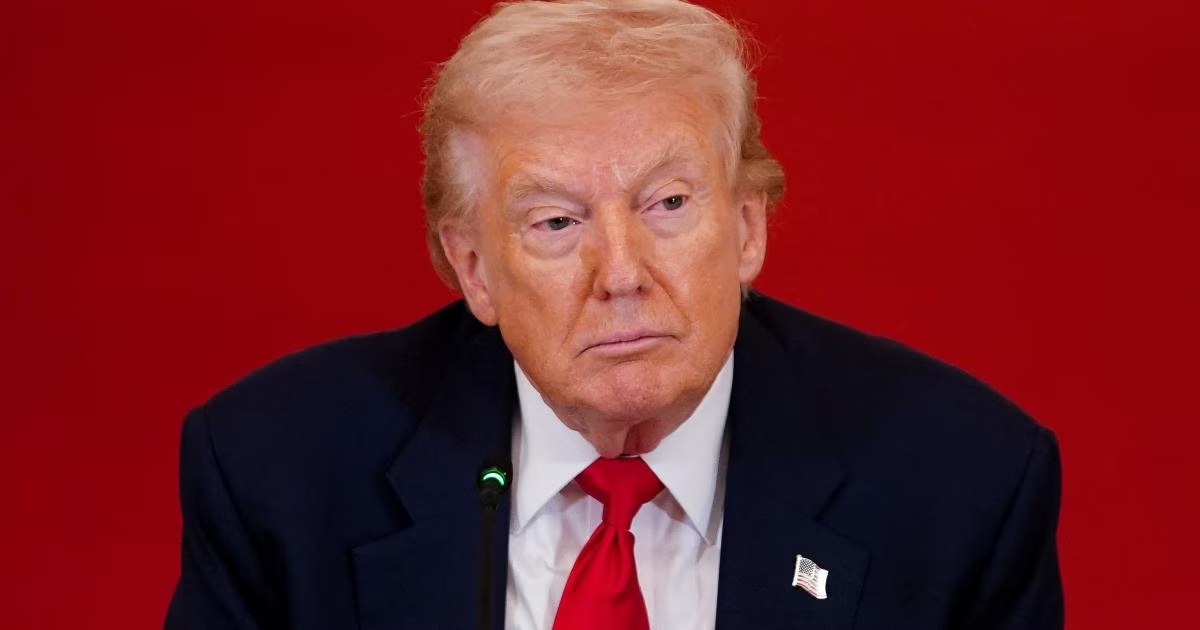
Recent reporting by Politico suggests that the Pentagon is quietly preparing for military operations that could continue until September. That timeline stands in stark contrast to the early public statements by Donald Trump, who indicated that the campaign might last roughly four weeks.


The difference between those two timelines highlights a familiar dynamic in American wars. Political leaders often promise swift, controlled operations to reassure the public, while military planners prepare for the far messier reality of prolonged conflict.


Evidence of that shift is already visible. The Pentagon has begun reinforcing planning capabilities at United States Central Command, the command responsible for U.S. military operations across the Middle East. Officials have requested additional intelligence officers to support operational planning at the command’s headquarters in Tampa, Florida.


According to military officials, the move is intended to support planning for a campaign that could last at least 100 days. In bureaucratic language, such requests are rarely routine. They typically signal that commanders expect the conflict to become longer, more complex, and more resource-intensive than initially anticipated.


In practical terms, this suggests that Washington is already moving away from the notion of a quick punitive strike and toward the possibility of a sustained air war.


Pentagon rhetoric reflects the same ambiguity. Defense Secretary Pete Hegseth recently confirmed that the United States is reinforcing its military presence in the Middle East while expanding the air campaign against Iranian targets. Additional bombers and fighter aircraft have been deployed to the region, and U.S. forces continue to rely heavily on precision-guided munitions, including bombs weighing 500, 1,000, and 2,000 pounds.


Hegseth has emphasized that the United States maintains “complete control of the skies.” Yet control of the skies has rarely been the decisive factor in modern wars. Air power can destroy infrastructure, degrade military capabilities, and impose heavy costs on an adversary. But it does not necessarily produce quick political outcomes.


Despite growing pressure in Washington to define a clear end date for the conflict, the defense secretary has deliberately avoided doing so. The campaign, he suggested, could last “four weeks, six weeks, eight weeks — or longer.” The United States, he insisted, will determine the “pace and speed” of the war.


This carefully calibrated ambiguity serves a political purpose: it preserves flexibility while avoiding the admission that the war may be far longer than originally presented.


On the ground, however, the costs are already becoming evident. Early estimates suggest that more than one thousand Iranian civilians have been killed in American and Israeli airstrikes since the war began. At least six American soldiers have also died in Iranian drone attacks targeting U.S. positions in the region.


The Pentagon has simultaneously begun reinforcing its stockpiles of missiles and air defense interceptors in the Middle East after reserves dropped sharply during the opening days of the war. Military sources say that the rate of ammunition consumption during the first phase of operations forced the Pentagon to accelerate resupply shipments from bases in Europe and the United States.


Such developments highlight the logistical realities of modern warfare. Even a war fought largely from the air can quickly consume enormous quantities of weapons, forcing the military to expand supply lines and sustain a steady flow of equipment into the theater.


Beyond the battlefield, the conflict has also exposed weaknesses in Washington’s broader crisis planning. According to reporting by Politico, the U.S. State Department was forced to scramble to organize evacuations for American citizens stranded in several Middle Eastern countries as tensions escalated.


Despite months of military buildup and repeated threats of military action against Iran, the administration reportedly lacked a comprehensive evacuation plan when hostilities began. Diplomats were therefore forced to arrange departures through commercial flights and improvised land routes during the early days of the crisis.


This disconnect between military readiness and civilian preparedness is not new, but it remains troubling. Time and again, American administrations appear ready to initiate military operations while underestimating the broader logistical and humanitarian consequences that follow.


More fundamentally, the Pentagon’s preparations for a campaign lasting into September reveal the growing gap between political messaging and military reality. The initial narrative of a short, decisive operation now appears increasingly difficult to sustain.


Even overwhelming air superiority does not guarantee rapid strategic success. Iran has spent years preparing for precisely this type of confrontation. Instead of confronting U.S. forces directly, Tehran relies heavily on drones, missiles, and regional proxy networks capable of striking American targets without engaging in conventional battle.


This strategy allows Iran to prolong the conflict while raising its political and military costs for Washington. Each drone attack, each missile launch, and each disruption across the region forces the United States to commit more resources to containment and defense.


The result could be a familiar pattern in American foreign policy: a war launched with promises of speed gradually evolving into an open-ended military commitment.


If that trajectory continues, the central question facing Washington will not be whether the United States can win air battles over Iran. It will be whether the political leadership ever defined what victory actually means.

ARAB AND WORLD

Sun 08 Mar 2026 10:26 pm - Jerusalem Time

Trump launches fierce attack on Tehran, accusing it of targeting civilians amid controversy over school bombing

US President Donald Trump launched a scathing attack on the Iranian leadership, describing them as the most evil entities on Earth at present. These sharp remarks came in the context of escalating reactions to the growing military tensions between Washington and Tehran, with Trump accusing the Iranian side of committing horrific crimes including abusing women and killing children.

In statements made from aboard the presidential plane, Trump downplayed Iranian protests regarding the targeting of civilian infrastructure, specifically a desalination plant. The US President affirmed that he pays no attention to Tehran's complaints about water facilities at a time when the world faces the reality of brutal Iranian practices targeting innocent people, as he put it.

For his part, Iranian Foreign Minister Abbas Araqchi directly accused the United States of committing a desperate and blatant crime by attacking a freshwater desalination plant on Qeshm Island. Araqchi considered Washington to be the one that set the rules for targeting vital facilities, warning of the repercussions of this escalation on regional security and stability.

Regarding the humanitarian catastrophe that occurred at a primary girls' school and resulted in the deaths of 175 children, Trump categorically denied the involvement of US forces in the attack. The US President went further by accusing Tehran of deliberately bombing the school, considering that the Iranian regime is trying to pin the blame on Washington to cover up its crimes against its people.

On the military front, Defense Secretary Pete Hegseth affirmed that investigations are still ongoing to determine the circumstances of the targeting of the school and other civilian facilities. Hegseth stressed in his statements that the American military doctrine does not target civilians, claiming that the only party that practices systematic killing against the defenseless in this confrontation is the Iranian side.

Despite official denials, media sources quoted American officials as suggesting that US forces may actually be responsible for the deadly attack on the girls' school in southern Iran on Saturday. The sources indicated that military investigators are reviewing aerial operation records, confirming that the final results have not yet been decided despite strong indications of a grave military error.

In the context of international reactions, the United Nations High Commissioner for Human Rights intervened in the crisis, demanding the necessity of a transparent and independent investigation into the incident. The Commissioner's spokesperson said that the responsibility for the investigation lies directly with the forces that carried out the attack, warning that if Washington's involvement is proven, this incident will be among the deadliest in the history of American operations in the Middle East.

I know nothing about the desalination plant, they complain about a water plant and we complain about the fact that children should not be beheaded.

ARAB AND WORLD

Sun 08 Mar 2026 10:26 pm - Jerusalem Time

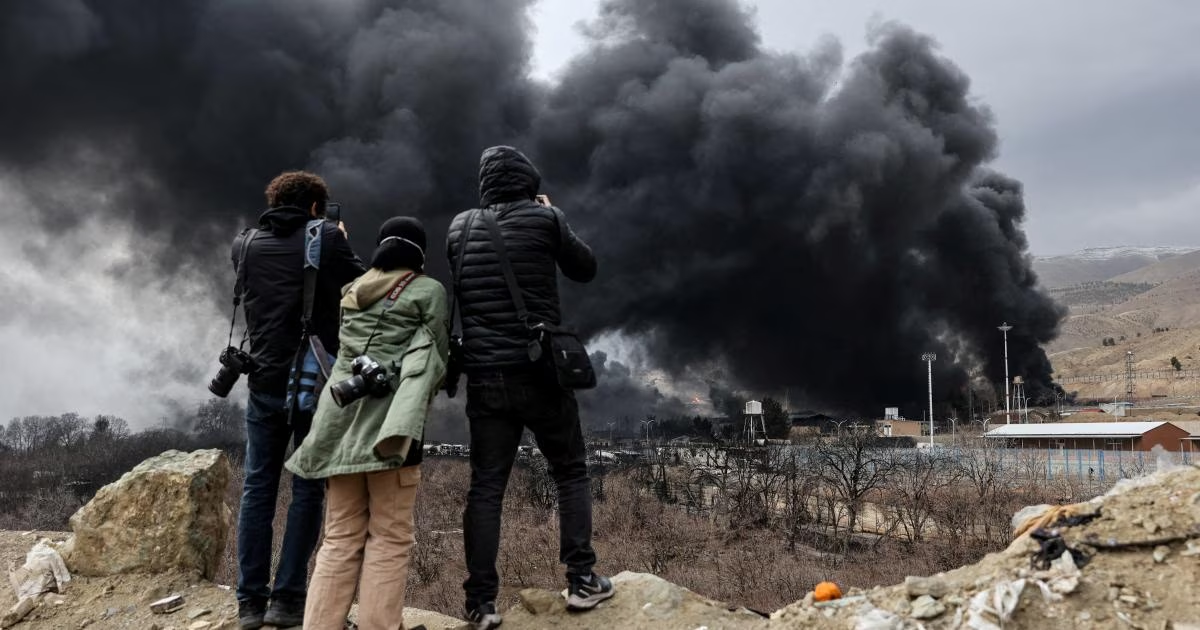
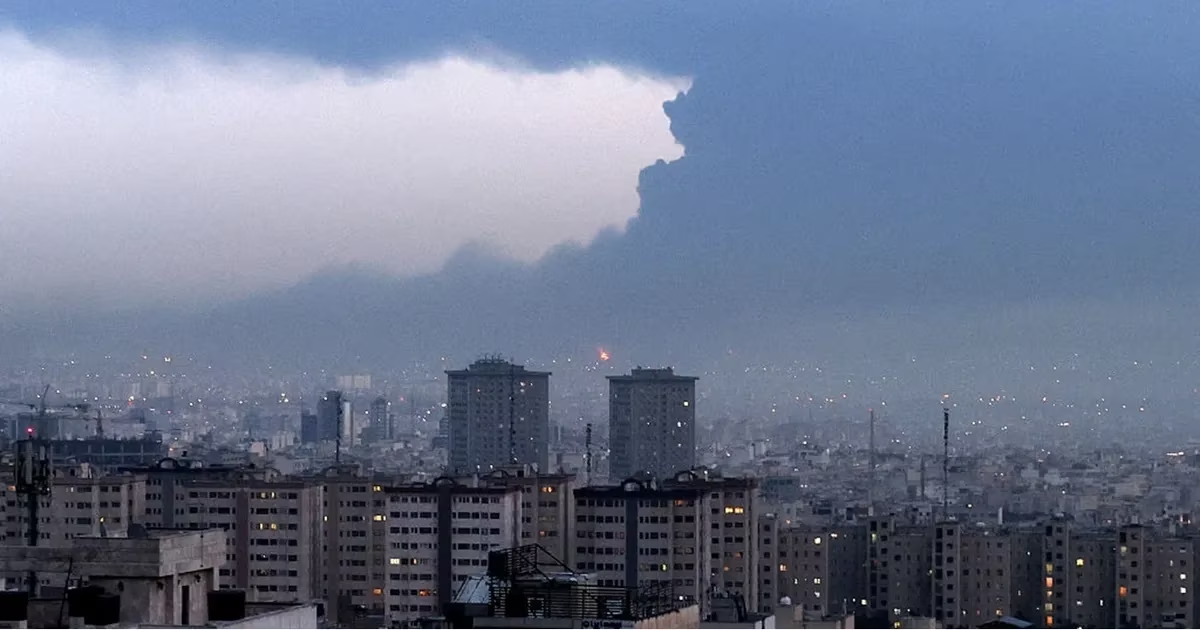
Dangerous Escalation in Iran: Raids Target Oil Facilities in Tehran and Threats to Control Kharg Island

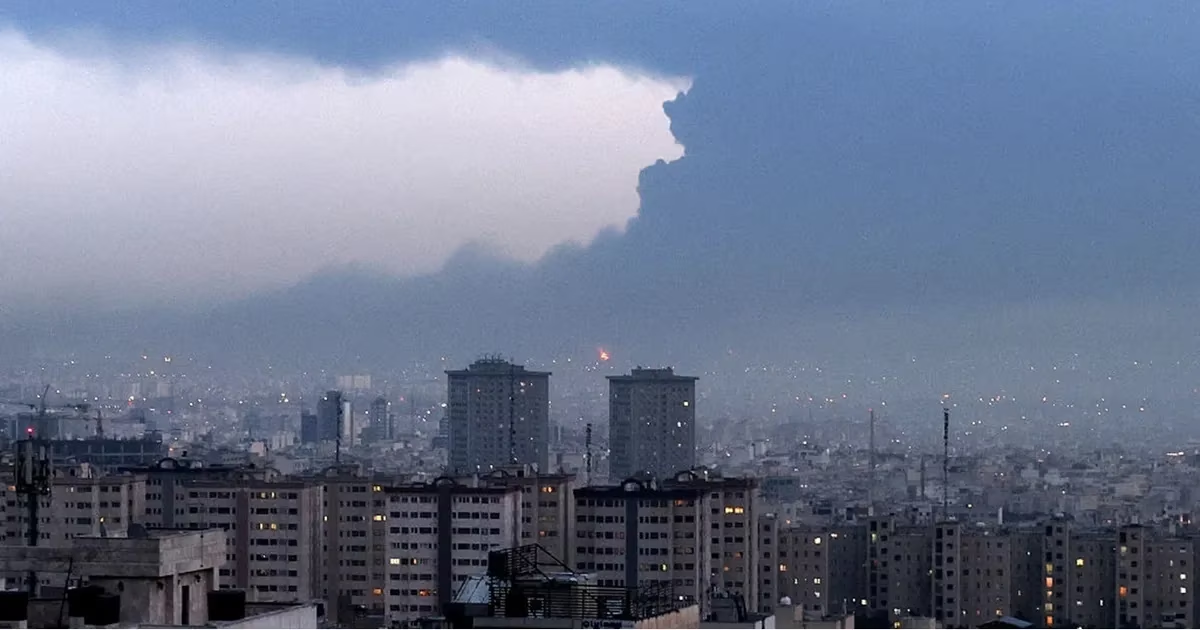
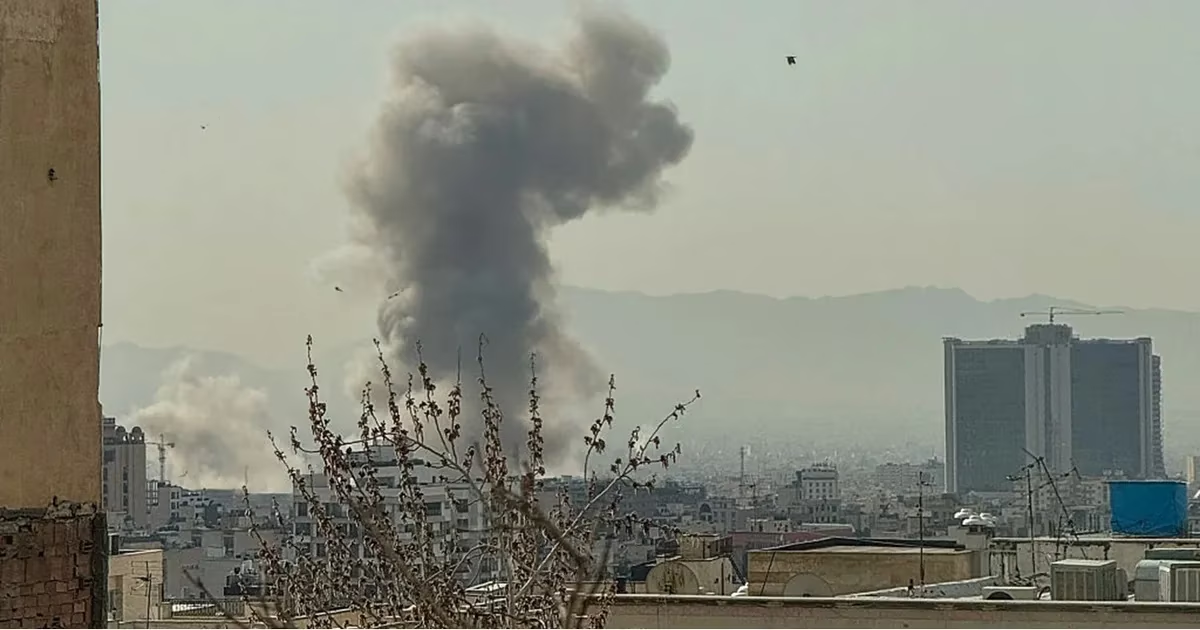
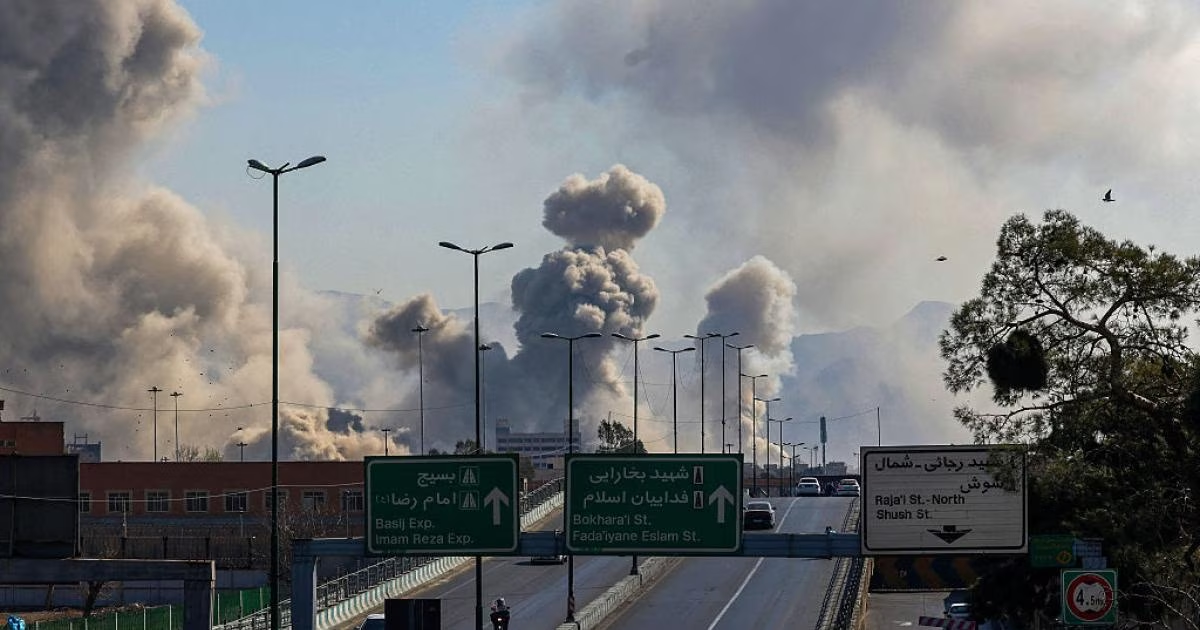
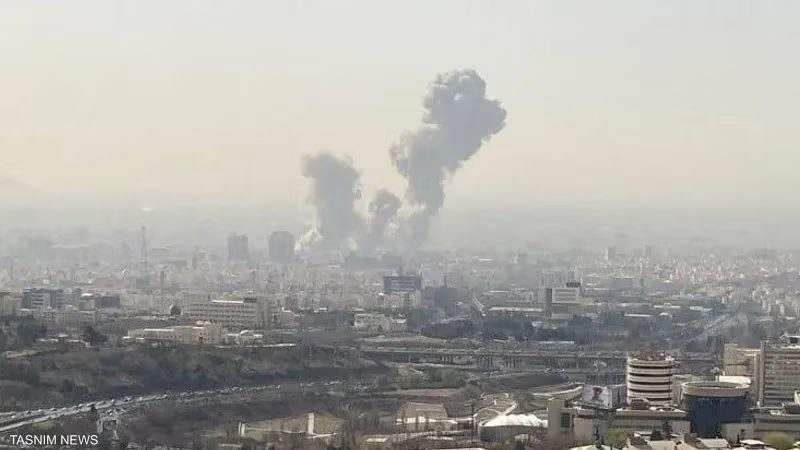
Field sources reported that military operations against Iran witnessed a dramatic shift early Sunday morning, as American and Israeli airstrikes targeted four major oil storage facilities and a vital logistical site for transporting oil derivatives in the capital Tehran and its suburbs. The bombing resulted in the death of four people and caused a temporary halt to fuel distribution operations within the capital, indicating a new direction to strike the Iranian regime's economic infrastructure on the eighth day of the comprehensive war.

In an interpretation of this escalation, Dr. Mosaddegh Pour, a professor of political science, stated in remarks to media sources that the war has moved to more dangerous levels by targeting fuel production refineries. Pour explained that these strikes reflect an attempt to overcome the failure to achieve rapid military objectives, noting that the nature of the selected targets aims to directly paralyze the logistical and internal capabilities of the Iranian state.

These developments coincide with intelligence reports discussing Washington and Tel Aviv's consideration of a scenario for field control of Kharg Island in the Arabian Gulf. This island is considered the aorta of the Iranian economy, as it contains the primary port for shipping crude oil from various national fields to global markets, making its control a complete cut-off of Tehran's financial resources.

Economically, these confrontations have caused a jump in global oil prices to reach $80 per barrel, amid fears of disruption to international energy supplies. In contrast, the Israeli budget is suffering from immense pressure, with Ministry of Finance estimates indicating weekly losses exceeding 9.4 billion shekels, in the absence of an approved budget for 2026 and a funding gap of up to $18 billion.

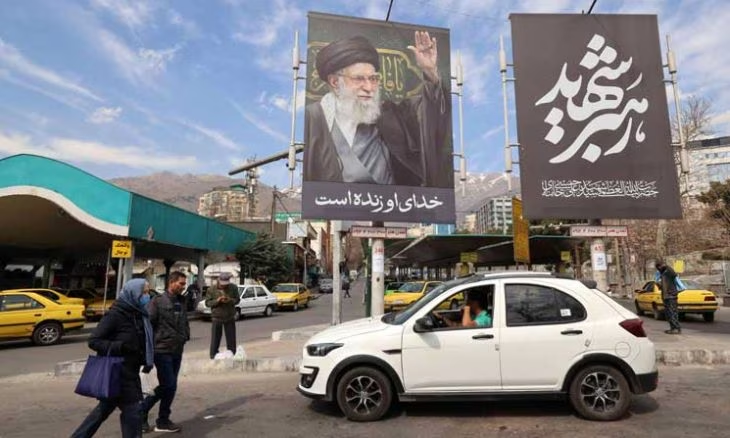
Internally in Iran, observers believe that the continuation of mutual shelling and the targeting of sovereign symbols, most notably the martyrdom of the Supreme Leader in the first strike, has contributed to strengthening societal mobilization. Dr. Pour pointed out that younger generations have become more widely involved in political discourse and military confrontation, which may change the calculations of the attacking forces that aim, according to statements by Benjamin Netanyahu and Donald Trump, to overthrow the regime.

Militarily, the Iranian leadership has hinted at resorting to unprecedented defensive and offensive tactics if the targeting of energy facilities continues. Sources close to decision-making circles in Tehran spoke of the possibility of using advanced generations of ballistic missiles capable of bypassing defense systems, in response to the raids carried out by thousands of aerial sorties daily since the outbreak of the war on February 28th.

In a related context, the regional war reflected escalating tension in the Palestinian territories, where settler attacks in the West Bank increased by 25%. Local sources reported the martyrdom of two brothers in the town of Qaryut by settler bullets, coinciding with forced displacement operations of Bedouin communities in the Jordan Valley, linking the various fronts of confrontation amid international preoccupation with the comprehensive war against Iran.

The war has indeed entered a new and dangerous phase with the expansion of targeting to include oil facilities and vital energy sources.

OPINIONS

Sun 08 Mar 2026 10:25 pm - Jerusalem Time

War on Iran: A Tactical Gain or Strategic Loss for Arabs?

Arabs rarely view any war fought by the United States in the Middle East as one that might bring them direct strategic benefit. Historical experience since the end of World War II mostly indicates the opposite: military interventions reshape balances, but often leave the region more turbulent and complex.

It becomes even rarer when it involves military action in which the United States and Israel participate together. In the Arab political consciousness, it is difficult to find a clear precedent where a joint decision between Washington and Tel Aviv directly served Arab interests.

However, the ongoing war today between Iran on one hand, and the United States and Israel on the other, raises an unusual question: Could this be one of those rare moments where American and Israeli interests intersect with a clear Arab interest?

To understand this possibility, one must go back to a pivotal moment in the region's history: the Iranian Revolution. Since then, Iran has no longer been merely a regional state with traditional policies, but has gradually transformed into a political and strategic project seeking to expand influence beyond its national borders.

Over more than four decades, this influence has spread through multiple tools: political alliances, armed groups, and indirect military presence in a number of Arab arenas, from Iraq to Syria and Lebanon, all the way to Yemen. For many Arab countries, this was not merely a natural competition between neighboring states, but evolved into a long-term strategic challenge that altered the balance of power in the Middle East and opened the doors to complex conflicts.

In this context, the current war seems to strike at the heart of that equation. If it ends with the weakening of Iranian military capabilities or the reduction of its regional project, it could remove one of the most prominent sources of strategic tension that has pressured the region since the late 1970s.

However, reading the scene so simply might be misleading. The United States, as international relations literature confirms, does not act out of a motive to serve others, but according to precise calculations related to its strategic interests: maintaining the balance of power, preventing adversaries from threatening its influence, and ensuring the continuation of its leading position in the international system.

Here another, more complex paradox emerges. Israel alone may not be the ultimate beneficiary of this war; Arabs may ultimately find themselves facing a greater strategic cost than initially appears.

Major geopolitical shifts in the world today are not only about the Middle East, but about the escalating competition between the United States and China for leadership of the international system. In this context, the outcomes of the war in the Middle East could become part of broader arrangements aimed at reorganizing global alliances.

In one possible scenario, after weakening Iran, the United States might seek to establish a new regional order that links Arab countries more closely to American strategy in confronting China's rise. This could manifest in political, economic, or security pressures that limit the ability of Arab countries to expand their cooperation with Beijing.

Here a new equation might emerge: weakening a regional adversary like Iran, in exchange for restricting the strategic maneuvering room of Arab countries in their relationship with the rising power in the world.

Many Arab countries today have growing economic ties with China, whether in energy, infrastructure, or technology. If the region becomes part of the front line in the US-China competition, these countries may find themselves forced to choose between their economic partnerships and their position in the US-led security system.

In this case, the problem may not be the war itself, but the arrangements that may follow it.

The worst-case scenario for Arabs lies in the possibility that the war leads to a dual outcome: a decline in Iranian influence on one hand, and the region being drawn into a larger global conflict equation between major powers on the other. In such a situation, Arabs might become a party to a strategic confrontation that does not necessarily concern them, but for which they bear the consequences.

For this reason, the real question is not only about the outcome of the war, but about the phase that will follow it. If Arab countries can deal with the coming transformations with greater coordination and strategic vision, this moment could turn into an opportunity to rebuild a more stable regional balance.

However, if post-war arrangements are left to be entirely shaped from outside the region, Arabs may once again find themselves facing a new regional order whose rules are determined by other powers.

In the Middle East, major transformations often begin with war, but their true effects appear in the order that emerges afterward.

ARAB AND WORLD

Sun 08 Mar 2026 10:25 pm - Jerusalem Time

Regional War Developments: Occupation Casualties in Lebanon and Targeting of a Nuclear Facility in Isfahan

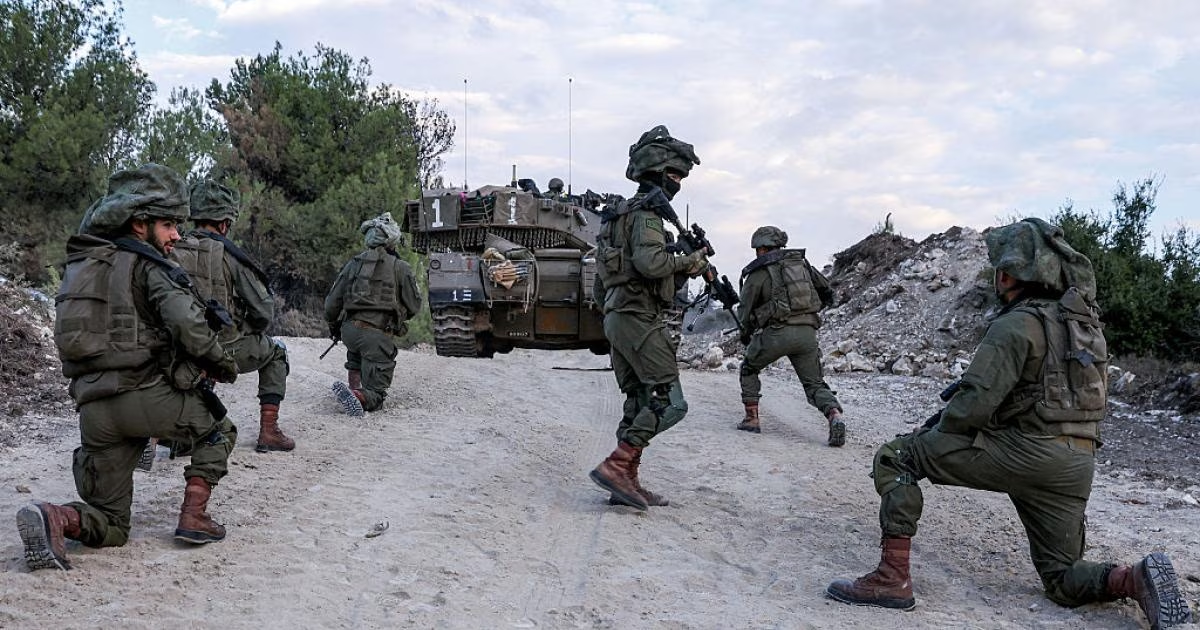
Field sources reported the killing of a number of Israeli occupation army soldiers during fierce clashes on the Lebanese front, at a time when the regional confrontation, which erupted on February 28, is escalating. Concurrently with the ground battles, reports revealed material damage to a radiation facility in the Iranian city of Isfahan following airstrikes, raising international concern about the repercussions of targeting sensitive facilities.

Economically, the occupation faces a suffocating crisis as the war continues into its eighth day, with estimates from the Israeli Ministry of Finance indicating direct losses exceeding $3 billion per week. The call-up of 100,000 reserve soldiers from various sectors of work has led to a partial paralysis of the economy, in the absence of an approved budget for 2026 and a funding gap of $18 billion, which places Israel's credit rating under the scrutiny of international rating agencies.

Internally, the cities of Tel Aviv, Haifa, and West Jerusalem witnessed massive demonstrations demanding an end to the war on Iran and Lebanon, where protesters held Prime Minister Benjamin Netanyahu responsible for the continuous failures since October 7. The demonstrations saw attacks by right-wing activists on protesters, while the police arrested a number of participants on charges of disturbing public order, amid notable participation from Knesset members who opposed the military escalation that led to a global rise in oil prices to $80 per barrel.

The comprehensive war that began last February has caused an economic bleeding for the occupation estimated at 9.4 billion shekels per week, amidst escalating internal protests against the Netanyahu government.

ARAB AND WORLD

Sun 08 Mar 2026 10:25 pm - Jerusalem Time

Behind the Scenes of Tehran's First Strike: Washington Killed 'Negotiators' and Iran Activates 'Madman Operation'

International press reports revealed new details concerning the first American-Israeli strike that targeted the Iranian capital, Tehran, last Saturday. Sources indicated that the bombing resulted in the killing of a group of Iranian officials who were holding a meeting in a targeted complex, noting that some of these casualties were classified by the White House as figures willing to negotiate.

American officials stated that the killing of these officials might hinder efforts to end the conflict quickly, as they were seen as potential diplomatic channels compared to hardline leaders. This information is based on interviews conducted with dozens of officials in the United States, the occupying state, and Iran, reflecting the complexity of the field and political scene after the escalation of violence.

In the context of military capabilities, intelligence estimates presented to the US Congress indicate that Iran still retains about 50% of its missile arsenal. Reports also confirmed that Tehran possesses a larger stock of drones, which was evident in the attack that targeted American soldiers in Kuwait last Sunday, killing six of them.

Financially, Pentagon officials informed Congress that the cost of the first week of military operations amounted to about $6 billion. Observers expect the US administration to request additional funding from lawmakers to ensure the continuation of military operations amid the ongoing escalation in the region.

For its part, the Iranian leadership expressed confidence in the ability of state institutions to withstand intensive aerial bombing campaigns. Iranian officials affirmed that their strategy relies on exhausting the desire of the United States and the occupying state to continue the war by raising the human and economic cost of the conflict to an unprecedented level.

Under the name 'Madman Operation,' Tehran began implementing a plan aimed at igniting the region and expanding the scope of military confrontation to include unconventional targets. This plan includes several stages, starting with striking deep into Israel, then moving to target American military bases spread across neighboring Arab countries.

Reports indicated that the Iranian plan is not limited to military targets but also includes attacking civilian locations frequented by Americans, such as hotels, airports, and embassies. Iran has already begun using missiles and drones to strike vital oil and gas infrastructure in Gulf countries, creating immense economic pressure on global markets.

Iranian attacks have choked shipping traffic in the Strait of Hormuz, leading to the closure of international transit centers, a halt in tourism, and a sharp rise in energy prices. Military leaders in Tehran believe that this path is the only way to force Washington and Tel Aviv to retreat from their military campaign.

Regarding the leadership structure, sources revealed that Ayatollah Khamenei had issued preemptive orders before his death to ensure the continuation of military operations. Khamenei established four layers of alternative leadership to avoid any power vacuum, with explicit directives to escalate attacks if the country faced major strikes.

On the other hand, American military leaders believe that the coming days will be crucial in determining Iran's ability to continue its retaliatory strikes. General Kenneth McKenzie described the current situation as a 'race' between the ability to destroy and the ability to respond, with the number of American forces in the region reaching over 50,000 soldiers.

The American political scene is in a state of confusion due to President Donald Trump's fluctuating positions on the ultimate goals of the war. While Trump initially called for a popular uprising within Iran, he later reaffirmed his desire for direct intervention to choose the country's next leadership, demanding unconditional surrender.

Trump warned in his latest statements that the United States and Israel might expand the target bank to include areas and groups not previously targeted. This verbal escalation coincides with American preparations for a long-term conflict that could extend for several weeks, despite widespread popular opposition to the war within the United States.

On the ground, the occupying forces and the US military divided geographical tasks, with the former focusing on targeting military and religious leaders in the north. In contrast, US forces undertook the destruction of air defense systems and ballistic missile launch platforms in the southern regions of Iran.

Despite the intensity of the strikes, reports confirm that the basic structure of political power in Iran remains intact, with the heads of government branches remaining in their positions. However, a large number of military commanders who fell in the first waves of bombing have been replaced, leaving the region open to further escalation scenarios.

Our plan is to expand the war and prolong its duration; it is the biggest blow we can deal to Trump, and we have no other option.

PALESTINE

Sun 08 Mar 2026 10:25 pm - Jerusalem Time

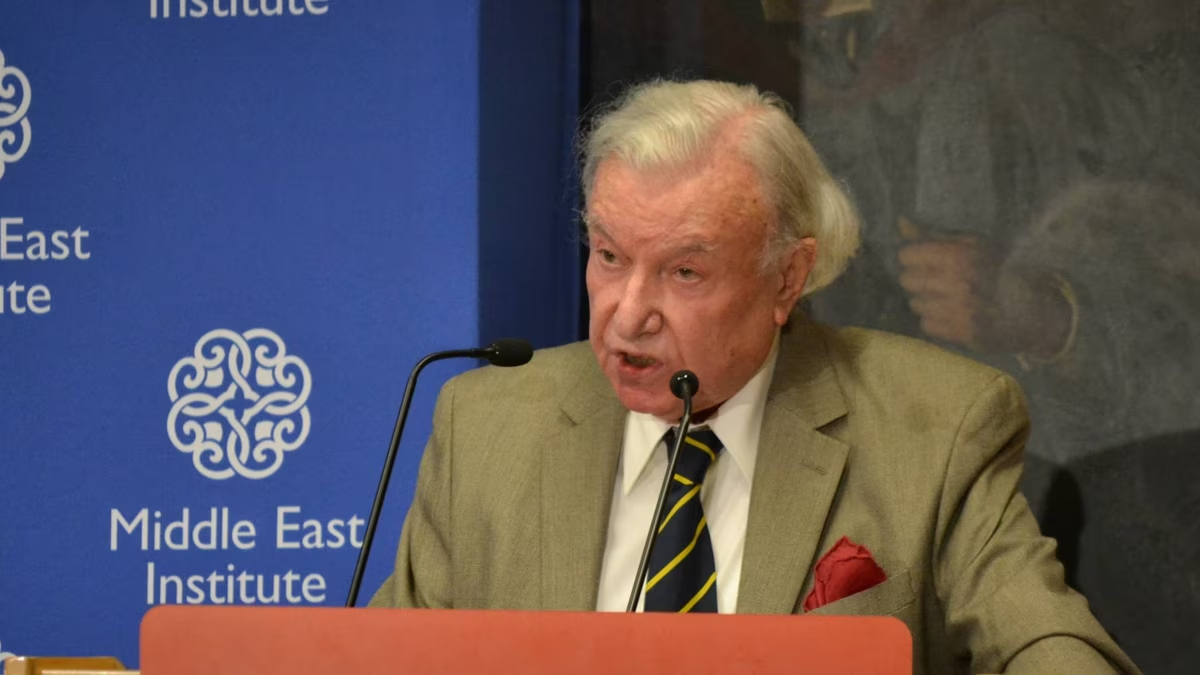
The passing of the great Palestinian historian Walid Khalidi.. A hundred years of documenting the Nakba and protecting the narrative

Palestine and international academic circles lost on Sunday the great historian and thinker Professor Walid Khalidi, who passed away in Cambridge, Massachusetts, at the age of 101. The deceased is considered one of the most prominent pillars of contemporary Palestinian thought, and one of the few who dedicated their scientific and practical lives to documenting the details of the Palestinian cause and the crimes of the Israeli occupation since the Nakba.

Palestinian President Mahmoud Abbas mourned the deceased with great sadness, praising his career full of national and intellectual contributions. The President affirmed in his statement that Khalidi was a faithful guardian of the Palestinian historical narrative, as through his rigorous research and his works, which were translated into several languages, he was able to prove the Palestinian right in international academic forums, pointing to his pioneering role in establishing major research institutions.

For its part, the Institute for Palestine Studies mourned its honorary president and one of its early founders, stressing that his passing represents a tremendous loss for the Arab and international libraries. The Institute indicated in its statement issued from its offices in Beirut, Ramallah, and Washington, that Khalidi remained, until his last years, an inspiring reference for researchers and scholars, and supervised the most precise details of research work related to the Arab-Israeli conflict.

Walid Khalidi was born in the heart of Jerusalem in 1925, where he grew up in a distinguished Jerusalemite family known for its knowledge and literature. He received his early education at the Friends School in Ramallah and then St. George's School in Jerusalem, before traveling to Britain to complete his higher education and graduate from the prestigious Oxford University in 1951, after which he began an exceptional academic career.

Khalidi held high academic positions, working as a lecturer in political studies at the American University of Beirut for three decades, then moving to work as a researcher at the Harvard Center for International Affairs. He also lectured at Princeton and Oxford universities and was elected a fellow of the American Academy of Arts and Sciences, reflecting the prestigious position he enjoyed in Western academic circles.

History records that Walid Khalidi was one of the first to lay the foundations of what is known as 'Nakba studies,' as he did not merely narrate events but delved into the analysis of Zionist documents. He was credited with exposing 'Plan Dalet' to the world in the 1960s, which was the main military plan implemented by Zionist gangs to occupy Palestinian cities and villages and displace their inhabitants in 1948.

Khalidi's works are indispensable references for any researcher on Palestinian affairs, foremost among them his encyclopedic book 'All That Remains' which documented the destroyed Palestinian villages, and the book 'Before Their Diaspora'. His scientific output exceeded forty books, in addition to hundreds of research papers and articles published in major peer-reviewed scientific journals around the world.

In 1963, Khalidi participated in the founding of the Institute for Palestine Studies in Beirut alongside Constantine Zurayk and Burhan Dajani, to be the first independent research institution specializing in Palestinian affairs. Under his administration, the Institute transformed into an intellectual beacon and a primary reference providing decision-makers and researchers with accurate information and deep analyses of the conflict.

The deceased received wide official recognition, as President Mahmoud Abbas awarded him the Star of Honor of the State of Palestine of the highest class in 2015. This honor came in appreciation of his scientific contributions that formed a cultural shield against attempts to falsify history, and in recognition of his role in consolidating Palestinian national identity through systematic scientific research.

Khalidi's contributions did not stop at official awards; he also received a special honor in 2025 with the Lifetime Achievement Award during the fourteenth session of the Palestine Book Award. The Journal of Palestine Studies also issued a special supplement on the occasion of his hundredth birthday, reviewing a century of intellectual contributions that never ceased despite the conditions of displacement and diaspora.

Khalidi's methodology was characterized by extreme precision and reliance on original archives, which made it difficult for Israeli historians to refute his conclusions. His efforts contributed to changing the perspective of many Western academics towards the roots of the conflict, as he presented the Palestinian narrative in a rigorous scientific language, devoid of mere emotion, which earned it international credibility.

Even after his retirement from Harvard University, Khalidi continued to follow the daily affairs of the Institute for Palestine Studies from his residence in Boston until 2017. He saw institutional work as the only guarantee for the continued defense of Palestinian rights, and he remained convinced that knowledge is the strongest weapon in confronting the settlement project.

Sources close to the deceased's family reported that his body will be laid to rest in the United States, with memorial services befitting his national stature to be held in Ramallah, Beirut, and Amman. Palestinian factions, national forces, and cultural institutions mourned him, considering his passing to close a chapter of the Palestinian intellectual struggle that spanned more than seven decades.

Walid Khalidi leaves behind a great legacy and students spread across universities worldwide who carry the torch of scientific research he ignited. His name will remain etched in the memory of the Palestinian people as one of the giants who were not broken by exile, nor deterred by the years from continuing the battle of consciousness and preserving collective memory from oblivion.

The deceased dedicated his life to defending the Palestinian historical narrative and documenting the history of Palestine and its people, and contributed to establishing the truth in international academic circles.

ARAB AND WORLD

Sun 08 Mar 2026 10:25 pm - Jerusalem Time

Two killed and 12 injured by military projectile in Al-Kharj Governorate, Saudi Arabia

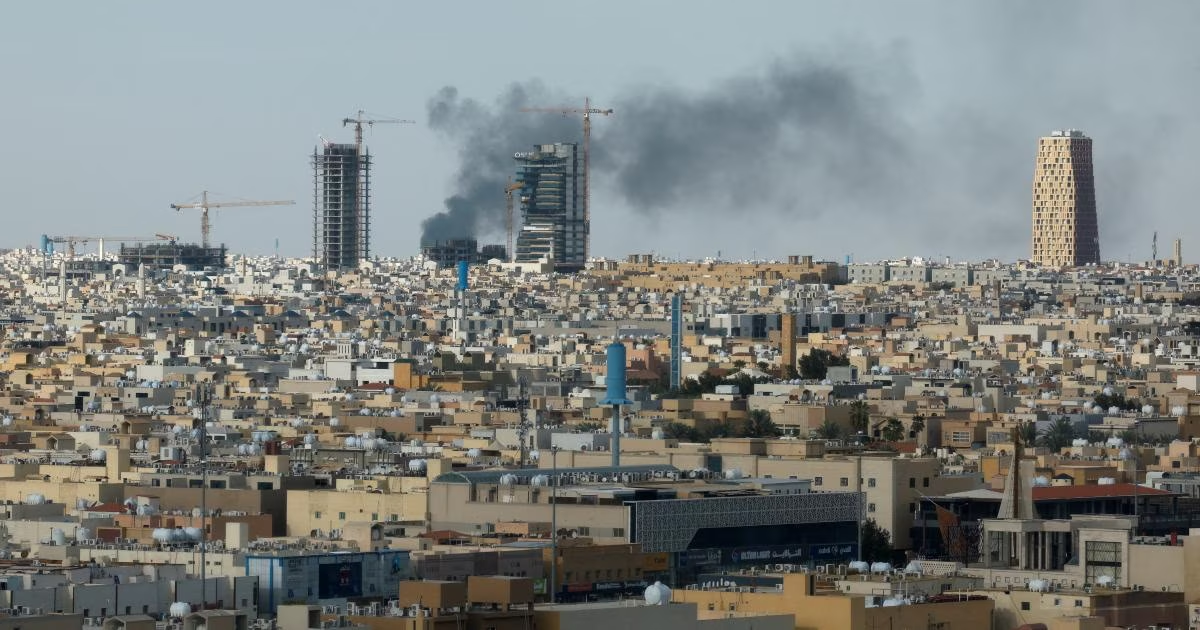
Saudi authorities announced on Sunday that human casualties occurred in Al-Kharj Governorate, south of the capital Riyadh, after a military projectile fell on a populated area. The Civil Defense reported that the incident resulted in the death of two individuals of Indian and Bangladeshi nationalities, in addition to 12 others sustaining various injuries. The injured were transported to receive necessary medical care.

Official sources clarified that the projectile directly hit a residential complex designated for workers of a maintenance and cleaning company in the governorate. The Al-Kharj region includes a vital air base, which has been a target of repeated strikes since the escalation of military tensions in the region in late February, raising the pace of security concerns in both vital and civilian installations.

For its part, the Iranian Revolutionary Guard announced its responsibility for carrying out operations targeting radar systems and military sites in Al-Kharj and other areas within the Kingdom. These attacks come in the context of Tehran's response to military operations led by the United States and Israel against Iranian targets, which have entered a new phase of direct and open confrontation.

Saudi Civil Defense stressed that deliberately targeting civilian objects and residential facilities constitutes a clear violation of international humanitarian conventions and laws. The authorities affirmed that they have initiated the implementation of all approved procedures to deal with such emergency situations, while maintaining a state of alert to confront any potential aerial threats that may affect Saudi territories.

In a related context, Sunday witnessed a coordinated escalation affecting several Gulf countries, as Bahrain, Kuwait, and the United Arab Emirates announced that they had been subjected to similar attacks. Drones and ballistic missiles were used in these attacks, indicating the expansion of the regional conflict as the confrontation enters its ninth day amidst the absence of any prospect for de-escalation.

Iranian President Masoud Pezeshkian had previously delivered a televised speech, in which he apologized to neighboring countries for the collateral damage of military operations. Pezeshkian indicated that his country is prepared to cease targeting these countries on the condition that their territories or military bases are not used as a launchpad for attacks against Iran by international powers.

It is worth noting that the region has been in a state of turmoil since February 28, following a widespread aggression launched by Israel and the United States against Iran, which led to the killing of high-ranking leaders. Since then, Tehran has responded with missile barrages targeting Israeli depth and what it describes as American interests in the region, leading to civilian casualties and severe material damage in several Arab countries.

Attempts to target civilian objects represent a blatant violation of international humanitarian law.

ARAB AND WORLD

Sun 08 Mar 2026 10:24 pm - Jerusalem Time

Iraq in the Eye of the Storm.. How Did the Land of Two Rivers Turn into a Battleground for Score-Settling Between Washington and Tehran?

Iraq has once again slipped into a cycle of regional conflicts after a short period of relative stability, as its airspace and territories have become an open theater for the military confrontation that erupted between the United States, Israel, and Iran. Since the launch of the joint attack on Tehran on February 28th, the Iraqi arena has witnessed an unprecedented escalation, including airstrikes and reciprocal missile attacks.

Successive Iraqi governments since 2003 have sought to maintain a delicate balance in their relations between Washington and Tehran, but this balance is now threatened with complete collapse. Although neither the United States nor Israel officially admits to launching strikes inside Iraq, they are accused of targeting headquarters of armed groups allied with Iran.

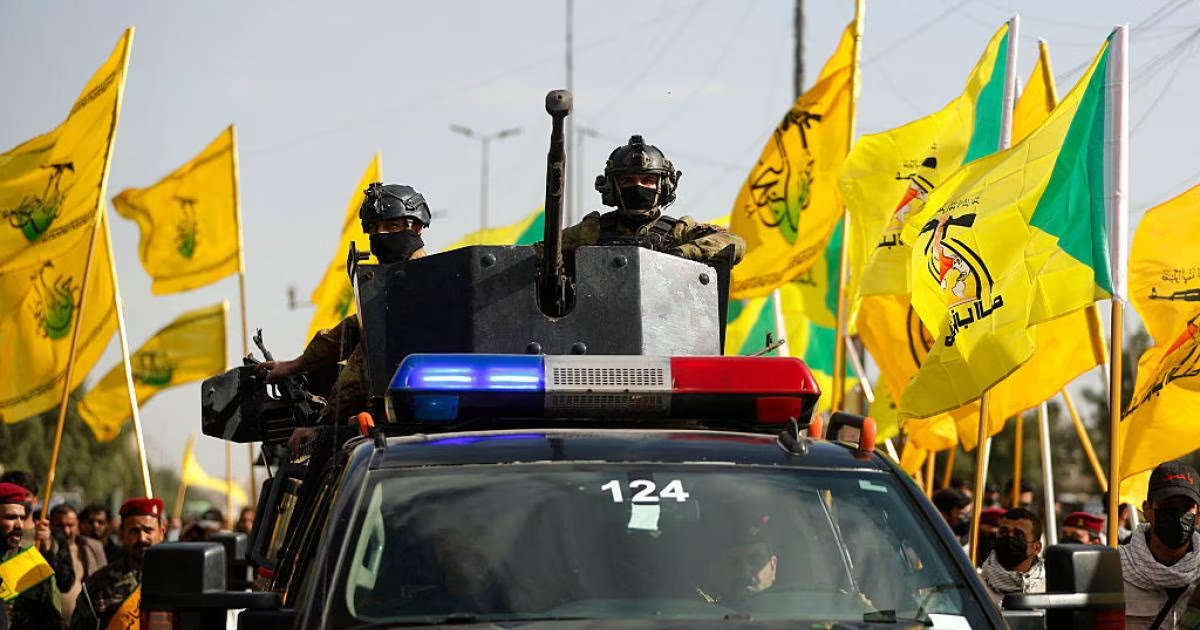
Iraqi armed factions have explicitly declared that they will not stand idly by in the face of attacks on Iran, and have already begun to carry out operations targeting what they described as 'enemy bases.' These factions have used drones and missiles to attack American military and diplomatic facilities across the country.

Pro-Iranian forces enjoy widespread influence within the Iraqi political system, possessing parliamentary representation and military wings operating under the Popular Mobilization Forces. However, some of these brigades, such as 'Hezbollah' and 'Sayyid al-Shuhada,' operate independently within the framework of the 'Islamic Resistance in Iraq' to implement agendas linked to the Tehran axis.

The Green Zone in Baghdad, specifically around the American embassy, has been subjected to repeated missile attacks that have been intercepted by air defense systems. Baghdad International Airport, which hosts American logistical support teams, has also not been spared from continuous targeting by drones and missiles launched by armed factions.

The scope of targeting has extended to economic interests, with oil fields managed by foreign and American companies in Basra and the Kurdistan Region being shelled. These attacks raise serious concerns about the stability of the energy sector, which represents the backbone of Iraq's ailing economy.

In the Kurdistan Region, air defenses in Erbil have daily intercepted unidentified drones flying over the city. The region hosts international coalition forces and a major American consulate, making it a constant target for factions seeking to expel foreign forces.

Washington has warned of the possibility of targeting hotels frequented by foreigners in the Kurdistan Region, amid escalating security tensions. The region has already recorded attacks targeting tourist facilities, reflecting the desire of some parties to exert maximum pressure on the Western presence there.

On another front, Tehran has exploited the current circumstances to intensify its strikes against the camps of opposing Iranian Kurdish factions located in northern Iraq. Iran accuses these groups of working for hostile intelligence agencies and participating in subversive operations within Iranian territory.

Five opposing Kurdish groups, including the Democratic Party of Iranian Kurdistan, announced the formation of a new political alliance aimed at overthrowing the regime in Tehran. This alliance seeks to benefit from international military pressure on Iran to strengthen the Kurds' position in determining their own destiny.

Press reports have circulated about the possibility of these Kurdish factions launching a ground attack on Iran with American support, which has greatly angered Tehran. The Iranian leadership has threatened to target all vital facilities in the Iraqi Kurdistan Region if its territory is used as a launching pad for any ground invasion.

For his part, US President Donald Trump tried to calm fears about the Kurdish escalation, emphasizing his desire not to complicate the military scene further than it already is. Trump indicated a friendly relationship with the Kurds, but ruled out supporting a ground attack that could open new, uncontrollable fronts of conflict.

The authorities in Baghdad and Erbil find themselves in a critical position, constantly emphasizing their rejection of turning Iraqi territory into a launching pad for aggression against neighboring countries. However, controlling armed factions or preventing foreign interventions seems an almost impossible task given the current balance of power.

Iraqi Prime Minister Mohammed Shia' al-Sudani issued strict directives to pursue those involved in missile attacks on diplomatic missions. Al-Sudani affirmed that the protection of embassies is the responsibility of the state, stressing that these actions harm Iraq's supreme interests and hinder the path of stability and development.

Targeting diplomatic missions and embassies operating in Iraq is an act that cannot be justified or accepted under any circumstances.

ISRAELI AFFAIRS

Sun 08 Mar 2026 10:24 pm - Jerusalem Time

Netanyahu describes confrontation with Iran as 'War of Armageddon' amidst questions about contradictions in his discourse

Israeli Prime Minister Benjamin Netanyahu considered the ongoing military confrontation with Iran a decisive stage, which he described as the 'War of Armageddon'. In a televised speech, he affirmed that this war primarily aims to reshape the geopolitical reality in the Middle East, emphasizing that his government possesses a strategic and organized plan aimed at undermining the Iranian regime and ending its threats.

Netanyahu touched upon what he described as a 'historic victory', indicating that the current operations will lead to results that serve Israel's security for generations and decades to come. This verbal escalation comes at a time when the region is witnessing unprecedented tension, as Tel Aviv seeks to rally broader international support for its military stances towards Tehran and its armament programs.

In contrast, media sources observed a clear contradiction in Netanyahu's discourse, as he had announced only eight months prior that Israel had achieved a victory that would last for decades. However, the return to a comprehensive confrontation with Iran, in coordination with the United States, raises questions about the accuracy of the security and political assessments previously presented by the Israeli Prime Minister.

Sources reported that the official Israeli narrative has undergone a remarkable shift; after claims of eliminating the Iranian ballistic missile program last year, Israeli agencies have returned to warning of an existential threat. Israel now claims that these missiles not only threaten its security but also extend their risks to include the European continent and the United States within the next few years.

Domestically, this contradiction in the official discourse is being ignored by Israeli media preoccupied with the state of general mobilization. A widespread consensus currently prevails in Israeli society supporting the continuation of military operations, as a broad segment of Israelis sees the necessity of military decisive action in this critical phase.

Remarkable in the current political scene is the supportive stance shown by the Israeli opposition towards the war on Iran, a position similar to the alignment that occurred after the events of October 7th. This support stems from the opposition leaders' feeling that they are true partners in the field achievements made by the Israeli army on various fronts.

This cohesion between the government and the opposition is linked to the social composition of the armed forces, especially in the air force and technical intelligence units such as '8200'. Opposition leaders boast that their constituents' sons are carrying out qualitative operations deep inside Iran, despite Netanyahu's continuous attempts to attribute these military successes to himself and his unilateral political decisions.

Israel has an organized plan to eliminate the Iranian regime, and this confrontation is the War of Armageddon that will redraw the features of the Middle East.

ARAB AND WORLD

Sun 08 Mar 2026 10:24 pm - Jerusalem Time

Iranian Military Escalation Targets Infrastructure in Kuwait and Bahrain, Kuwaiti Ministry of Interior Mourns Two Officers

Official sources reported severe damage to infrastructure in both the State of Kuwait and the Kingdom of Bahrain, following a wave of military escalation launched by Iranian forces targeting vital facilities in both countries. This field development comes amidst escalating tensions in the region, leading to widespread security alert.

In a related context, the Kuwaiti Ministry of Interior issued an official statement mourning two of its members who were martyred during the performance of national duty as a result of this targeting. The Ministry stated in its communiqué No. (10) that the two martyrs are Lieutenant Colonel Abdullah Emad Al-Sharrah and Major Fahad Abdulaziz Al-Majmad, affirming its pride in the sacrifices of its sons in protecting the country's security.

Reports from the field indicate that the shelling caused partial disruption to some essential facilities, while emergency teams and relevant authorities in Kuwait and Bahrain have begun damage assessment operations and repairing what was destroyed by the shelling. Gulf capitals are closely monitoring the situation amidst international calls for de-escalation and preventing the region from sliding into a comprehensive confrontation.

Ministry of Interior mourns the martyrs of duty, Lieutenant Colonel Abdullah Emad Al-Sharrah and Major Fahad Abdulaziz Al-Majmad.

PALESTINE

Sun 08 Mar 2026 10:24 pm - Jerusalem Time

Deterrence and Alliances: A Reading of the Major Military Confrontation Between Iran and the Western Alliance

The military confrontation between Iran and the US-Israeli-led coalition entered a pivotal phase since its outbreak in late February 2026, with the initial days revealing an American strategy based on rapid international mobilization. Washington sought to expand the umbrella of military and logistical support, exceeding the direct capabilities available in the region to include a complex network of Western bases and allies.

In contrast, Tehran chose to fight this war by relying entirely on its deeply rooted defense institutions and local manufacturing capabilities, despite the severe blow it received at the beginning of the conflict. This disparity highlights a struggle between two models; the first relies on collective technological and logistical superiority, and the second is based on internal cohesion and strategic independence built over decades of sanctions.

The US administration realized early on that military operations against Iran's vast geography required massive infrastructure that extended beyond Israel's borders. This realization prompted Washington to activate its military agreements with Britain, which placed its strategic air bases at the disposal of American heavy bombers heading towards their targets deep within Iran.

Britain's 'Fairford' base and 'Diego Garcia' base in the Indian Ocean are vital strongholds in this war, providing safe air routes and maintenance and supply services. Without this logistical network, American operations would have faced enormous challenges in maintaining the intensity of air raids targeting vital Iranian facilities.

The European role was not limited to British logistical support but extended to direct French military action in the Mediterranean basin and the Gulf region. Paris sent the aircraft carrier 'Charles de Gaulle' to reinforce the Western naval presence, a move reflecting European concern about the war's repercussions on global energy security and international trade routes.

On the Iranian side, military institutions such as the Revolutionary Guard and the army showed an ability to manage the crisis despite the martyrdom of Supreme Leader Ali Khamenei and a number of senior commanders in the initial strike. This institutional cohesion reflects the nature of a system that has developed alternative command and control mechanisms capable of operating under conditions of total war and extreme pressure.

Iran's defensive strategy relies on the multiplicity of institutions and local production of missiles and drones, which reduced its need to request direct external military intervention. Observers believe that this approach expresses a historical political culture that tends towards self-reliance, which has led Tehran to engage in the confrontation with its independent national capabilities.

On the ground, Iran did not cease to retaliate, targeting American bases in the Gulf and vital facilities with ballistic missiles, raising the cost of the war for the American side to about one billion dollars daily. This financial attrition places increasing pressure on the US administration, which seeks to achieve its stated goals of overthrowing the Iranian regime.

Inside Israel, reports revealed enormous economic losses amounting to 9.4 billion shekels weekly due to the halt of wide sectors and the cost of military mobilization. Despite unlimited American support, the continuation of mutual shelling places the Israeli home front before unprecedented challenges in the history of regional conflicts.

In parallel with the regional war, the occupied Palestinian territories witnessed a dangerous escalation, as settlers exploited the world's preoccupation with the war to increase the pace of their attacks in the West Bank by 25%. These attacks resulted in the martyrdom of Palestinians in the village of Qaryout, in addition to forced displacement operations of Bedouin communities in the Jordan Valley.

Informed sources confirm that American participation in this war came in part to protect strategic interests and ensure Israel's security, although the actual decision to launch the attack was under direct Israeli pressure. This overlap of interests reinforces the 'organic' nature of the alliance linking Washington to Tel Aviv in confronting Iranian influence.

A comparison between the military capabilities of the two sides reveals that power lies not only in technology but also in the ability to bear long-term economic and human consequences. While the Western alliance possesses overwhelming air superiority, Iran has geographical depth and a distributed military infrastructure that makes it difficult to decisively win the battle with swift strikes.

This war is a real test of the theory of 'self-reliance' versus 'collective security,' as the world watches how a single country can withstand an international alliance that includes great powers. The field results so far indicate that the conflict may be prolonged, threatening to radically change the map of political balances in the Middle East.

In conclusion, the Palestinian arena remains the most affected by the repercussions of this conflict, as Palestinians fear the liquidation of their field issues under the cover of the rising smoke from the regional fronts. As the war continues, the question remains about the ability of international institutions to curb the escalation and prevent the region from sliding into a comprehensive catastrophe whose end cannot be predicted.

Power is not measured only by the size of alliances, but by a state's ability to rely on itself and manage its national resources in the face of extreme military pressures.

ISRAELI AFFAIRS

Sun 08 Mar 2026 10:24 pm - Jerusalem Time

Billions Bleeding: War with Iran Pushes Israeli Economy to the Brink of Collapse

The Israeli economy is facing its toughest test in decades, as hopes for stability recorded at the beginning of 2026 vanished with the outbreak of direct military confrontation with Iran. The economy, which was a cornerstone of the Zionist project, has turned into a continuous drain to finance a broad aggression strategy that includes multiple fronts.

Financial sources reported that the war, which began on February 28, imposed immediate financial burdens that exceeded the capacity of traditional budgets. According to Ministry of Finance estimates, the direct cost of military operations and ammunition amounts to about three billion dollars per week, a figure likely to rise with the continuation of mutual shelling.

The losses are not limited to the purely military aspect but extend to include a near-complete paralysis of commercial and service activity within major cities. These figures reflect the nature of modern wars that strike the joints of the local economy and abruptly halt production in vital sectors.

The call-up of about 100,000 reserve soldiers is a devastating blow to the labor market, as the most productive segments have been withdrawn and turned into a budget-consuming force. This measure has raised overall operating costs to unprecedented levels, with these soldiers currently making no contribution to the GDP.

This financial crisis is being managed amidst a dangerous financial constitutional vacuum, as the general budget for 2026 has not yet been approved. This confusion has led to a funding gap estimated at about 18 billion dollars, complicating the task of the Netanyahu government in managing both war and state affairs.

Economic circles are anxiously awaiting reports from international credit rating agencies such as 'Moody's' and 'Standard & Poor's'. Sources indicated that any new downgrade of the sovereign rating would mean an immediate increase in the 'risk premium' on Israeli debt, diverting resources from developmental spending to debt servicing.

The high-tech sector, which represents the core of economic growth, is suffering from capital flight due to a lack of stability. As this sector is considered 'fickle capital,' the continuation of military operations is pushing international companies and investors to seek safer environments away from the conflict zone.

Geopolitical tensions have contributed to a global rise in oil prices to $80 per barrel, which directly translated into imported inflation. The final Israeli consumer is currently bearing the additional costs of transportation, production, and essential goods affected by rising energy prices.

On the ground, the war continues on its eighth day with thousands of airstrikes targeting Iranian depth, while Tehran responds by targeting vital bases and facilities. Reports reveal the exorbitant cost of air defenses, with a single 'Patriot' missile costing 3 million dollars to counter inexpensive drones.

These economic pressures coincide with escalating internal tensions, as police dispersed demonstrations in Tel Aviv, Haifa, and West Jerusalem rejecting the continuation of the war. Protesters raised slogans holding Netanyahu responsible for the failure, describing his government as the 'October 7th government' leading the country to ruin.

The occupied West Bank is also witnessing parallel escalation, with settler attacks increasing by 25% since the start of the war on Iran. These attacks have led to the martyrdom of Palestinians in Qaryout, further complicating the security and political landscape for the Israeli government.

Analysts believe that economic repercussions will be the main driver for Israeli voters in the general elections scheduled for next October. The cost of living and rising prices are expected to lead to changes in the party map and electoral slogans that will attempt to appeal to the angry public.

Benjamin Netanyahu may find himself unable to return to power despite his attempts to export 'military victories.' The voter who bears the exorbitant costs of war may prefer political change over the continuation of the financial and human bleeding caused by extensive military adventures.

Ultimately, the Israeli economy appears as a soft underbelly in the face of a long-term regional war for which financial calculations were unprepared. With continued shelling and destruction, the question remains about the ability of financial institutions in Tel Aviv to withstand a budget deficit that worsens day by day.

The direct weekly losses of the war exceed three billion US dollars, imposing a financial burden that goes beyond the capacity of the emergency budget.

ARAB AND WORLD

Sun 08 Mar 2026 10:24 pm - Jerusalem Time

Western Covert Operations to Track Chemical Weapons in Iran and Israeli Preparedness for 'Terrifying Scenarios'

International press reports have revealed the involvement of British intelligence operatives in a highly dangerous covert mission inside Iranian territory, aimed at monitoring and identifying the locations of chemical weapons stockpiles. These movements come amid growing fears of the potential integration of these deadly weapons into drone attacks targeting countries in the region, primarily Israel and the United Arab Emirates.

Sources reported that British intelligence officers are working in close coordination with their counterparts from the United States and France, relying on intelligence provided by Israel regarding potential nerve gas caches. Despite recent intensive airstrikes targeting Iranian military facilities, the CIA and Mossad possess evidence of chemical supplies hidden in four precisely identified key locations.

High-level security sources conveyed warnings against underestimating the Iranian reaction should military pressure on the regime increase, noting that the combat doctrine there might push towards suicidal options. A security official warned that Tehran might resort to using its chemical arsenal against regional targets, emphasizing that the ability to inflict thousands of casualties in major cities like Dubai remains a real and worrying possibility for Western circles.

In a related context, accusations have emerged against the regime in Tehran for using chemical agents against its own people during the suppression of protests that erupted in the cities of Isfahan, Shiraz, and Mashhad earlier this year. These reports coincide with the World Health Organization's revelation of the distribution of prophylactic drugs, such as potassium iodide, in various parts of the Middle East to deal with the repercussions of any potential nuclear or chemical attack that might occur in the region.

Security experts believe that the Iranian chemical program is no longer merely a defensive project but has evolved into a 'directed offensive capability' relying on chemical compounds and narcotics designed to disrupt the central nervous system. Israeli diplomatic warnings had been issued earlier in 2025, indicating that these substances could be fatal even with very small exposures, raising the level of existential threat.

International concern is not limited to the direct use of these weapons by Tehran but extends to the possibilities of transferring them to allied parties in the region, such as the Houthi rebels in Yemen or the Syrian regime. Intelligence estimates indicate strong suspicions about actual transfers of nerve gases and toxic materials that have recently occurred, which reinforces the state of constant alert in the joint operations rooms between Washington and Tel Aviv.

On the nuclear front, informed sources revealed ongoing discussions between the United States and Israel about the possibility of special forces operations deep inside Iranian territory to seize enriched uranium stockpiles. Attention is currently focused on approximately 450 kilograms of 60% enriched uranium, which officials see as an imminent danger to Tehran's ability to convert it into military nuclear fuel within a few weeks.

Estimates suggest that any military operation to seize nuclear materials would be extremely complex given the fortification of facilities underground and in rugged mountainous areas. Washington and Tel Aviv are likely to postpone this step until Iranian defensive capabilities are fully neutralized, to ensure the safety of forces that may have to operate on the ground in a hostile and highly dangerous environment.

We should not underestimate the Iranians, as history shows that their culture pushes them to death rather than surrender, and if cornered, they may resort to chemical weapons.

ARAB AND WORLD

Sun 08 Mar 2026 10:23 pm - Jerusalem Time

Iran's Assembly of Experts chooses a successor to Khamenei, and news points to his son Mojtaba

Informed sources from inside the Iranian capital, Tehran, reported that the Assembly of Experts held a crucial meeting on Sunday, which resulted in the selection of a new leader for the Islamic Republic. This urgent move comes to fill the leadership vacuum following the killing of the former leader, Ali Khamenei, who died on the first day of the joint military attack launched by the United States and Israel on Iranian territory on February 28th.

Ahmed Alamolhoda, a member of the Assembly of Experts, stated that the voting process was successfully completed and resulted in the identification of the person who will lead the country in the next phase. Alamolhoda clarified in statements reported by local media that the General Secretariat of the Assembly is the body authorized to reveal the identity of the new leader, and an official statement is expected to be issued later to arrange the inauguration ceremony.

In a related context, other members of the Assembly revealed details of the selection process, with one of them explicitly indicating that Mojtaba Khamenei, the son of the late leader, is the person chosen to assume the high position. Mojtaba has long been a name circulated in Iranian political circles as a potential successor to his father, who led the country from 1989 until his recent death.

For his part, Mohsen Heidari, the representative of Khuzestan province in the Assembly of Experts, affirmed that the chosen personality is the most suitable for the current stage Iran is going through. Heidari added that the new candidate received widespread support and approval from the vast majority of the Assembly members, reflecting a state of internal consensus to face the escalating security and political challenges following the external attacks.

In a video clip broadcast by media sources, Assembly member Mohammad Mehdi Mirbagheri said that the deliberations reached a decisive and final opinion that represents the will of the majority within the supreme religious and political establishment. Mirbagheri stressed that this decision aims to preserve the stability of the state and its institutions in light of the exceptional circumstances the region is experiencing due to the recent military escalation.

International and regional circles are awaiting the official announcement of the new leader's name, due to its direct impact on Iranian foreign policy and the future of confrontation with Western powers. This transition process is the first of its kind in decades, putting the Iranian regime to a real test of its ability to maintain its internal balances in the absence of the head of the leadership hierarchy.

It is worth noting that Ali Khamenei assumed power after the founder of the Islamic Republic, Ruhollah Khomeini, and his reign witnessed major transformations in nuclear and regional issues. His sudden departure as a result of the American-Israeli attack accelerates the succession file, which was managed with utmost secrecy and widespread speculation about his son Mojtaba's role in the future power structure.

Reports from Tehran indicate that the selection of the new leader was made in an atmosphere of extreme secrecy to ensure a smooth transfer of power and avoid any internal disturbances. The upcoming leader is expected to determine the features of the Iranian response to the recent attacks, and the extent of the continuity of the political and military approach adopted by Tehran over the past decades.

The vote to choose the leader was held, the leader was chosen, and the Assembly's secretariat will announce the name later.

PALESTINE

Sun 08 Mar 2026 5:20 pm - Jerusalem Time

Cluster Missile Attack Hits 16 Locations in Tel Aviv, Causing Injuries and Widespread Damage

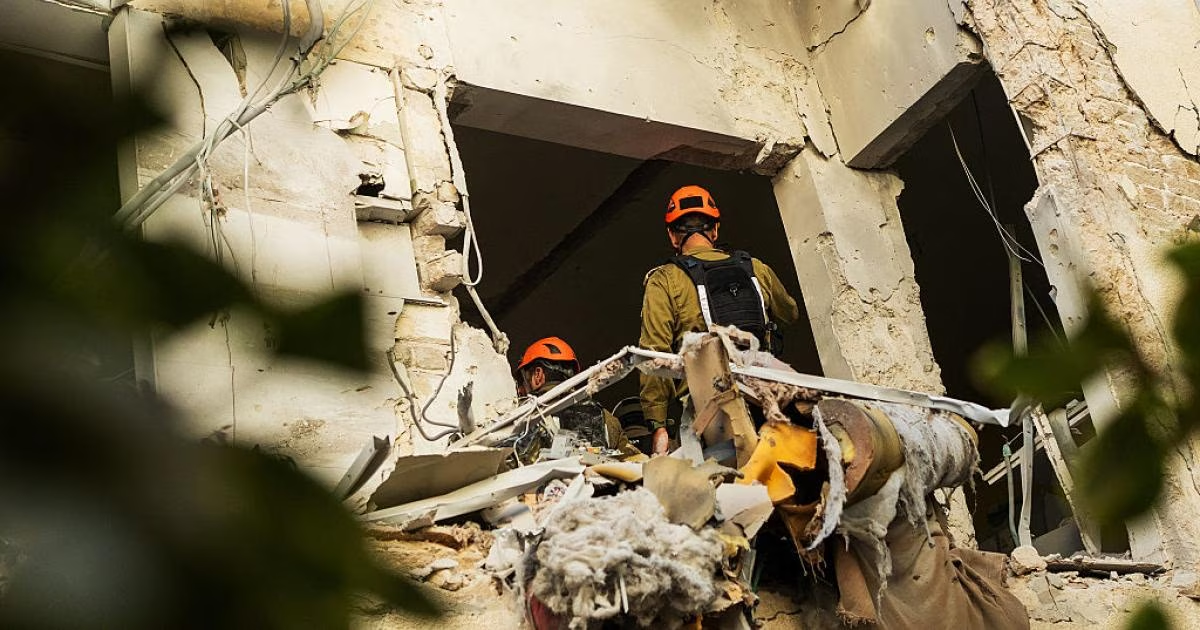
The greater Tel Aviv area experienced a state of security disruption following the impact of cluster missile fragments in 16 different locations, leading to injuries and extensive material damage. Israeli medical sources confirmed that ambulance teams responded to multiple reports in the central region, where six injured individuals were transported for treatment due to the heavy fall of missile fragments.

The damage was primarily concentrated in Tel Aviv and the city of Petah Tikva, located north of it, where fragments shattered building facades and damaged infrastructure. Local sources reported that municipal crews are currently working at two main sites that suffered significant destruction, attempting to clear debris and assess the extent of losses to public and private property.

Eyewitnesses and field observations described the scale of destruction as enormous, with the force of the explosions and scattered fragments causing vehicles to be thrown into the air and windowpanes to shatter in dozens of surrounding buildings. These developments come amidst a notable military escalation, with reports indicating that the missile used is of the cluster type, designed to inflict widespread damage over extended geographical areas.

In a related context, media sources revealed the launch of eight such missiles towards Israeli targets, raising the level of concern among security circles about the recurrence of these attacks. The danger of these missiles lies in their ability to bypass some air defense systems and scatter fragments over populated areas, multiplying the potential for human and material casualties.

Regarding residential losses, data indicates that the repercussions of the recent missile attacks have directly or indirectly damaged the homes of over 3,100 Israelis. These affected individuals are currently residing in hotel facilities after their residential units became uninhabitable, while damage assessment operations by relevant authorities continue.

Civil defense and rescue teams continue to deploy in the affected areas to deal with potential fires and ensure the structural integrity of buildings hit by fragments. This missile strike puts the home front on high alert, coinciding with ongoing regional tensions and an escalating pace of military confrontation.

The intercepted missile is a cluster missile, raising significant concern due to the extensive damage it causes in impact zones.

ARAB AND WORLD

Sun 08 Mar 2026 5:19 pm - Jerusalem Time

Widespread Destruction in Iran: Thousands of Residential Units Targeted, Thousands of Civilian Casualties

Reports issued by the Iranian Red Crescent today, Sunday, stated that military operations led by the United States and Israel have resulted in the destruction and targeting of 9,669 civilian units across the country since the end of February. The destruction included 7,943 residential homes and 1,017 commercial establishments, reflecting the extensive damage inflicted on civilian infrastructure and the daily lives of residents.

The targeting was not limited to residential facilities but also directly affected the health and education sectors, with 32 health centers and 65 educational schools reported damaged. Official sources also recorded the targeting of 13 centers belonging to the Iranian Red Crescent, which hinders relief efforts and humanitarian services provided to those affected in the devastated areas.

Regarding human casualties in the medical sector, the statement announced the killing of 11 healthcare workers and the injury of 33 others with varying degrees of wounds while performing their duties. In a related context, a United Nations spokesperson revealed shocking figures regarding child victims, confirming the killing of approximately 180 children as a result of ongoing attacks on Iranian cities.

For its part, the Iranian Ministry of Health stated that the civilian death toll has exceeded 1,200, while the number of injured has surpassed 10,000 after eight days since the outbreak of the war. These figures come amidst an unprecedented military escalation in the region, with warnings of an imminent humanitarian catastrophe if the intensity of the shelling continues at the same pace.

In contrast, the Israeli army announced an intensification of its air operations, indicating that more than 400 sites inside Iranian territory were targeted in the past twenty-four hours alone. A military statement clarified that the total number of strikes carried out since the start of joint operations with Washington reached approximately 3,400 strikes, using nearly 7,500 various munitions.

Field sources confirmed the start of a new wave of violent air raids targeting sites in the capital Tehran and its suburbs, leading to massive explosions. This wave is part of a strategy to expand the scope of targets to include vital centers, at a time when warplanes continue their intensive flights in Iranian airspace.

On the other hand, the Israeli Ministry of Health revealed that the number of injured Israelis has reached 1,929 people since the start of the confrontation on February 28th. The ministry explained that hospitals received 157 new injuries in recent hours, with dozens still receiving treatment in emergency departments and intensive care.

The severity of injuries within Israel varies, with 9 critically injured and 42 moderately injured, while the remaining cases were described as minor or resulting from panic. Medical authorities appealed to settlers to adhere to shelters and exercise extreme caution when hearing sirens to avoid injuries resulting from stampedes or shrapnel.

At the beginning of March, the city of Beit Shemesh, west of Jerusalem, witnessed the fall of an Iranian missile that killed 9 people and injured 27 others, the highest toll since the start of the war. The shelling caused extensive material damage to residential buildings and widespread fires, necessitating the intervention of explosives experts and ambulance teams to secure the affected area.

Military operations since the end of February have targeted 9,669 civilian units across Iran, including homes, schools, and health centers.

ANALYSIS

Sun 08 Mar 2026 5:18 pm - Jerusalem Time

Why does the 'blitzkrieg' strategy fail against Iran? A reading of military doctrine and geographical depth

The hypothesis of concentrated air strikes as a tool to achieve rapid political collapse in Iran dominates Western strategic thinking, based on successful historical models in previous wars. However, this perception clashes with a complex geopolitical reality, as Iran is not merely a centralized military structure that can be crippled by a single blow, but rather a state with immense geographical depth and a solid combat doctrine.

This resilience dates back to ancient historical roots, where successive empires on the Iranian plateau realized that independence required the ability to absorb initial military shocks. From the Achaemenid era to conflicts with the Romans and Ottomans, the vast geography and multiple population centers remained an impenetrable barrier against any complete control.

The Iran-Iraq War in the 1980s served as the real laboratory that reshaped the modern Iranian military mind. Under suffocating international isolation and a severe shortage of advanced weapons, the leadership in Tehran drew a lesson: relying on external forces to ensure national security is a losing gamble.

From this lesson, a long-term project was launched to build a local defense industrial base, primarily focused on bridging the technological gap through asymmetric means. Instead of draining resources into building an air force that would be difficult to secure under sanctions, the compass turned towards developing a terrifying missile arsenal capable of achieving deterrence.

Iran's missile arsenal today is the largest in the region, designed to overcome advanced air defense systems through maneuverability and saturation techniques. Missiles such as 'Khorramshahr' stand out as strategic deterrent tools due to their heavy warheads and their ability to reach distant targets with increasing accuracy.

In addition to missiles, drones have emerged as a crucial element in Iranian military doctrine, providing a low-cost means of carrying out precise strikes. In this context, Tehran relies on a 'quantitative saturation' strategy aimed at exhausting enemy defenses through a barrage of synchronized drones and missiles.

What distinguishes the Iranian situation is its state of 'strategic independence,' as the country is not part of international military alliances such as NATO. This reality has pushed it to build an autonomous defense system that makes the cost of any attack on it extremely high, prompting adversaries to hesitate before engaging in an all-out confrontation.

Iran's topographical nature plays a pivotal role in protecting its military capabilities, as its geography varies between rugged mountain ranges and vast deserts. These terrains have enabled Tehran to construct underground 'missile cities' and fortified bases that are difficult to fully target even with the latest bunker-buster bombs.

Analytical sources confirm that the purpose of these fortified facilities is to ensure the continuity of the ability to retaliate even after being subjected to intense waves of aerial bombardment. This means that any conflict that might begin as a quick surgical operation would quickly turn into a regional war of attrition whose effects would extend over vast areas.

Compared to its situation in the 1980s, Iran today appears more prepared to manage long-term conflicts thanks to its advanced industrial base. It no longer relies on the black market for weapons but has become a source of military technologies used in various international conflicts, which enhances its leverage.

At the core of Iran's strategy is the principle of 'denying the enemy victory,' a defensive concept that seeks to transform any hostile technological superiority into a financial and military burden. By integrating geographical depth with missile capabilities, Tehran has created an equation that makes war an option with uncertain outcomes.

Experts indicate that any military assessment that ignores Iran's resilience may fall into the trap of miscalculations that preceded major wars. History proves that states with vast areas and ideological centrality do not fall to air strikes, no matter how destructive their power.

Ultimately, the idea of a 'blitzkrieg' against Iran remains merely a risky strategic gamble in the presence of a complex network of defenses and offensive capabilities. The transformation of the conflict into an open regional confrontation is the most likely scenario, which major powers fear and take into account.

Based on current data, Iran's military power is specifically designed to confront invasion or concentrated bombing scenarios. This design makes any attempt to militarily subdue the state a complex operation that far exceeds merely controlling the skies or destroying vital facilities.

The true power of the Iranian state lies not only in achieving a quick victory but in preventing the enemy from achieving a swift victory and turning the conflict into a war of attrition.

ANALYSIS

Sun 08 Mar 2026 5:18 pm - Jerusalem Time

From the Twelve-Day War to the February War: The Gradual Path of US-Israeli Aggression Against Iran

Said Erikat

Opinion Writer

Washington – Said Arikat – 3/8/2026

News Analysis

The developments of the past two years in the confrontation between the United States and Israel on one side, and Iran on the other, reveal a gradual path of wars and temporary truces. This reflects a recurring pattern in the management of major conflicts, where rounds of fighting are interspersed with short pauses to re-evaluate military and political calculations. The chronological sequence of events shows that the ceasefire announced in mid-2025 was not the end of the confrontation, but rather a transitional phase between two wars.

This phase began on June 13, 2025, when Israel, led by Prime Minister Benjamin Netanyahu, launched a widespread war on Iran, later known as the "Twelve-Day War." According to military assessments, Tel Aviv aimed to weaken Iran's military capabilities and re-establish the deterrence equation that had eroded due to accumulated tensions in the region. However, Iranian responses, both direct and through its regional allies, raised the level of risks and opened the door to the possibility of the confrontation expanding into a wider regional war.

Amidst that war, US President Donald Trump announced a ceasefire on June 23, 2025, after twelve days of fighting. The decision was presented at the time as a step aimed at containing the war and preventing its expansion in the Middle East. However, subsequent readings of this decision within political and military circles in Washington led a number of analysts to consider it closer to a tactical truce than a sustainable settlement, especially since it was not accompanied by a clear diplomatic path or political negotiations that could lead to a long-term de-escalation.

During the months following the ceasefire, a relative calm prevailed for approximately eight months. However, this calm was not widely interpreted as the end of the war, but rather as a phase for re-evaluation and repositioning. This period gave Washington and Tel Aviv an opportunity to review the results of the first round of fighting and re-arrange their military preparations, while Tehran worked to strengthen its defensive capabilities and prepare for the possibility of a new confrontation.

Historical experiences in managing international conflicts indicate that periods of calm between wars are often used to rebuild military capabilities or modify strategic plans, especially when parties are not ready for a long war at a specific moment. In this context, the ceasefire in the summer of 2025 seemed more like a transitional phase in an ongoing conflict, rather than an endpoint.

After about eight months of relative calm, the confrontation returned to the forefront when the United States and Israel launched a widespread war against Iran on February 28, 2026, which appeared more extensive than the previous war, both in terms of the nature of the targets and the level of military coordination between Washington and Tel Aviv.

According to multiple accounts, the initial strikes focused on targeting the Iranian political and military leadership structure, including Supreme Leader Ali Khamenei and a number of senior military officials. Initial estimates indicate a large number of Iranian leaders were killed in these strikes, as part of an attempt to create a shock within the political and military system.

In addition to military targets, reports emerged of a large number of civilian casualties, adding a sensitive humanitarian dimension to the war. Among the most controversial incidents was what the "New York Times" revealed about the killing of at least 158 girls from the "Good Tree School" as a result of an American bombing, which sparked widespread reactions in the media and among human rights organizations.

In contrast, US President Donald Trump continued to defend the strategy of intense military pressure, considering that the war might ultimately push Iran to accept new conditions or modify its regional policies. This assessment is based on the premise that the accumulation of military and economic pressures can weaken the Iranian regime's ability to continue the confrontation for a long period.

However, this assessment is not universally accepted within strategic analysis circles. Iran still possesses a wide network of regional allies, in addition to missile and military capabilities that could contribute to expanding the scope of the war if it decides to respond more broadly. Moreover, the confrontation is not limited to its direct military dimension, but is also linked to regional power balances and the future of security arrangements in the Middle East.

The chronological sequence of events since the summer of 2025 indicates a clear pattern in the management of this conflict, where wars are interspersed with temporary truces that allow parties to re-evaluate the field and prepare for new rounds. The ceasefire announced in June 2025 did not open a clear diplomatic path as much as it paved the way for a subsequent, more extensive war.

At the same time, the reliance on targeting the supreme leadership of countries as a means to bring about rapid change in their behavior remains a controversial strategy in modern conflicts. Many experiences have shown that this type of operation can sometimes lead to counterproductive results, as it strengthens internal cohesion and gives the political leadership an opportunity to mobilize society around a confrontational discourse.

Specifically in the Iranian case, external military pressure may reinforce nationalist sentiment within Iranian society and expand the circle of support for the regime, which could make the war more complex and prolonged. Thus, the current confrontation appears to be part of an extended strategic conflict that may continue through successive phases of wars and truces, rather than being resolved in a single military round.

ARAB AND WORLD

Sun 08 Mar 2026 5:18 pm - Jerusalem Time

Two Israeli Soldiers Killed and Bloody Escalation in Lebanon: Evacuation Warnings for 100 Towns South of the Litani

The Lebanese front witnessed a significant field escalation today, Sunday, as the Israeli army admitted to the killing of two of its soldiers and the injury of an officer with varying degrees of wounds. These losses followed a direct targeting of a 'D9' military bulldozer during ongoing ground operations in southern Lebanon, amidst continued fierce clashes on the front lines.

Field sources reported that Israeli forces were subjected to five qualitative targeting operations in recent hours, including the firing of anti-tank missiles, mortar shells, and intense rocket barrages. These attacks focused on troop concentrations and vehicles near the border, reflecting the ferocity of the field resistance in confronting infiltration attempts.

In a related context, reports indicated that most operations were carried out using anti-tank missiles from long distances, reaching approximately seven kilometers. The shelling also targeted barracks and military sites within the Israeli side, where eight soldiers were previously injured, five of whom were described as being in serious condition, after shells fell on a military position.

On the humanitarian side, Israeli aircraft continued their violent raids, resulting in the martyrdom of 23 Lebanese in an initial toll for Sunday. The raids targeted a hotel in the heart of the capital Beirut, in addition to a residential building in the south, leading to widespread destruction and casualties among unarmed civilians.

Lebanon's Ministry of Health revealed shocking statistics since the start of the aggression earlier this month, recording the martyrdom of 394 people, including 83 children and 32 women. The number of injured also rose to 1130, including hundreds of children and women, due to the intense and continuous air raids across various governorates.

In a new massacre at dawn today, 19 people were martyred after an airstrike targeted a three-story residential building in the town of Sair Al-Gharbi in the Nabatieh district. This raid is part of a series of attacks targeting residential areas and southern villages, exacerbating the humanitarian crisis and cases of forced displacement.

On the ground, the Israeli army issued widespread and unprecedented evacuation warnings covering more than 100 towns and villages located south of the Litani River. These orders were characterized by being open-ended and not specifying a return date, suggesting the occupation's intention to expand the scope of its ground military operations in these strategic areas.

Military estimates indicate that the occupation seeks to impose field control over a border strip ranging from 5 to 8 kilometers deep inside Lebanese territory. Evacuation orders were not limited to the south but extended to include villages in the Beqaa region and specific neighborhoods in the southern suburbs of Beirut, amidst warnings of a major displacement wave.

These rapid developments confirm that the confrontation has entered a more dangerous phase, as the Israeli army seeks to strike newly established Lebanese fortifications and military points. In contrast, Lebanese field forces continue to target Israeli concentrations and prevent the stabilization of invading forces, leaving the situation open to all possibilities.

For the fourth time, the Israeli army renewed evacuation warnings directed at residents of wide areas south of the Litani River, covering more than 100 Lebanese towns.

ARAB AND WORLD

Sun 08 Mar 2026 5:18 pm - Jerusalem Time

Netanyahu Vows 'Surprises' for Iran in Second Phase, Trump Threatens Harsh Strikes

Israeli Prime Minister Benjamin Netanyahu announced that his government has developed an organized military plan that includes a series of surprises for the next phase of confrontation with Iran. Netanyahu clarified in his statements that the military operations are directly aimed at destabilizing the Iranian regime and creating conditions for radical political change in Tehran.

Netanyahu stressed that Israel has succeeded in changing the face of the Middle East region as previously promised, noting that the decisions he made involved significant risks but were necessary to eliminate those he described as Israel's enemies. He considered that the Hebrew state has been undergoing a comprehensive internal and regional transformation since the events of October 7th.

In contrast, the Iranian arena witnessed remarkable diplomatic moves, as Iranian President Masoud Pezeshkian apologized for the attacks on neighboring countries during the past period. This apology coincided with Tehran's continued launching of barrages of missiles and drones targeting various locations, including countries in the Arabian Gulf region.

Reports from Tehran indicate a sharp division within Iranian decision-making circles, specifically between the pragmatic wing seeking de-escalation and the hardline wing committed to continuing the fight. This tension comes at a sensitive time following the killing of Supreme Leader Ali Khamenei in the first airstrikes that initiated the war.

For his part, US President Donald Trump entered the crisis with strong threats, affirming that Iran will be subjected to extremely harsh strikes in the coming period. Trump warned that US military operations would not be limited to inside Iran, but would also include other regions and groups that would become legitimate targets for US forces.

On the ground, the Israeli army officially confirmed the transition to the second phase of the war against Iran, after carrying out extensive operations targeting more than 300 strategic sites. These successive strikes led to severe disruptions in global markets and contributed significantly to weakening the military and political leadership structure in Tehran.

Despite increasing international pressure, Iranian President Pezeshkian categorically rejected the US President's call for unconditional surrender, describing these demands as dreams that will not come true. Pezeshkian affirmed that his country would not raise the white flag despite the significant human and material losses caused by hundreds of Israeli and American airstrikes.

The roots of the current escalation date back to a series of bloody events that began on October 7, 2023, when Palestinian factions launched Operation Al-Aqsa Flood against Israeli bases and settlements. Since then, the region has been embroiled in a spiral of violence, including a devastating war in the Gaza Strip that lasted two years before a fragile ceasefire agreement was reached.

Direct confrontation between Israel and Iran began on February 28, when Tel Aviv and Washington launched intensive attacks that led to the killing of high-ranking security and political leaders. Iran has since responded by launching ballistic missiles and suicide drones towards Israeli territory, leading to strict military censorship over the extent of the damage.

Informed sources reported that the Israeli media blackout on the results of Iranian missile barrages aims to prevent the collapse of the home front and deprive Tehran of accurate intelligence information. Israeli security circles fear that leaked information could lead to updating the coordinates of Iranian missiles and increasing their accuracy in upcoming rounds.

In the absence of effective Iranian air and naval cover, Tehran relies primarily on its missile arsenal to deter continuous attacks carried out by Israeli air forces with American support. Observers believe that the collapse of the central command in Iran could lead to unexpected repercussions on the entire map of alliances in the Middle East.

Military estimates indicate that the second phase of the war will witness an intensification of qualitative operations targeting vital installations and remaining command and control centers. Netanyahu seeks through these 'surprises' to quickly resolve the conflict before Iran can reorganize its leadership ranks after the absence of the Supreme Leader.

On the humanitarian level, the mutual attacks have caused hundreds of casualties and widespread destruction of infrastructure, amid international warnings of the region sliding into an uncontrollable comprehensive war. International organizations continue their calls for restraint, but the language of threat remains dominant among the parties to the conflict.

Anticipation remains the master of the situation for what the coming days will bring in terms of 'surprises' promised by Netanyahu, amid Iranian insistence on continuing despite the siege and strikes. All eyes are on the new Iranian Leadership Council to see whether it will move towards de-escalation or escalate the military confrontation to unprecedented levels.

Israel has an organized plan that includes many surprises for the next phase of the war, and the goal is to destabilize the regime and allow for change.

LATEST NEWS

Sun 08 Mar 2026 5:18 pm - Jerusalem Time

Tehran Vows More Painful Strikes, Affirms Ability to Continue War for Six Months

Iranian authorities affirmed on Sunday their long-term resilience and sufficient military capability to continue the open confrontation against Israel and the United States for at least an additional six months. These statements reflect Tehran's determination to proceed with current military operations at the same pace, while hinting at a qualitative escalation in the field in the coming phase.

In official statements broadcast on Iranian television, the spokesperson for the Revolutionary Guard, Ali Mohammad Naeini, revealed the armed forces' intention to adopt a new offensive approach in the coming days. Naeini explained that the anticipated attacks would rely on long-range missiles and advanced weapons not extensively used before, warning that the strikes would be more precise, focused, and painful for the Israeli side.

On the ground, hundreds of thousands of Israelis experienced a state of terror early Sunday morning, as air raid sirens blared across wide geographical areas including the cities of Haifa, Tel Aviv, and Beersheba. These missile barrages prompted the occupation authorities to activate extreme emergency procedures, urging residents to remain in shelters and fortified areas to avoid direct injuries.

Military sources reported that Israeli air defense systems faced a difficult night, intercepting no less than four consecutive waves of missiles launched from Iranian territory. These offensive waves continued for five consecutive hours, leading to a state of confusion in navigation and public life within major cities and settlements.

For its part, Israeli police confirmed that shrapnel from interception operations fell in the Hof Hacarmel area, south of Haifa. Concurrently, loud explosions were heard in central Tel Aviv and its eastern suburbs, extending to areas in the southern West Bank, as Iranian missiles reached long-range targets.

Field sources indicated that the pace of Iranian missile bombardment has seen a significant escalation over the past forty-eight hours, which contradicts the Israeli narrative that previously claimed the destruction of most launch platforms. It appears that Tehran has succeeded in changing its military tactics more than once to circumvent defensive systems and direct successive barrages.

In recent attacks, a significant reduction in the early warning period available to Israelis was observed, decreasing from ten minutes to only about five minutes in some areas. This technical development in the speed of missile arrival or launch method has increased pressure on the Israeli home front, which has faced unprecedented security challenges since the escalation began.

These rapid developments come within the framework of the war that erupted on February 28, following attacks by the United States and Israel on sites inside Iran. The mutual missile confrontations have so far resulted in the deaths of 10 people inside Israel, amid international fears of the region sliding into an uncontrollable comprehensive regional conflict.

Iranian armed forces are capable of continuing a fierce war for at least six months at the current pace of operations, and the enemy should expect more painful strikes.

ANALYSIS

Sun 08 Mar 2026 5:17 pm - Jerusalem Time

War of Uncertainty: How the Current Confrontation Reshapes Civilizational Balances in the East?

The current confrontation in the region has transcended the boundaries of traditional military engagement, transforming into a comprehensive civilizational and ideological conflict that pits Western technological superiority directly against the resilience of history and geography. This in-depth reading reveals the necessity of moving from reliance on international illusions towards building comprehensive sovereignty that includes food, medicine, and weaponry.

The collective Arab and Islamic mind is experiencing a state of analytical confusion and wishful chatter fueled by superficial media platforms, leading to the absence of robust methodologies in understanding the psychology of peoples. The war raging today acts as a strategic laboratory, exposing the falsity of fragile concepts that peoples have clung to for long decades, while highlighting, in contrast, solid truths that were previously obscured.

One of the most prominent features of this stage is the collapse of the myth of absolute technological decisive victory, as it has been proven that artificial intelligence and cyber arsenals cannot end wars with the push of a button. Reality has revived Clausewitz's principle of 'uncertainty,' confirming that war is a living entity whose final paths cannot be predicted solely through inanimate machines.

The concept of a 'civilizational state' emerges on the horizon as an alternative to the functional state that feeds on external support, where vast geography and a human mass believing in a trans-generational ideology grant immense capacity to absorb shocks. This model pushes towards the necessity of developing solid regional alliances, such as transforming cooperation entities into more cohesive political units.

The region is currently witnessing a contemporary version of what was known as the 'Eastern Question' that previously dismantled the Ottoman Empire, but with 21st-century tools. The new colonial goal is no longer to rapidly change regimes, but to manage creative chaos to keep the region in a state of permanent attrition that serves regional expansion projects.

The conflict is systematically being transformed from a political dispute over borders into a comprehensive holy war, where the West is reviving the spirit of the Crusades with a modern Zionist tint. This transformation calls for a reciprocal response from regional powers that find in religious doctrine the only means of mobilization capable of steadfastness and confrontation.

The current war has acted as a 'surgical scalpel' that excised the illusions of international protection, as it has become clear to everyone that international law is merely a tool to serve Western centrality. Reliance on external umbrellas has proven to be the beginning of self-erosion for states that do not possess independent decision-making or self-strength.

Recent confrontations have revealed the impotence of the 'ignorant educated' and the procrastinating analyst who sells illusions to the masses through screens, and a dire need has emerged for the appearance of the 'engaged intellectual.' This type of intellectual is capable of connecting the movement of a tank on the battlefield with the deep historical roots that move peoples.

Field experience has proven the fragility of small states lacking geographical depth and industrial sovereignty, as they have become mere pawns in the struggle of giants, susceptible to sacrifice. The absence of sovereignty in the food, medicine, and weapons sectors makes any political entity vulnerable to collapse at the first real confrontation.

Within this suffering, what can be called the 'Islamic and Arab Civilizational Basin' is forming, where artificial borders in popular consciousness fade under the pressure of successive shocks. This concept transcends narrow sectarian differences to coalesce as a geopolitical bloc capable of standing against the fragmentation projects targeting the region.

Self-responsibility for defense has become an inescapable destiny, as the production of knowledge and the localization of basic industries are no longer an intellectual luxury but a fundamental condition for existence. In the jungle of international uncertainty, there is no place for the weak who await solutions from international institutions that have proven their complete bias towards the aggressor.

We are not living at the end of a war, but rather the throes of birth of a new regional order in which thrones based on corruption and external dependence will fall. This system will restore dignity to pivotal states that have the courage to possess deterrent weapons and make their sovereign decisions away from international dictates.

The current conflict redefines power; it is not merely possessing advanced technology, but a combination of solid doctrine, vast geography, and popular will. Peoples who understand their historical roots are the only ones capable of resisting attempts at civilizational erasure practiced by colonial powers.

In conclusion, the 'War of Uncertainty' remains the primary driver for redrawing the boundaries of consciousness before geographical boundaries, as true powers emerge from beneath the ruins of old illusions. The future in this new East will belong to those who possess long-term endurance and the ability to transform existential threats into opportunities for independent civilizational building.

The future is not for those who possess the latest technology, but for those who possess the deepest history, the most solid doctrine, and the widest geography.

ARAB AND WORLD

Sun 08 Mar 2026 5:17 pm - Jerusalem Time

Member of the Political Bureau of the CPC Central Committee, Foreign Minister Wang Yi Answers Questions from Chinese and Foreign Journalists on China's Foreign Policy and International Relations

The Fourth Session of the 14th National People's Congress held a press conference at the Media Center, where Wang Yi, Member of the Political Bureau of the CPC Central Committee and Foreign Minister, answered questions from Chinese and foreign journalists on China's foreign policy and international relations.

Wang Yi: Good morning, friends from the press! I am very pleased to meet you again. Today is International Women's Day, and first of all, I would like to extend my sincere wishes to all women. I would also like to take this opportunity to express my sincere thanks to our media friends and personalities from various circles for your attention and support for Chinese diplomacy.

Today's world is witnessing rapid developments of unprecedented changes in a century, with transformations and turbulences intertwined, and wars and conflicts continuously succeeding each other. Meanwhile, China is experiencing a rapid pace of building a strong nation, an irresistible momentum of national rejuvenation, and international influence growing day by day. Under the strong leadership of the CPC Central Committee with Comrade Xi Jinping as its core, Chinese diplomacy revolves around the central task of the Party and the nation, follows the scientific guidance of Xi Jinping Thought on Diplomacy, firmly defends the country's sovereignty, security, and development interests, firmly upholds the rule of law in the world, fairness and justice, firmly opposes all unilateral actions, power politics, and bullying, firmly adheres to and fulfills required international commitments, and firmly stands on the right side of history's progress. We are full of confidence in the future of humanity as the most important force for peace, stability, and justice in the world, and we are ready to work with all like-minded and ambitious countries to continue writing a contemporary chapter characterized by peace, development, cooperation, and win-win outcomes towards the lofty goal of building a community of shared future for mankind.

Therefore, I am ready to answer your questions.

CCTV: The year 2025 is a very special year for Chinese diplomacy. Could you highlight the achievements of summit diplomacy in the past year? And what are the new notable points for this year?

Wang Yi: Summit diplomacy is an anchor for Chinese diplomacy. In the past year, President Xi Jinping engaged in fruitful summit diplomatic practices, in the face of strong winds and turbulent waves in the international situation, creating a series of important historical moments.

Over the past year, President Xi Jinping held important meetings with leaders of major countries in the world and conducted strategic communication with them, creating a new experience of dialogue and coordination among major powers; he visited Southeast Asia, Russia, Central Asia, and the Republic of Korea, establishing a new landscape of good neighborliness with neighboring countries; he presided over the Tianjin Summit of the Shanghai Cooperation Organization and the China-CELAC (Community of Latin American and Caribbean States) Forum, mobilizing new impetus for the solidarity of the Global South; and he attended a series of events commemorating the 80th anniversary of the victory of the Chinese People's War of Resistance Against Japanese Aggression and the victory of the World Anti-Fascist War, issuing a strong new voice for defending peace and justice.

Over the past year, the international community has come to know China, approached it, and placed greater trust and expectations on it through summit diplomacy. An increasing number of countries have realized that Chinese diplomacy, personally planned and led by President Xi Jinping, has provided factors of stability and certainty, which are the most precious things in a turbulent world, and it has become an irreplaceable backbone amidst the world's turbulences. Especially, the important initiatives and concepts put forward by President Xi Jinping embody his distinguished strategic insight and broad global vision, and they have set the correct direction for the development of unprecedented changes in a century.

This year, President Xi Jinping will welcome world guests to China, preside over the informal APEC leaders' meeting, the Second China-Arab States Summit, and other major events hosted by China, and make several important visits. This will undoubtedly promote the development of relations between China and countries around the world in a more positive direction, undoubtedly open up new prospects for building a community of shared future for mankind, and undoubtedly enable the Chinese nation to make new contributions to the cause of world peace and development.

Sputnik: In the complex international situation, how do China and Russia, as two major countries, confront attempts to reshape international law and global trade rules?

Wang Yi: This year marks the 30th anniversary of the establishment of the China-Russia strategic partnership of coordination, and the 25th anniversary of the signing of the "Treaty of Good-Neighborliness, Friendship and Cooperation between China and Russia." China-Russia relations have always "stood firm as a mountain amidst storms" in the intertwined changes and turbulences of the international situation.

Why have these relations reached this level? I believe the main reason is that the China-Russia strategic partnership of coordination has been established from the outset on the basis of equality, respect, and mutual benefit, reflecting the content of a new type of international relations and representing the direction of development of a new type of relations between major countries.

China and Russia are strategically independent. We always respect each other's core interests, do not forcibly impose our will and agenda on each other, and adhere to non-alliance, non-confrontation, and non-targeting of a third party.

China and Russia have a high degree of mutual political trust. Standing shoulder to shoulder is a fundamental characteristic of China-Russia relations, which possess enormous strategic resilience regardless of any attempts to sow discord or exert external pressure.

China and Russia have extensive practical cooperation. China and Russia have the most strategic consensus and closest strategic cooperation on important international and regional affairs, including the issue you mentioned of defending international rules and the international order.

The international order established after World War II is once again at a critical juncture after enduring 80 years of challenges and difficulties. Last year, the Chinese and Russian presidents attended commemorative events for the victory of the Anti-Fascist War held on the other side, where both sides issued three weighty joint statements on deepening comprehensive strategic cooperation, consolidating global strategic stability, and defending the authority of international law. This sent a clear message to the world about the necessity of upholding the correct understanding of the history of World War II, defending the outcomes of the victory of World War II, and rejecting unilateral actions and bullying with unwavering determination. 80 years ago, we made a "Sino-Russian contribution" to establishing the post-war order, and today, 80 years later, we will inject "Sino-Russian energy" to welcome a multipolar world.

Phoenix TV: The United States and Israel have once again launched military strikes on Iran, and the conflict is currently extending to the entire Middle East region. What are China's views on resolving the Iranian issue?

Wang Yi: This is a matter of concern to all parties, and also a focal point of the current international situation. The Chinese side adheres to an objective and just position, and has repeatedly clarified its principled stance, which can be summarized in one sentence: cease fire and prevent war. Ancient Chinese say, "War is a dangerous tool, one must be cautious in resorting to it." In the face of the Middle East engulfed in the flames of war, I would like to emphasize that this war should not have broken out in the first place, and no party wins in it. The history of the Middle East repeatedly reminds people that resorting to force is not a solution to problems, and war only leads to more hatred, and only generates more crises. The Chinese side once again calls for an immediate cessation of military operations, preventing the continuous escalation of the situation, and avoiding the expansion of the war's scope.

The Chinese side believes that finding correct and appropriate solutions to the relevant problems in Iran and the Middle East requires adherence to the following basic principles:

First, respect for state sovereignty. Sovereignty is the cornerstone of the existing international order. We call for the necessity of respecting the sovereignty, security, and territorial integrity of Iran and all countries in the Gulf region, without prejudice.

Second, refraining from arbitrary use of force. The power of the fist does not equal the power of right, and the world should not return to an era governed by the law of the jungle. Those who use force arbitrarily do not prove themselves strong, and the peoples should not be innocent victims of war.

Third, adherence to non-interference in internal affairs. The peoples of the Middle East are the true masters of this region, and the countries of the Middle East should decide their affairs by their independent will. Planning colored revolutions and carrying out regime change is unacceptable to the peoples.

Fourth, politically resolving hot issues. China always advocates for prioritizing peace, and all parties should return to the negotiating table as soon as possible, settle differences through equal dialogue, and make efforts to achieve common security.

Fifth, major countries should play a constructive role and use their power in good faith. Another ancient Chinese proverb says, "Without justice, the scales tip from victory to defeat." Major countries should adhere to justice and follow a straight path, and provide more positive energy for peace and development in the Middle East.

As a sincere friend and strategic partner of the Middle Eastern countries, China is ready to work with them to implement the Global Security Initiative, thereby restoring order to the Middle East, restoring security to its peoples, and restoring peace to the world.

CNN: Since President Donald Trump's return to the White House, China-US relations have seen fluctuations. His visit to China at the end of this month is highly anticipated. How will the US and Israeli military strikes on Iran affect this visit? And what are China's expectations for the outcomes of Trump's visit to China and the developments in bilateral relations in the coming period?

Wang Yi: China-US relations concern everyone and affect the world. Cutting off communication between the two countries will only lead to misunderstanding and misjudgment, and the two countries heading towards wrestling and confrontation will harm the world. China and the United States are two major countries, and neither can change the other, but they can change the way they deal with each other, which is to adhere to a position of mutual respect, defend peaceful coexistence as a red line, and pursue a horizon of cooperation and win-win outcomes. This approach is consistent with the interests of the two peoples and the aspirations of the international community.

What is heartening is that the two heads of state have made personal efforts and maintain good communication at the highest level, which has provided an important strategic guarantee for improving and developing China-US relations, and contributed to the overall stability of these relations after going through twists and turns. This year is a busy year for China-US relations, as the agenda for high-level communication between the two countries has been placed on our table. Now, it is required of both sides to make full preparations, create favorable conditions, control existing risks, and remove trivial disturbances. The Chinese side's position has always been positive and open, and it is important for the American side to move in the same direction as well. I am confident that as long as both sides deal with each other with sincerity and faithfulness, we can continuously extend the list of cooperation and shorten the list of problems, and under the strategic leadership of the two heads of state, we can achieve satisfactory results for both peoples, reach consensuses welcomed by the entire international community, and make 2026 a pivotal year for China-US relations to move towards a sound, stable, and sustainable development path.

China Daily: What is your assessment of the leading role played by the countries of the Global South in the reform process of the global governance system? Since this year, the international situation has witnessed significant changes, with protectionism and power politics escalating. How can the Global South achieve the solidarity and self-strengthening that the Chinese side always advocates?

Wang Yi: The collective rise of the Global South is a remarkable sign of major changes in the world. The share of the Global South in the global economy has risen from 24% to over 40% in the past four decades, making it a pivotal driving force for global multipolarity.

Currently, hegemony and power politics are rampant, posing a serious shock to the existing international order. Therefore, the Global South should enhance communication and coordination, and make joint efforts to safeguard its legitimate rights and interests and expand the space for its independent development.

The Global South is an emerging, active, and benevolent positive force in the international arena. The more intense the transformations and turbulences in the world, the greater the need to consolidate confidence, strengthen solidarity and cooperation, and jointly raise the banner of peace, development, cooperation, and win-win outcomes. It should also activate the role of BRICS, the Shanghai Cooperation Organization, the "Group of 77 and China," and other important platforms, in order to voice peace and drive development.

Multilateralism is the "safe haven" for countries of the South. The Global South should push the international community to implement true multilateralism, and maintain healthy growth of the international system centered on the United Nations and the international order based on international law. It should adhere to dealing with world affairs through consultation among all countries, and setting international rules with the participation of all countries.

The development of the Global South needs an international environment characterized by openness and cooperation. Therefore, we must advocate for economic globalization characterized by inclusiveness and benefit for all, push for the building of an open world economy, and firmly maintain the multilateral trading system, so that we can share opportunities and achieve win-win outcomes through openness.

China has always cared for the Global South and integrated into its fabric, ready to work hand in hand with other countries of the South on the path of modernization, and push for the building of a community of shared future for mankind.

CGTN: Amidst the ongoing Israeli-Palestinian conflict and the fragile ceasefire in Gaza, the United States proposed establishing a "Peace Council" to resolve the Gaza issue and arrange for the post-war period. How does the Chinese side truly push for a solution to the Palestinian issue?

Wang Yi: The situation in Gaza concerns the preservation of the minimum international morality. The international community's efforts to achieve a ceasefire in Gaza are welcome, but continuous efforts are still needed to consolidate the ceasefire, push for reconstruction, and then find a comprehensive and lasting solution to the Palestinian issue.

There is only one reasonable and universally recognized solution to the Palestinian issue, which is the "two-state solution." Any other arrangement or new mechanism must support the "two-state solution" rather than undermine it. The international community will not accept marginalizing the Palestinian issue again. The United Nations, in particular, should bear the responsibility of playing a leading role in this process.

Living under the burden of turmoil and wars is not the written destiny of the Palestinian people, who have the same legitimate right as peoples in other regions of the world to achieve peaceful development away from the flames of war. As a responsible major country, China will, as usual, support the just cause of Palestine to restore its legitimate national rights, and push the international community to restore justice to the Palestinian people.

NBC: Does the Chinese side accept the framework of "governance by China and the United States" to address global challenges? If not, what is China's alternative solution to avoid confrontation between China and the United States, and to make the world trust that China does not intend to overturn the current international order after its rise?

Wang Yi: There is no doubt that China and the United States have significant influence on the world. But we must not forget that there are more than 190 countries on this planet, and they jointly write the history of the world, and their peoples jointly create the future of humanity. Coexistence in diversity is the original face of human society, and the presence of multiple poles is the desired appearance of the international equation.

If we review history, we will find that every time major powers fought for hegemony and confrontation between blocs brought disasters and suffering to humanity. Therefore, China will never follow the old path of the inevitability of hegemony for a major country, nor does it agree with the logic of "joint governance by major countries." The Chinese Constitution clearly states the necessity of adhering to an independent foreign policy and adhering to the path of peaceful development. Chinese leaders have repeatedly emphasized in international forums that China will never seek hegemony or expansion, no matter how the international situation changes, and no matter how much China develops.

As for how the international equation develops, the Chinese solution calls for building a global multipolarity characterized by equality and order. Equality means equal membership for all countries in the international community, whether large or small, strong or weak, and they can find their own place in the multipolar equation and play their required role. Order means that all countries must adhere to universally recognized international rules, namely the purposes and principles of the UN Charter and the basic principles of international relations.

Building a global multipolarity characterized by equality and order must be a shared responsibility of all countries. Since major countries have greater resources and capabilities, they must bear more responsibility with a broader mind, and be a model for adhering to rules, fulfilling promises, and upholding the rule of law. China is keen to be a constructive force in a world undergoing transformations, and welcomes a multipolar world with all countries.

Brazil de Fato: The "National Security Strategy" issued by the United States last year indicates that the US priority is to interfere in relations between China and Latin American countries by pressuring Latin American countries. How does the Chinese side deal with this?

Wang Yi: The old play of the 19th century should not be staged again in the international theater of the 21st century. The resources in Latin America belong to its peoples, and they choose their countries' paths and choose their friends by their independent will.

Cooperation between China and Latin America is mutual assistance and mutual support between countries of the Global South. If we review what has happened over more than half a century, we will find that the key to the rapid development of relations between China and Latin America lies in China's constant respect for the peoples of Latin America, and China's adherence to dealing with Latin American countries on an equal footing and on the basis of mutual benefit and win-win outcomes. We have not made geopolitical calculations, nor have we interfered in the internal affairs of other countries, nor have we asked other countries to take sides. We jointly launched the five initiatives of solidarity, development, civilization, peace, and people-to-people communication at the ministerial meeting of the China-CELAC Forum, which outlined the broad strokes for China and Latin America to move together towards modernization.

China-Latin America cooperation is not aimed at a third party, and should not be disturbed by a third party. We are full of confidence in the future of China-Latin America relations. China is keen to work together with Latin American countries to steadily advance the building of a China-Latin America community of shared future, no matter how the situation changes, so that the comprehensive cooperative partnership between China and Latin America can better serve the peoples of both sides.

China Review News Agency: Recently, the Lai Ching-te (Lai Qingde) authorities have repeatedly claimed that Taiwan is a "sovereign independent state," and that the Taiwan issue is not China's internal affair. The Taiwan issue and the situation in the Taiwan Strait are continuously escalating, how do you assess this?

Wang Yi: Taiwan has been Chinese territory since ancient times, and it was never in the past, nor is it in the present or future, a so-called "state" at all. The return of Taiwan to China is the result of the victory of the Chinese People's War of Resistance Against Japanese Aggression, and also a fruit of the victory of World War II. Taiwan's status has been definitively settled by a series of international legal documents such as the "Cairo Declaration," the "Potsdam Proclamation," the "Instrument of Surrender of Japan," and UN General Assembly Resolution 2758. Any attempt to create so-called "two Chinas" or "one China, one Taiwan" on the international stage is doomed to failure.

The Democratic Progressive Party authorities, who stubbornly adhere to the separatist stance of "Taiwan independence," are the source of the turmoil that undermines peace and stability in the Taiwan Strait. Facts have repeatedly proven that the clearer the international community's stance in rejecting "Taiwan independence" separatist forces, and the firmer its stance in adhering to the One-China principle, the greater the guarantee for peace and stability in the Taiwan Strait.

The Taiwan issue is China's internal affair, and it is the most important core of China's core interests. This red line must not be crossed or trampled upon. We will never allow anyone or any force to separate Taiwan, which was recovered from Japanese occupation more than 80 years ago, from China again. An overwhelming consensus has formed in the international community on adhering to the One-China principle. An increasing number of countries are standing with China, reaffirming their adherence to the One-China principle and recognizing that Taiwan is part of Chinese territory, and even explicitly rejecting all "Taiwan independence" separatist activities and supporting China's reunification cause. This clearly proves that rejecting "Taiwan independence" and supporting China's reunification is in line with the general trend of the times and also consistent with the aspirations of the international community.

The resolution of the Taiwan issue and the complete reunification of the motherland is an irresistible historical process. Those who follow it prosper, and those who oppose it perish.

Global Times: In the current situation, conflicts and disputes in the world are increasingly intensifying, and the pace of competition and confrontation is escalating. Why does Chinese diplomacy set building a community of shared future for mankind as its goal?

Wang Yi: Indeed, as you said, humanity is currently living in an era full of challenges. When we review history, we find that there are always pioneers who tirelessly pursue ideals and light, no matter the difficulties the world faces. President Xi Jinping proposed building a community of shared future for mankind, which embodied his profound vision, far-sightedness, and broad mind as a leader of a major country, and answered the contemporary question "where is humanity heading?" He told the world that humanity's enemy is not within itself, but rather war, poverty, hunger, and injustice. These challenges cannot be overcome individually, and it is impossible to distance oneself from them; solidarity, cooperation, mutual support, and collaboration are essential throughout the world. Isolation cuts off assistance, and solidarity generates strength. The peoples of the world are increasingly realizing the contemporary value and power of truth of the concept of a community of shared future for mankind, which serves as a beacon illuminating humanity's path forward.

The concept of a community of shared future for mankind also embodies China's responsibility as a major country and its historical mission towards the world. Chinese people have always been characterized by a broad vision to create a world shared by all and characterized by greater harmony. The path of the great rejuvenation of the Chinese nation and the rise of a major country with a population of 1.4 billion will not be a reproduction of the old path taken by traditional major powers of practicing hegemony and expansion. Instead, we will follow the path of peaceful development with unwavering determination, and encourage all countries to follow the path of peaceful development and work together to build a clean and beautiful world characterized by lasting peace, global security, common prosperity, openness, and inclusiveness.

We have seen with great satisfaction that the concept of building a community of shared future for mankind has been taking root in people's hearts day by day in recent years, and has received support from more than 100 countries and international organizations, and endorsement from about 80% of international public opinion. More than 40 countries and regional organizations have participated in cooperation in building a community of shared future, which once again proves that "those who stand with justice receive greater help," and the just cause will be supported by all countries and will mobilize the strength of the peoples.

The future of humanity is bright, but it will not be realized automatically. Building a community of shared future for mankind is a beautiful prospect, and it is also a historical process that requires continuous struggle and joint efforts generation after generation. China will work hand in hand with all parties with firm conviction and practical actions to continuously transform the community of shared future for mankind from vision to reality.


PALESTINE

Sun 08 Mar 2026 12:50 pm - Jerusalem Time

Fears of a long attrition.. Israel and America seek to resolve the confrontation with Iran through the 'oil weapon' and regional alliances

The direct military confrontation between Iran on the one hand, and Israel and the United States on the other, entered its second week amidst an unprecedented escalation targeting vital facilities. Tel Aviv and Washington are seeking to achieve a strategic breakthrough that will quickly decide the battle, fearing a slide into a long-term war of attrition that could drain the military and economic resources of both sides.

The current strategy involves intensifying strikes against Iranian oil facilities to undermine the regime's financial resilience, in conjunction with widespread displacement operations in Lebanese border towns. These moves come amidst a shared desire between US President Donald Trump and Israeli Prime Minister Benjamin Netanyahu to achieve a swift victory that will fundamentally end the Iranian threat.

Despite the painful blows Tehran has received, including the martyrdom of Supreme Leader Ali Khamenei and prominent military commanders in the first strike, signs of internal cracks have not appeared as clearly as intelligence circles had hoped. Iran is currently struggling to confront the 'hell' targeting its capabilities, amidst warnings of missile responses that could ignite the entire region uncontrollably.

Inside Israel, opinion polls show widespread support for the war, reaching 79%, but dissenting voices have begun to rise, warning of the cost of this adventure. Yair Golan, head of the 'Democrats' party, warns that Netanyahu may be driven by sectarian and personal motives in prolonging this war, which could put Israel's national security at grave risk.

For his part, Israeli Education Minister Yoav Kisch called for continued military pressure on all fronts, including Hezbollah in Lebanon, even if it requires a large ground campaign. Kisch believes that retreating at this stage would give Israel's adversaries an opportunity to regroup and launch more ferocious attacks in the future.

On the analytical front, Reserve General Michael Milstein warned against indulging in 'illusions' of reshaping the Middle East anew through military force alone. Milstein stressed that the brilliant intelligence successes achieved in the early days of the war must be translated into a realistic strategic path, warning against the 'fantasy' of immediate normalization with the region's countries.

In a related context, political analyst Shimon Sheffer pointed out that history proves the failure of American attempts to change regimes by force, citing historical examples that ended in disasters and chaos. Sheffer expressed concern that this adventure might end with the control of more extremist parties if the Iranian state collapses without a ready and stable political alternative.

Economic estimates indicate that Israel has incurred heavy losses amounting to approximately 9.4 billion shekels weekly since the outbreak of the war on February 28. The United States is also spending nearly a billion dollars daily to cover the costs of its military operations and protect its interests in the region, which could put political pressure on the Trump administration in the future.

On the ground, sources reported that Israeli military pressures also aim to push Gulf states to engage directly in the conflict against Tehran. Reports speak of the possibility of Saudi Arabia joining the confrontation if Iran continues to target its facilities, especially after cracks were observed in the Iranian decision-making structure following the recent attacks.

In parallel with the regional war, the West Bank is witnessing a dangerous escalation in settler attacks, which have increased by 25%. These attacks have resulted in the martyrdom of two Palestinian brothers in the town of Qaryut, in addition to forced displacement operations targeting Bedouin communities in the Jordan Valley under the cover of the raging war.

US President Donald Trump affirmed in his recent statements that he seeks 'complete surrender' and not just a political deal with Tehran, threatening to expand the target bank to include vital state joints. However, Trump backed down from the idea of militarily involving the Kurds in the confrontation, which sources attributed to Turkish pressure and fears of complicating the regional scene.

Observers warn that the continuation of the war could lead to Israel losing popular support in the United States, as forecasts indicate growing opposition to military aid. Analyst Ben-Dror Yemini believes that any military victory will be worthless if it ultimately leads to international isolation and a long-term existential threat to the Hebrew state.

Amidst these complexities, the question remains about the ability of the Israeli home front to withstand the continuous missile barrages that force millions to remain in shelters. Analysts criticize the insufficient preparation of the home front during Netanyahu's long years in power, which makes Israeli society vulnerable to immense psychological and economic pressures.

In conclusion, the region appears to be at a historical crossroads, where the political ambitions of leaders intertwine with the harsh realities of the military field. While air raids continue with thousands of tons of explosives daily, the possibilities of sliding into comprehensive chaos remain, unless a strategic way out is found to end the escalating cycle of violence.

Brilliant intelligence and military gains are not enough; they must be translated into strategic action away from illusions.

ARAB AND WORLD

Sun 08 Mar 2026 12:50 pm - Jerusalem Time

Iran's Assembly of Experts Decides on Khamenei's Successor Amid Israeli Assassination Threats

Members of Iran's Assembly of Experts revealed today, Sunday, that a new Supreme Leader for the Islamic Republic has been officially chosen to succeed Ali Khamenei, confirming that the voting process was successful. Despite the identity being decided, the General Secretariat of the Assembly has not yet officially announced the name, pending necessary protocol and security arrangements given the current circumstances the country is facing.

Ahmed Alamolhoda, a member of the Assembly, clarified that the decision made by the Assembly of Experts is final and irreversible, emphasizing that the Iranian constitution prevents members from changing their opinions after the result is issued. He indicated that official institutions would announce the name later, affirming that the process was conducted according to strict legal controls applicable in such major political transitions.

For his part, Ayatollah Mohammad Mehdi Mirbagheri confirmed that the majority of the Assembly members reached a comprehensive consensus on the figure who will lead the country in the next phase. He added that intensive consultations led to the selection of the person the Assembly deems most suitable to confront the grave challenges facing Iran, especially in light of the open war with the Israeli occupation and the United States.

In the same context, Mohsen Heidari, the representative of Khuzestan province in the Assembly, stated that the chosen candidate gained the confidence of the vast majority of members. Heidari described the selection as reflecting the unity of the religious and political establishment in Iran, noting that the chosen figure possesses the necessary competence to manage state affairs at this critical historical moment.

On the other hand, the Israeli army quickly issued direct threats to pursue any figure who assumes the position of Supreme Leader after Khamenei. The occupation army published messages in Persian via social media platforms, vowing to target anyone involved in the appointment process of the new successor, in a clear attempt to intimidate members of the Assembly of Experts and obstruct the transfer of power.

Media sources reported that the Israeli warnings come after information circulated about Mojtaba Khamenei, the son of the late leader, surviving a failed assassination attempt. Monitoring circles believe that the occupation seeks through these threats to disrupt internal Iranian calculations and prevent the stability of the new leadership by brandishing the weapon of direct assassinations against senior officials.

Field assessments indicate that Israeli and American policy aims essentially to create a comprehensive constitutional vacuum in Tehran, not just a vacuum at the top of the leadership pyramid. This is evident through the direct targeting of members of the Assembly of Experts and the attempt to undermine the legitimacy of their meetings to choose the country's new leadership.

Through its repeated statements, Israel seeks to suggest that it possesses extensive intelligence influence within the capital Tehran and the ability of its agencies to penetrate the narrow circles of decision-making. This psychological warfare runs parallel to field military operations targeting vital facilities and buildings belonging to Iranian sovereign institutions in various cities.

In Tehran, informed sources confirmed that Iranian authorities have imposed strict and unprecedented security measures to protect members of the Assembly of Experts and the venue of their meetings. These precautions come after a building belonging to the Assembly in Qom was directly targeted, in addition to serious threats detected during the last meeting that witnessed the decisive voting process.

The region has been experiencing military escalation since late February, with Israel and the United States waging a large-scale war against Iranian targets. These confrontations have resulted in the deaths of hundreds of Iranians, including Leader Ali Khamenei and a number of security commanders, plunging the country into a critical transitional phase under mutual bombardment.

Tehran continues to respond to Israeli attacks by launching batches of ballistic missiles and drones targeting sites deep within Israel. The attacks have also extended to what Iran describes as American interests in the region, amid widespread international and Arab condemnations of targeting civilian facilities and demands for an immediate halt to the military escalation that threatens regional security.

The Assembly of Experts has made its decision and elected the new Supreme Leader, and this decision is irreversible, and no one has the right to retract their vote under the constitution.

ARAB AND WORLD

Sun 08 Mar 2026 12:50 pm - Jerusalem Time

Israeli Massacres in Lebanon and Hezbollah Strikes Intelligence Bases in Tel Aviv

The southern suburbs of Beirut (Dahiyeh) and wide areas in southern Lebanon witnessed a violent wave of Israeli airstrikes this Sunday morning, targeting residential neighborhoods and infrastructure. These attacks were accompanied by forced evacuation orders from the occupation army for residents of four southern towns: Arnoun, Yahmar, and Zawtar East and West, under claims of military activities in their vicinity.

Field sources reported that the raids on Dahiyeh focused on adjacent buildings, leading to widespread destruction that affected residential blocks surrounding the direct targets. The sources indicated that fires broke out in the Haret Hreik area, with extreme difficulty in determining the nature of the targets due to the intensity and indiscriminate nature of the shelling, which affected civilians.

In the Nabatieh district, occupation forces committed a horrific massacre in the town of Sair Al-Gharbi, where warplanes targeted a three-story building. The attack resulted in the martyrdom of about 19 citizens, most of them women and children who were inside the building, in a bloody escalation added to the series of ongoing violations.

The aerial aggression extended to include the town of Aitit, where three people were martyred as a result of a direct raid on one of the houses, while the town of Sha'itiyeh in the Tyre district was subjected to similar strikes that left a number of martyrs and wounded. The shelling also affected the towns of Rashaf, Sarbin, Ghaziyeh, and Konin, amid intense artillery shelling targeting the border city of Khiam.

In contrast, Hezbollah announced the execution of a series of qualitative military operations at dawn today, targeting strategic sites deep inside Israel. In its statements, the party confirmed the use of swarms of suicide drones and advanced missile barrages to respond to the massacres committed against Lebanese civilians.

Among the most prominent targets hit by the party's response was the Glilot base, which houses the headquarters of Military Intelligence Unit 8200 in the suburbs of Tel Aviv. The statement clarified that the drones accurately hit their targets, emphasizing that these operations come within the framework of defending Lebanon and its people and supporting the Palestinian resistance.

Lebanese resistance also targeted the Ramla base, which is the headquarters of the Israeli Home Front Command southeast of Tel Aviv, with an intense missile barrage. Sources stated that these strikes caused confusion within the occupation's defense system, with widespread activation of air interception systems.

In the Upper Galilee and northern occupied Palestine, Hezbollah announced the shelling of a military division command headquarters and the Nahariya settlement with large missile barrages. The party confirmed direct hits among the occupation forces, in response to attempts at ground incursions and continuous aerial aggressions on border villages.

On the ground at the border, Hezbollah fighters targeted a gathering of occupation soldiers at the Al-Malikiyah site opposite the town of Ayta al-Shaab using a guided missile. A gathering of occupation military vehicles was also observed targeted at the Qaba'a hill on the southeastern outskirts of the town of Markaba, leading to the destruction of several of them and casualties.

Sirens continuously blared in more than 58 Israeli settlements along the border with Lebanon, following the detection of infiltrating drones and missiles. Hebrew media acknowledged significant material damage to several buildings in the settlement of Ofarim in the Western Galilee as a result of exploding suicide drones.

This escalation comes amid the ongoing Israeli aggression that has been escalating since the beginning of March, despite previous understandings for a ceasefire. The escalating bloody attacks have caused the displacement of hundreds of thousands of Lebanese from their villages and cities, especially in the south, Bekaa, and Dahiyeh.

Reports indicate that the occupation army is pursuing a scorched-earth policy in border areas, by destroying entire neighborhoods and preventing ambulance crews from reaching victims. Despite this, field sources confirm that the resistance still retains its ability to inflict painful blows deep inside Israel and disrupt life in the northern settlements.

The southern suburbs of Beirut (Dahiyeh) witnessed a difficult morning with renewed Israeli raids that follow a clear methodology of destroying residential buildings.

ARAB AND WORLD

Sun 08 Mar 2026 12:50 pm - Jerusalem Time

Air strikes target oil facilities in Tehran and Isfahan, halting fuel distribution

The Iranian capital, Tehran, and its surroundings witnessed a series of violent air raids at dawn on Sunday, targeting energy infrastructure. The strikes hit four main oil depots, in addition to a vital logistics center used for the transportation and distribution of petroleum derivatives, causing widespread destruction at the targeted sites.

The National Iranian Oil Products Distribution Company announced the death of four of its personnel as a result of these attacks, including two drivers who were at the scene. The company's general administration confirmed that the targeting was concentrated in the Tehran and Alborz regions, which necessitated a decision to temporarily suspend fuel distribution in the capital to assess the damage and ensure safety.

Official sources reported that firefighting and civil defense teams made strenuous efforts to control the massive fires that broke out in the storage tanks. Despite the extent of the damage to the facilities, Iranian officials reassured citizens that there are sufficient strategic fuel reserves to cover local needs in the coming period.

A thick black cloud covered the sky of the capital, Tehran, as a result of the smoke rising from the burning oil facilities, which raised significant environmental and health concerns. Local residents reported the spread of strong burning odors in various parts of the city since the early morning hours as a result of successive explosions.

The Iranian Red Crescent issued a warning statement confirming the emission of huge quantities of toxic gases, including nitrogen and sulfur oxides, due to the burning of hydrocarbons. The organization warned of the danger of rain in the coming hours, as it will be highly acidic and may cause skin burns and severe respiratory damage.

Coinciding with the strikes on the capital, Isfahan province in the center of the country was subjected to widespread attacks that included eight different cities. Field sources confirmed that the bombing targeted industrial facilities and civilian sites, including an equestrian club, reflecting the expansion of the circle of targets in this wave of military escalation.

Health authorities in Isfahan recorded an initial death toll of 11 as a result of the raids that targeted the provincial center and surrounding cities. Rescue teams are working to remove debris at the affected sites, with expectations of a rise in the number of victims due to the intensity of the explosions that rocked the region.

Military operations extended to include areas in southern Iran and along the northwestern border strip all the way to the southwest. Sources reported that the raids were coordinated and targeted strategic and vital points, indicating a new phase of direct confrontation in the region.

Qeshm Island, located in southern Iran, was directly targeted, hitting a desalination plant, which led to its complete shutdown. This attack caused an interruption in the supply of potable water to several villages on the island, exacerbating the suffering of local residents under the current circumstances.

Iranian Parliament Speaker Mohammad Bagher Ghalibaf warned of the repercussions of the continuation of these attacks on the global and regional energy sector. In his statements, he indicated that the continuation of military operations may impose a new reality that leads to the cessation of Iranian oil production and export, which threatens the stability of international markets.

These rapid developments come in the context of what observers describe as an 'energy war' that has begun to emerge in the region, with increasing threats to international shipping lanes and the Strait of Hormuz. These strikes reflect a qualitative shift in the nature of the chosen targets, as vital and service facilities have become at the heart of the military confrontation.

The continuation of the war may lead to a halt in the sale of Iranian oil and a complete disruption of its production.