







Washington Message
Washington – Said Ghraiqat – 24/7/2026
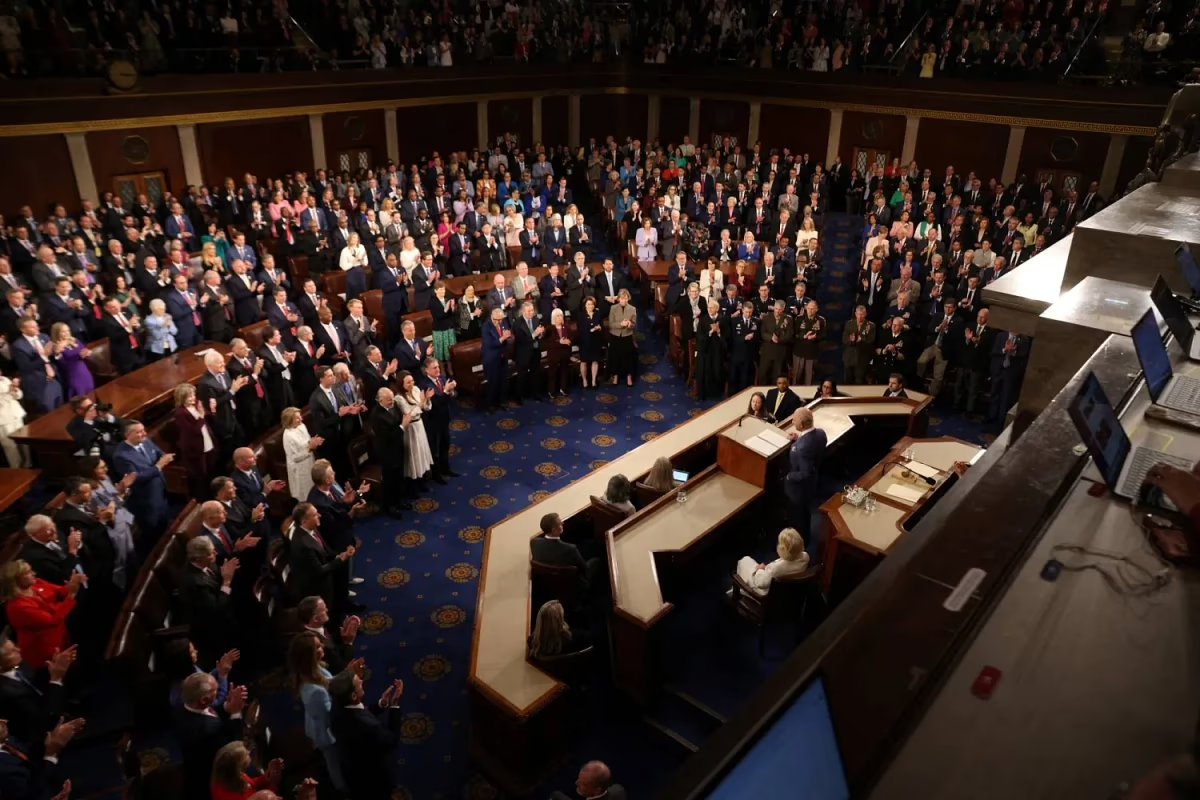
In a scene reflecting the growing division within the American political establishment regarding the war with Iran, the House of Representatives, on Thursday, voted in favor of a resolution calling on President Donald Trump to end the participation of American forces in military operations, while the Senate rejected a stronger bill that would have legally obliged the administration to stop the war. This contradiction highlights the extent of the disagreement between the two chambers, and at the same time reveals the delicate political balances that govern the Republican Party's handling of a war that has become one of the most rejected foreign conflicts in American public opinion.
The House of Representatives voted 214 to 208 in favor of the non-binding resolution, with the support of all Democrats and the joining of four Republicans: Thomas Massie, Tom Barrett, Warren Davidson, and Brian Fitzpatrick, in a clear political message calling on the administration to withdraw American forces from hostilities against Iran.
However, the resolution, despite its political importance, does not carry legal force that obliges the White House to implement it, which prompted Democrats to move the battle to the Senate, where a "joint resolution" with the force of law was introduced, but it failed by a vote of 49 to 47, after Republican Senator Susan Collins joined the Democrats, while other Republicans (almost all of them) voted against it, with the exception of four members who were absent from the vote.
This discrepancy reveals a striking paradox; a number of Republicans had previously publicly affirmed that the continuation of the war for more than sixty days requires congressional authorization under the War Powers Act, yet they simultaneously rejected the resolution that would have ended military operations. Among them were Senators Tom Tillis and John Curtis.
Tillis justified his position by saying that the sixty-day deadline began in July, not in February when the United States and Israel began their military strikes against Iran, considering that the administration did not officially describe what was happening as "war" until July 10. He added that Congress should grant formal authorization if operations continue after the legal deadline, in a reference to the Republicans' attempt to legitimize the war constitutionally rather than stop it.
This proposal reflects an attempt to balance constitutional considerations and political support for the president, as Tillis said that Congress can "help the president in an unpopular war by giving it legal legitimacy," a statement that reveals an awareness within the Republican Party of the growing popular opposition to the war, while at the same time being careful not to appear to be abandoning the president.
For their part, Democrats stressed that the goal of repeatedly introducing bills to end the war is not limited to trying to stop military operations, but also to record the positions of Republicans before the midterm elections, and to re-emphasize that the Constitution grants Congress, not the president, the authority to declare wars.
Gregory Meeks, the senior Democrat on the House Foreign Affairs Committee, said that the House vote reflects the beginning of Congress's response to the will of Americans, noting that about 70% of citizens oppose the war and consider it a "war of choice." He added that Democrats are considering using other constitutional tools, including the power to approve the budget, to pressure the administration to end military operations.
Meeks also announced his intention to introduce a resolution to prosecute the Trump administration for exceeding congressional powers in managing the war, to be put to a vote after the House returns from its summer recess, in a move that could open a new constitutional confrontation between the legislative and executive branches.
In contrast, Republicans, especially those representing swing districts, face increasing political pressure due to the economic repercussions of the war. Republican Representative Rob Briesehan acknowledged that voters link the war to rising fuel and fertilizer prices, but stressed that Iran should not possess nuclear weapons, while at the same time calling for a quick end to the crisis and the reopening of the Strait of Hormuz to ease economic pressures.
Despite these concerns, Briesehan chose to vote against the resolution to end the war, a position that reflects the dilemma many Republicans face between adhering to national security rhetoric and confronting voters concerned about the economic and political costs of the war.
This was not the first time Congress voted against the continuation of the war; the House of Representatives had previously approved a similar resolution in early June by a majority of 215 to 208, before the Senate also adopted the non-binding version, but the administration continued its military operations unchanged.
Democratic Party leaders affirm that the continued introduction of these resolutions aims to hold Republicans politically responsible for a war that, according to opinion polls, is one of the least popular wars in modern American history. Representative Pramila Jayapal said that even a large part of Trump's "MAGA" base is now looking suspiciously at the continuation of the war, considering that many of the president's supporters believed his promises to end "endless wars," not to enter new ones.
The votes in both chambers reflect the fact that the debate in Washington is no longer limited to the war with Iran, but has become about the limits of presidential power itself. For decades, the White House's powers to use military force without explicit congressional authorization have expanded, while lawmakers have often settled for delayed reactions. Today, Democrats are trying to reclaim this constitutional role, while many Republicans prefer to maintain the president's freedom of action, even while acknowledging that there are legal restrictions that should be respected.
The limited Republican division does not reflect a deep ideological disagreement as much as it reflects varying electoral calculations. Most of the Republicans who joined the Democrats represent more moderate constituencies or enjoy greater political independence, while most party members prefer not to directly challenge Trump. Therefore, the vote in the House of Representatives was a political protest message, but it did not reach the level of forming a Republican bloc capable of forcing actual change in the course of the war.
Public opinion is becoming increasingly important in this matter as the midterm elections approach, as opinion polls indicate that the majority of Americans oppose the continuation of the war, not only because of military losses, but also as a result of its economic repercussions on energy prices, inflation, and supply chains. Hence, Democrats are seeking to turn the war into a domestic electoral issue, while Republicans are trying to avoid appearing to support an open war, without abandoning support for the president or his foreign policies.
The voting results reveal that the future of the war may be determined politically more than militarily. If military operations continue without achieving clear objectives, and their popularity continues to decline, the White House may find itself facing increasing pressure from Congress when discussing the budget and funding the Department of Defense. At that point, federal spending tools and constitutional lawsuits may become more effective means than symbolic resolutions, forcing the administration to re-evaluate the cost of the war domestically before its calculations on the battlefields.
Share your opinion
Congress divided over Iran war: House demands end, Senate gives Trump leeway to continue fighting