






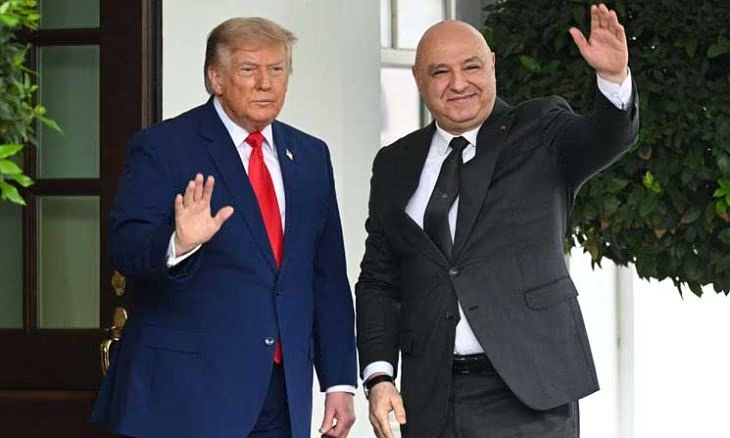
Eyes in the Lebanese capital, Beirut, are focused on the practical outcomes of President Joseph Aoun's visit to Washington, where he held a summit with his American counterpart, Donald Trump, at the White House. These talks come at a sensitive time when Lebanon is banking on a breakthrough in thorny sovereign issues, most notably strengthening the capabilities of the Lebanese Army and ensuring the withdrawal of Israeli forces from border areas.
During the joint press conference, US President Donald Trump pledged to provide the necessary support to Lebanon, noting that this country has suffered from marginalization and mistreatment for many decades. Trump affirmed that his administration would work to ensure Lebanon regains its international standing and respect, in a clear indication of Washington's desire to play a pivotal role in the stability of the Lebanese state.
For his part, President Joseph Aoun focused on the pivotal role of the military institution, considering it the sole guarantor to prevent the collapse of the state and extend its authority over all territories. Aoun stressed the necessity of continued and developed American military support, especially in light of the enormous tasks entrusted to the army in the coming phase to secure the southern borders.
Through this visit, the Lebanese state seeks to activate the 'framework agreement' sponsored by Washington, which aims to end the Israeli military presence in the still-occupied points. The proposed path involves strengthening the deployment of Lebanese Army units in the South, in exchange for obtaining American political and military cover that guarantees the implementation of the ceasefire provisions.
Observers believe that the success of this visit depends on the American administration's ability to exert effective pressure on the Israeli side to complete the field withdrawal. While positive political statements continue, the field in South Lebanon continues to witness tensions and violations that hinder the full implementation of the agreements concluded between the concerned parties.
In the context of political analyses, experts considered the visit a serious attempt to restore the Lebanese state's presence in international forums and manage its sovereign files away from the influence of factions. They pointed out that the message from Washington confirms that official dealings will be confined to legitimate state institutions, foremost among them the presidency and the army.
On the domestic front, major challenges arise concerning Hezbollah's weapons and the extent to which local forces align with the path led by President Aoun in Washington. While some see the visit as a historic opportunity for salvation, others express concern that the new understandings could lead to a clash with forces that refuse to engage in the American project for the region.
Political analyst Ghassan Rifi pointed out that the Lebanese demands carried by Aoun are clear, consisting of a comprehensive ceasefire and the immediate start of reconstruction operations. He added that the ball is now in the American court to prove the seriousness of the promises made by Trump, especially in light of the ongoing sporadic Israeli military operations in the South.
In a different reading, analyst Alain Sarkis believes that the visit is the most important since the Taif Agreement, as it restores credibility to official Lebanese diplomacy in managing major crises. He explained that the increasing American interest reflects an international desire not to leave Lebanon to face its fate alone amidst successive economic and security crises.
Informed sources indicate that the next phase may witness a flow of military and logistical aid to the Lebanese Army to enable its widespread deployment south of the Litani River. This deployment is a fundamental condition within international understandings to ensure long-term stability on the northern borders of the occupied territories and prevent renewed confrontations.
On the other hand, analyst George Aakouri placed the visit within the framework of major regional transformations that followed the events of October 7, pointing to a shift in the balance of power in the region. He considered that the international community is looking for a new formula for stability based on strengthening national armies and reducing the role of non-state actors in security files.
The Lebanese government has already begun taking field steps coinciding with the visit, with the Prime Minister touring southern towns such as 'Zawtar Al-Gharbiya' to inspect the situation. These moves aim to send positive signals to the international community about the state's seriousness in assuming its security and administrative responsibilities in border areas.
Despite cautious optimism, a gap remains between political pledges and implementation on the ground, as Lebanese citizens monitor the extent of Israel's commitment to withdraw from disputed points. These points are considered the real test of Washington's influence on the Tel Aviv government in implementing the commitments made during the summit.
In conclusion, Joseph Aoun's visit to Washington represents a turning point in bilateral relations, through which Lebanon seeks to secure international cover to protect it from regional tug-of-war. The coming days will have the final say in translating Trump's promises into a tangible reality that the Lebanese citizen feels in their security and the stability of their country.
Without the Lebanese Armed Forces, everything will collapse, and they are the primary pillar for extending state authority.
Share your opinion
Washington Summit: Aoun Discusses Army Support and Israeli Withdrawal from the South with Trump