






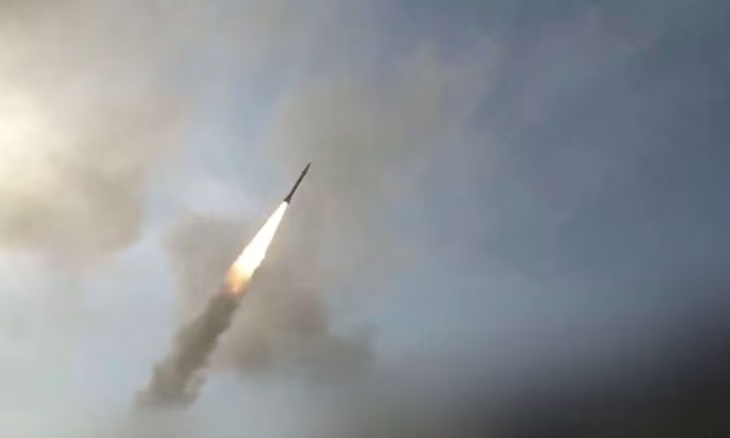
International press reports have revealed a strategic shift in retaliatory Iranian attacks, with Tehran intensively focusing its strikes on US bases located in Jordan. According to informed sources, US forces were subjected to four consecutive attacks in just five days, the most violent of which was Friday's attack, which resulted in the death of two soldiers and the loss of a third, in an unprecedented escalation on the ground.
Responsible sources clarified that this series of attacks not only caused human casualties but also led to the injury of dozens of soldiers and significant material damage to a number of military helicopters. These developments indicate that Iranian forces still possess a huge missile arsenal, with a remarkable development in their ability to maneuver and bypass advanced American air defense systems.
Jordan's strategic importance as a center for US operations in the region has increased, especially after the Pentagon transferred large numbers of its forces from Bahrain, the UAE, and Qatar to locations previously considered safer in Jordan. These moves came amid restrictions imposed by other regional allies on US military air traffic and the deployment of forces over their territories.
Iran began expanding the scope of its military operations to include Jordanian territory for the first time since the signing of the last ceasefire agreement between Tehran and Washington last June. This shift represents a breach of previous rules of engagement, as the Iranian side seeks to pressure the US military presence at its new and vital strongholds.
American sources detailed the five attacks that the Pentagon did not announce in detail at the time, as the targeting began with striking a residential complex at King Faisal Air Base. This initial shelling resulted in the injury of five American servicemen, giving an early indication of Iran's intention to escalate the situation in the Jordanian arena.
The second attack was more specialized, targeting a base in eastern Jordan dedicated to operating the famous American 'Black Hawk' helicopters. Direct strikes caused severe damage to a large number of these helicopters, temporarily affecting the logistical and operational capabilities of the forces stationed there.
Two days before the deadly Friday attack, Muwaffaq Salti Air Base in the Azraq area was subjected to intense Iranian missile shelling. This attack caused injuries to about 20 American soldiers, but the incident did not result in any deaths at that time due to personnel taking refuge in fortified shelters immediately after the sirens sounded.
The scene was repeated on Friday at the same base in Azraq, but the results were tragic this time with the killing of two soldiers and the injury of four others with varying degrees of wounds. Although the rest of the base's personnel underwent medical examinations and returned to duty, the attack caused a shock in American military circles due to the accuracy of the hit and its timing.
For its part, the Iranian army officially announced its responsibility for carrying out drone attacks that directly targeted fuel tanks at the Azraq base. The Revolutionary Guard also confirmed, through its media outlets, the use of a mixture of missiles and suicide drones to strike aircraft shelters, in an attempt to neutralize American air power.
Military experts, including retired US Air Force generals, believe that Jordan's geographical location gives Washington a major advantage for carrying out effective air operations in Syria and Iraq. Therefore, the Iranian targeting primarily aims to undermine this regional alliance and politically and security-wise embarrass the host countries of US forces.
In response to these attacks, the US military announced retaliatory strikes targeting sites belonging to the Iranian Revolutionary Guard, with the aim of reducing threats to navigation in the Strait of Hormuz. Washington considered these moves a clear punitive message to those responsible for planning and carrying out the attacks that targeted soldiers in Jordan.
In a related context, President Trump hinted at a larger military escalation in the coming days, indicating his administration's intention to target vital infrastructure inside Iran. Potential targets include bridges, power generation stations, and distribution networks, in an attempt to impose new deterrence that prevents the recurrence of targeting US bases in the region.
Friday's attack was not just an attack on a base, but an attempt to make the political cost of hosting US forces outweigh the security benefit.

Share your opinion
Why have US bases in Jordan become a primary target for Iranian attacks?