






Washington's Message
Washington – Said Arikat – 28/6/2026
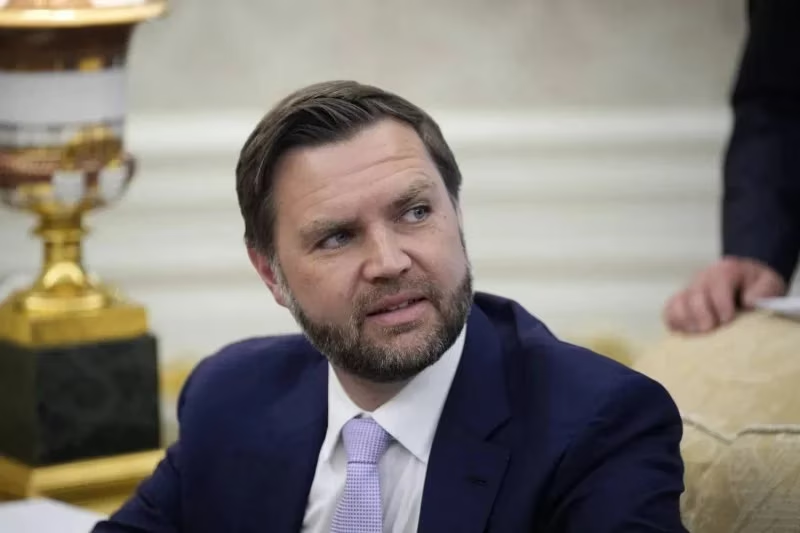
The escalating crisis between US President Donald Trump's administration and the Israeli government is no longer limited to the sharp statements made by Vice President J.D. Vance; rather, it reflects a deeper shift in the structure of political thinking within Washington towards Israel. The original article published by Politico reveals that what Tel Aviv is facing is not a personal dispute with Vance, but the beginning of a new phase in which Israel no longer enjoys the exceptional status it maintained for decades within American foreign policy.
These indicators emerged a few months after joint American and Israeli strikes against Iran in late February, when the Israeli government believed that the alliance with the Trump administration had entered an unprecedented phase of strength and cohesion. However, subsequent developments painted a completely different picture, as Washington began to deal with Middle East issues based on direct American interests, rather than an absolute commitment to Israeli priorities.
According to the report, Vance sent an unprecedented message to Israel when he said that President Trump is the only global leader who still stands by it, warning the Israeli government against losing its strongest ally. He also implied that continued American support is no longer guaranteed if Tel Aviv continues to take steps that conflict with American interests.
American and Israeli sources who spoke to the magazine confirm that Vance does not represent an exceptional case within the administration, but embodies a growing trend that believes the relationship with Israel, like any other alliance, must be subject to the "America First" criterion. This means that American interests are no longer automatically defined as identical to Israeli interests, a shift that Israeli officials describe as the most dangerous in decades.
Since Trump's return to the White House, Israel had bet that the "America First" policy would exempt it from any review of traditional alliances, but this bet began to dissipate quickly. Politico quoted an Israeli political advisor as saying that his government was naive when it believed that Israel would remain immune to the transformations affecting American foreign policy.
Signs of this coolness appear in the declining pace of political contacts between the two sides. After Israeli Prime Minister Benjamin Netanyahu visited Washington five times in 2025, he has only visited once this year, and no new date has yet been set for a White House visit, while phone calls between the two leaders have significantly decreased.
Despite the White House's affirmation that relations between the two countries are still strong, Trump's tone towards Netanyahu has become sharper in recent months, especially after disagreements related to Lebanon and negotiations with Iran. The magazine indicates that the US President described Netanyahu on one occasion in harsh terms, before successfully convincing him to freeze military strikes that Israel intended to carry out against Beirut, a stance consistent with Vance's vision calling for avoiding any escalation that could threaten the negotiation process with Tehran.
The report reveals that the US Vice President has for years believed that the interests of the United States and Israel are not always identical, and that Washington should not be drawn into a war with Iran in defense of Israel. Today, having become one of the most prominent architects of American negotiations with Tehran, this vision has gained executive weight that can no longer be ignored within the administration.
In contrast, Israel views the ongoing understandings with Iran with concern, because they focus on the nuclear program, opening maritime corridors, and lowering oil prices, while not directly addressing Iran's ballistic missile program or Tehran's military influence in the region, two files that Tel Aviv considers an existential threat.
Researchers and officials who spoke to Politico believe that the Netanyahu government still underestimates the extent of the ongoing shift in Washington, believing that the crisis is limited to Vance alone, while facts indicate that the change has become broader and deeper, and may become clearer as the next US elections approach, which will in turn witness increasing debate within the Republican Party about the future of the relationship with Israel.
These developments reveal that for the first time in decades, Israel faces the possibility of losing its status as an "exceptional ally" within the American political establishment. New generations of Republican politicians no longer view unconditional support as a strategic constant, but rather link it to economic and electoral calculations and direct American interests. This means that the historical alliance is entering a redefinition phase, where Israel becomes an important partner, but not a permanent exception to the rules of American foreign policy that Trump and his team are reformulating according to the concept of national interest first.
The crisis also reflects a broader shift within American society itself. Opinion polls over the past two years have shown a decline in public support for Israel, especially among youth, independents, and even within segments of the Republican Party. This change forces American politicians, especially J.D. Vance, to address a public that no longer accepts open military involvement in the Middle East or unlimited support for foreign allies. Hence, Vance's statements appear to be a reflection of internal transformations rather than merely a diplomatic dispute with the Netanyahu government.
As for Israel, the traditional reliance on a personal relationship with the US President is no longer sufficient to ensure the continuation of the political and strategic privileges it has enjoyed for decades. If previous disagreements usually ended with White House intervention to restore warmth to relations, the current disagreement is linked to a change in the philosophy of decision-making within Washington itself. Therefore, any future Israeli government may find itself forced to reformulate its strategy towards the United States and adapt to a new reality in which Israeli priorities no longer automatically precede American calculations.
The report concludes that the future of US-Israeli relations will not only be determined by the results of the upcoming Israeli or American elections, but by the extent to which both sides succeed in adapting to a new political equation that no longer grants Israel an exceptional status within the United States' strategy. And if J.D. Vance has become the clearest face of this transformation, the main message of the current phase is that Washington has begun to view the Middle East from the perspective of its national interests first, even if this leads to unprecedented restrictions on its closest allies in the region.
Share your opinion
A profound American shift confuses Israel: Vance's crisis is just a title for a new phase in Washington