






Syrian President Ahmed Al-Sharaa took a firm stance, refusing to comply with increasing American pressure aimed at dragging Damascus towards military intervention in the Lebanese arena. Al-Sharaa affirmed that reports about Syrian forces entering Lebanon are nothing more than rumors, emphasizing his country's commitment to respecting Lebanon's unity and working to stop the war instead of expanding its scope.
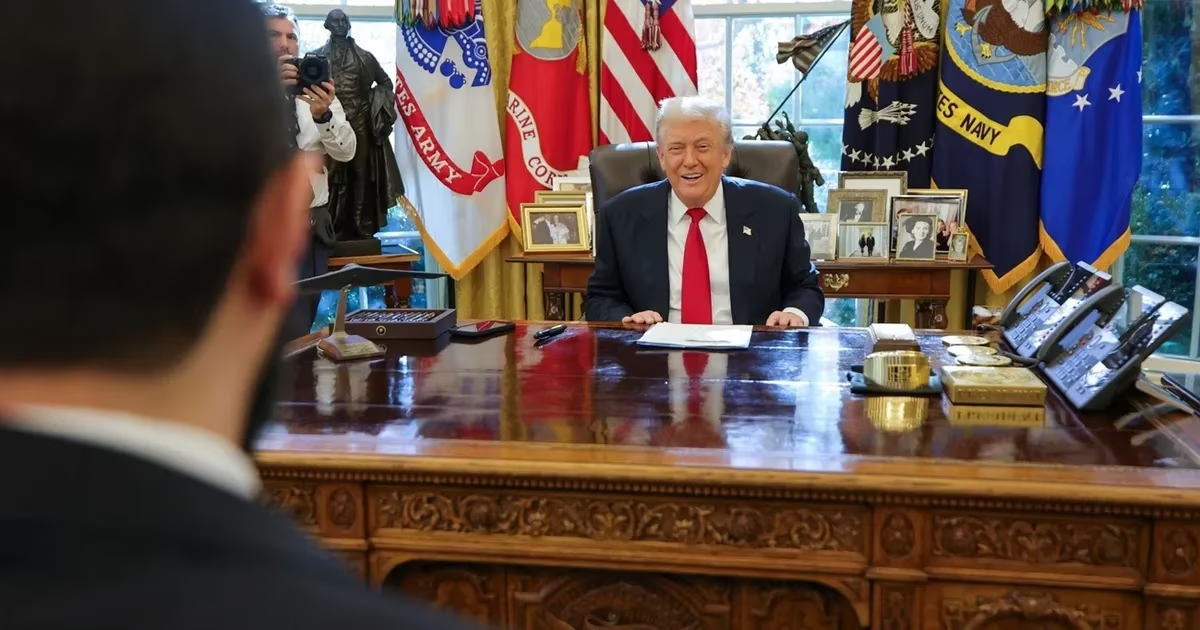
In a notable development during the G7 summit held in the French city of Evian, US President Donald Trump renewed his call for the new Syrian regime to play a direct military role in Lebanon. Trump suggested that Syria take on the task of dealing with the Hezbollah issue, in a clear attempt to find an alternative to Israeli forces in the field confrontation.
Political readings indicate that the American administration is trying to market the idea of re-employing armed groups present in Syria to perform sectarian-tinged combat roles within Lebanese territory. This approach raises deep concerns about turning the conflict into a regional war of attrition fueled by sectarian divisions.
Despite this American desire, realistic obstacles prevent the implementation of this scenario, foremost among them being the categorical Lebanese rejection of any foreign intervention. While a limited number of Lebanese media and political voices have called for seeking assistance from Damascus, the national consensus tends towards preserving Lebanese sovereignty.
Observers believe that rational political forces in Beirut agree that the issue of disarming Hezbollah is a purely internal matter that falls to the Lebanese state institutions. Involving any foreign forces in this complex issue could lead to an uncontrollable explosion of the security situation.
Reports warn that employing foreign fighters present in Syria, estimated at about 200,000 fighters of various nationalities, in a mission inside Lebanon will ignite a major sectarian war. The scope of this war will not be limited to inside Lebanon but its effects will extend to include the entire Arab region.
International procrastination in resolving the fate of these foreign fighters in Syria intersects with scenarios sought by Trump and Netanyahu to entrench sectarian conflicts. The goal appears to be to form new fighting fronts that serve Israeli interests under the guise of regional interventions.
On the regional level, the American desire faces strong Turkish reservations, as Ankara affirmed its rejection of any pressure pushing Syria towards military involvement in Lebanon. The Turkish leadership considers that any such move would directly threaten Turkish national security.
Recent Turkish statements expressed a deep awareness of the dangers of attempts to impose a new fait accompli in the region, especially concerning biblical ambitions. Ankara believes that its national security is strategically linked to the stability of surrounding Arab capitals such as Damascus and Beirut.
As for the Arab world, there is no political coverage for Trump's proposal, as central countries such as Saudi Arabia and the Arab Republic of Egypt show clear opposition to Syrian intervention. This unified Arab stance weakens the chances of success for any American pressure in this direction.
Questions remain about the reason for Trump's insistence on proposing this option despite its lack of legal and political justifications and regional acceptance. It seems that the American administration is looking for a way out that reduces the human and material costs for its allies in the region at the expense of the stability of neighboring countries.
In conclusion, President Ahmed Al-Sharaa's stance represents a bulwark against attempts to internationalize the Lebanese crisis through the Syrian gateway. Maintaining regional balance requires respecting the national sovereignty of states and refusing to turn fighters into tools in cross-border sectarian conflicts.
Disarming Hezbollah is the responsibility of the sovereign Lebanese state, not a task entrusted to foreign forces or external interventions.
Share your opinion
Background to US insistence on pushing Syria towards military intervention in Lebanon