






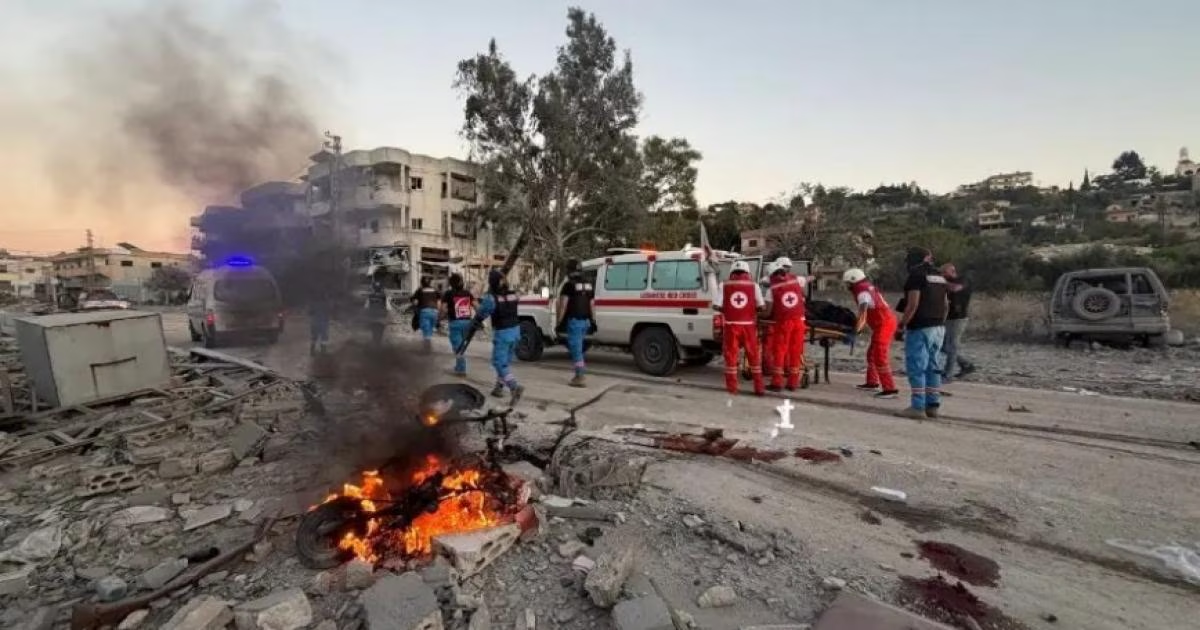
Southern Lebanon witnessed a dangerous field escalation despite the ongoing ceasefire agreement. Field sources reported that the Israeli occupation army carried out intense artillery shelling targeting the heights of Ali al-Taher. In this attack, the occupation forces used internationally prohibited phosphorus and cluster munitions, which constitutes a blatant violation of existing security understandings.
In a related context, units of the occupation army carried out extensive demolition operations that affected a number of residential homes in the town of Kunin, which belongs to the Bint Jbeil district. The towns of Nabatieh al-Fawqa and Kafr Tibnit were also subjected to intermittent artillery shelling, which led to a state of panic among residents who tried to return to their homes after the truce was announced.
Regarding human casualties, two people were martyred as a result of a raid carried out by an Israeli drone targeting a motorcycle on the Zibdin road in the Nabatieh area. With this targeting, the death toll from Israeli attacks on Lebanese territory on Friday alone rose to 49 martyrs and about 97 others injured with varying degrees of severity.
Diplomatically, the US State Department announced a phone call between Secretary Marco Rubio and Lebanese President Joseph Aoun to discuss developments in the situation. Rubio informed the Lebanese side that the next round of Lebanese-Israeli talks will be held in the capital, Washington, from June 23 to 25.
During the call, the US Secretary of State affirmed his country's commitment to working towards achieving permanent security and stability in Lebanon, with a focus on extending state authority over all its territories. Rubio also stressed support for legitimate Lebanese institutions and security forces, foremost among them the army, reiterating his call for the necessity of disarming Hezbollah to ensure full state sovereignty.
For his part, Lebanese President Joseph Aoun demanded the necessity of an immediate and comprehensive cessation of all Israeli attacks targeting Lebanese sovereignty. Aoun explained that achieving a real and sustainable ceasefire is the fundamental pillar without which no tangible progress can be made in the ongoing political negotiations.
Reports from Washington indicate that the agenda of the upcoming meeting will include a plan for the Lebanese army to take over experimental areas that were under the control of Israeli forces. This step aims to open the door for partial and gradual Israeli withdrawals from some points, as a test of the Lebanese forces' ability to control security in those areas.
In the same context, media sources stated that the negotiations, which will begin next Tuesday, will seek to reach an agreement on the names and coordinates of the experimental withdrawal areas. These areas are likely to be concentrated on the front edges of what is known as the Yellow Line, away from the direct border strip, as a first step in a long process of delineating final security arrangements.
Aoun stressed the necessity of stopping Israeli attacks by achieving a comprehensive ceasefire, which Lebanon considers a fundamental pillar for the progress of negotiations.

Share your opinion
Despite the truce agreement... Martyrs in Israeli raids and anticipated negotiations in Washington on Tuesday