






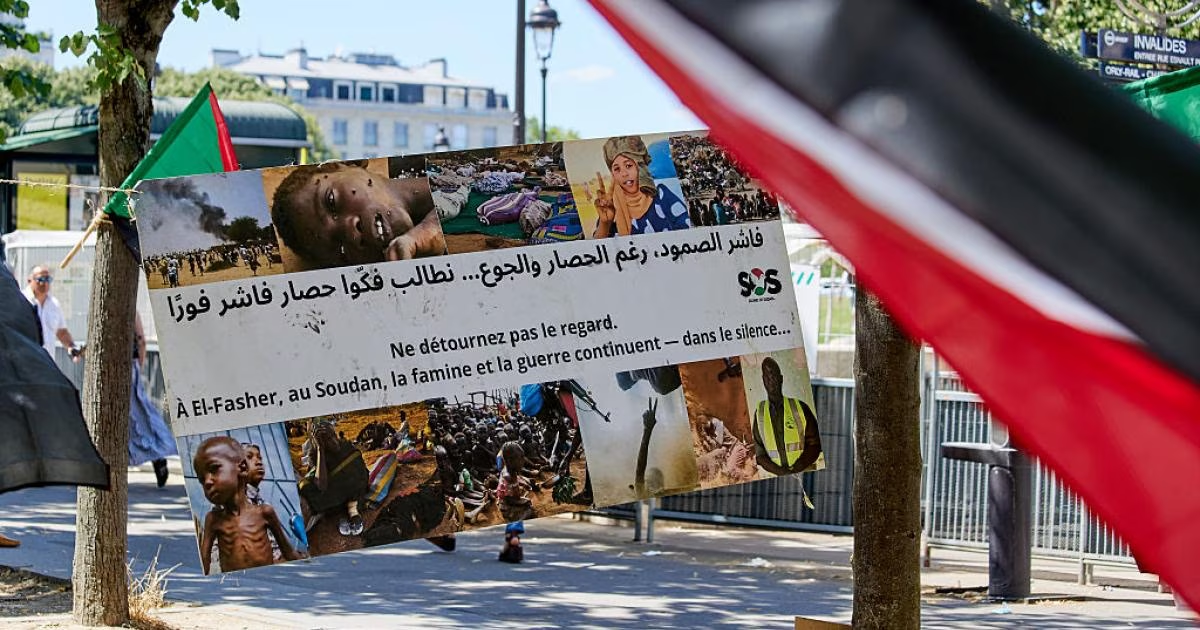
The United Nations issued an urgent appeal on Thursday, demanding that the Rapid Support Forces (RSF) withdraw from their plans to launch a military attack on El Obeid, the strategic capital of North Kordofan state. The international organization warned that any military escalation in this densely populated area would lead to catastrophic consequences, the extent of which cannot be predicted, for unarmed civilians.
UN Secretary-General António Guterres expressed deep concern over field reports indicating the arrival of massive military reinforcements for the RSF around the city. His spokesperson, Stéphane Dujarric, clarified that these movements portend an imminent ground attack that could turn the city into a large-scale battlefield, putting hundreds of thousands of lives at grave risk.
For his part, the High Commissioner for Human Rights, Volker Türk, stressed the need for immediate intervention to stop what he described as 'military madness' before it is too late. Türk noted that the increasing drone strikes and indiscriminate artillery shelling around El Obeid recall the bloody scenarios witnessed in other areas of Sudan in recent months.
El Obeid holds immense geographical and military importance, as it lies on the main road connecting the Darfur region in the west with areas controlled by the Sudanese army in the east. Since the outbreak of the conflict in April 2023, the warring parties have sought to control this vital corridor to enhance their logistical and field influence.
The UN official warned against a repeat of the 'atrocities' documented by international organizations in El Fasher and the Zamzam IDP camp, emphasizing that the world cannot stand by and watch a new tragedy unfold. He added that civilians in Kordofan face an existential threat if the current military escalation is not curbed and humanitarian aid is not allowed to pass unhindered.
Türk described the current situation as a 'stark warning' to the international community of a horrific deterioration in the human rights situation and the overall humanitarian situation. He called on countries with regional and international influence to exert real pressure on the parties to the conflict to cease hostilities and return to the negotiating table to protect what remains of the infrastructure.
In a related context, sources from the United Nations Office for the Coordination of Humanitarian Affairs (OCHA) reported that the situation in El Obeid is highly volatile and rapidly deteriorating. The sources confirmed that the escalation of hostilities has already led to a complete paralysis of relief operations, threatening the lives of thousands who depend on aid to survive.
Local reports indicated that fear of the imminent attack has led residents to close most schools, markets, and shops, and humanitarian warehouses have ceased operations. The United Nations called for the need to secure safe corridors for civilians wishing to leave the city and to ensure that they are not targeted while attempting to save themselves.
Sudan has been living for more than two years under the weight of a devastating conflict that has killed tens of thousands and displaced more than 11 million people inside and outside the country. The United Nations describes this crisis as the worst displacement and hunger catastrophe in the modern world, with no immediate prospect for a comprehensive political solution.
Recent months have witnessed an unprecedented intensification of battles in the Kordofan region and Blue Nile state, especially after the fall of El Fasher to the Rapid Support Forces. The cities of Kordofan, rich in natural and agricultural resources, are a strategic target for both parties, making the conflict over them characterized by excessive violence and widespread destruction.
Previous reports by the Independent Fact-Finding Mission concluded that the siege imposed on Darfur cities bore 'characteristics of genocide.' Human rights experts expressed concern that these practices might spread to El Obeid, where drones are being increasingly used, raising the rate of civilian casualties.
In a parallel diplomatic move, 29 countries at the Human Rights Council in Geneva expressed grave concern about the risks of deliberate killings in Sudan. These countries, including Britain, France, Germany, and Canada, demanded that the Rapid Support Forces immediately and unconditionally cease their attack on El Obeid.
The joint statement by the countries affirmed that approximately 500,000 civilians, including more than 100,000 displaced persons who sought refuge in the city fleeing previous battles, now face the risk of falling victim to heinous crimes. The statement stressed that the international community will not tolerate any grave violations of international humanitarian law in this region.
UN sources concluded by warning that the international community's failure to take coordinated action could lead to a complete collapse of the social system in North Kordofan state. Hope remains for the warring parties to respond to international appeals to spare the city and its inhabitants the horrors of a devastating street war.
We cannot allow a repeat of the atrocities that were avoidable, and which we documented in El Fasher and Zamzam camp last year.



Share your opinion
UN warnings of 'imminent catastrophe' in Sudan's El Obeid as RSF mobilizes forces