






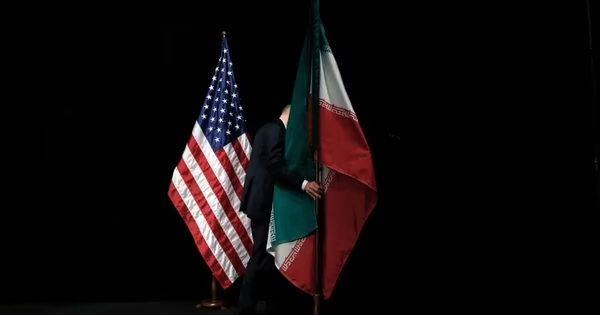
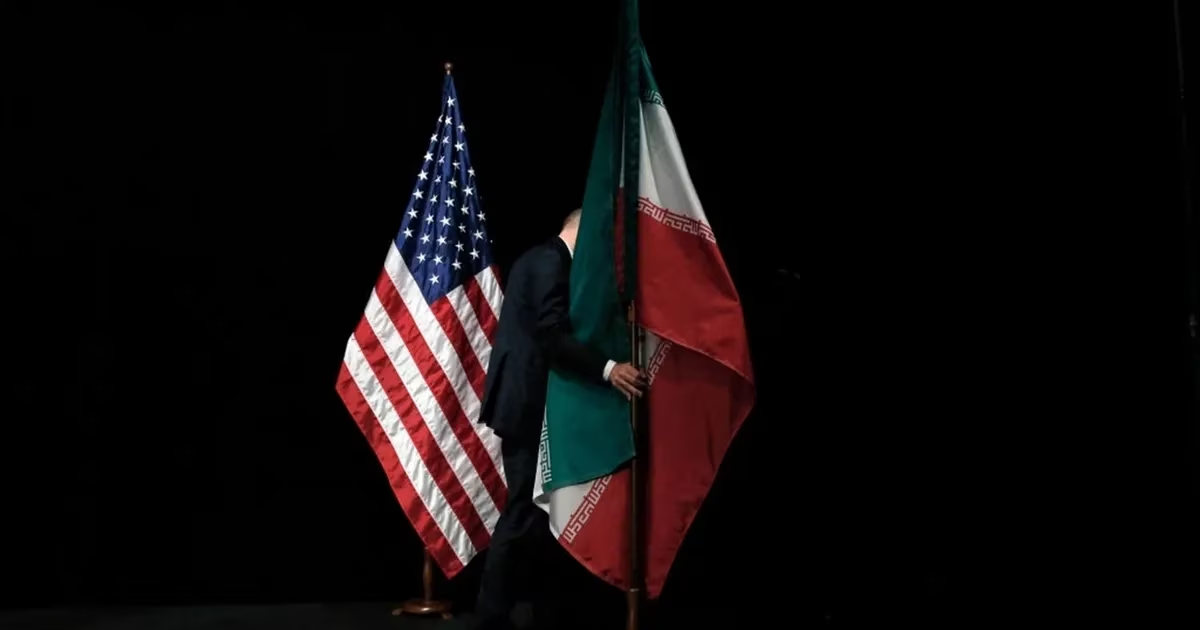
The announcement of a ceasefire agreement between the United States and the Islamic Republic of Iran came as a surprise to many, especially as it was described as fragile given the surrounding circumstances. This agreement was preceded by a widespread Israeli military escalation in Lebanon, clearly reflecting Benjamin Netanyahu's desire to obstruct any diplomatic path that might end the state of war, which he sees as a lifeline for his political future threatened by prosecution.
For its part, Tehran showed no eagerness to sign the agreement; rather, it appeared ready to strike at sources of aggression in support of Hezbollah, which did not stand idly by. This Iranian stance put the American administration in a predicament, as the US President sought to finalize the agreement at any cost to present himself to voters as a man of peace, especially after realizing that military force alone could not impose his will.
The recent confrontation revealed that Iran is fundamentally different from other countries whose regimes Washington tried to change, as Tehran proved its possession of strategic power tools capable of raising the cost of war. Prominent among these tools is the ability to control the Strait of Hormuz, in addition to a political system structure that does not collapse merely by targeting leaders, which came as a surprise to decision-makers in the White House.
American ambitions shifted from attempting to overthrow the regime and impose alternatives like Reza Pahlavi, the son of the former Shah, to seeking a formula that ensures a minimum level of stability. Events proved that betting on the external opposition was a losing bet, as Washington failed to market these figures who lack a real popular base within Iranian society.
In contrast, the Israeli position stands out as a potential detonator for this agreement, as observers believe that Netanyahu might resort to harassing Lebanon again to drag the region into a comprehensive confrontation. Iran realizes that any new aggression against its allies will necessarily mean its direct response, which puts the entire agreement at risk and brings it back to square one.
On the Israeli domestic front, warnings of imminent security and political collapses increased, as former military leaders like Moshe Ya'alon criticized the absence of a strategic vision in dealing with the Iranian file. Ya'alon described current policies as leading Israel towards an apartheid system, warning that Iran emerged stronger from the recent confrontation despite the strikes.
Iran now needs huge budgets and a long time to rebuild what the aggression destroyed, especially in the capital Tehran, whose vital facilities were damaged. Despite these wounds, analysts believe that Tehran will not abandon its regional aspirations; rather, it may use the period of calm to rearrange its internal affairs and strengthen its presence in the region through new methods.
The experience has proven that complete reliance on American protection was a great illusion sold to the countries of the region for many years, as it became clear that American bases could become a burden in moments of real confrontation. This requires the Arab world to formulate a new strategy that deals with Iran as a neighboring country according to the rules of good neighborliness, away from illusions of expansion or external dependence.
Iranian resilience, despite heavy losses, represents a guarantee against Washington violating the agreement, as it fears the repercussions of failure on the upcoming congressional elections. The Democratic Party is anticipating any stumble by Trump, who finds himself compelled to curb Netanyahu's ambitions to ensure the continuation of de-escalation and achieve internal political gains.
Considering the figures Washington bet on to change the regime, Reza Pahlavi stands out as a model of failure, as he tried to exploit American support to return to power without success. Events proved that 'he who is covered by America is naked,' as Washington abandoned its allies at critical moments, just as it happened with his father previously.
The Iranian regime, with its complex structure and multiple layers of power, has proven its ability to continue despite the assassination of senior leaders, a governance pattern that the author believes needs to be studied to understand its sources of strength. This resilience is what forced the American administration to humble its demands and accept an agreement that does not achieve all its declared goals at the beginning of the conflict.
In light of this scene, a question arises about the international community's ability to compel all parties to the agreement, especially with the presence of national religious currents in Israel that believe in the superiority of the Jewish race and push for escalation. These currents, which Ya'alon referred to, pose a danger not only to Palestinians but to the stability of the entire region.
In conclusion, the next phase requires the countries of the region to take the initiative to open direct channels of communication with Tehran, to ensure its transformation into a 'normal state' that respects the sovereignty of its neighbors. External protection has lost its effectiveness, and the peoples of the region have no choice but to rely on themselves to build a sustainable regional security system away from international interventions.
The lessons learned from this war confirm that brute military force does not always guarantee the achievement of political goals, and that peoples with the will to resist are capable of imposing their conditions. The American-Iranian agreement remains a real test of the major powers' ability to control their allies and prevent the region from sliding into a wider catastrophe.
He who is covered by America is naked; experience has proven that the Iranian regime is not the rule of an individual that falls with the arrest of its president, but rather a complex structure that has surpassed the objectives of the American war.
Share your opinion
Washington and Tehran's Fragile Agreement: Iranian Resilience and Israeli Predicament in the Face of Transformations