







Washington Message
Washington - Said Arikat - 12/6/2026
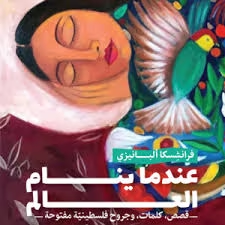
There are books that are read and then put away, and books that leave a fleeting impression on memory, but there are rare books that haunt their reader long after the last page, denying them the comfort of returning to their previous certainties. Francesca Albanese's book "When the World Sleeps" belongs to this rare category. Between its covers, we find not just a new narrative about Palestine, but a moral confrontation with one of the most disturbing questions of our time: How can the world witness such human suffering and then continue its life as if nothing happened?
I closed the last page of the book, but the book did not close its doors within me. One question kept echoing insistently: What happens to the world's conscience when human pain becomes familiar? And how does tragedy, through repetition, silence, and political impotence, turn into a mere fleeting news item in the daily news cycle?
This question is the beating heart of Albanese's work. It is also what gives the book its uniqueness and importance.
"When the World Sleeps" is not a political book in the traditional sense, although it addresses one of the most complex and controversial political issues in the world. It is, above all, an attempt to reclaim the human from the ruins of cold geopolitical language that for decades reduced Palestine to maps, negotiations, UN resolutions, and power balances. At a time when international institutions were accustomed to talking about "conflict," "political process," and "crisis management," Albanese brings the reader back to the first and simplest truth: there are human beings living, dying, and suffering under this reality every day.
This work was written at one of the bloodiest and darkest moments in the contemporary history of the region, resulting in a coherent blend of autobiography, legal reflection, human testimony, and ethical thought. Through ten personalities who had a decisive impact on shaping her consciousness, Albanese weaves a narrative that transcends the boundaries of political analysis to touch upon major questions related to justice, memory, and human responsibility.
These individuals are not just fleeting characters in the book, but mirrors reflecting different facets of tragedy and resilience together. Palestinians and Jews, activists, thinkers, and ordinary individuals, are united by one truth: they all experienced, in different ways, the effects of injustice, violence, and displacement. Through their stories, Albanese refuses to reduce Palestine to a manageable political conflict, insisting on seeing it as a daily human experience lived by millions under the weight of occupation, deprivation, and fear.
And herein lies one of the book's most prominent strengths. Much of what has been written about Palestine has fallen captive to one of two contradictory tendencies: either a dry political language that loses the human presence, or a noisy ideological discourse lacking depth and complexity. Albanese, however, succeeds in escaping both pitfalls. She writes with the precision of a legal researcher, and with the sensitivity of someone who has spent many years listening to the voices of the marginalized and oppressed. Therefore, her language appears clear without simplification, emotional without vulgarity, and sharp without losing its balance.
The book's title summarizes its central idea in the most eloquent way. Tragedy, in the author's view, lies not only in the occurrence of injustice but in the world's habituation to it. The problem is not that atrocities happen, but that they now happen before everyone's eyes without provoking enough anger, action, or accountability. Palestinians, according to this perception, are not only victims of occupation and violence, but victims of a global system that has become accustomed to seeing them suffer without feeling an urgent need to change the reality that produces this pain.
One of the most important features of the book is its ability to combine law and ethics in a single narrative. Albanese, as an expert in international law, discusses concepts of occupation, apartheid, forced displacement, collective punishment, and genocide, but she does not allow these concepts to remain mere technical terms. Each legal concept is linked to a human face, a life story, and a concrete experience. The law here does not speak of numbers and statistics, but of flesh-and-blood human beings.
This human dimension is most clearly evident in the chapters dealing with the children of Gaza. Children do not appear as anonymous victims in news reports, but as individuals with names, dreams, features, and a future that awaited them. The story of the child Hind Rajab stands out as one of the most painful testimonies in the book, not only because of the tragic nature of her end, but because it reveals the extent to which the world has become capable of watching the highest degrees of human suffering without being met by a real will to intervene or change.
Nevertheless, the book does not succumb to despair. Despite the magnitude of the pain it documents, it remains imbued with a deep belief in the value of human solidarity and the ability of conscience to awaken. For this reason, Albanese gives ample space to Jewish voices, thinkers, and Holocaust survivors who refused to exploit historical tragedy to justify new injustice. These testimonies acquire special importance because they refute attempts to conflate criticism of Israeli state policies with anti-Semitism, and affirm that defending Palestinian rights does not contradict respect for Jewish memory or opposition to hatred in all its forms.
The personal honesty with which the author writes about herself also draws attention. She does not speak from the position of an expert insulated by academic distance, but reveals the frustration that accompanies working within international institutions, the psychological toll paid by those who dedicate their lives to confronting injustice, and the feeling of helplessness in the face of repeated tragedy. This personal dimension gives the book additional human warmth and makes it closer to a testimony than to a report.
Literarily, the work is characterized by elegant language and a style that moves smoothly between personal reflection, political analysis, and legal advocacy. Some of its pages seem closer to meditations on grief, memory, and moral responsibility, while other pages appear as a precise and coherent indictment against a global system that applies principles of justice with clear selectivity.
The publication of this book comes at a historical moment witnessing significant shifts in the global discourse on Palestine. New generations, especially in the West, are more willing to question traditional narratives that have long dominated public debate, and more sensitive to the contradiction between declared principles and actual practices in international politics. From this perspective, the book appears as an expression of an emerging moral awakening as much as it is a documentation of the tragedy itself.
But the true value of this work lies in the fact that it does not allow the reader to remain a spectator at a safe distance. It does not ask for fleeting sympathy or temporary pity, but rather imposes a moral confrontation with oneself. After finishing the reading, the question is no longer about Palestine alone, but becomes a question about the nature of our world and the limits of our shared humanity: What happens to a human being when they get used to seeing tragedy? And what happens to the international community when silence becomes its natural response to injustice?
"When the World Sleeps" is not just a book about Palestine. It is, in essence, a moral indictment of an entire era. An era that saw, knew, and understood, and then often chose to turn its back.
Hence its true importance.
It not only tells the story of the victims but also holds the witnesses accountable.
In a time filled with propaganda, polarization, and media noise, Francesca Albanese offers something increasingly rare: a voice driven by a moral compass more than by political calculations. Whether the reader agrees with all her conclusions or disagrees with them, this book remains an important contribution to documenting Palestinian suffering, and to holding accountable a world that is still unable to confront that suffering with the honesty and courage it deserves.
And perhaps for this very reason, the book remains present in the mind after it ends. It does not offer the reader the comfort of final answers, but leaves them with an open and disturbing question: If the world is truly asleep, who will wake it up?
Share your opinion
When Silence Becomes a Partner in Tragedy: A Reading of Francesca Albanese's "When the World Sleeps"