





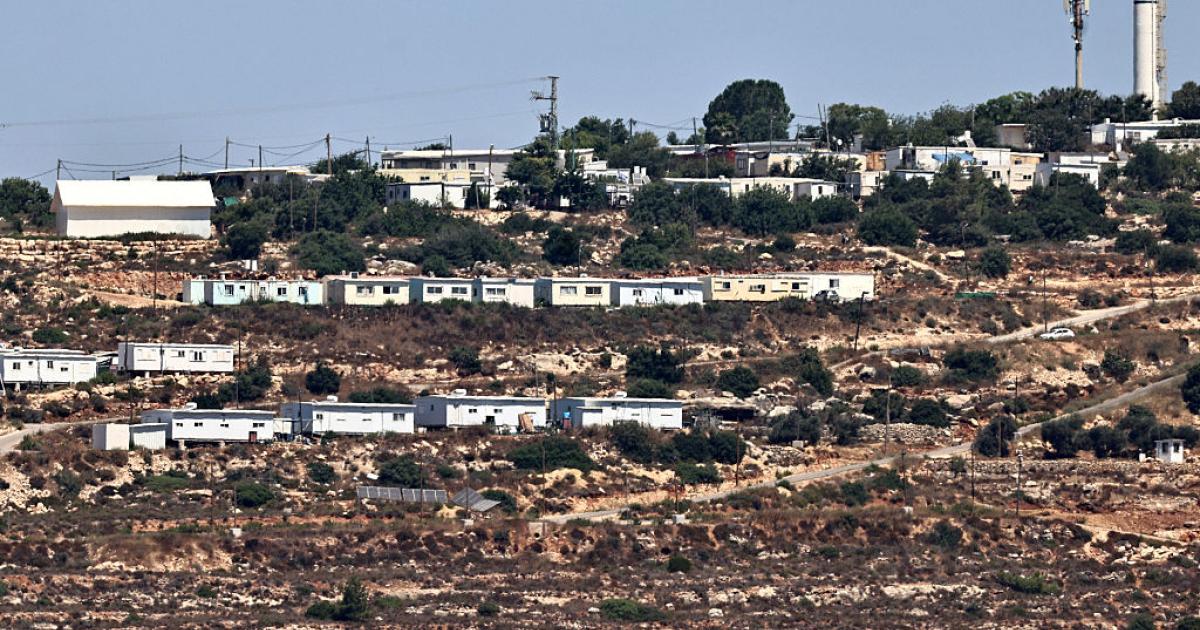
Hebron - Jihad Al-Qawasmi - The village of Sikka, west of Dura city in Hebron governorate, faces a triple Israeli siege that has tightened the lives of its residents: the apartheid wall, bypass roads, and new settlement outposts. The village has become besieged from three sides, and the Israeli goal is to displace farmers from the village to pave the way for the overwhelming settlement expansion that is devouring Palestinian lands. Theft of thousands of dunams. The head of the Sikka village council, Walid Hsheesh, says that the apartheid wall, to the west, cuts through citizens' lands near the school and is a few tens of meters from the homes of the village's citizens, estimated at about 1200 people, where the apartheid wall has encroached on vast areas of the village's land. About 3 km to the east of the village, settlers established a pastoral settlement outpost in 2016, affiliated with the nearby "Neghohot" settlement, where the settler residing in the pastoral outpost owns a herd of livestock and a number of workers, and controls thousands of dunams in the vicinity of the settlement outpost, launching many attacks from it on the lands of the village and surrounding villages, which have escalated significantly recently. A new settlement outpost. Hsheesh added that about two weeks ago, settlers seized an old house belonging to the Ajouri family, as well as the surrounding lands, where the settlers prevented the homeowners from accessing it, despite obtaining a paper from the Israeli police confirming their right to reclaim their home, but the occupation forces detained them and assaulted them when they returned to the house. The occupation forces also abused the citizens who were near the house, expelled farmers and their livestock from the area, then began to build a new settlement road leading to the house, before bringing caravans and placing them on the land. Hsheesh pointed out that since October 7, 2023, settler attacks have escalated, while the unarmed Palestinian has no choice but to defend himself in the face of settlers armed with weapons and supported by the occupation army, and thus the village has become besieged by settlement projects from its three sides. From the west is the annexation and expansion wall, from the north is the military tower and the settlement road connecting the "Neghohot" settlement and other outposts to the occupied interior, and from the east is the "Neghohot" settlement and the pastoral outpost. Destruction of plant and animal production patterns. Hsheesh summarizes the environmental and agricultural damage inflicted on the agricultural village due to settlement, saying: Access to agricultural lands for plowing and cultivation has been prevented, and sheep herders from the village and neighboring villages have been prevented from accessing these lands and grazing in them, thus allowing the settler to monopolize them and continue his attacks on citizens' property from them, which contributed to the imposition of settlement control over them. He adds, "After preventing citizens from accessing their lands, the settlers grazed vast areas of land, inflicting heavy losses on the landowners, as the number of livestock in the village decreased after the settlers took control of the pastures, and farmers in the village now raise their sheep on expensive feed. He continued, the occupation prohibited the use of the northern and western lands of the village, especially in the Al-Baqa'a area, which is estimated at about 300 dunams, under the pretext of security due to its proximity to the settlement road, which was clearly reflected on the citizens of the village. These lands were cultivated with vegetables and grains, and have not been cultivated since the occupation prevented work in them. Huge losses for farmers. Hsheesh pointed out that about (100) dunams of the village's olive-cultivated lands, belonging to the families (Hsheesh, Al-Zir, Abu Samra, Qteit, Rashed, Al-Ajouri, Abu Eid), were cut off by the wall, and many trees were uprooted, noting that the occupation began building the wall on the village's lands in 2006, starting with a barbed wire fence, and soon converting it into a concrete wall in 2016, and access to the lands held behind the wall became through a gate in the wall near the town of Beit Awwa. He pointed out that after October 7, 2023, the occupation prohibited entry to these lands during the olive harvest season, thus inflicting great losses on farmers, and also causing other damage to the lands due to not allowing farmers to care for them, and also prohibited work in the lands east of the wall, and near citizens' homes and village neighborhoods, under security pretexts, estimating the area of prohibited access lands at about 200 dunams, noting that the village's olive-cultivated lands, located in the northern part of the village, on which the occupation army built a military tower for its soldiers, are estimated at about 40 dunams, some of which are owned by citizens of Sikka village, and the other part is owned by citizens from the neighboring town of Beit Awwa, but the prohibition applies to everyone. Dead animals, rodents, and insects. Farmer Dawood Hreibat said that settler and occupation attacks on Sikka village and its residents have become daily, and that the new settlement outpost established is dangerous for citizens and their lands, pointing out that after October 7, the settler grazed the cultivated crops in about 1500 dunams, with his livestock of more than 400 sheep in Wadi Kharsa and Al-Baqa'a up to the wall, and settlers also seized the adjacent lands of Sikka and Beit Awwa. He added that he saw the settler throwing his dead animals in the crops and among the trees, and around the water wells, pointing out that he and another farmer submitted a written complaint to the occupation police near the "Kiryat Arba" settlement, but it did not deter the settler from these actions, explaining that foul odors emanate in the areas where he throws dead animals, and rodents, flies, and insects spread in those areas, and staying or residing in or around them becomes difficult, and this makes farmers stay away from them, and this method is considered one of the methods used by settlers to attack Palestinian farmers, in addition to these armed settlers chasing shepherds and preventing them from accessing pastures, and he is one of them, as most days he cannot take his sheep out of their pen, as the pastures have come under the control of the settlers. Daily attacks. Citizen Mubasher Jawadeh, from Sikka village, confirmed that settler attacks have become daily, and as a result, he and his neighbors cannot sleep at night, as their homes are opposite the outpost, and they fear that settlers will burn their homes, as happened in many areas, pointing out that it used to take him five minutes to reach the town of Beit Awwa, and now it takes an hour and a half through the Marah Al-Baqar road to Dura and then to Beit Awwa, and this is an additional suffering for the residents. Citizen Saif Hsheesh explained that what is happening in his village of Sikka is a pastoral settlement, by the occupation forces and settlers, and their government that gives them all support, to control citizens' lands, explaining that the area of land threatened with confiscation exceeds 300 dunams, which is controlled by settlers and occupation forces.

PALESTINE
Wed 03 Jun 2026 10:46 am - Jerusalem Time
Besieged by the wall, pastoral settlement, and bypass road... "Sikka"... A village in daily confrontation with settler terrorism and their army

Tags
MORE FROM PALESTINE

Share your opinion
Besieged by the wall, pastoral settlement, and bypass road... "Sikka"... A village in daily confrontation with settler terrorism and their army