






Washington Message
Washington – Said Arikat – 29/5/2026
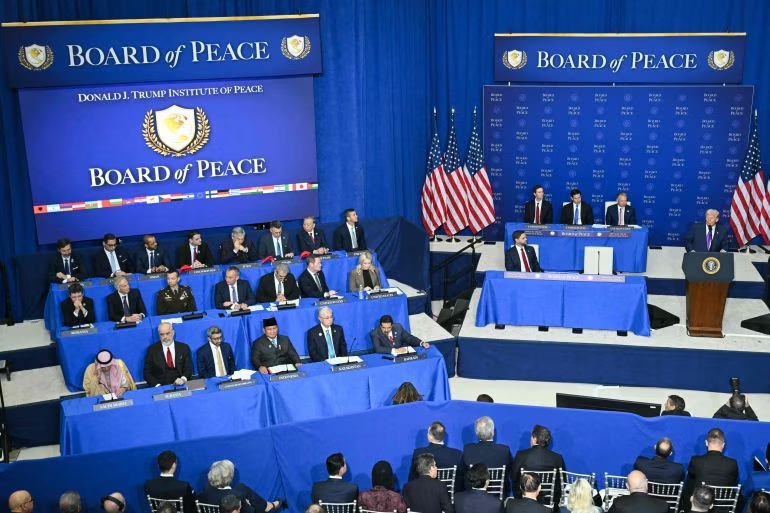
A report by the British newspaper "Financial Times" revealed that the "Peace Council" fund for the reconstruction of Gaza, which was launched with the support of US President Donald Trump and is officially managed by the World Bank, currently contains no money, despite financial pledges amounting to approximately $17 billion.
The newspaper quoted a senior aide in the US Congress as saying that "none of these funds have been transferred to the Council, nor are they managed through it, and the US State Department does not intend to place these funds under the Council's supervision."
In this context, Al-Quds newspaper's correspondent in Washington learned from a responsible source that there are two accounts linked to the project, one of which contains the required amounts of money, without revealing the size of those funds or the nature of their management.
According to the report, the main dispute revolves around where the funds are held, as sources indicate that the official UN-backed fund remains empty, while donations have been directed to a private bank account at "J.P. Morgan" bank, which has drawn criticism due to the absence of transparency standards and independent oversight adopted in World Bank mechanisms.
The report indicated that some limited funds, including $3 million from Morocco and $20 million from the UAE, were used to cover staff salaries, while major allocations related to security and infrastructure remained frozen or unused.
Trump personally chairs the "Peace Council," retaining ultimate authority in its management even after his presidential term ends, according to the Council's internal regulations, which require a payment of $1 billion to obtain "permanent membership."
Despite some allied countries to Washington and small countries seeking to gain Trump's support joining, major European powers such as France and Britain refrained from joining the initiative.
The report also noted criticisms from members of Congress, including Senator Brian Schatz, who compared the US State Department's description of the Council as a UN-like body to Trump's description of it as a "royal court."
Despite estimates indicating Gaza needs approximately $71 billion for reconstruction over the next decade, no funds have yet been allocated for actual reconstruction projects.
A spokesperson for the Council explained that contracts have not yet been awarded because the institution has not started operating within Gaza, accusing "Hamas" of refusing to disarm, which he considered the main obstacle to the project's launch.
The report also stated that the Palestinian technocratic committee formed to manage the sector is still unable to implement any field projects due to the lack of full funding.
In light of the significant financial deficit, the newspaper reported that Washington pressured Saudi Arabia to fund a large part of the project, after several countries that had pledged to contribute began to backtrack on their commitments due to the faltering political process and the ongoing American-Israeli war on Iran.
It added that the US administration is also considering the possibility of deducting a portion of the Palestinian tax funds held by Israel, amounting to approximately $5 billion, to finance the Council's operations, provided that the remaining funds are transferred to the Palestinian Authority only if it agrees to implement specific reforms demanded by Israel.
Observers believe that the current crisis reveals the extent of the disparity between the political ambitions that accompanied the launch of the "Peace Council" and the financial and administrative reality facing the project on the ground. The absence of actual funding, despite huge pledges, reflects international hesitation to engage in initiatives that still lack a clear legal framework and transparent oversight mechanisms. Moreover, linking reconstruction to complex political and security conditions increases the difficulty of implementing any real projects in Gaza, especially in light of continued regional tensions and differing international positions regarding the future of the sector and its political and security administration in the coming period.
Western diplomats believe that the project's heavy reliance on Gulf countries may weaken its long-term success, especially with the absence of broad international consensus on the proposed administration for Gaza after the war. The reluctance of major European countries to join the initiative also reflects growing concerns about turning the reconstruction file into a tool of political influence linked more to Trump's person than to stable international institutions. They point out that the continued ambiguity regarding fund management and disbursement mechanisms will lead to further hesitation among donors, complicating any future efforts to secure sustainable funding for humanitarian and development projects in the sector.
Economic experts warn that any attempt to use Palestinian tax funds held by Israel to finance transitional arrangements in Gaza could open the door to a wider political and financial crisis between the Palestinian Authority, Washington, and Tel Aviv. They believe that transferring these funds to alternative parties or linking their release to Israeli political conditions could weaken the fragile financial situation of the Palestinian Authority and increase internal Palestinian division. Moreover, the continued obstruction of reconstruction projects will exacerbate the humanitarian and economic crisis in Gaza, where infrastructure and basic services continue to suffer from widespread destruction and a lack of resources.
Share your opinion
Trump's Peace Council Has "Zero Dollars" Despite $17 Billion Pledges