






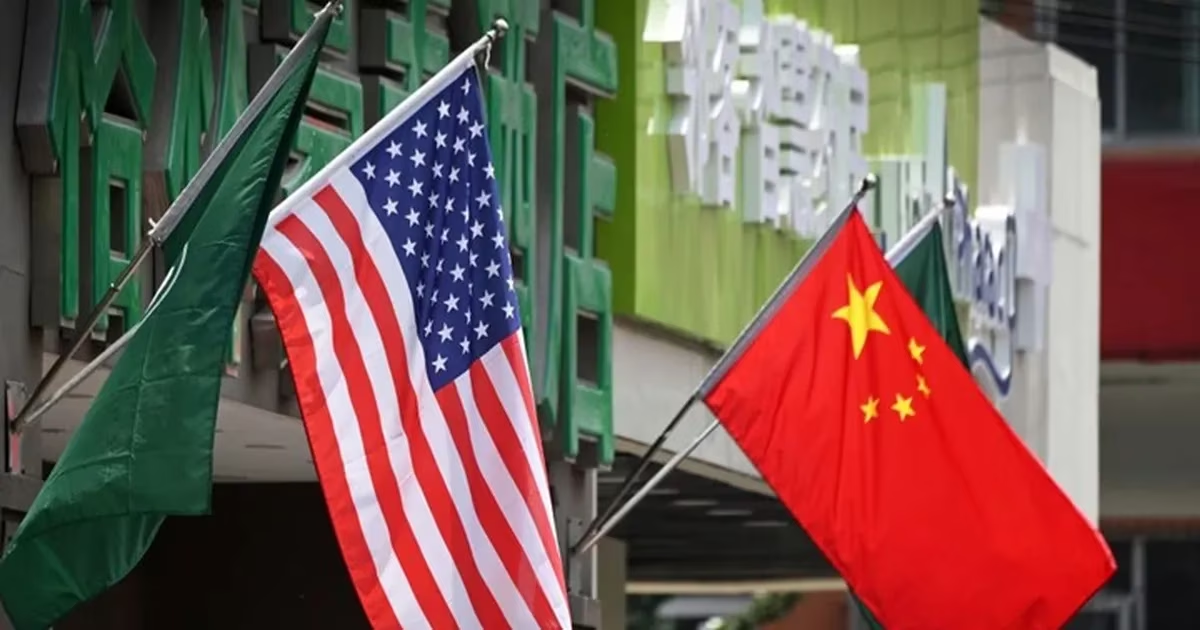
A high-level US security assessment, circulated concurrently with President Donald Trump's visit to Beijing, revealed alarming data regarding China's exploitation of the ongoing military confrontation with Iran. US officials familiar with the analysis explained that Beijing successfully leveraged the war to enhance its superiority over the United States in military, economic, and diplomatic spheres, benefiting from Washington's preoccupation in the Middle East.
The report, prepared by the Intelligence Directorate of the Joint Chiefs of Staff, used the 'DIME' framework to assess Chinese power across four key axes. The assessment indicated that Beijing skillfully employed diplomatic, informational, military, and economic tools to undermine US influence, at a time when the Pentagon faces increasing logistical and strategic challenges due to the prolonged conflict.
Since the outbreak of military operations launched by the United States and the occupying state against Iran in late February, China has emerged as an alternative arms supplier. Beijing has sold defense systems to Washington's traditional allies in the Gulf region, who seek to protect their bases and oil facilities from intense Iranian missile and drone attacks.
Economically, Beijing exploited the global energy crisis resulting from the closure of the Strait of Hormuz, through which one-fifth of global oil production passes. China provided technological and energy assistance to many countries struggling to meet their needs, taking advantage of the absence of the usual US leadership role in managing global fuel and gas supply shortages.
The intelligence report warned that the war has depleted massive stockpiles of advanced US munitions, which were earmarked for a potential confrontation in the Pacific region. This severe shortage raises serious concerns among Washington's allies in Taiwan, Japan, and South Korea about the US military's ability to intervene quickly should Beijing decide to take military action against Taiwan.
The war also provided a golden opportunity for the Chinese military to observe modern US combat methods and test the effectiveness of Western weapons in the field. According to informed sources, Beijing is currently studying the shortcomings that appeared in US military performance to develop its future operational plans and enhance its defensive and offensive capabilities based on these lessons.
Diplomatically, China adopted rhetoric describing the war as 'illegitimate,' exploiting global public criticism of military operations to enhance its image as a responsible power. Through this approach, Beijing sought to undermine US claims of leading a rules-based international order, describing Washington as a reckless power drawn into endless bloody conflicts.
In an official reaction, Pentagon spokesman Sean Parnell denied the validity of these conclusions, considering claims of a shift in the global balance of power in China's favor to be 'completely false.' Parnell affirmed that the United States still maintains its qualitative and quantitative superiority, despite the challenges posed by the current confrontation in the Middle East.
For her part, White House spokeswoman Olivia Wells stated that US forces succeeded in destroying the bulk of Iran's military capabilities in record time. She added that the naval blockade currently imposed is one of the most successful operations in history, aiming to dry up the Iranian regime's funding sources and force it to comply with international demands.
In contrast, the Chinese Embassy in Washington affirmed that its priority is to prevent renewed fighting and work to de-escalate the volatile situation. A spokeswoman for the embassy said that Beijing rejects exploiting the situation to tarnish the reputation of nations, emphasizing her country's commitment to promoting global peace away from alliance politics and military incitement.
Security experts, such as Jacob Stokes, believe that the current timing of the disclosure of this information is highly sensitive given Trump's visit to Beijing. The visit aims to reset relations between the two largest economies, but it comes amid a decline in Trump's global standing due to the severe damage to the global economy caused by the war and the disruption of energy supplies.
Despite Trump's assurances before leaving Washington that he does not need Beijing's help to end the war, the reality on the ground indicates otherwise. China has become the second most fortified country against energy crises after the United States, thanks to its massive investments in renewable energy and its oil reserves, which gives it strong leverage in negotiations.
Analyst Ryan Hass points out that Beijing is not exercising 'benevolence' in providing energy solutions to Thailand, the Philippines, and Australia, but rather sowing discord between Washington and its partners. The gap left by the US administration in managing the current energy crisis has allowed China to present itself as a reliable provider of technological solutions and alternative fuels in the long term.
In conclusion, the shortage of munitions and US defense industrial capacity remains the biggest concern facing planners in Washington. The high cost of interceptor missiles and the long time required to replace them put US military readiness to the test, which reinforces China's geopolitical position as it quietly observes the scene and awaits the opportune moment to impose a new reality.
The war on Iran significantly improves China's geopolitical standing and portrays Washington as a power mired in costly conflicts.
Share your opinion
Intelligence Report Warns: China Reaps Benefits from US War on Iran, Bolsters Geopolitical Superiority