






Washington – Said Arikat – 8/5/2026
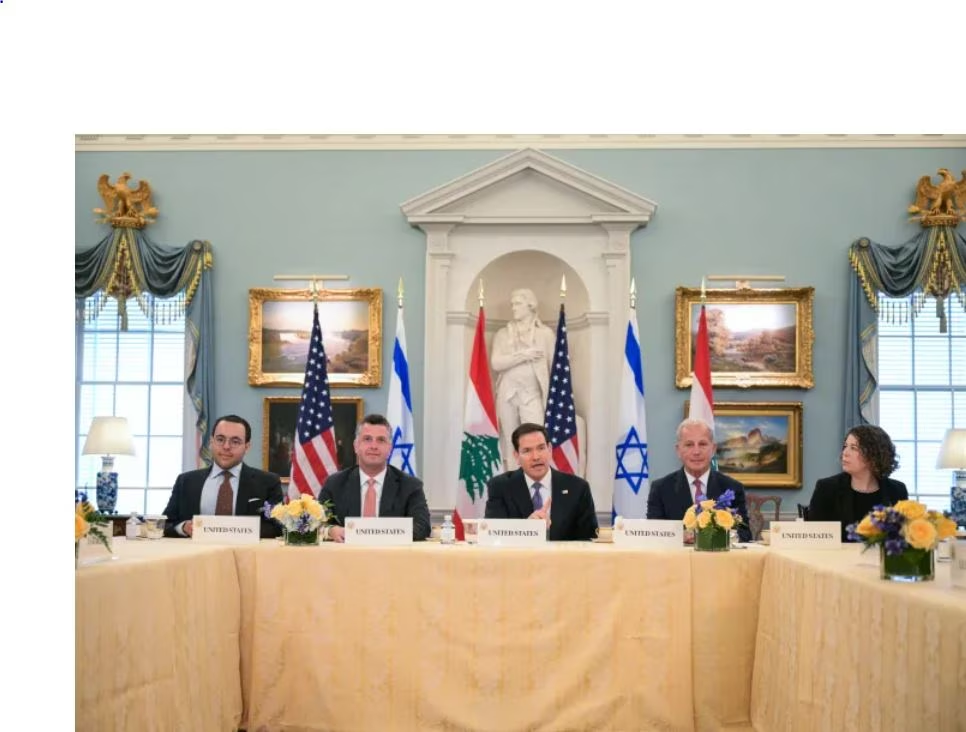
While Washington seeks to market a new round of negotiations between Israel and Lebanon as a step towards "stability," field realities reveal that these talks are taking place amidst bombardment, pressure, and a stark imbalance of power. A US State Department official announced on Thursday that the United States will host the third round of talks between representatives of Israel and Lebanon at the ambassadorial level on May 14 and 15, with unprecedented participation from military representatives from both sides.
According to Israeli media, the meetings will not be limited to discussing traditional security arrangements, but will directly address "concrete measures" to disarm "Hezbollah," a clear indication that Washington and Tel Aviv are trying to impose a political-security agenda that goes beyond merely establishing a ceasefire, aiming to reconfigure the internal Lebanese balance in a way that serves Israeli interests.
Despite the American desire to present these meetings as an entry point for future political normalization, Beirut refused to fully comply with US pressure aimed at holding a direct meeting between Lebanese President Joseph Aoun and Israeli Prime Minister Benjamin Netanyahu. Aoun affirmed on Monday that any such meeting remains out of the question as long as Israel continues its raids within Lebanese territory and maintains its forces in southern Lebanon.
This Lebanese stance reflects an understanding that any direct political engagement with Israel while military operations continue would be viewed internally as submission to American and Israeli dictates, especially since southern Lebanon is still under daily bombardment, while the buffer zone established by the Israeli army within Lebanese territory is expanding.
During the two previous rounds, held last month for the first time in decades, the parties discussed a general framework for a potential agreement that includes Israel's withdrawal from southern Lebanon, in exchange for a Lebanese commitment to disarm "Hezbollah" and strengthen state authority, leading to the normalization of relations between Beirut and Tel Aviv. However, this proposal seemed, to many Lebanese, closer to an attempt to impose the victor's terms by military force, rather than a balanced negotiation process between two states.
Beirut agreed to engage in these meetings in the hope of stopping the continuous Israeli strikes, but field realities quickly dashed these expectations. Just two days after the first round, a second meeting was held on April 23 with US President Donald Trump present, where Washington announced an extension of the truce for an additional three weeks. However, southern Lebanon did not experience any actual calm; instead, Israeli raids continued almost daily, under the pretext of targeting "Hezbollah" positions and elements.
In contrast, "Hezbollah" continued to target Israeli occupation forces within the "buffer zone," in addition to launching rockets and drones towards northern Israel, a scene that confirms the fragility of any agreement that does not address the roots of the conflict, but merely manages it securely to ensure Israeli superiority.
US policy towards Lebanon reveals a stark contradiction; on the one hand, Washington provides Israel with political and military cover to continue its strikes inside Lebanon under the slogan of "self-defense," and on the other hand, it claims to sponsor a negotiating process supposedly aimed at de-escalation. This contradiction has transformed American mediation into a tool of pressure rather than impartial mediation, especially with Washington's insistence on linking any Lebanese stability to the issue of disarming "Hezbollah," without any serious talk about ending the Israeli occupation or stopping repeated violations of Lebanese sovereignty.
The US administration also tried to separate the Lebanese file from its ongoing negotiations with Iran, at a time when Tehran sought to use its influence in Beirut as a bargaining chip within the broader regional negotiation. While Washington denied any direct link between the ceasefire in Lebanon and understandings with Iran, subsequent US pressure on Israel to extend the truce revealed the extent of the interconnectedness between the two tracks, and that Lebanon is still being used as an arena for settling regional and international scores.
Although Aoun's government is considered the least close to "Hezbollah" in many years, it recognizes the fragility of the internal Lebanese situation and the danger of pushing the country towards a new civil conflict. Therefore, Beirut is moving with extreme caution, trying to avoid an internal explosion with the Shiite community, which constitutes a broad popular base for the party, especially in light of the economic and institutional collapse that Lebanon is experiencing.
In contrast, Israel continues its scorched-earth policy in the southern border villages, where it has destroyed hundreds of homes and infrastructure under the pretext of their use by "Hezbollah." The scenes of destruction, which brought back memories of what happened in the Gaza Strip, sparked a growing wave of international condemnation, while the international community once again appeared unable to impose any actual commitment on Israel to stop its military operations.
Israel says the buffer zone is necessary to protect its northern settlements, but critics believe that this policy only reinforces "Hezbollah's" narrative based on resisting occupation and defending Lebanese sovereignty, which gives the party additional justifications for maintaining its weapons and strengthening its popular influence.
According to the Lebanese Ministry of Health, Israeli strikes have killed about 2,700 people since the outbreak of the latest confrontation, including dozens killed after the ceasefire began. The Israeli army, meanwhile, says it has killed more than 1,900 "Hezbollah" elements, including hundreds from the elite "Radwan" forces. Between these conflicting figures, Lebanese civilians remain the biggest losers in a war managed in the name of security, but which produces more destruction, division, and instability.
The ongoing negotiations between Lebanon and Israel reveal the extent of the structural imbalance in the American role in the region, as Washington is no longer a political mediator as much as it has become a direct partner in imposing the Israeli vision by force. The US administration talks about stability and peace, while giving Israel open cover to continue bombardment, incursions, and imposing facts on the ground. This model of "armed diplomacy" does not create real peace, but rather produces fragile coercive arrangements that quickly collapse with the first escalation. Moreover, ignoring the roots of the conflict, especially the Israeli occupation and violations, makes any talk about disarming "Hezbollah" seem selective and detached from the broader political and security context.
Israel is trying to exploit the current regional moment to reshape Lebanon militarily and politically, benefiting from Lebanon's economic collapse and unlimited American cover. But betting on imposing the equation of "security for sovereignty" carries enormous risks, because it pushes a large segment of Lebanese to believe that the state is being forced to concede under military threat. In a country based on delicate sectarian balances, any attempt to break the equation of internal power by external force may reproduce civil war in new forms. Therefore, American pressure to disarm "Hezbollah" without addressing the Israeli occupation seems like a recipe for exploding Lebanon, not for saving it.
A striking aspect of the current scene is that Lebanon has once again become an arena for the intersection of regional and international projects, while the independent Lebanese voice capable of imposing the real priorities of the people is absent. The economically exhausted Lebanese citizen is not much concerned with the struggle for influence between Washington and Tehran as much as he is concerned with stopping the bombardment and restoring a minimum level of stability and dignity. But the major powers view Lebanon only from the perspective of their security and strategic interests. Between American, Israeli, and Iranian calculations, the country turns into an open bargaining chip, while civilians are left alone to pay the price of wars, deals, and fragile regional balances.
Share your opinion
Washington Hosts New Round of Lebanese-Israeli Negotiations Amid Escalating Bombardment and American Pressure